Rough Green Snake: Harmless, Nonvenomous, Easy to ID
The rough green snake (Opheodrys aestivus) is completely harmless to people. It has no venom, no fangs built for defense, and almost no interest in biting anything larger than a caterpillar. If a slender, bright green snake is draped across a shrub in your yard in Georgia, Texas, or New Jersey, this is almost certainly the species you are looking at, and the correct response is to leave it alone and enjoy the view.
That said, most people never get a good look at one. A rough green snake spends its day stretched along a branch at eye level, perfectly matched to the leaves around it, moving only when a grasshopper gives itself away. This guide covers identification, range, diet, the smooth green snake lookalike, whether the species makes a reasonable pet, and what its steady decline in some states actually means.
Rough green snakes are nonvenomous, nonaggressive, and harmless to humans and pets. They grow 22 to 32 inches (56 to 81 cm), eat insects and spiders, and live in shrubs and low trees across the southeastern United States. Bites are extremely rare and cause nothing worse than a scratch.
| Quick Facts | Rough Green Snake |
|---|---|
| Scientific name | Opheodrys aestivus |
| Adult length | 22 to 32 in (56 to 81 cm), rarely to 46 in (117 cm) |
| Venom | None, harmless to humans |
| Diet | Crickets, grasshoppers, caterpillars, spiders |
| Habitat | Shrubs and low trees near water |
| Range | Southeastern US, north to New Jersey, west to Texas |
| Lifespan | About 5 years wild, 8 or more in captivity |
Is Rough Green Snake Poisonous?
No. The rough green snake is neither venomous nor poisonous, and the two words describe different things. Venomous animals inject a toxin through a bite or sting. Poisonous animals harm you when you eat or touch them. The rough green snake does neither. It has no venom glands, no enlarged rear fangs worth worrying about, and no toxic skin secretion.
This matters because the question “is the green snake poisonous” gets asked about several unrelated species. Green tree pythons, green mambas, and green vine snakes all turn up in image searches, and only one of those is genuinely dangerous. In the United States, a thin green snake in a bush is a rough green snake or a smooth green snake, and both are safe.
Handling one carries no medical risk at all. The usual advice about washing your hands after touching any reptile still applies, since snakes can carry Salmonella on their skin, but that is a hygiene issue rather than a venom issue. No antivenom exists for this species because none has ever been needed.
How to Identify a Rough Green Snake
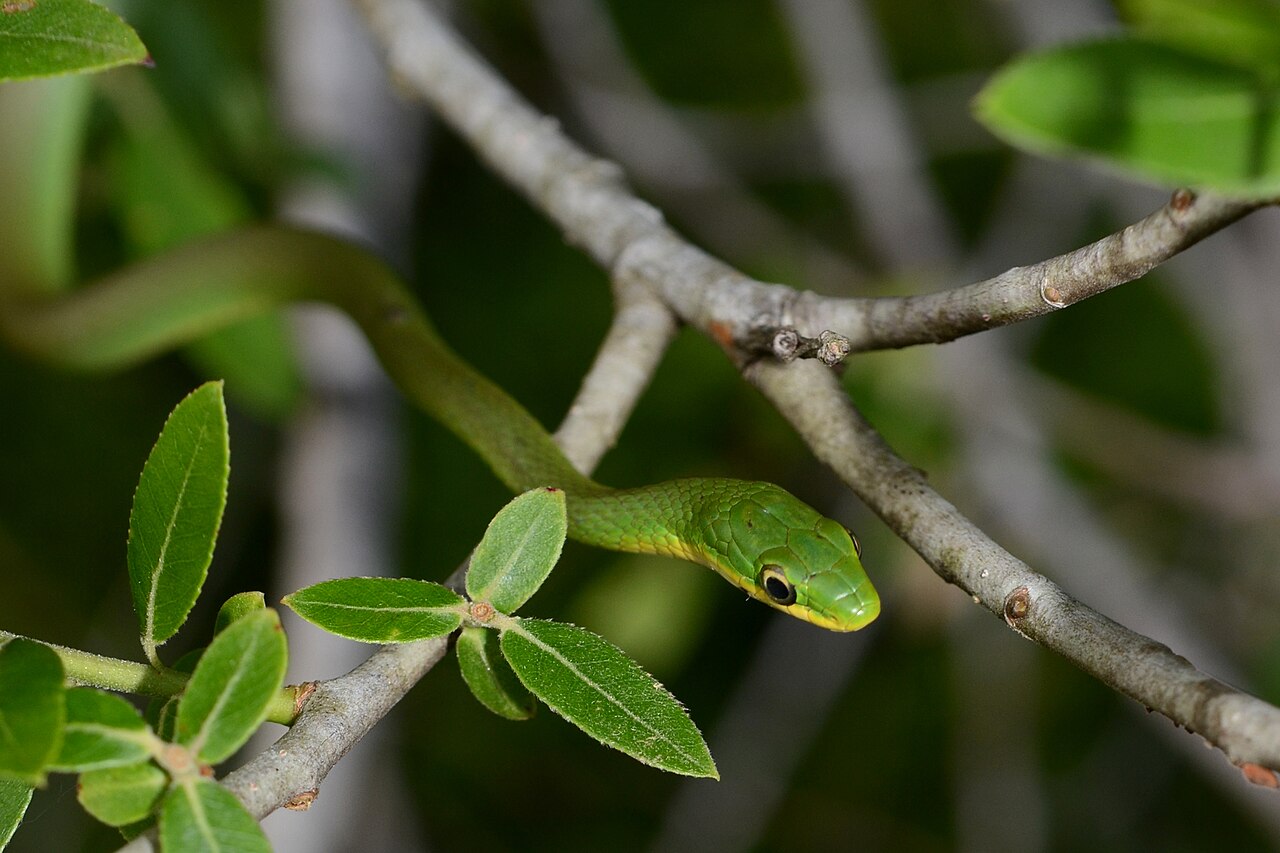
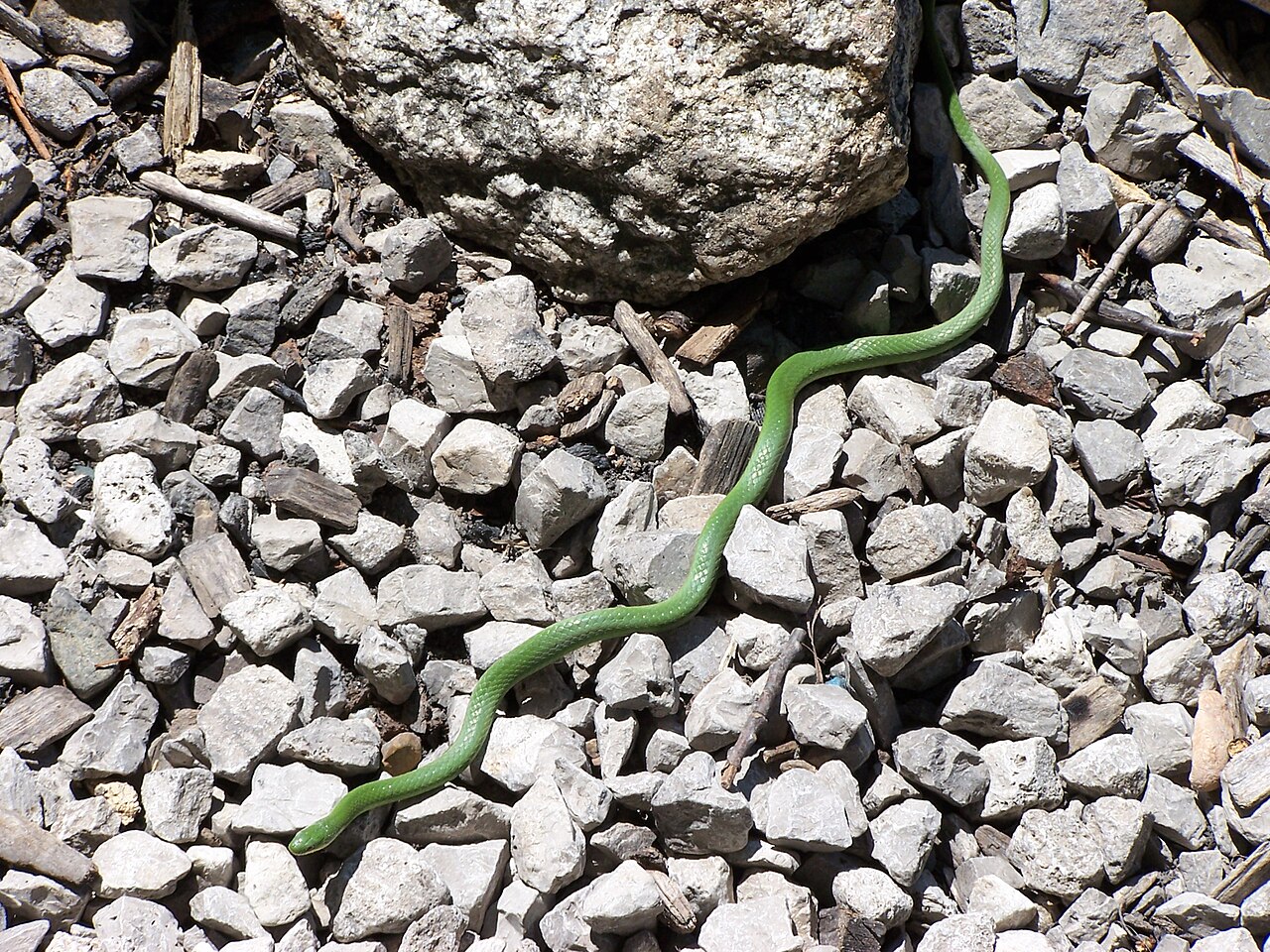
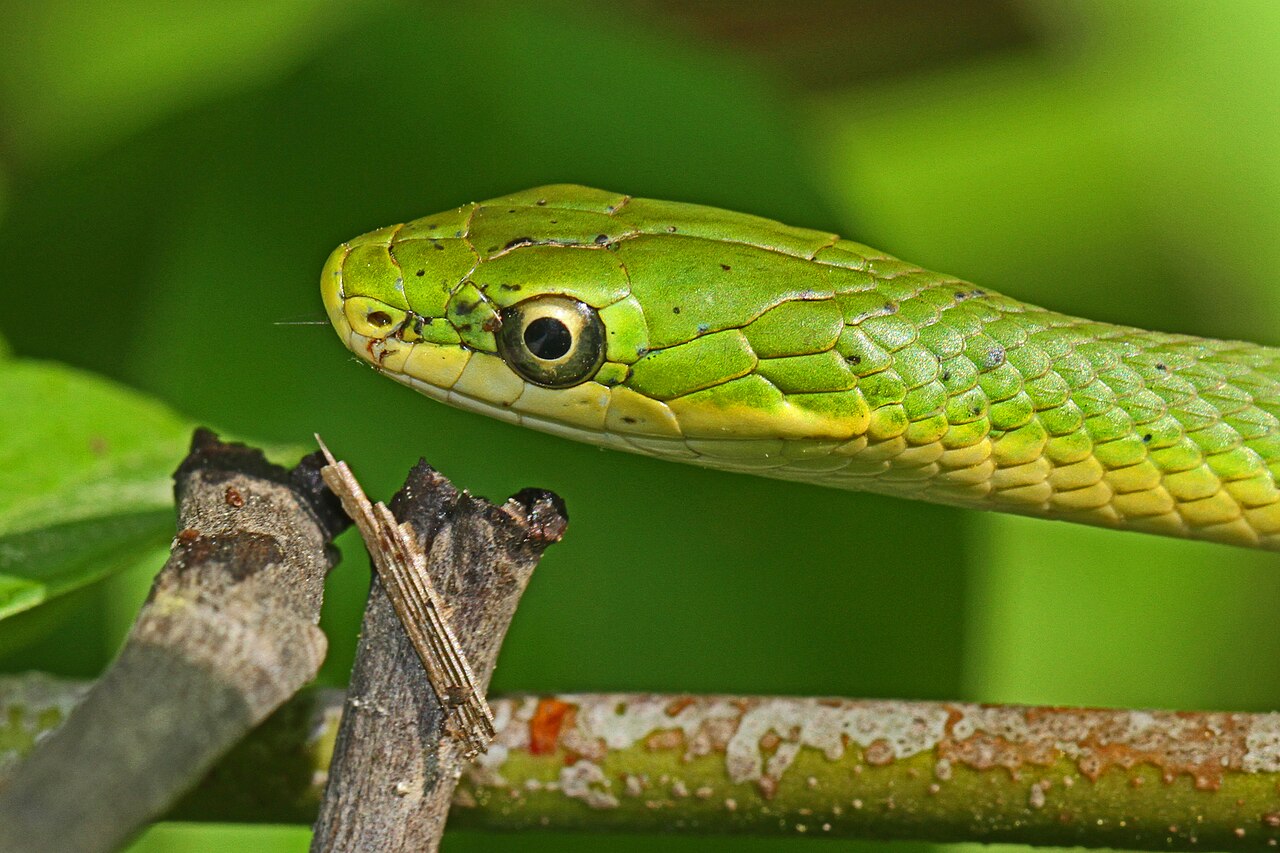
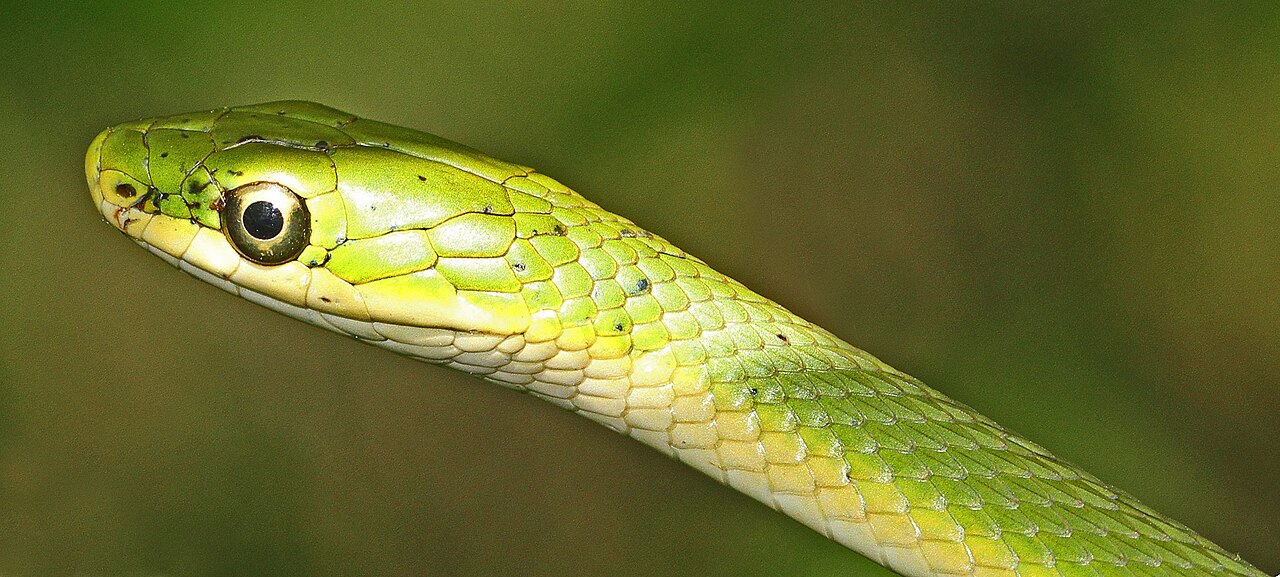
Look for a uniform bright green back, a plain yellow to cream belly, and a body so thin it looks like a piece of vine. Adults are usually 22 to 32 inches (56 to 81 cm) long, and a third of that length is tail. The head is only slightly wider than the neck, and the eyes are large with round pupils.
The name comes from the scales. Each dorsal scale carries a raised ridge, called a keel, which gives the skin a faint matte texture instead of a polish. You can often see this in a photograph: the animal does not shine the way a garter snake does in the same light.
Dead specimens cause a lot of confusion. The green pigment in these snakes is a combination of blue and yellow layers, and the yellow fades quickly after death. A rough green snake found dead on a road is frequently bright blue, which sends people searching for a species that does not exist in their state.
Rough Green Snake vs Smooth Green Snake
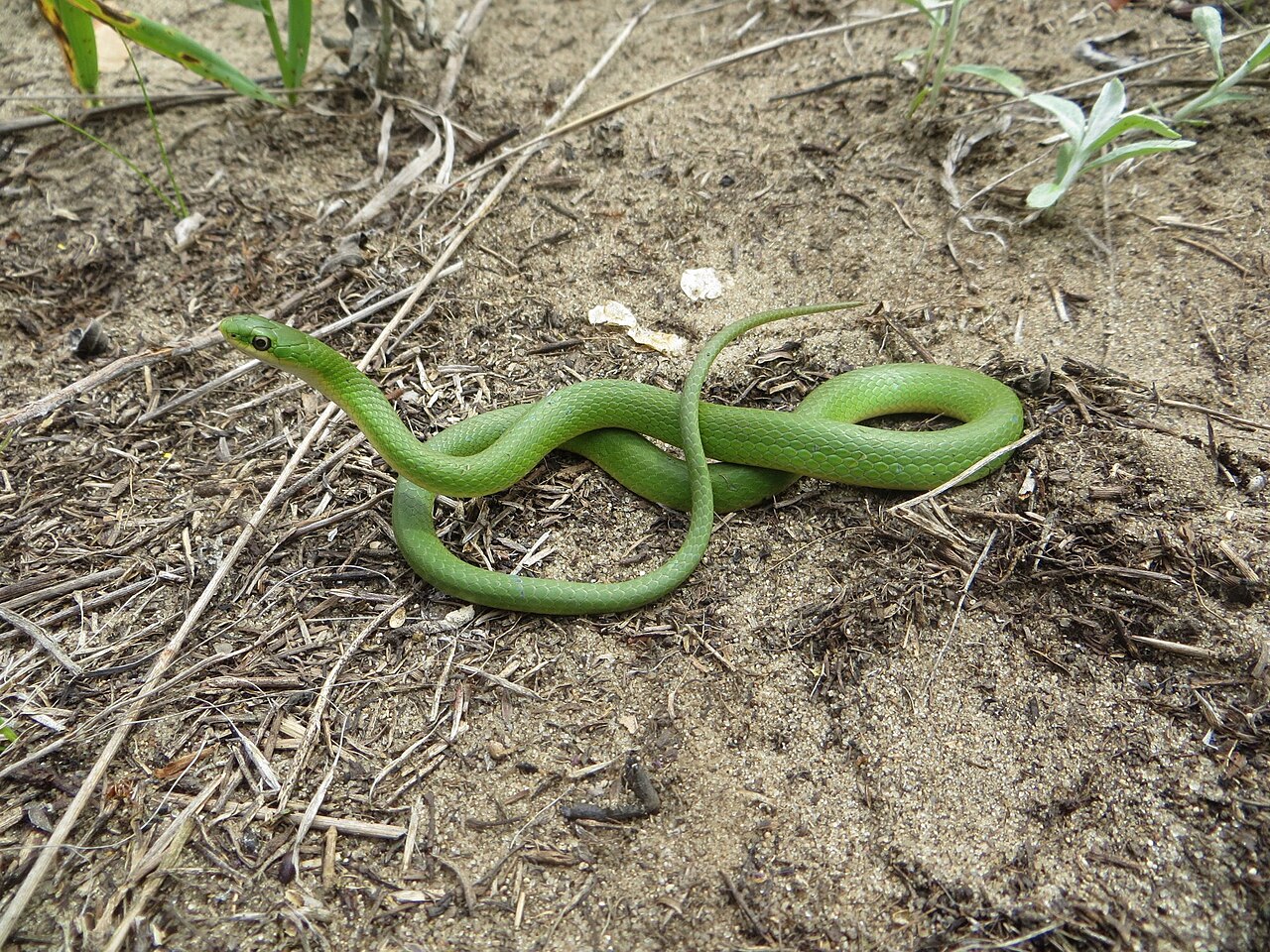
The two species split cleanly on scales and on geography. The smooth green snake (Opheodrys vernalis) has flat, unkeeled scales and a glossy finish, and it is noticeably shorter, usually 14 to 20 inches (36 to 51 cm). Side by side, the rough green snake looks stretched and the smooth green snake looks compact.
Range helps more than anything. Smooth green snakes occupy the northern tier: New England, the Great Lakes, the upper Midwest, and scattered pockets in the Rockies. Rough green snakes cover the Southeast and the lower Midwest. The two overlap only along a narrow band, so in most of the country only one option is on the table.
Behavior separates them too. The smooth green snake is a ground animal that hunts in damp meadows and old fields. The rough green snake is arboreal and rarely leaves the vegetation. If the snake is three feet off the ground in a blackberry tangle, it is the rough one.
Where Do Rough Green Snakes Live?
Rough green snakes live across the southeastern United States, from southern New Jersey down through Florida, west into central Texas, and north up the Mississippi Valley into Indiana and Kansas. They also range south through Mexico into Central America. Within that range they are tied to dense low vegetation near water.
Streamside thickets, lake margins, cypress edges, overgrown fence lines, and suburban hedges all qualify. The species needs branches thin enough to support a very light snake and thick enough to hide it. A mowed lawn with three ornamental shrubs will not hold one, but an unmowed brushy border along a creek often will.
Vertically they concentrate between two and ten feet off the ground. Studies in the Southeast repeatedly find them draped over vegetation that overhangs open water, which gives them an escape route: a threatened snake simply drops into the stream and swims away. That habit puts them in the same streamside habitats as sunfish, frogs, and the dragonflies that share the overhanging brush.
What Rough Green Snakes Eat
This is one of the few North American snakes that is essentially an insect specialist. Crickets, grasshoppers, caterpillars, moths, and spiders make up nearly the entire diet. Soft-bodied prey dominates, and hard-shelled beetles are usually ignored. A large green grasshopper is about the upper limit of what an adult will attempt.
The hunting style is patient rather than fast. The snake moves along a branch in slow increments, tongue flicking, then holds motionless with the front third of its body lifted free of the support. When a prey animal moves within reach, the strike is a short forward lunge, and the snake swallows the insect alive without constricting it.
Small tree frogs and the occasional snail appear in stomach studies, but they are rare. Nothing in this diet brings the species into conflict with people, and an established population in a garden quietly removes a meaningful number of caterpillars from the shrubs every summer.
Are Rough Green Snakes Rare?
Across their range as a whole, rough green snakes are common, and they are listed as Least Concern globally. What makes them feel rare is that they are extraordinarily hard to see. A green snake lying still in green leaves defeats ordinary searching, and most people who live inside good habitat have never spotted one.
Local declines are real, however. Several states at the edges of the range track the species as a conservation concern, and observers in parts of the Midwest and the mid-Atlantic report far fewer sightings than in past decades. Broad insecticide use and the clearing of streamside brush are the usual suspects, since both remove the food and the cover at once.
Counting them is genuinely difficult, so trend data is thinner than anyone would like. Researchers at the University of Georgia’s Savannah River Ecology Laboratory have published some of the better field accounts of the species; their herpetology program remains a useful reference for southeastern reptiles.
Will a Green Snake Bite You?
Almost never. The first response of a rough green snake to a threat is to freeze, then to sway gently with the surrounding leaves. If that fails it flees along the branches or drops. Biting sits at the very bottom of a long list of options, and many people who have handled dozens have never been bitten once.
On the rare occasion it happens, the result is a few pinprick scratches that may bleed slightly. The teeth are tiny and built for gripping crickets. Compare that with a defensive garter snake bite, which is itself minor but still more substantial than anything this species can deliver.
The species also lacks the theatrical defenses of its relatives. It does not rattle its tail like a bull snake, it does not musk heavily, and it certainly does not perform the elaborate death act of a hognose snake playing dead. Its entire survival strategy is not being noticed in the first place.
Daily Behavior and Activity
Rough green snakes are strictly diurnal. They warm up in filtered morning sun, hunt through the middle of the day, and settle into dense cover before dark. Unlike most snakes they rarely bask on open surfaces, because a bright green animal on a bare rock loses every advantage it has.
Movement is deliberate and almost mechanical. The snake bridges gaps between branches by extending a long section of body across open air, holding it rigid, and easing forward. This is expensive in energy but nearly silent, which matters when your prey is a grasshopper that will jump at the first vibration.
At night they coil loosely in thick vegetation, often in the same spot for several days. Telemetry work has shown individuals using home ranges of well under an acre, so a snake you find in July is plausibly the same one you find in August a few yards away.
Breeding and Life Cycle
Mating happens in spring and sometimes again in early fall. Females lay 3 to 12 elongated eggs in June or July, tucked into rotting logs, leaf litter, loose bark, or the gaps under rocks. Communal nests are well documented, with several females using one cavity and the total clutch running into the dozens.
Incubation takes roughly 5 to 12 weeks depending on temperature. Hatchlings emerge at 7 to 8 inches (18 to 20 cm), already green, already arboreal, and immediately hunting prey small enough to fit a hatchling’s jaw, mainly small spiders and soft insect larvae. No parental care follows the laying.
Sexual maturity arrives in the second year. Wild lifespan appears to average around five years, though the honest answer is that we have few long-term recapture records. Captive individuals with steady food and no predators have reached eight years or more, which is typical of small colubrids generally.
Are Rough Green Snakes a Good Pet?
For most keepers, no. Rough green snakes are widely sold and cheap, which has more to do with how easy they are to collect than with how easy they are to keep. They are nervous, fragile, and adapted to a lifestyle that a small glass box reproduces badly.
The care requirements are also unusual for a snake. They will not take frozen rodents, so a keeper needs a constant supply of live crickets, roaches, and hornworms, gut-loaded and dusted. They need a tall, heavily planted enclosure, daily misting, UVB lighting, and a temperature gradient. Wild-caught animals frequently arrive with parasites and stop eating.
If you want an easy first snake, a captive-bred corn snake does everything a beginner needs and thrives on a simple feeding schedule. If you specifically want a green snake, insist on captive-bred stock and expect an animal to watch rather than handle.
Size, Growth, and Lifespan
Adults typically measure 22 to 32 inches (56 to 81 cm), with the record near 46 inches (117 cm). Despite that length the animal is remarkably light, often under an ounce, because the body is only about as thick as a pencil. Females run slightly longer than males on average.
Growth is fastest in the first full season. A hatchling that emerges in late summer at 7 inches (18 cm) may approach adult length within two years if insect prey is abundant. Shedding follows the same schedule as in other small colubrids, roughly every four to six weeks during active growth.
Predation, not old age, sets the ceiling. Hawks, kingsnakes, racers, bullfrogs, and domestic cats all take them, and a snake that spends its life exposed on vegetation is an easy target once spotted. The king snake in particular eats other snakes as a matter of routine.
Threats and How to Help
The two pressures that matter most are pesticide use and brush removal. An insect-eating snake cannot survive in a landscape where the insects have been sprayed out, and the habit of mowing and clearing right up to the edge of creeks and ponds removes exactly the vegetation layer the species depends on.
Collection for the pet trade adds to the problem locally. Large numbers of wild rough green snakes enter the trade every year, most of them die within months, and the removal falls hardest on accessible roadside populations that are already fragmented.
Helping is straightforward. Leave a brushy, unmowed buffer along any water on your property, skip broad-spectrum insecticides, plant native shrubs that hold caterpillars, and keep cats indoors. Report sightings to a state herp atlas if one exists, because the shortage of trend data for this species is a counting problem as much as a biology problem.
Frequently Asked Questions
Is a rough green snake poisonous?
No. Rough green snakes have no venom and no toxic skin secretions, so they are neither venomous nor poisonous. A bite, which is very unlikely, leaves only tiny scratches. Wash your hands after handling any reptile as a general hygiene precaution, but there is no toxic risk from this species.
Are rough green snakes a good pet?
They are a poor choice for beginners. They require live insects daily, a tall planted enclosure, misting, and UVB, and they stress easily under handling. Wild-caught individuals often refuse food and carry parasites. If you keep one, buy captive-bred stock and treat it as a display animal rather than a handling animal.
Are rough green snakes rare?
They are common across the Southeast as a whole but very hard to see because of their camouflage. Several states at the edge of the range list local declines linked to pesticide use and clearing of streamside brush. Globally the species is still classified as Least Concern.
Will a green snake bite you?
Very rarely. A rough green snake freezes, sways, or flees long before it considers biting, and many experienced handlers have never been bitten. If it does bite, the tiny gripping teeth produce a few pinpricks at most. Clean the spot with soap and water and no further treatment is needed.
What snake has 100% fatality?
None does. Even the most dangerous species, such as the inland taipan or black mamba, are survivable with prompt antivenom, and many bites from venomous snakes are dry bites with no venom injected. The rough green snake sits at the opposite extreme and has never caused a medically significant bite.
How do I tell a rough green snake from a venomous species?
No venomous snake in the United States is uniformly bright green with a plain cream belly. If the animal is thin as a pencil, unbroken green above, and sitting in a shrub, it is a green snake. For banded red, yellow, and black patterns see our coral snake vs king snake comparison.