Smallmouth Bass: Identification, Best Baits, and Eating Quality
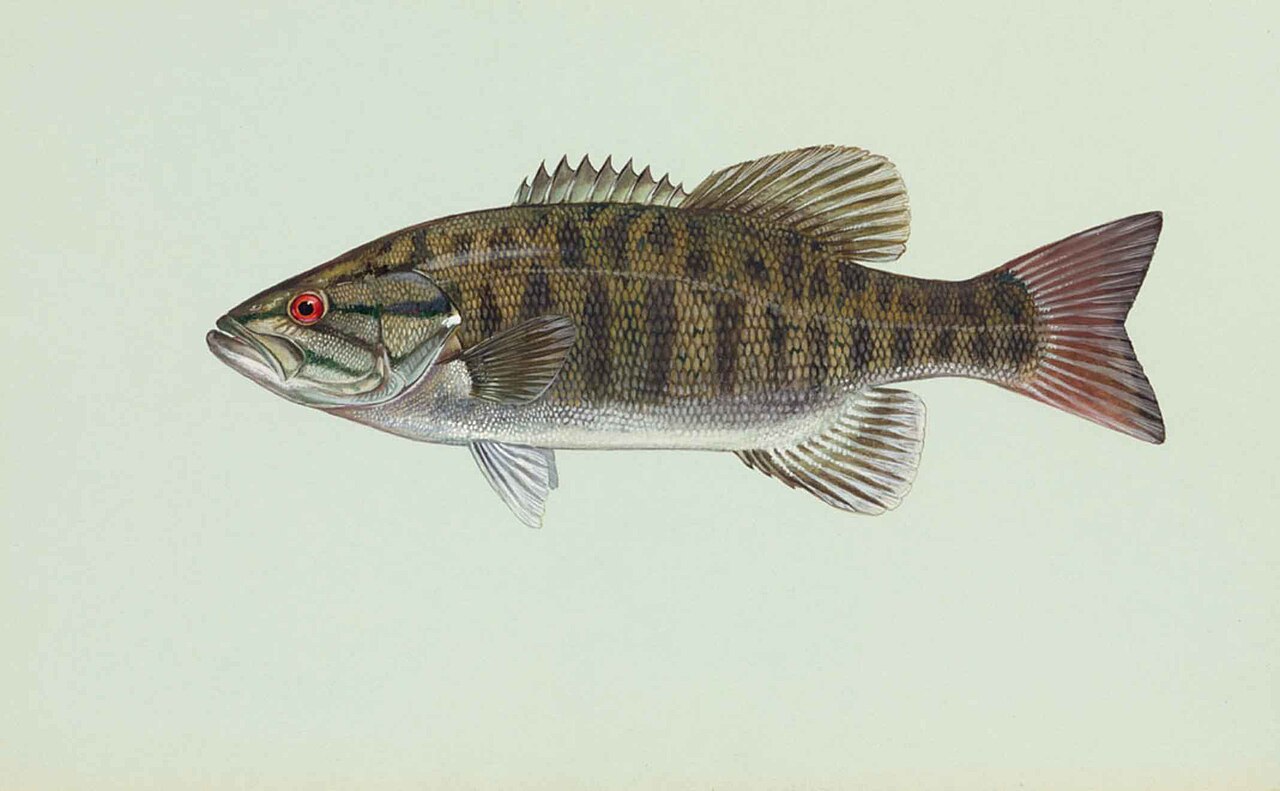
The smallmouth bass (Micropterus dolomieu) is a bronze to olive freshwater gamefish of clear, rocky rivers and lakes, and it is widely considered the hardest fighting fish of its size in North America. Anglers recognize it by the dark vertical bars on its flanks, the red or orange eye, and a jaw that stops below the middle of the eye rather than behind it. Most adults run 12 to 20 in (30 to 51 cm) and weigh 1 to 4 lb (0.5 to 1.8 kg).
Smallmouth bass are native to the Ohio, Mississippi, and Great Lakes drainages and have been stocked into 40 or more states. They hold in current, around gravel, boulders, and rocky points, and they feed heavily on crayfish. That single preference explains most of what works on them: bait choice, color choice, and the seasons when they bite hardest all track the crayfish.
Smallmouth bass are bronze, bar sided members of the sunfish family found in clear rocky lakes and rivers across most of the United States. They average 12 to 20 in and 1 to 4 lb, feed mainly on crayfish and baitfish, bite best at water temperatures of 55 to 70 F, and are excellent eating when taken from cold clean water.
| Quick Fact | Detail |
|---|---|
| Scientific name | Micropterus dolomieu, family Centrarchidae |
| Typical size | 12 to 20 in (30 to 51 cm), 1 to 4 lb (0.5 to 1.8 kg) |
| World record | 11 lb 15 oz (5.41 kg), Dale Hollow Lake, Tennessee, 1955 |
| Preferred habitat | Clear water, gravel and boulder bottom, current or wind swept rock |
| Main foods | Crayfish, shad, alewife, sculpin, hellgrammites, adult insects |
| Best bite window | Water at 55 to 70 F (13 to 21 C), spring and fall |
| Lifespan | 6 to 12 years, up to 20 in northern lakes |
How to Identify a Smallmouth Bass
A smallmouth bass is identified by three features that hold no matter the water color: vertical bars instead of a horizontal stripe, an eye tinted red or copper, and an upper jaw that ends under the eye. The body color ranges from pale tan in sandy lakes to deep bronze in stained rivers, which is why the fish is nicknamed bronzeback. Young fish under 6 in (15 cm) usually show three distinct bands of color on the tail: orange at the base, black in the middle, and white at the tip.
The dorsal fin is one continuous unit with a shallow notch between the spiny and soft sections. On a largemouth that notch is deep enough that the two halves look almost separated. Count the spines and you will find 9 or 10 in front, then 13 to 15 soft rays behind, a detail that matters when you are sorting a mixed bag of sunfish relatives at the cleaning table.
Smallmouth Bass vs Largemouth Bass: The Differences That Matter
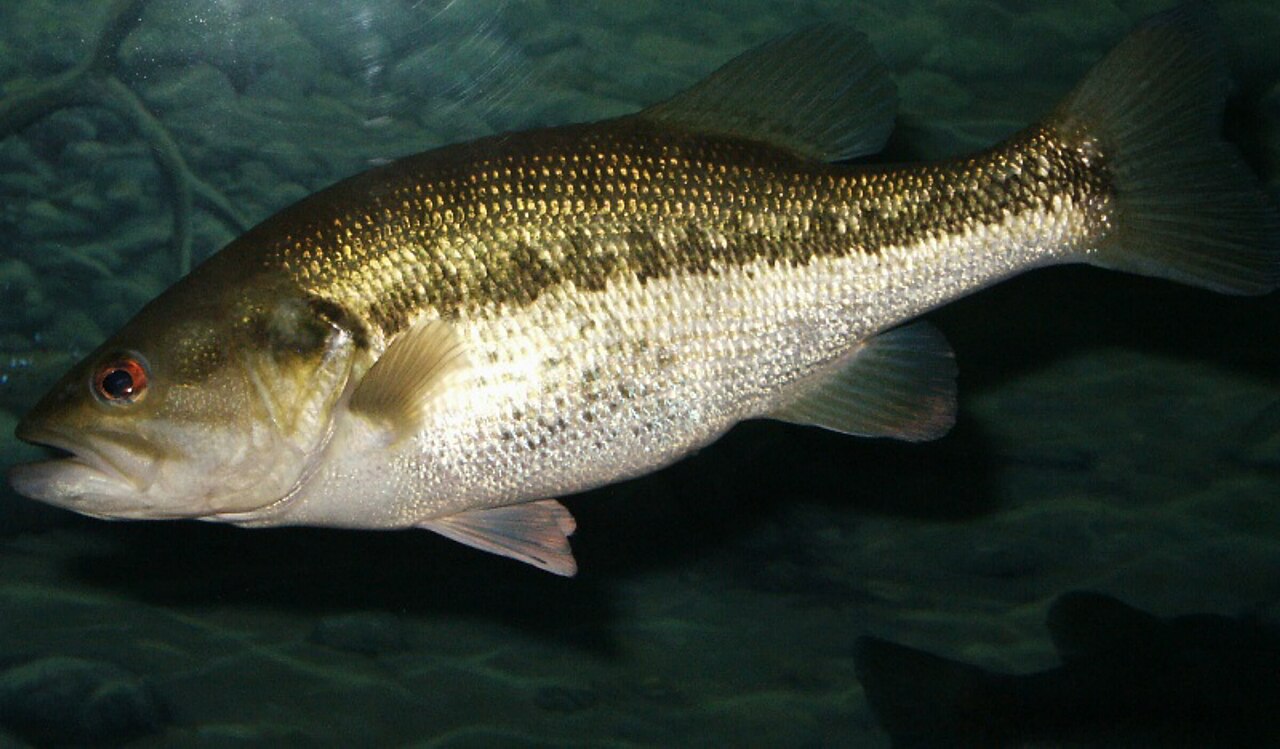
Smallmouth and largemouth bass separate cleanly on jaw length, body markings, and habitat. The largemouth (Micropterus nigricans) has a jaw extending past the rear edge of the eye and one ragged horizontal stripe along the side. The smallmouth has the shorter jaw and vertical bars. In the water, the largemouth looks green, the smallmouth looks brown or bronze.
Behavior separates them further. Largemouth bass prefer warm, weedy, slow water and ambush prey from cover. Smallmouth prefer cool, clear water over rock and will chase prey into open water and into current. Where both species share a lake, they usually split the lake between them: largemouth in the back of weedy bays, smallmouth on main lake points and rock piles.
Fight quality is the difference anglers talk about most. A hooked smallmouth typically jumps two or three times and runs for deep water, while a largemouth of the same weight often heads for cover and heavy vegetation. Pound for pound the smallmouth pulls harder, which is the honest reason many river anglers stop fishing for anything else. If you also fish panfish waters, the green sunfish and redear sunfish are close relatives that share the same family and much of the same rocky habitat.
Where Smallmouth Bass Live in the United States

Smallmouth bass live in clear, cool, rocky water across most of the country, with strongholds in the Great Lakes, the Ozark rivers, the upper Mississippi system, and the Tennessee River impoundments. Their native range covered the Ohio and Great Lakes basins, but stocking programs starting in the 1800s spread them into New England, the Pacific Northwest, and the desert Southwest. The U.S. Geological Survey tracks those introductions and their effects through its aquatic species program at usgs.gov.
In lakes they hold on main lake points, gravel flats, submerged humps, and riprap banks, usually in 5 to 25 ft (1.5 to 7.6 m) of water during the warm months. In rivers they sit behind current breaks: boulders, bridge pilings, the seam below a riffle, and the downstream edge of a gravel bar. Current is not an obstacle to them, it is a conveyor belt that delivers food.
What Is a Smallmouth Bass’ Favorite Food?
Crayfish are the favorite food of smallmouth bass across nearly all of their range. Stomach studies from state fisheries agencies routinely find crayfish in more than half of adult smallmouth sampled during summer, with baitfish taking over in winter and early spring. A smallmouth will eat a crayfish of almost any size it can fit in its mouth, and it prefers soft shelled individuals that have just molted. For a closely related question, see our guide to world record largemouth bass.
Baitfish make up the rest of the diet: gizzard and threadfin shad in southern reservoirs, alewives in the Great Lakes, sculpin and dace in northern rivers, and young sunfish almost everywhere. Insects matter more than most anglers assume. Hellgrammites, mayfly and stonefly nymphs, and adult cicadas in a hatch year can dominate the diet for weeks. For a broader look at how freshwater species feed, see our guide to what fish eat.
Diet shifts with age. Fry eat zooplankton, fish under 4 in (10 cm) eat aquatic insects, and once a smallmouth passes about 8 in (20 cm) it moves onto crayfish and fish and rarely goes back. Knowing that progression tells you what to throw: match the crayfish in summer, match the baitfish in cold water.
What Is the Best Bait for Smallmouth Bass?

The best bait for smallmouth bass is a live crayfish hooked through the tail and drifted along rocky bottom, and the best artificial is a tube jig in a brown or green pumpkin crayfish pattern. Both work because they present the fish with the food item it already hunts. A 3 in (7.6 cm) tube on a 1/8 to 3/8 oz internal jighead, dragged and hopped over gravel, has caught more smallmouth than any other single lure.
Live bait ranks in this order in most waters: crayfish, shiners, nightcrawlers, hellgrammites, and leeches. Nightcrawlers catch fish everywhere but also catch every other species in the lake. Hellgrammites are hard to buy and outstanding in rivers, and leeches shine in northern lakes during early summer.
Among artificials, the productive short list is a tube jig, a Ned rig, a drop shot with a 3 in minnow bait, a small swimbait, and a topwater walking bait at dawn. Clear water rewards light line and finesse presentations, while stained water or heavy current calls for a 3/8 oz jig and heavier line.
What Color Do Smallmouths See Best?
Smallmouth bass see red and green wavelengths best, and their vision is tuned to the middle of the spectrum rather than the blue end. Research on black bass eyes has consistently found two cone types, one peaking near green and one near red, which means color contrast between those two ranges is what the fish resolves most sharply. Practically, green pumpkin and brown, often with an orange or red accent, cover the majority of smallmouth fishing.
Depth changes the answer. Red light disappears first in water and is effectively gone by 15 to 20 ft (4.6 to 6.1 m), so a red bait at that depth reads as dark gray. Green and chartreuse penetrate deeper, which is why deep water finesse baits lean green and why a dark silhouette often outfishes a bright one at depth.
What Month Do Smallmouths Start Biting?
Smallmouth bass start biting reliably when water temperature climbs past 48 to 50 F (9 to 10 C), which means March in the mid South, April through May across the Midwest and Northeast, and late May in northern Minnesota and Maine. The prespawn period at 55 to 62 F (13 to 17 C) is the best fishing of the year in most waters, because big females feed hard in shallow water where you can reach them.
The bite does not stop in summer, it moves. Once surface temperatures pass 75 F (24 C) the fish drop to deeper structure and feed at first and last light. September and October bring a second peak as cooling water pushes baitfish shallow and smallmouth feed to build reserves for winter.
Are Smallmouth Bass Harder to Catch Than Largemouth Bass?
Smallmouth bass are not harder to catch than largemouth, but they are harder to find, and that difference fools a lot of anglers. Largemouth relate to visible cover such as docks, laydowns, and weed edges. Smallmouth relate to invisible structure: a gravel transition, a rock hump in 18 ft, a current seam. You cannot see the spot from the surface, so location work matters more than lure selection.
Once located, smallmouth are usually more aggressive than largemouth of the same size. They roam in loose groups, compete for food, and will chase a bait a long way in clear water. Finding one often means finding five, which is why a good smallmouth day can produce numbers a largemouth angler rarely sees.
How Rare Is a 5 Pound Smallmouth Bass?
A 5 lb (2.3 kg) smallmouth is genuinely rare and represents a top one percent fish in most waters. State creel surveys show average caught smallmouth running 1 to 2 lb, with a 3 lb fish counting as a good day and a 4 lb fish worth a photograph. In an average river system, a lifetime of fishing may produce a handful of 5 pounders.
Geography decides the odds more than skill. Lake Erie, Lake St. Clair, Lake Champlain, Dale Hollow, and the Columbia River system grow 5 lb smallmouth in real numbers because of long growing seasons combined with rich forage such as gobies and alewives. A northern Wisconsin lake with a short season may top out near 4 lb no matter how well the population is managed.
The all tackle world record stands at 11 lb 15 oz from Dale Hollow Lake, Tennessee, caught in 1955 and still unbroken after seventy years. That fish and the handful of contenders since are covered in our breakdown of the world record smallmouth bass, including the disputed catches that were never certified.
Is Smallmouth Bass Good for Eating?
Smallmouth bass is good eating, with firm white flaky flesh and a mild flavor comparable to walleye or perch when the fish comes from cold clean water. The meat is lean, holds together well in a pan, and takes a simple flour or cornmeal coating better than a heavy batter. Fish in the 12 to 15 in (30 to 38 cm) range give the best texture.
Water quality drives flavor more than anything else. Smallmouth from warm, algae heavy, or muddy water can taste earthy or muddy, a flavor that comes from compounds in the fish’s skin and fat rather than from the fillet itself. Removing the skin, trimming the dark lateral line meat, and icing the fish immediately after the catch fixes most of the problem.
Check your state advisory before you keep a limit. Mercury and PCB advisories apply to predatory fish in many river systems, and the guidance typically limits older, larger fish rather than the eating sized ones. Toothy predators in the same water, such as the fish we cover in our look at walleye teeth, fall under similar advisories.
Why Do Fishermen Not Eat Bass?
Most bass anglers release their fish for conservation and culture reasons, not because the meat is bad. Catch and release became standard practice in competitive bass fishing during the 1970s and spread through the whole sport, to the point that keeping a bass now feels unusual to many anglers even where it is fully legal. Tournament rules that require live release reinforced the habit.
There is a biological argument behind it. Large smallmouth are slow growing and disproportionately valuable to the population: a 5 lb female may be 12 years old and produce far more eggs than three smaller fish combined. Removing the largest fish from a small river system changes the size structure for years.
The practical compromise most fisheries biologists recommend is selective harvest. Keep a few fish in the middle of the slot, release the largest, and respect closed seasons during the spawn when males are guarding nests and are easy to catch. Nest guarding males abandon the nest when caught, and predators such as the birds covered in our guide to birds that eat fish clear an unguarded nest within minutes.
Frequently Asked Questions
Are smallmouth bass harder to catch than largemouth bass?
They are harder to locate, not harder to hook. Smallmouth relate to invisible structure such as gravel transitions and deep rock rather than to visible cover, so finding them takes more work. Once you are on a group, smallmouth are usually more aggressive and more willing to chase a bait than largemouth of the same size.
Is smallmouth bass good for eating?
Yes. The fillets are white, firm, and mild, closer to walleye than to catfish. Fish from cold clear water taste best, while those from warm muddy water can be earthy. Skin the fillets, trim the dark lateral meat, ice the fish right away, and follow your state mercury advisory for larger individuals.
How rare is a 5 pound smallmouth bass?
Rare almost everywhere. Most caught smallmouth weigh 1 to 2 lb, and a 5 lb fish is a top one percent catch in the majority of waters. Lake Erie, Lake St. Clair, Lake Champlain, Dale Hollow, and the Columbia River produce them most consistently because of rich forage and long growing seasons.
What is the best bait for smallmouth bass?
A live crayfish drifted along rocky bottom is the single best natural bait, and a brown or green pumpkin tube jig is the best artificial. Both imitate the crayfish that dominate the summer diet. Shiners, nightcrawlers, hellgrammites, and leeches also produce, and a Ned rig covers tough clear water days.
What color do smallmouths see best?
Their eyes are tuned to green and red wavelengths, so green pumpkin and brown with orange or red accents match their vision well. Red light disappears below roughly 15 to 20 ft, so deep presentations should lean green or dark. Water clarity matters more than exact shade in stained conditions.
What month do smallmouths start biting?
The bite turns on when water passes 48 to 50 F, which is March in the mid South, April or May across the Midwest and Northeast, and late May in the far North. Prespawn at 55 to 62 F is the strongest period of the year, and a second peak arrives in September and October.