Map Turtle: 14 Species, Size, Diet and Care Facts
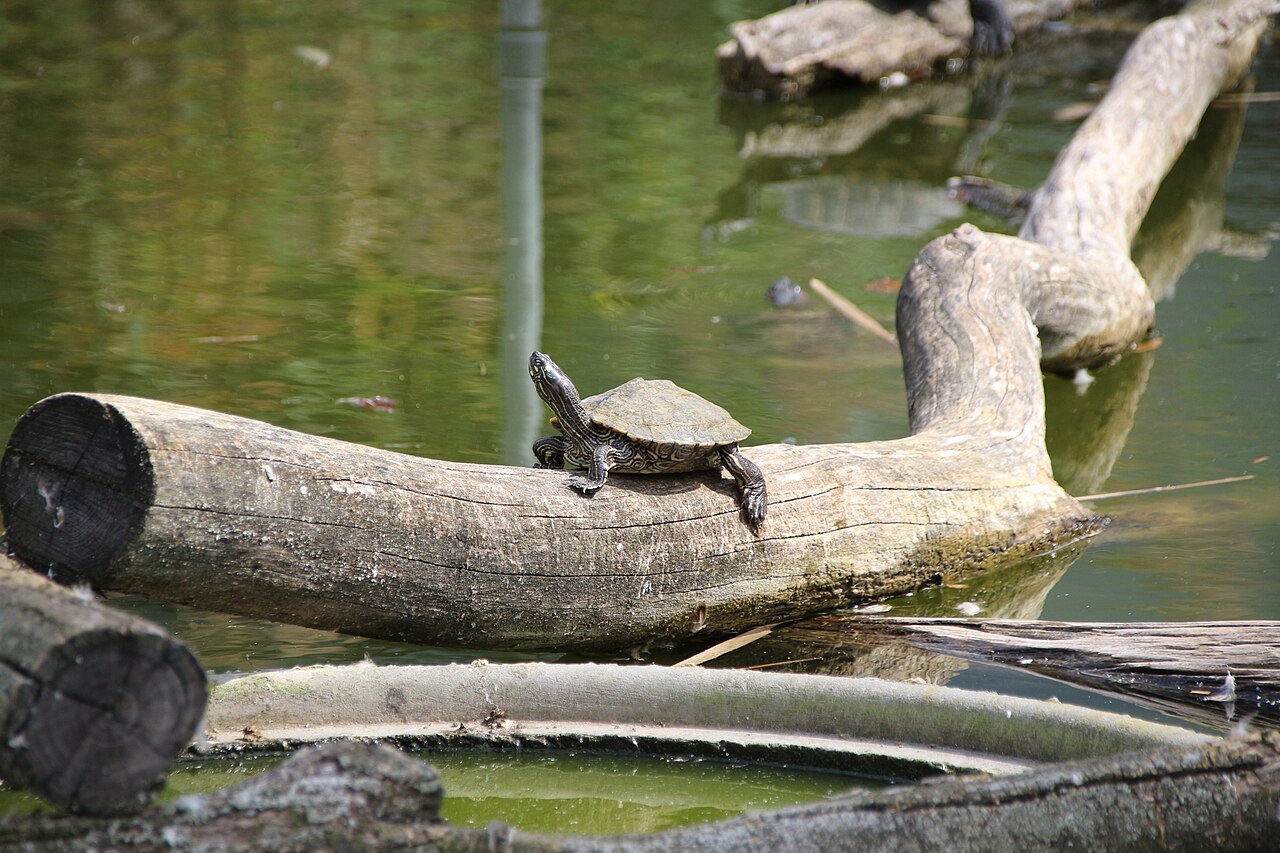
A map turtle is any of the roughly 14 North American freshwater turtles in the genus Graptemys, named for the fine contour lines on the shell that look like a printed map. They are river turtles with a sawtooth keel down the back, and the females grow to more than twice the size of the males.
Most sightings in the United States come from the Mississippi drainage, the Great Lakes, and the Gulf Coast rivers of Alabama, Mississippi, and Louisiana, where several species live nowhere else on earth. The same traits that make them striking on a basking log, wariness and a need for moving water, are what make them a demanding aquarium animal.
Map turtles are keeled freshwater turtles of the genus Graptemys, found only in North America. Females reach 7 to 10.75 in (18 to 27 cm), males just 3.5 to 6.25 in (9 to 16 cm). They eat snails, clams, and insects, bask heavily, and need large, filtered, moving water in captivity.
| Quick Facts | Map Turtle (Graptemys) |
|---|---|
| Species | About 14, all native to North America |
| Female size | 7 to 10.75 in (18 to 27 cm) shell length |
| Male size | 3.5 to 6.25 in (9 to 16 cm) shell length |
| Habitat | Rivers and large lakes with current, deadwood, and mussel beds |
| Diet | Snails and clams (females), insects and crustaceans (males) |
| Lifespan | 15 to 30 years typical, females sometimes past 50 |
| Minimum adult tank | 75 gallons for a male, 125 gallons or more for a female |
How to Recognize a Map Turtle
Look at the spine first. Every Graptemys carries a raised vertebral keel, and in the sawback group it rises into black spines or knobs that break the outline of the shell. The carapace itself is olive to brown, overlaid with thin yellow lines that branch like waterways on a chart, and the rear edge is serrated.
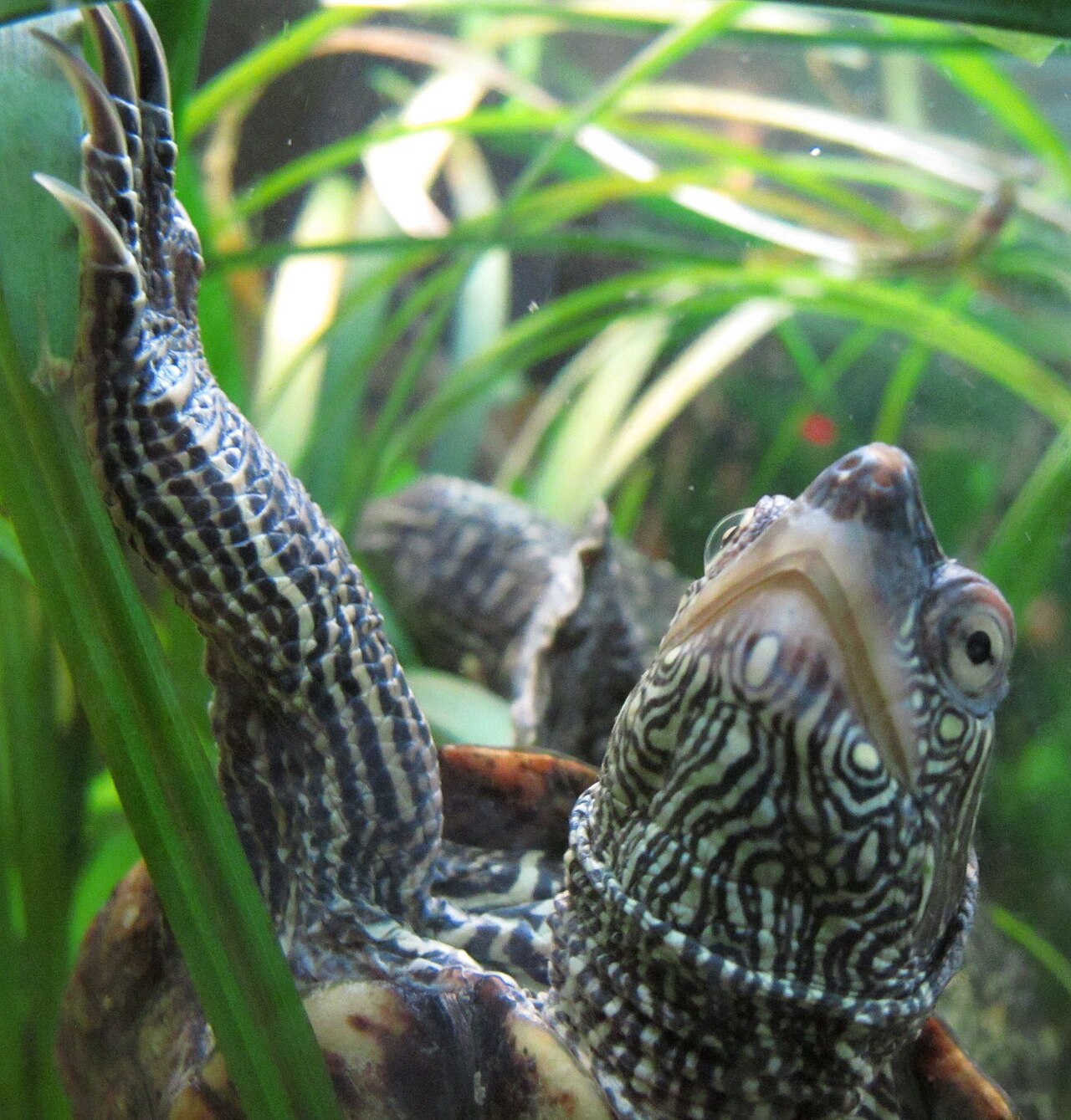
The head markings identify the species. A Mississippi map turtle shows a yellow crescent curving behind the eye that stops the neck stripes short. A northern map turtle has a small triangular spot behind the eye. Older females darken, and the map pattern can fade almost to nothing, which is why a large dark female is often mistaken for a painted turtle at a distance.
How Big Will a Map Turtle Get?
Size depends entirely on sex, and the difference is extreme. Female northern map turtles reach 7 to 10.75 in (18 to 27 cm) of shell and can weigh over 5 lbs (2.3 kg). Males of the same species top out at 3.5 to 6.25 in (9 to 16 cm) and stay slim, with long front claws and a thicker tail.
That split drives every housing decision. A male stays manageable for life in a 75 gallon tank; a female needs 125 gallons or a stock tank and will still look cramped. Buyers who cannot sex a hatchling should assume they are raising a female. Growth is fast for the first three years, then slows, with females maturing around 10 to 14 years old.
Map Turtle Species You Are Most Likely to See
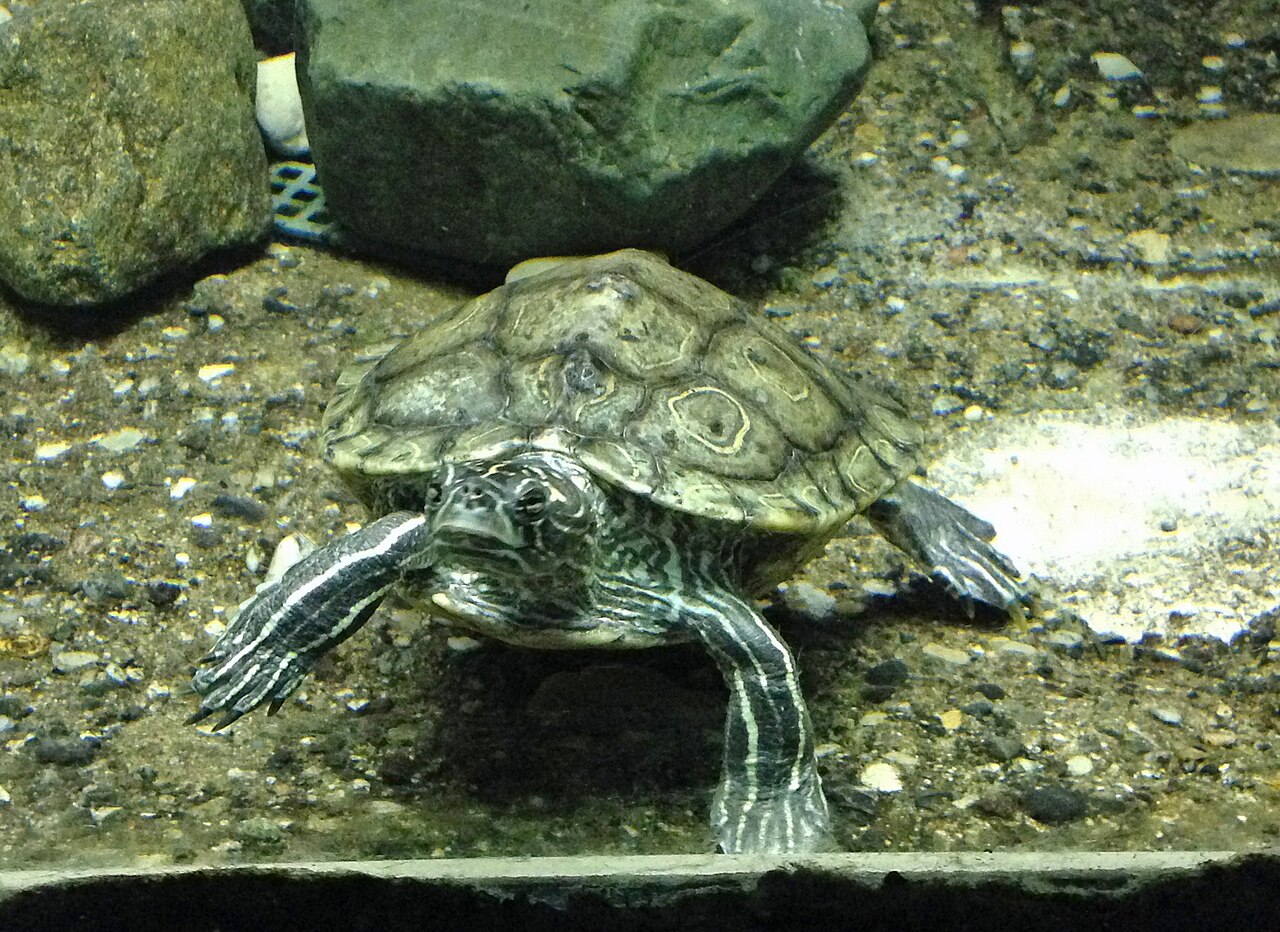
The northern map turtle (Graptemys geographica) has the widest range, from Quebec and the Great Lakes down the Mississippi to Arkansas. The false map turtle and the Mississippi map turtle (G. pseudogeographica) dominate the big river channels and are the two most often sold in the pet trade. The Ouachita map turtle shares that range with brighter facial spots.
The Gulf Coast species are the specialists. Barbour’s map turtle, the black-knobbed sawback, the yellow-blotched sawback, and the ringed map turtle each occupy a single river system, and several are federally listed. Their entire world is one drainage, so a dam or a dredging project is a population-level event.
What Do Map Turtles Eat?
Map turtles eat mollusks, insects, and crustaceans, and the sexes eat differently. Large females develop broad, heavy heads with crushing jaw surfaces that handle snails, clams, and invasive zebra mussels. Males and juveniles keep narrow heads and take mayfly larvae, caddisflies, small crayfish, and carrion.
In an aquarium that means a calcium heavy menu: whole snails, krill, shrimp with shell, a quality pellet, and greens such as duckweed or anacharis. Feeding only pellets gives females nothing to wear their jaws against. They forage on the bottom rather than scavenging the surface, a habit they share with the mud turtle and with river specialists like the spiny softshell turtle.
Can You Keep a Map Turtle as a Pet?
Yes, and captive bred map turtles are legal in most states, but they suit an experienced keeper rather than a first timer. They are powerful swimmers built for current, so the tank needs a canister filter rated well above the water volume, plus a return that actually moves water. Keep the water at 75 to 80 F (24 to 27 C) and a dry basking platform at 90 F (32 C) under UVB.
The bigger issue is temperament. Map turtles are the most nervous North American basking turtles, and a tank in a busy room means an animal that dives every time someone walks past. They rarely become handleable, and a beginner is better off with an eastern painted turtle. Check state law before collecting one from the wild, since several species are protected and some states prohibit taking any native turtle.
Are Map Turtles Rare?
It depends on the species. The northern and false map turtles are common through the big rivers and can be counted by the dozen on a single log jam in summer. The narrow-range Gulf Coast species are a different story: the yellow-blotched sawback and the ringed map turtle are federally threatened, and Barbour’s map turtle is protected across its range.
The pressures are consistent across the genus. Dams flatten the current these turtles hunt in, riprap removes the sand banks they nest on, and the loss of native mussel beds takes the food supply with it. Species profiles from the US Fish and Wildlife Service track the listed populations river by river.
Frequently Asked Questions
What fish can live with a map turtle?
Fast, cheap, and expendable ones. Rosy red minnows, guppies, and zebra danios survive longest because they outswim a turtle, but assume anything in the tank is eventually food. Slow or ornamental fish such as fancy goldfish and bettas are a bad match, and any fish adds to the filtration load.
How long do map turtles live?
Most live 15 to 30 years in good care, and wild females have been aged past 50. Longevity depends on water quality, UVB, and a calcium rich diet more than on anything else. Shell rot and metabolic bone disease, the two common killers in captivity, both trace back to poor husbandry rather than bad luck. Compare that with painted turtle lifespan.
How can you tell a turtle is happy?
Turtles do not show happiness, but they do show health. A settled animal basks fully every day, eats readily, swims with a level trim, holds its head up, and has clear eyes and a firm shell. Constant glass surfing, refusing to bask, and hiding from light are the signals that something in the setup is wrong.
What is the most aggressive type of turtle?
The common snapping turtle and the alligator snapping turtle, and only on land, where they cannot flee and strike instead. In water both prefer to retreat. Map turtles sit at the opposite end: they are nervous rather than aggressive and will abandon a basking log rather than defend it.
Do map turtles hibernate?
Northern populations overwinter on the bottom of rivers and lakes, often in the same deep pools year after year, taking in oxygen through the skin and throat lining while barely moving. Indoor captive animals kept warm do not need a cold period. The mechanics are covered in whether turtles hibernate.