Northern Leopard Frog: Identification, Diet, and Safe Handling
The northern leopard frog (Lithobates pipiens, formerly Rana pipiens) is a green or brown frog covered in dark, rounded spots ringed by pale halos, and it is harmless to handle. It is the classic biology class frog of North America, once so common across wet meadows that dealers shipped it by the barrel, and it is now missing from large parts of the western United States.
Most people meet a northern leopard frog in the grass rather than in the water, which is why the species also carries the name meadow frog. Telling it apart from the pickerel frog matters, because one of those two has skin secretions strong enough to sicken a pet, and it is not this one.
The northern leopard frog is a 2 to 4.5 in (5 to 11 cm) frog with unbroken dorsolateral ridges and dark spots surrounded by light rings. It is not poisonous to touch, eats insects and other small prey, breeds in shallow ponds in early spring, and overwinters underwater. It remains common in the Midwest and Northeast but has declined sharply in the West.
How to Identify a Northern Leopard Frog
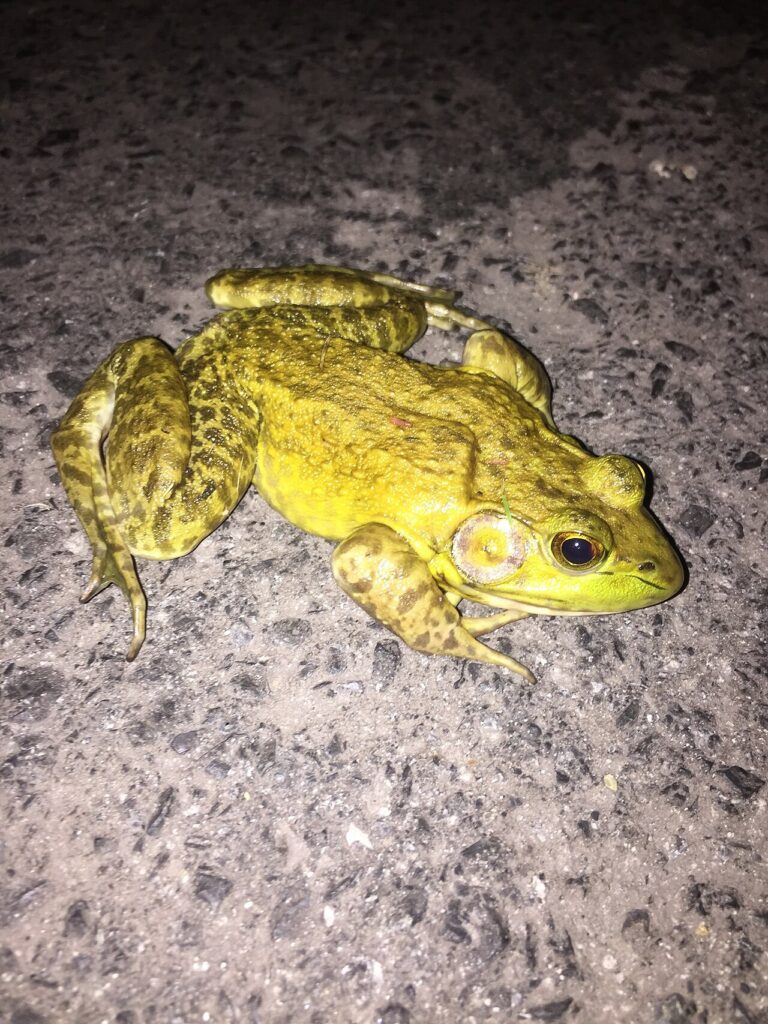
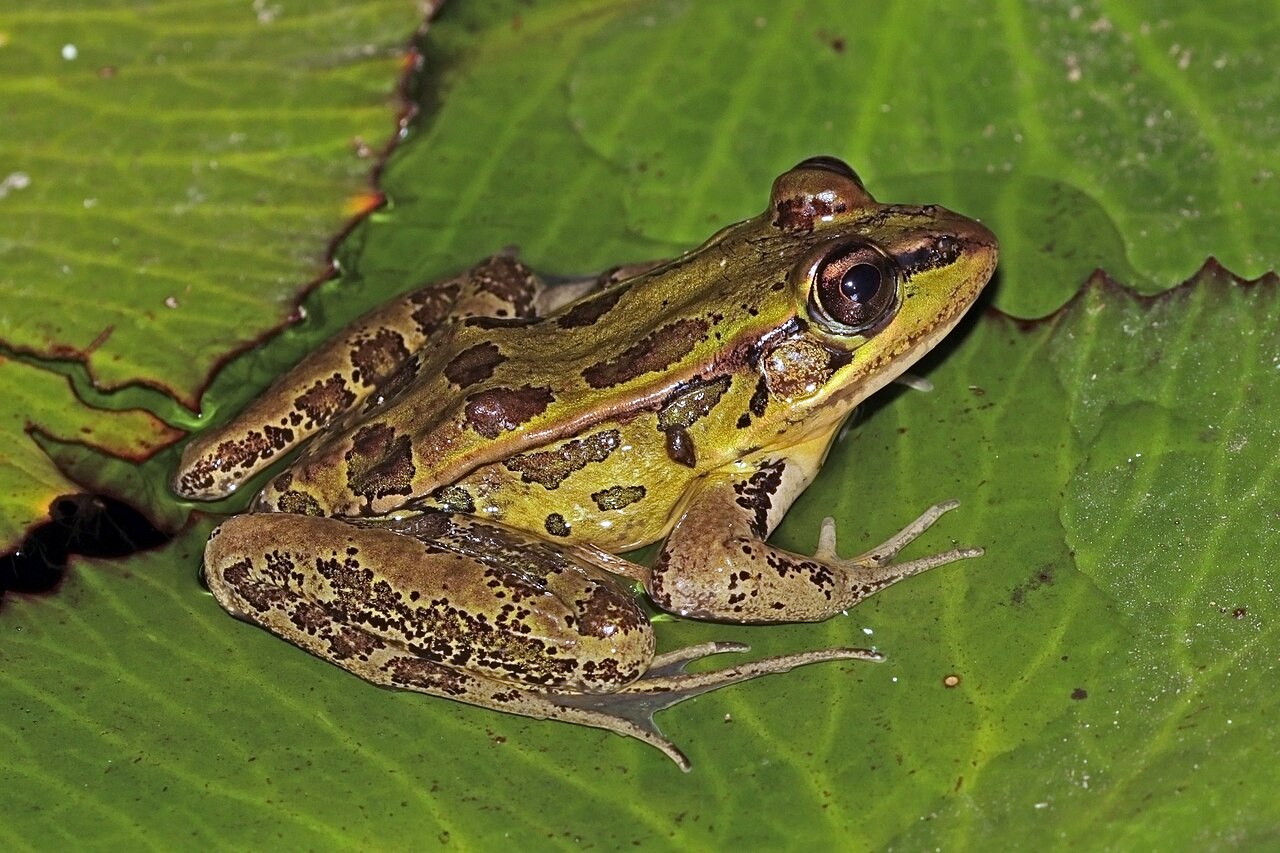
Three features settle the identification together: two light, unbroken ridges running down the back from the eye to the groin, dark spots with clearly lighter borders, and a plain white belly. The spots are round to oval and scattered irregularly, not arranged in tidy rows. Body color runs from bright grass green to olive brown, and both morphs can appear in the same pond.
Adults measure 2 to 4.5 in (5 to 11 cm) from snout to vent, with females noticeably larger than males. Males have slightly swollen thumbs during breeding season and paired vocal sacs that balloon out behind the jaw when they call. The hind legs are long and powerful, and a startled frog can cover several feet in one erratic zigzag jump toward cover.
A rare burnsi morph lacks the dorsal spots entirely and turns up regularly in Minnesota and Manitoba. Another variant, the kandiyohi morph, has mottled dark pigment smeared between the spots. Both are genetic color forms of the same species, not separate frogs, and they still show the pale dorsolateral ridges.
Northern Leopard Frog vs Pickerel Frog and Southern Leopard Frog
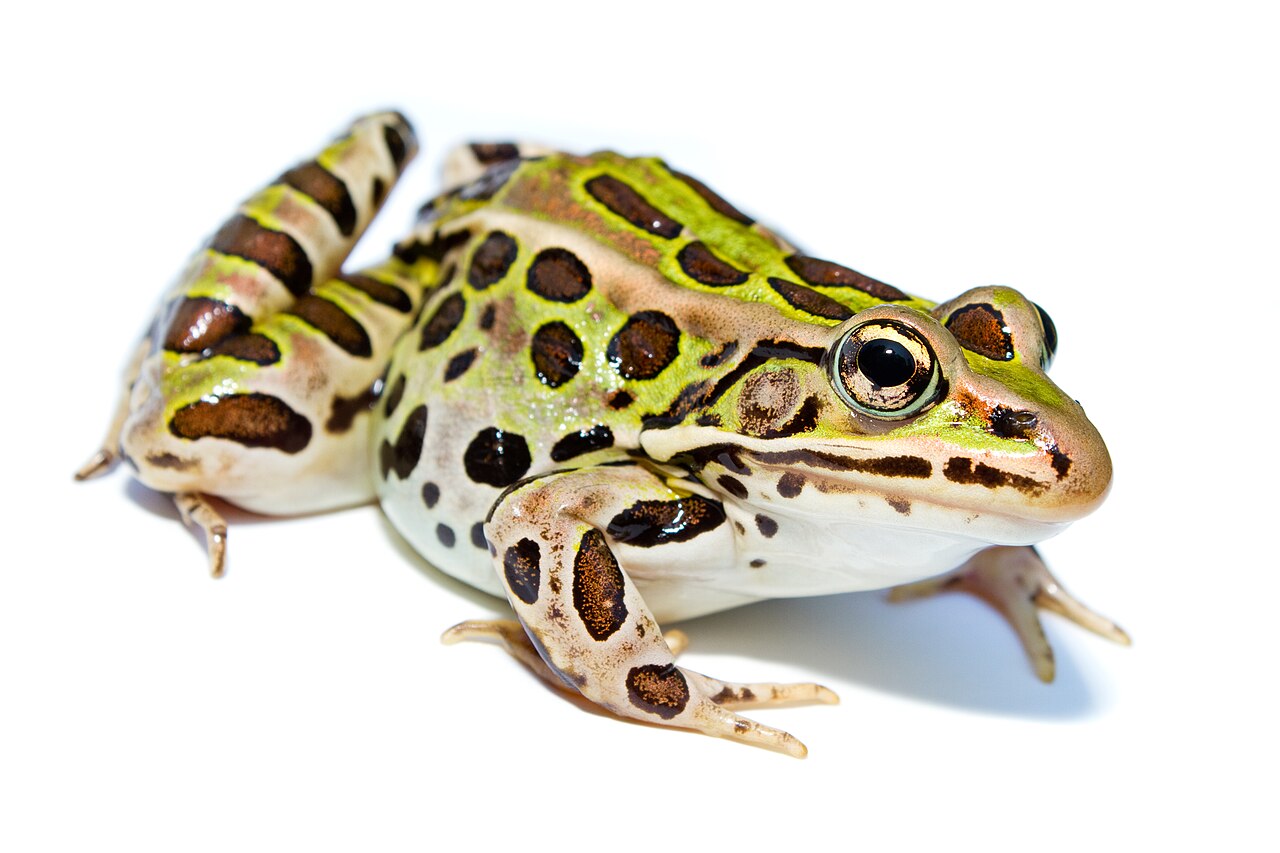
The pickerel frog (Lithobates palustris) is the lookalike that actually matters. Its spots are squarish and arranged in two parallel rows down the back, and the inner thighs and groin flash bright yellow to orange. Its skin secretions are genuinely noxious and can kill other amphibians kept in the same container, so it is the one frog in this group you should not toss into a bucket with others.
The southern leopard frog has a more pointed snout, fewer and more sharply defined spots, and usually a small light spot in the middle of the eardrum. Where the two ranges overlap across the mid Atlantic and lower Midwest, that eardrum spot is the fastest check. Our guide to the southern leopard frog walks through the full side by side comparison.
If you only got a glance and the ridges looked broken or the frog was bulky and plain, you may have seen a green frog or a young bullfrog instead. The wider leopard frog overview covers all the North American species in the group, including the Rio Grande and plains forms in the Southwest.
Where Northern Leopard Frogs Live
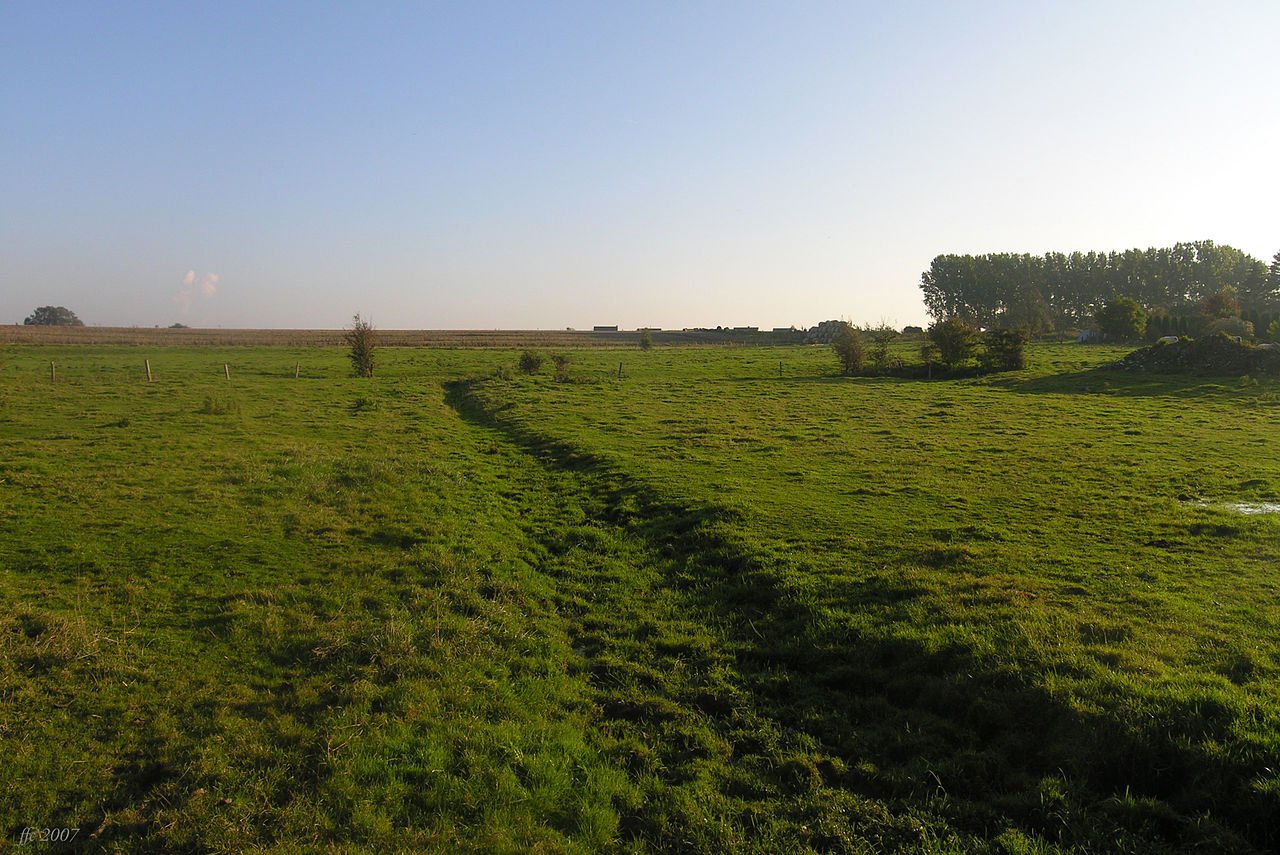
The range covers southern Canada from British Columbia to Labrador and dips south across New England, the Great Lakes, the northern plains, and scattered pockets in the Rockies and Southwest. It is the most widely distributed frog in Canada. In the United States the strongholds are Minnesota, Wisconsin, Michigan, and the Dakotas.
Breeding happens in still or slow water: marsh edges, beaver ponds, oxbows, roadside ditches, and the shallow bays of lakes. After breeding, adults move into damp grassland, hayfields, and forest edges and spend the whole summer hunting there, often several hundred feet from the nearest water. That summer dispersal into uplands is why mowing and field conversion hit the species so hard.
Populations west of the Rockies have collapsed in most of their historical range. Frogs are gone from much of Washington, Oregon, California, Nevada, and Arizona, and the survivors sit in isolated ponds that state agencies track individually. The U.S. Fish and Wildlife Service reviewed the western population for federal listing and documented losses across the interior West.
Is the Northern Leopard Frog Poisonous?
No. The northern leopard frog is not poisonous and it is not venomous. Its skin produces mild antimicrobial peptides that protect the frog from infection, not a toxin aimed at predators. Handling one briefly with clean, wet hands does no harm to you, and washing afterward is a sensible habit because amphibians can carry Salmonella.
The frog is also not dangerous in the other direction. It has no teeth capable of breaking skin and it does not bite defensively; a cornered leopard frog jumps rather than fights. The only risk in a handling encounter runs toward the frog, since dry hands, sunscreen, and insect repellent damage the permeable skin it breathes through.
Truly toxic frogs exist, but they live elsewhere and advertise it. The blue poison dart frog of Suriname carries alkaloids sequestered from its diet and wears warning colors to match. A spotted brown frog in an Iowa ditch is using camouflage, which is the opposite strategy.
What Do Northern Leopard Frogs Eat?
Northern leopard frogs eat almost any moving animal small enough to swallow. Stomach studies turn up beetles, ants, flies, grasshoppers, crickets, spiders, slugs, snails, and earthworms in the bulk of the diet. They hunt by sight and ambush, lunging with an open mouth rather than flicking a long sticky tongue at range.
Large adults take vertebrate prey when the chance appears, including small frogs, hatchling birds, garter snakes, and even small bats caught at the water surface. That opportunism is well documented and unusual for a frog of this size. Cannibalism of smaller leopard frogs happens in crowded ponds.
Tadpoles eat a completely different menu. They scrape algae, diatoms, and decaying plant matter from submerged surfaces with rasping tooth rows, and they will also feed on dead animals in the pond. The switch from herbivore to predator happens during metamorphosis, when the gut shortens dramatically.
Do Leopard Frogs Need Water?
Yes, but less constantly than most people assume. Leopard frogs need standing water to breed and to overwinter, and they need moisture against their skin at all times, yet adults spend the summer foraging in damp vegetation rather than sitting in a pond. Heavy dew and shaded grass supply enough humidity for weeks at a stretch.
The dependence is physiological. A frog absorbs water and oxygen through its skin, so drying out for even a few hours in the sun is fatal. This is why summer leopard frogs are found in the morning and evening, after rain, and in low spots where the grass stays wet.
Winter is where open water becomes non negotiable. The species overwinters submerged, and a pond that freezes to the bottom or goes anoxic under thick ice kills the whole cohort. Our overview of frog hibernation strategies explains why aquatic overwintering is riskier than burrowing.
Northern Leopard Frog Sound and Mating Calls
The advertisement call is a long, low snore of about 3 seconds followed by a series of clucks and grunts, often compared to a thumb rubbed across a wet balloon. It carries poorly compared with the whistle of a spring peeper, so a chorus of leopard frogs can be easy to miss from a road.
Males call while floating at the surface with the vocal sacs inflated on either side of the head, and they call both day and night during the short breeding window. Water temperature drives the timing more than the calendar does. Choruses usually start once shallow water reaches the mid 50s Fahrenheit (about 12 to 13 C).
Males also produce a sharp release call when grabbed by another male, and both sexes give a loud, startling squeak when seized by a predator. That distress scream is one of the loudest sounds a small frog makes and sometimes startles a snake into letting go.
Breeding Season and the Tadpole Stage
Breeding runs from March to early June depending on latitude, typically within two weeks of ice out. Females deposit a firm, flattened egg mass of roughly 3,000 to 6,500 eggs attached to submerged stems in shallow, sun warmed water. One female usually lays a single clutch per year.
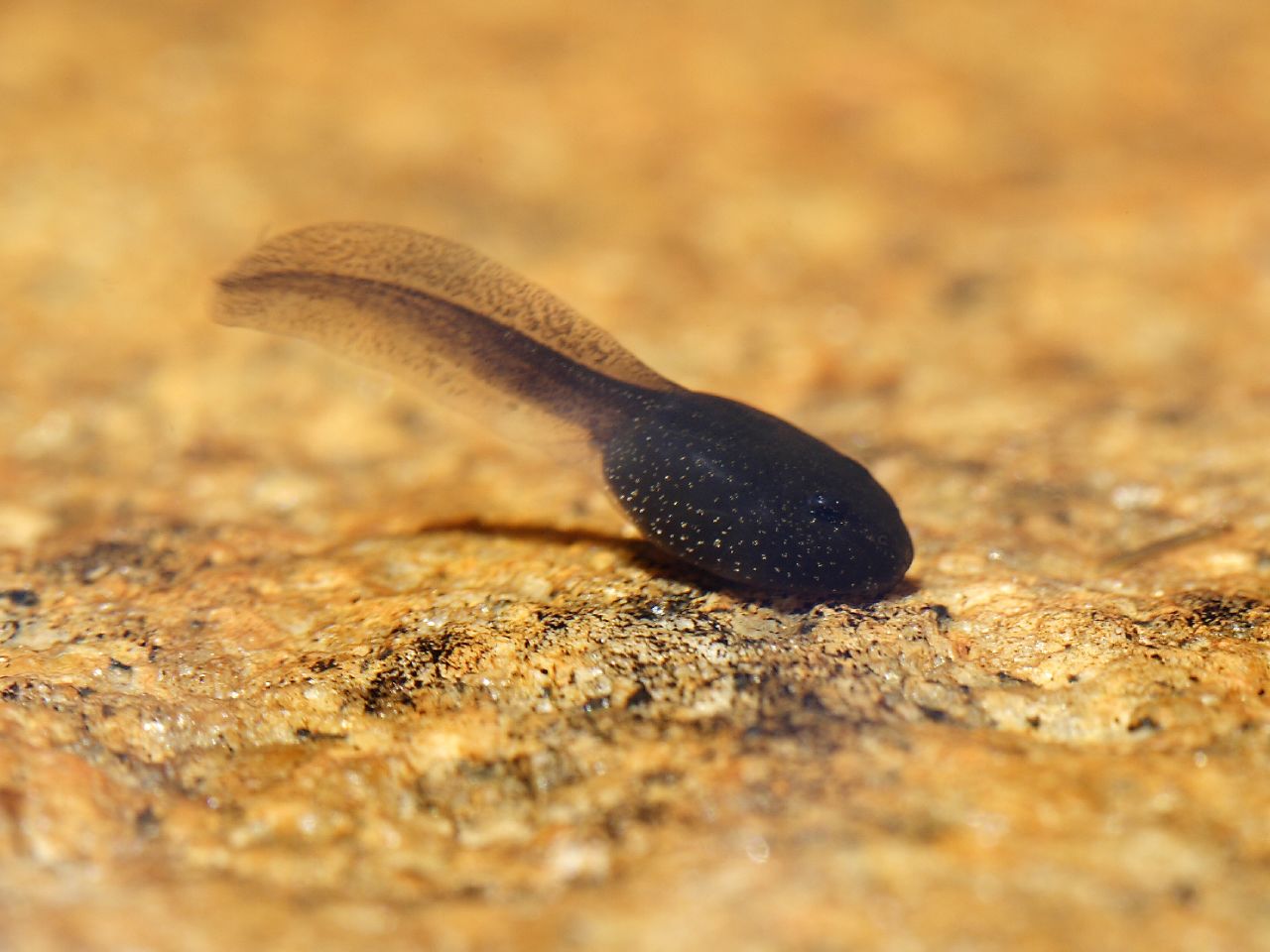
Eggs hatch in about 9 to 17 days, and the resulting tadpoles are large, olive to brown, with a pale belly and a translucent tail fin flecked with dark pigment. They reach 3 in (about 8 cm) before transforming, which makes them among the bigger tadpoles in a northern pond.
Metamorphosis takes 70 to 110 days, so froglets leave the water in late July and August at about 1 in (2.5 cm). Survival from egg to froglet is brutally low, often under 5 percent, with fish, dragonfly larvae, and pond drying taking most of the clutch. Frogs that make it breed in their second or third spring.
Northern Leopard Frog Hibernation
Northern leopard frogs overwinter underwater, resting on the bottom or in loose debris rather than burying deep in mud. Buried frogs suffocate, because the frog relies on skin gas exchange with cold, oxygen rich water while its heart rate drops to a few beats per minute.
Suitable winter sites are therefore specific: deeper ponds, spring fed pools, and slow stream margins that hold flowing or well oxygenated water under the ice. Frogs may travel considerable distances in autumn from their summer meadows to reach one, and road crossings during that migration cause heavy mortality.
Winterkill events are a real limit on population size. A season with early, thick ice and heavy snow cover cuts photosynthesis under the ice, oxygen falls, and entire overwintering aggregations die. The following spring chorus can be a fraction of the previous year for that reason alone.
Are Northern Leopard Frogs Rare?
Globally the northern leopard frog is listed as Least Concern, but that label hides a split. It is still locally abundant across the upper Midwest and eastern Canada while functionally rare or extirpated through most of the West, where several states treat it as a species of greatest conservation need.
The decline began in the 1960s and 1970s with steep die offs in Minnesota and the Canadian prairies, and the causes stack: wetland drainage, chytrid fungus (Batrachochytrium dendrobatidis), ranavirus, agricultural chemicals, introduced bullfrogs, and predatory fish stocked into breeding ponds. Reintroduction programs are active in Arizona, Nevada, and Washington.
The species also carries a documented history with deformities. In 1995 Minnesota students found high rates of missing and extra limbs in leopard frogs, which triggered a national research effort that eventually pointed largely at trematode parasites interacting with nutrient runoff rather than at a single chemical cause.
What Is a Frog’s Worst Enemy?
For the northern leopard frog, habitat loss is the worst enemy by a wide margin, and disease runs second. No natural predator removes populations the way draining a breeding wetland does, and chytrid fungus can clear a pond that still looks perfectly healthy.
Among animals, the list is long because leopard frogs are edible at every life stage. Garter snakes and water snakes specialize on them, herons and bitterns take adults in the shallows, raccoons and mink work the shorelines, and bass and pike eat both tadpoles and swimming adults. American bullfrogs eat any leopard frog that fits in the mouth.
Roads deserve a mention as a modern predator. Because the species commutes between summer meadow, breeding pond, and winter pool, a single road across that triangle can remove most of the adults in a few migration nights. Culverts and seasonal closures measurably help.
Can I Keep a Northern Leopard Frog as a Pet?
Legally it depends on your state, and ethically the answer is to buy captive bred rather than collect. Several states require a permit or prohibit possession of native amphibians outright, while others allow a small personal take under a fishing license. Check your state wildlife agency before picking up a frog, not after.
Care is moderate but not beginner level. A single adult needs at least a 20 gallon long tank with a shallow water section, a land area of damp moss or soil, temperatures of 65 to 75 F (18 to 24 C), and a cool winter rest period. They are nervous, fast, and prone to injury by leaping into glass, so a planted, visually screened enclosure works far better than a bare one.
Wild caught adults rarely settle and often arrive carrying parasites or chytrid. Keepers who want a hardy, bold amphibian usually do better with a tree frog such as the Cuban tree frog or with a display species like the glass frog, and leopard frogs are best appreciated in the meadow where they already live.
| Trait | Northern Leopard Frog |
|---|---|
| Scientific name | Lithobates pipiens (formerly Rana pipiens) |
| Adult size | 2 to 4.5 in (5 to 11 cm), females larger |
| Key marks | Unbroken pale dorsolateral ridges, round spots with light halos |
| Range | Southern Canada, upper Midwest, Northeast, scattered West |
| Diet | Insects, spiders, worms, snails, occasional small vertebrates |
| Call | Low 3 second snore followed by clucks |
| Lifespan | 2 to 4 years wild, up to 9 in captivity |
Frequently Asked Questions
What is the northern leopard frog scientific name?
The current name is Lithobates pipiens. Older field guides and most laboratory literature use Rana pipiens, which was reassigned when North American true frogs were split out of the genus Rana. Both names refer to the same species, and many state agencies still print the older form.
Why can’t frogs drink water?
Frogs can swallow, but they do not drink to hydrate. Water crosses their permeable skin directly, concentrated in a highly vascular patch on the belly and thighs called the seat patch. A dehydrated leopard frog presses that patch against damp soil or shallow water and absorbs what it needs without opening its mouth.
What smell do frogs hate?
No scent reliably repels frogs, despite claims made for coffee grounds, vinegar, and citrus oil. What those substances actually do is irritate or burn permeable amphibian skin, which makes them cruel rather than effective. Removing standing water, trimming dense cover, and turning off insect attracting lights moves frogs along far better.
Which frog is the friendliest?
Among commonly kept species, White’s tree frog (Litoria caerulea) tolerates handling best and is the usual answer. Northern leopard frogs are not in that category; they are alert, flighty jumpers that treat a hand as a predator. Friendliness in amphibians means tolerance of disturbance, never affection.
Are northern leopard frogs still sold for dissection?
Yes, though far less than in the twentieth century, when commercial collecting pulled millions of wild frogs from prairie wetlands each year for classrooms and laboratories. Most suppliers now use captive raised animals or other species, and many schools have replaced dissection with models. Historic overharvest is considered one factor in the mid century decline.
How long do northern leopard frogs live?
Wild frogs typically live 2 to 4 years, with most of a cohort dying in the first winter after metamorphosis. Captive animals kept at stable temperatures and offered a winter cooling period have reached about 9 years. Frogs reach breeding age in their second or third spring, so few individuals breed more than twice.