Mississippi Map Turtle: Size, Care, and How to Identify One
The Mississippi map turtle (Graptemys pseudogeographica kohnii) is identified by one feature: a yellow crescent behind each eye that curves around and blocks the neck stripes from reaching the eye. No other map turtle in the Mississippi drainage carries that exact mark, which is why experienced keepers call it the backwards C turtle.
It is a strong swimmer, a dedicated basker, and a nervous animal that dives the moment a shadow crosses the tank. Females reach roughly twice the length of males, and that single fact drives every decision about tank size, diet, and cost.
Mississippi map turtles are freshwater basking turtles of the Mississippi River drainage. Females grow to 6 to 10 in (15 to 25 cm), males to 3.5 to 5 in (9 to 13 cm), and both live 20 to 35 years. They need a 75 to 125 gallon tank, strong filtration, a basking spot at 88 to 92 F (31 to 33 C), and UVB light.
| Quick Facts | Mississippi Map Turtle |
|---|---|
| Scientific name | Graptemys pseudogeographica kohnii |
| Female size | 6 to 10 in (15 to 25 cm) |
| Male size | 3.5 to 5 in (9 to 13 cm) |
| Lifespan | 20 to 35 years |
| Minimum tank | 75 gal male, 125 gal female |
| Price | 30 to 80 USD |
| Handling tolerance | Low, strictly a display species |
How to Identify a Mississippi Map Turtle
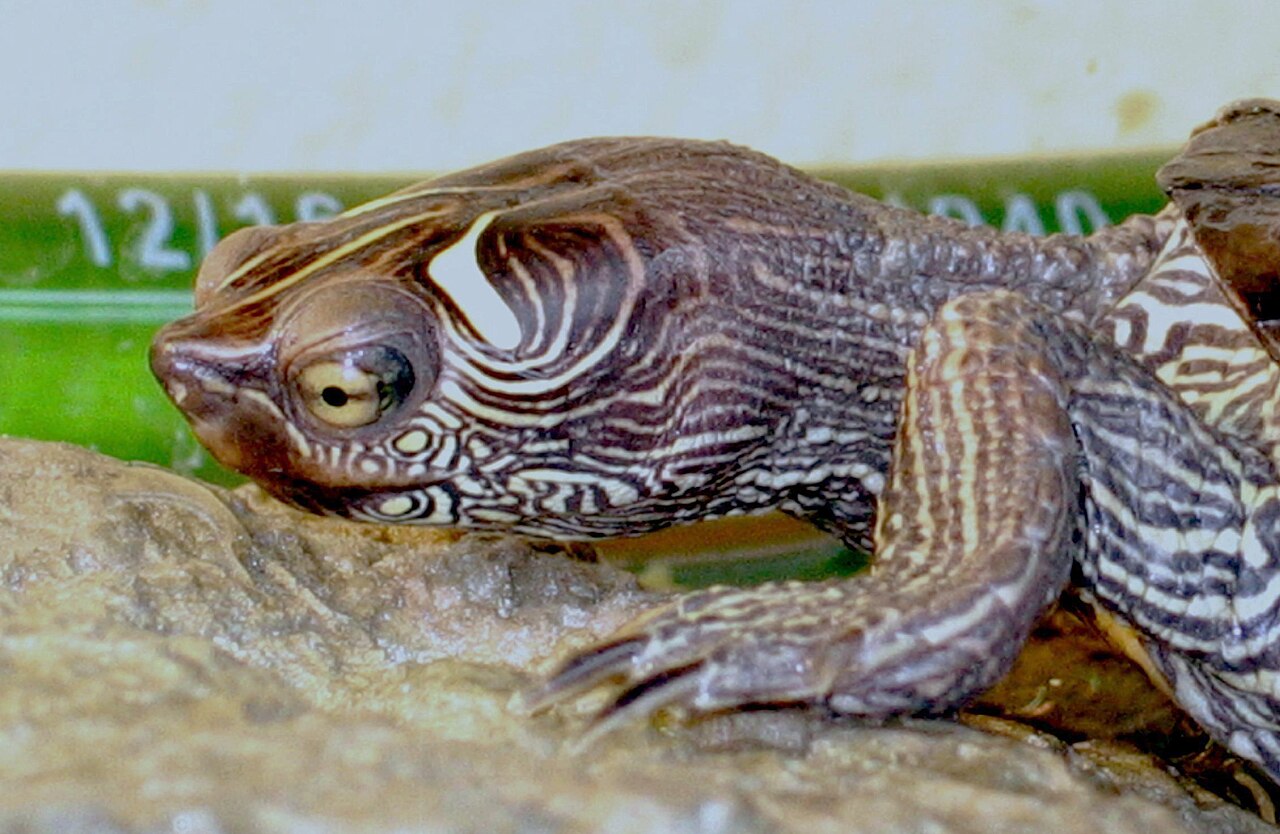
Start with the head. A broad yellow crescent sits behind the eye and curves upward, cutting off the fine neck stripes before they touch the eyeball. On a true Mississippi map turtle the eye itself has a white or pale iris crossed by a dark horizontal bar, which gives the animal a startled expression even when it is calm.
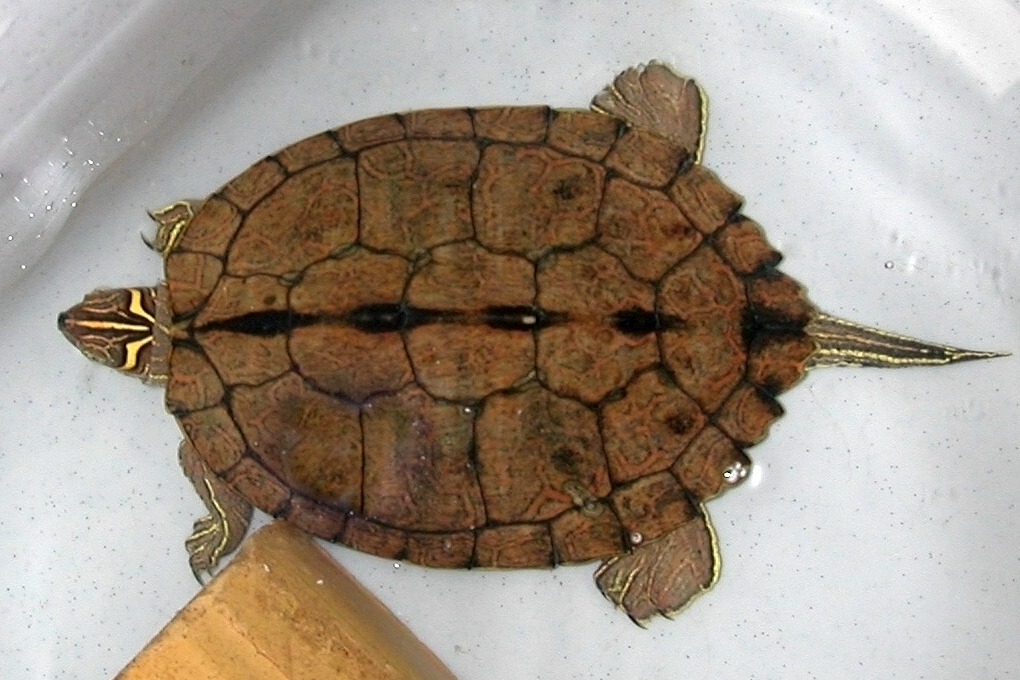
The shell is olive to brown with a network of thin yellow lines that look like contour lines on a map, the source of the common name. Those lines fade with age, and old females can look almost plain brown, so identification on an adult depends on the head marking rather than the shell.
Down the middle of the carapace runs a raised black keel with a serrated rear edge, which is why the whole genus is nicknamed sawbacks. The plastron is pale yellow with dark seam markings that are bold in juveniles and washed out in adults. For a broader look at the genus, see our overview of the map turtle.
How Can I Tell It From an Ouachita Map Turtle?
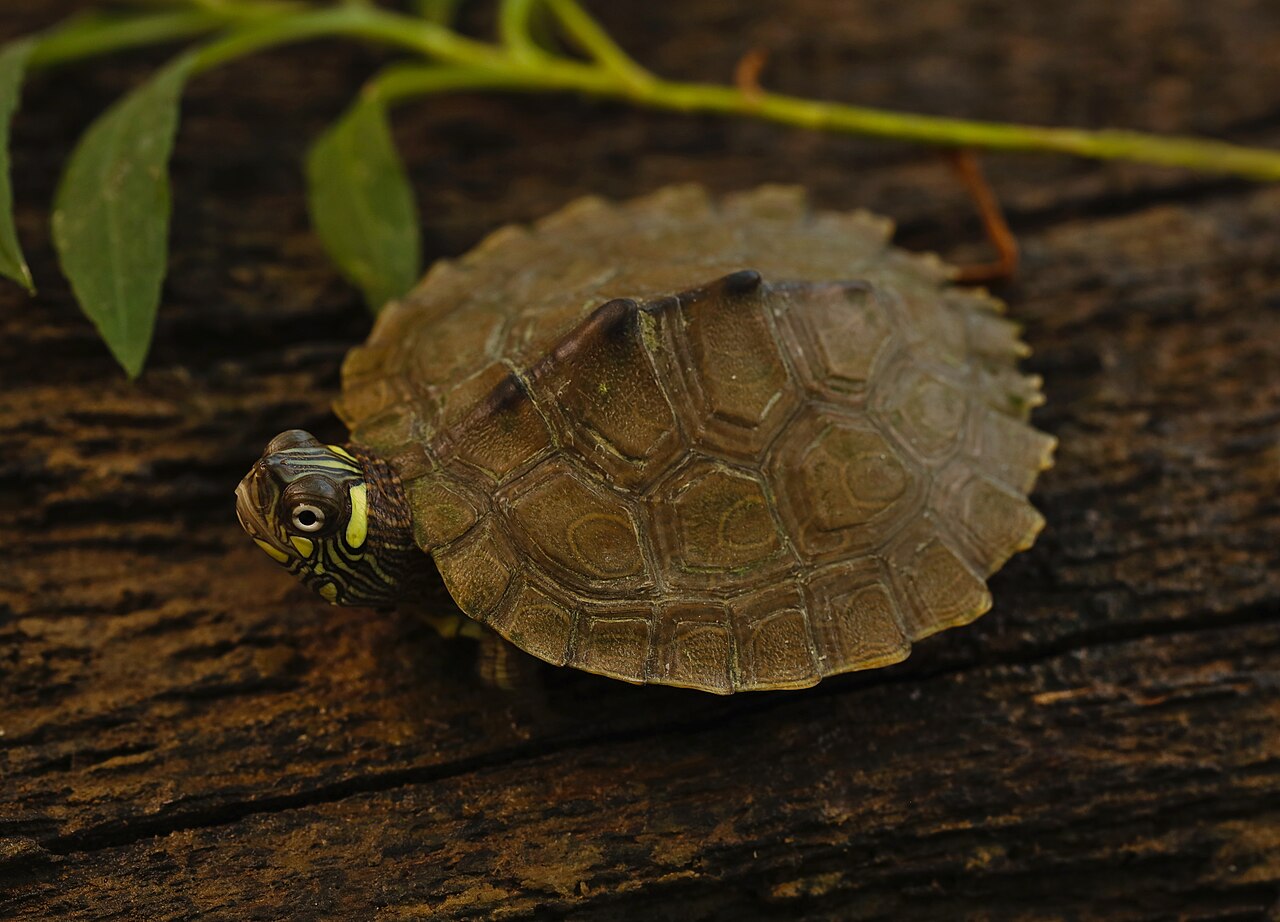
The Ouachita map turtle (Graptemys ouachitensis) shares the same rivers and is sold under the same label by careless dealers. Its postorbital mark is a large rectangular blotch rather than a crescent, and it carries one or two extra yellow spots low on the chin and under the eye. The Mississippi form has neither.
The false map turtle (G. pseudogeographica pseudogeographica), the nominate subspecies, shows a narrow L or backwards L shaped mark that does not wrap around the eye. Where ranges overlap, intergrades occur and some animals genuinely cannot be assigned with confidence. Honest sellers say so instead of guessing.
How Big Can a Mississippi Map Turtle Get?

Females reach 6 to 10 in (15 to 25 cm) of straight carapace length, with exceptional individuals near 11 in (28 cm). Males top out at 3.5 to 5 in (9 to 13 cm). This is one of the most extreme size differences in North American turtles, and it is the reason two hatchlings from the same clutch can need tanks a hundred gallons apart.
Hatchlings emerge at about 1.2 in (3 cm) and grow fast in the first three years given warm water and heavy feeding. Growth slows sharply after sexual maturity, which arrives at 2 to 4 years in males and 6 to 8 years in females.
Male or Female: Telling the Two Apart
Below 4 in (10 cm) of shell length there is no reliable way to sex a map turtle, and anyone selling a sexed hatchling is guessing. Wait for the secondary traits. Males develop greatly elongated front claws used in courtship display and a thick tail with the vent positioned beyond the shell margin.
Females keep short claws, a slim tail with the vent under the shell, and a much wider, deeper body. Because females alone become mollusc specialists with broad crushing jaw surfaces, their adult head looks noticeably heavier than a male’s of the same age.
Where Mississippi Map Turtles Live in the Wild
The range follows the Mississippi River system from Illinois, Iowa, and Nebraska south to the Gulf, west into eastern Texas and east into Alabama. They favor large rivers, oxbow lakes, backwater sloughs, and reservoirs with slow current, soft bottoms, and abundant deadfall for basking.
Numbers and distribution records for the genus are tracked by the USGS Nonindigenous Aquatic Species database, which also documents escaped pets outside the natural range. Unlike the eastern mud turtle, this species rarely leaves the water except to bask and to nest. Nesting females do need dry, open, sandy ground within reach of the water, much like the conditions described in our guide to box turtle habitat.
What Is the Average Life Expectancy of a Mississippi Map Turtle?
Expect 20 to 30 years in captivity, with well kept females reaching 35 and a handful of records passing 40. Wild animals average less because of predation on eggs and hatchlings, but adults have few natural enemies once the shell hardens.
The two things that shorten captive lifespan are chronically cool water and poor water quality. Both are quiet failures: the turtle keeps eating and looks normal for months while a respiratory or shell infection builds. Nothing about the species is short lived, so a purchase is a two decade commitment at minimum.
What Do Mississippi Map Turtles Eat?
Adult females are molluscivores. Their broad jaw surfaces crush snails and clams, and a wild female’s gut contents are mostly shellfish with some insect larvae and plant matter. Males and juveniles take aquatic insects, crayfish, small crustaceans, dead fish, and soft vegetation.
In captivity, build the diet on a quality aquatic turtle pellet, then add whole prey items with shells and exoskeletons intact: canned or live snails, freshwater clams, krill, earthworms, and crickets. That calcium and chitin is what keeps the shell hard and the jaw surfaces working correctly.
Offer leafy greens and aquatic plants free choice. Adults eat every other day, hatchlings and juveniles daily. Feed in the tank and expect a mess, or move the turtle to a separate feeding tub to spare the filter.
Is a Mississippi Map Turtle a Good Pet?
It is a good display animal and a poor interactive one. Map turtles are bright, active swimmers that use the whole water column and bask in plain sight, and watching a group settle onto a dock is the real reward of keeping them. They also panic easily and crash off the basking platform when someone walks past.
They are harder than a eastern painted turtle in one specific respect: they demand cleaner, better oxygenated water and are quicker to develop shell and skin infections when it slips. A keeper who enjoys aquarium maintenance will do well. A keeper who wants a turtle to handle should look at a terrestrial species instead.
Tank Size and Setup
Use 10 gallons of water volume per inch of shell as the working minimum. That means 75 gallons for an adult male and 125 gallons or a 100 gallon stock tank for a female. Water depth should be at least twice the shell length so the animal can swim properly, and deeper is better for this strong swimming species.
Filtration has to be oversized. A canister filter rated for double the tank volume, plus weekly partial water changes, is the standard that keeps shell rot away. Add driftwood, smooth rock piles, and tall plants near the surface. A sand or bare bottom both work, but avoid gravel small enough to swallow, and skip the deep sand bed that a Florida softshell turtle needs for burying.
The basking platform must be dry, stable, and easy to climb from the water. Floating docks work for males; females need something anchored that supports 3 lb (1.4 kg) without tipping. Cover the tank, because a frightened map turtle can climb surprisingly well.
Water Temperature, Basking, and Lighting
Hold the water at 75 to 80 F (24 to 27 C) with a submersible heater guarded against cracking. Set the basking surface to 88 to 92 F (31 to 33 C) with a low wattage spot lamp on a timer and a thermometer at shell height, not on the glass.
UVB is not optional. A linear T5 UVB tube across the basking area, replaced every 12 months whether or not it still glows, prevents metabolic bone disease and supports shell growth. Run a 12 hour light cycle and give the turtle a full night of darkness.
Can You Hold a Mississippi Map Turtle?
You can, briefly and for a reason, but this species does not tolerate handling well. Restraint triggers thrashing, scratching, and sometimes a bite, and repeated handling causes real stress that shows up as refused food and reduced basking. Pick the turtle up for health checks, transport, and tank cleaning only.
Support the body from below with both hands rather than gripping the shell edge, and hold it low over a table. Wash your hands afterwards. Aquatic turtles shed Salmonella in perfectly healthy animals, which is also why the enclosure should never be cleaned in a kitchen sink.
How Much Does a Mississippi Map Turtle Cost?
Captive bred hatchlings sell for 30 to 80 USD, and sexed subadults reach 100 to 150 USD. The animal is the cheapest part of the project. The tank, canister filter, heater, UVB fixture, and basking setup add 400 to 900 USD, and a 125 gallon build for a female costs more than that.
Running costs are modest: pellets, frozen snails, bulb replacements, and electricity for the heater. Budget 200 to 300 USD a year, plus a reptile vet who will actually see a turtle. Confirm state rules before buying, since several states within the range regulate collection and possession of Graptemys species.
Common Health Problems
Shell rot is the most common complaint and nearly always traces to water quality or a basking site that never dries the shell fully. Look for soft, pitted, or foul smelling patches on the carapace or plastron and treat early with dry docking and a vet prescribed topical.
Respiratory infection follows cool water and shows as a listing swim, open mouth breathing, and bubbles from the nostrils. Swollen eyelids point to a vitamin A shortage from an all pellet diet. None of these resolve on their own, and an animal that stops basking has been sick for a while already. Species that hibernate in the wild still need consistent warmth indoors, and a captive map turtle should never be cooled deliberately without veterinary guidance.
Frequently Asked Questions
Should I get 1 or 2 turtles?
One is simpler and perfectly content. Map turtles are not social and gain nothing from company, while two animals double the waste load and invite bullying at the basking site. If you want a group, keep several females or a single male with females in a large tank with multiple basking spots, and never house two adult males together.
What is the friendliest turtle?
Among aquatic species, red eared sliders and painted turtles are the boldest and quickest to beg at the glass. Map turtles are noticeably shier. Among land species, box turtles and Russian tortoises tolerate people best. No turtle is friendly in the way a mammal is; what looks like friendliness is a learned food response.
Do turtles get attached to owners?
They learn to recognize the person who feeds them and will swim to the front of the tank on sight, which is conditioning rather than attachment. Map turtles clearly distinguish a familiar keeper from a stranger, since strangers make them dive. That is the practical limit of the relationship.
Can a turtle be left alone for a week?
A healthy adult can skip a week of food without harm, but the equipment cannot be left unsupervised that long. A heater failure, a stuck filter, or a fallen basking lamp turns into an emergency within a day. Put lights on timers and have someone check the tank midweek.
Do Mississippi map turtles hibernate?
Wild animals brumate through winter on river bottoms, sometimes under ice, absorbing oxygen through the skin and cloaca. Captive turtles should not be cooled deliberately. Keep the water at 75 to 80 F (24 to 27 C) year round and the turtle stays active, eats normally, and avoids the health risks that badly managed brumation carries.
Why is my Mississippi map turtle not basking?
Check the basking temperature first, then the exit from the water. A platform that is too cool, too wobbly, or too hard to climb gets ignored, and so does a lamp positioned where the turtle feels exposed. A new arrival may skip basking for a week out of stress. Beyond that, a turtle that never dries off is usually ill.