Blue Salamander: 6 US Species and How to Identify Them
A blue salamander in the United States is almost always a blue-spotted salamander (Ambystoma laterale), a glossy black mole salamander dusted with pale blue flecks on its sides, limbs and tail. A salamander that is blue all over does not exist in the wild here, so the blue is a pattern on dark skin rather than a body color.
Six native species carry enough blue to send people searching, and two of them hybridize freely enough that biologists need chromosome counts to separate them.
Blue salamanders in the US are black or slate colored species marked with blue flecks, most often the blue-spotted salamander (Ambystoma laterale) of the Great Lakes and Northeast. They are not venomous and do not bite, but their skin secretes a mild toxin, so handling them is bad for you and worse for them.
Which Salamanders Are Actually Blue?
Blue in animals is usually structural rather than pigment, which is why blue birds and a blue butterfly look brighter than any amphibian.
Blue-spotted salamander (Ambystoma laterale). Jet black, 3 to 5.5 in (8 to 14 cm), with sky blue flecks densest on the flanks and tail. Michigan and Wisconsin east to New England. This is the species behind almost every US blue salamander photo. For a closely related question, see our guide to blue snake identification.
Jefferson salamander (Ambystoma jeffersonianum). Larger and grayer, 4.3 to 8.3 in (11 to 21 cm), with sparse bluish flecking that fades with age and sits mostly on the legs. Ohio Valley through the central Appalachians.
Unisexual hybrids. In the overlap zone, all female populations carry genomes of both parents and look intermediate: medium gray, moderate speckling. Field identification is often impossible.
Lead-backed red-backed salamander (Plethodon cinereus). The gray color phase of this slim woodland species has a bluish cast and fine pale flecks, 2.2 to 5 in (6 to 13 cm). The one found under logs and flowerpots.
Wehrle’s salamander (Plethodon wehrlei). Dark slate with bluish white spots along the sides, 4 to 6.3 in (10 to 16 cm). Appalachian plateau from western New York to Virginia, near rock outcrops and cave mouths.
Northern slimy salamander (Plethodon glutinosus). Black with silver flecks that read as blue in shade. Widespread in the East, and its sticky skin mucus is the practical reason not to pick one up.
Are Blue Salamanders Poisonous, and Why Can’t You Touch One?
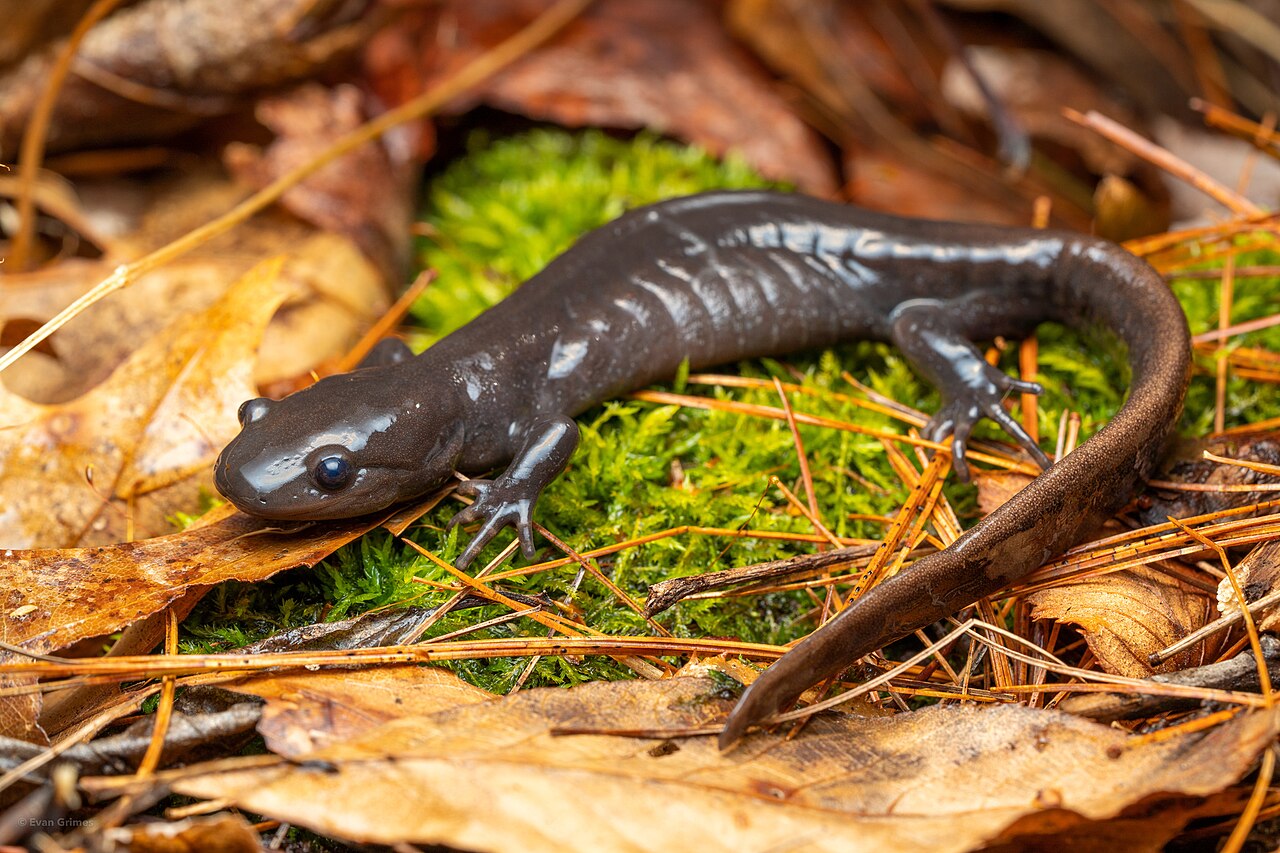
No blue salamander in the US is venomous, and none bites hard enough to break skin. They are mildly poisonous rather than venomous: skin glands release an irritant that tastes foul to a predator and can sting your eyes or an open cut afterward.
The bigger risk runs the other way. Amphibian skin absorbs whatever is on your hands, and a dry palm strips the protective mucus. To move one off a road, use a wet leaf, keep it brief, then wash up.
Blue-Spotted vs Jefferson Salamander: Telling the Lookalikes Apart
| Feature | Blue-spotted | Jefferson |
|---|---|---|
| Ground color | Jet black | Brownish gray |
| Blue markings | Heavy, bright, flanks and tail | Sparse, pale, mostly legs |
| Adult length | 3 to 5.5 in (8 to 14 cm) | 4.3 to 8.3 in (11 to 21 cm) |
| Snout and limbs | Short snout, stocky legs | Long snout, long toes |
| Core range | Great Lakes, Northeast | Ohio Valley, Appalachians |
| Breeding | Early spring vernal pools | Earliest breeder, often under ice |
Where They Live, What They Eat and How Rare They Are
Blue-spotted salamanders spend most of the year underground in mammal burrows in moist deciduous forest, then migrate to fishless vernal pools on the first warm rains of late winter. A blue-spotted salamander eats earthworms, slugs, snails, spiders, centipedes and insect larvae, hunted at night on the forest floor.
They are locally common but easy to miss, and state listings reflect lost breeding pools rather than global scarcity. Blue is far more common in insects, which is why a blue wasp, a blue fly or a blue carpenter bee gets reported as something rare every season. County records are kept by the US Fish and Wildlife Service.
Related reading: Pink Salamander.
Related reading: White Salamander.
Frequently Asked Questions
What kind of salamander is black with blue spots found in Michigan?
That is the blue-spotted salamander (Ambystoma laterale), which occurs in both Michigan peninsulas. Adults run 3 to 5.5 in (8 to 14 cm), jet black, heavily flecked with blue. In the southern counties some animals are unisexual hybrids with the Jefferson salamander.
Are blue salamanders rare?
They are hard to see rather than genuinely rare. Blue-spotted salamanders are common in forest with vernal pools, but they stay underground most of the year and surface mainly on rainy nights in early spring. Several states list them as a species of concern because their pools are easily drained.
What color salamanders are poisonous?
Color is no reliable guide, because every salamander has toxic skin secretions to some degree. Bright yellow, orange or red markings, as on the eastern newt, are the classic warning colors of the more potent species. No US blue species is dangerous to handle briefly.
Do salamanders have teeth?
Yes. Salamanders have rows of small, backward curving teeth on both jaws and on the roof of the mouth, used to grip prey rather than chew. They are far too fine to hurt a human hand, so a bite from a blue-spotted salamander feels like a pinch at most.