Bison Poop: Size, Shape and How to Tell It From a Cow Pat
Bison poop looks like a wide, flat, dark brown patty, usually 10 to 12 inches (25 to 30 cm) across and 1 to 2 inches (3 to 5 cm) thick, with a wet splattered surface that dries into a pale crusted disc. On green summer grass it is soupy and almost smooth. On dry winter forage the same animal drops a coarser, fibrous mound that holds its shape.
That size is the fastest clue in the field. No native North American animal except the American bison (Bison bison) leaves a plate sized pie of finely ground grass in open grassland, and the only serious look alike is a domestic cow. Everything below is about telling those two apart, reading how fresh the pile is, and knowing what is safe to touch.
Bison poop is a flat circular patty 10 to 12 inches (25 to 30 cm) wide, dark brown to olive black when fresh, drying to grey. It is made of finely chewed grass fiber with no hair, bone or fruit seeds. Expect it on trails, wallows and meadows in herds of piles, because a bison defecates 10 or more times a day.
| Feature | Bison scat |
|---|---|
| Diameter | 10 to 12 in (25 to 30 cm), up to 15 in (38 cm) on lush forage |
| Thickness | 1 to 2 in (3 to 5 cm) as a patty, 4 to 6 in (10 to 15 cm) as a dry mound |
| Shape | Flat disc with a splattered rim in summer, stacked fibrous clumps in winter |
| Color | Dark brown to olive black fresh, tan to grey white after a week in sun |
| Contents | Finely ground grass and sedge fiber, no fur, bone, insect parts or seeds |
| Odor | Mild and grassy, far weaker than carnivore or omnivore scat |
| Where | Grasslands, meadows, river bottoms, wallows, trails and park roads |
What does bison poop look like in pictures?
In photographs bison poop reads as a dark circle on grass with a raised center and a thin spattered edge, the shape people call a meadow muffin. The surface is glossy for the first few hours, then develops a dull skin while the inside stays wet. Within a few days the disc lifts at the rim and cracks across the middle.
Dry season scat photographs completely differently. Instead of a disc you see a loose heap of pressed green or brown fiber, sometimes in two or three overlapping lobes, each lobe the width of a fist. Both forms come from the same animal in the same month, so judge by width and fiber texture, not by the outline alone.
How big is a bison patty?

A single bison patty spans 10 to 12 inches (25 to 30 cm) in most herds and reaches 15 inches (38 cm) where forage is rich and wet. Mass runs from 2 to 5 pounds (1 to 2.3 kg) per drop. A bull weighing 2,000 pounds (900 kg) processes roughly 30 pounds (14 kg) of dry forage a day, and what comes out reflects that volume.
Size alone will not separate bison from cattle, but it rules out nearly everything else. If your find is smaller than a coffee cup saucer, you are looking at a different animal, and the pellet shaped scats in our deer and rabbit pellet comparison are a better starting point. For anything the size of a grain of rice, start instead with our lizard and mouse droppings comparison.
What is inside bison scat?
Break a dried patty with a stick and you see only plant fiber: short, uniform strands of grass and sedge, ground to a few millimeters by molars and a four chambered stomach. There are no berry seeds, no insect wings, no hair and no bone chips. That absence is diagnostic, because bear and coyote scat in the same meadow almost always shows one of those.
Winter scat holds longer, paler fibers because the animal is eating stems and standing dead grass. Spring scat is nearly homogeneous paste. If you find a patty sized dropping that contains fur or fruit pulp, you have a bear, not a bison, and the contents matter more than the width.
How does a bison’s digestive system work?
Bison are ruminants. Forage goes to the rumen, where microbes ferment cellulose, then returns to the mouth as cud for a second chewing before passing through the reticulum, omasum and abomasum. That loop is why the fiber in the scat is so fine and why a bison can live on grass that would starve a horse.
The system also explains the two scat forms. Green, high moisture forage ferments fast and leaves the animal as a wet patty. Dry winter grass moves slower, loses more water in the gut, and comes out as the stacked fibrous mound. Diet, not season, is the real variable.
Where to look for bison scat
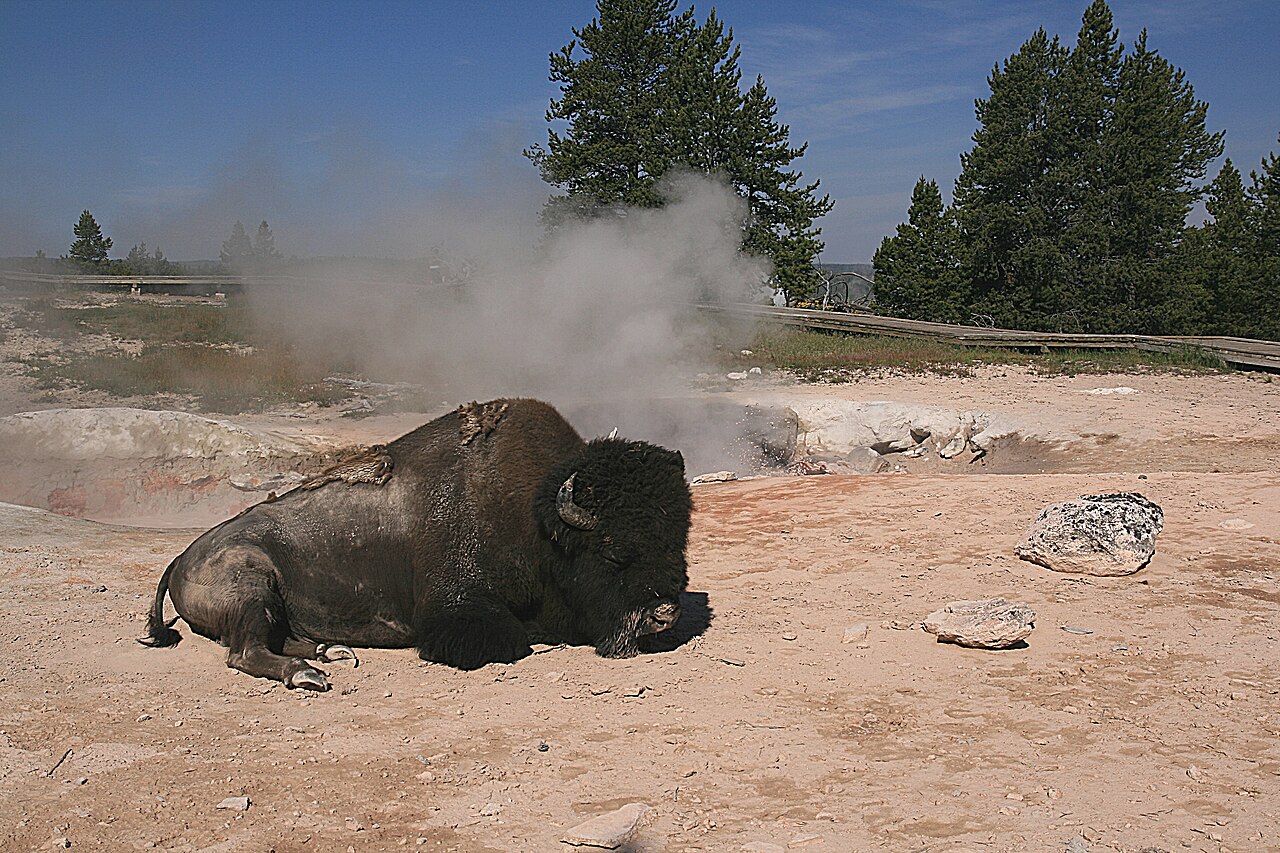
Bison defecate while they walk and graze, so scat concentrates where the herd spends time: short grass meadows, river terraces, dust wallows, and the compacted trails between them. In Yellowstone National Park that includes roadsides and boardwalk margins, which is why visitors meet it before they meet the animal.
Piles cluster. A grazing herd leaves dozens of patties in a few acres, often in a loose arc that marks the direction of travel. A single isolated patty far from grassland is more likely cattle that broke a fence. Check the ground for the broad, rounded, 5 inch (13 cm) hoof prints that come with it.
Bison poop vs cow poop
This is the hard one, because both are grass fed ruminant patties of nearly the same size and color. Cow pats average slightly smaller at 8 to 10 inches (20 to 25 cm) and tend to be wetter and more uniformly soupy on managed pasture. Bison scat more often shows the fibrous, layered structure that comes from coarse native forage.
Context decides it in practice. Fences, water troughs, salt licks and a single track network point to cattle. Wallows, rub trees with shed hair, and patties scattered across unfenced public grassland point to bison. Where ranches border a park, treat identification as uncertain and say so.
Bison poop vs moose poop
Moose (Alces alces) drop oval pellets about 1 to 1.5 inches (2.5 to 4 cm) long in winter, hundreds at a time, and a loose patty on summer browse. Even that summer patty rarely passes 6 inches (15 cm) across and contains woody twig fragments rather than grass fiber.
So the split is habitat plus content. Moose scat sits in willow bottoms and conifer edges and shows chewed bark and twig ends. Bison scat sits in open grass and shows nothing but grass. Pellet piles the size of grapes are never bison at any season.
Bison poop vs elk poop
Elk (Cervus canadensis) leave pellets 0.5 to 0.75 inches (1.3 to 2 cm) long, often dimpled on one end, and in spring a soft cow pie form that confuses people. That spring elk patty tops out near 6 inches (15 cm) and is thinner, with a smoother surface and no layered fiber.
Elk and bison share meadows in Yellowstone and the Black Hills, so you will find both within a few steps. Measure. Anything under 8 inches (20 cm) across in that company is elk. The size gap between a pellet pile and a bison patty is wide enough that no ruler argument is needed.
How fresh is that patty?
Fresh scat under two hours old is glossy, steams on cold mornings, and draws flies immediately. By day one the surface has a matte skin while the center stays liquid. By day three the rim curls and the color shifts toward tan. After a week the disc is a light grey crust you can lift in one piece.
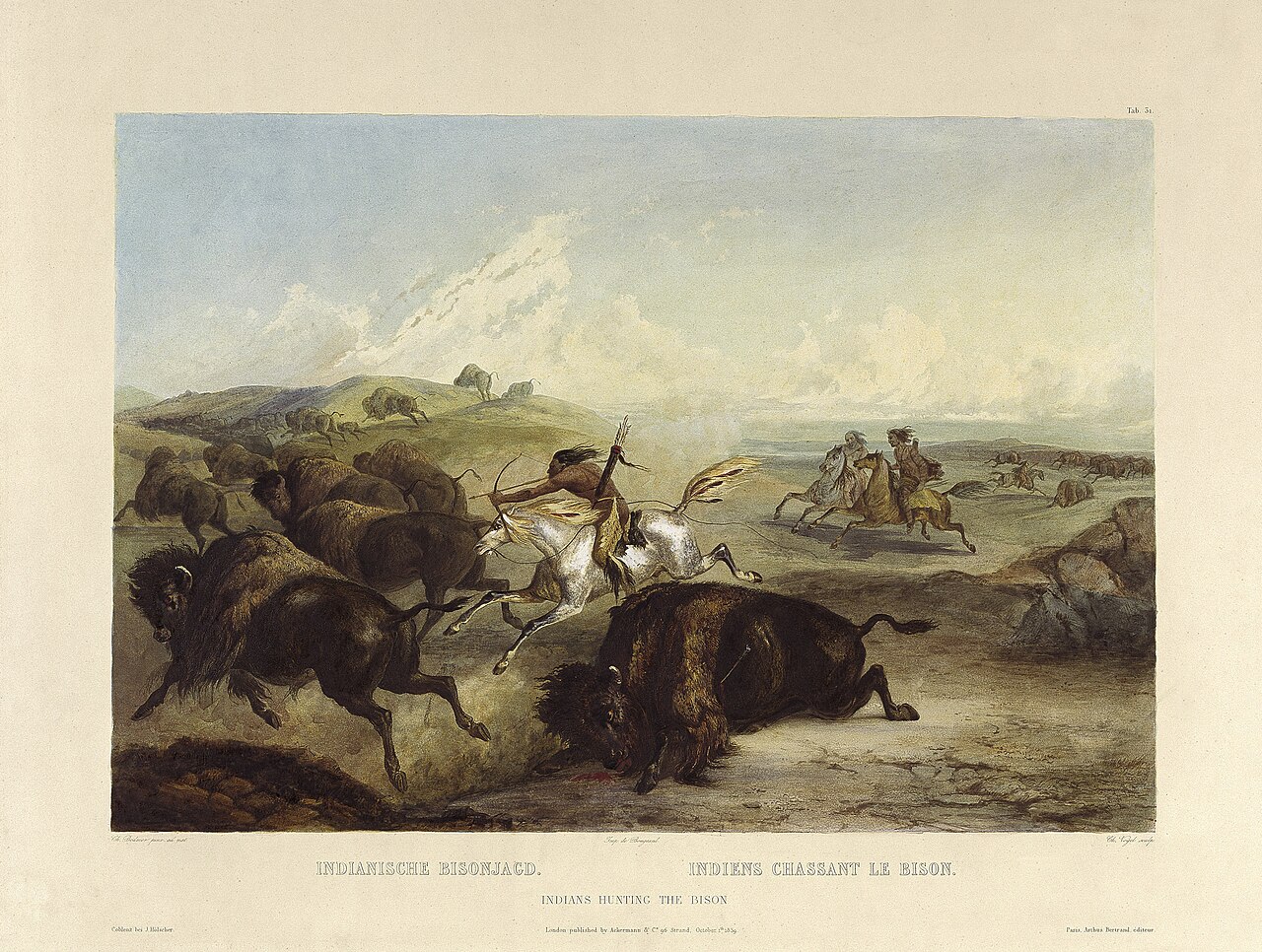
Dried patties survive months in dry grassland and were burned as fuel by plains travelers under the name buffalo chips. A field full of grey discs tells you a herd passed through weeks ago. A field with dark, fly covered piles means the animals are close, and that is a safety fact, not trivia.
Is bison poop dangerous to touch?
Treat it as you would any livestock manure. Ruminant feces can carry Escherichia coli O157:H7, Salmonella, Cryptosporidium and Giardia, all of which pass to people by hand to mouth contact rather than through the air. The practical risk is low and the precaution is cheap: do not handle it bare handed, keep it away from drinking water, and wash before eating. Public health guidance on animal feces is maintained by the Centers for Disease Control and Prevention.
If you must move or sample scat, use disposable gloves and a bagged tool, and keep dogs out of it. Rodent droppings deserve more caution than bison patties because of hantavirus, and the identification steps in our rat and mouse droppings guide, our bat and mouse droppings comparison and our squirrel and rat droppings comparison matter before you sweep anything indoors.
What bison dung does for the grassland
Each patty is a nutrient patch. Dung beetles, flies and their larvae colonize it within hours, birds work the pile for those insects, and the nitrogen and phosphorus released feed a green spot of grass that stays visible for a season. Researchers studying restored prairie treat dung density as a measure of ecosystem function, not waste.
The claim that bison poop helps pollinate Yellowstone is a shortcut for this chain. Dung and grazing create fertile, open patches where wildflowers establish, and those flowers feed native bees and butterflies. The dung does not pollinate anything itself. For a scat that genuinely signals a different ecological role, compare the dense, bone flecked droppings in our alligator scat guide.
Frequently Asked Questions
Are bison grazing animals?
Yes. Bison are obligate grazers, with grasses and sedges making up roughly 90 percent of the diet. They crop forage close to the ground and move constantly, which is why their scat is almost pure grass fiber and why herds leave broad trails and dust wallows across the range they use.
Do bison only have bottom teeth?
Bison have no upper front teeth. In place of upper incisors they have a hard dental pad, and they tear grass by pressing it between that pad and the lower incisors. Molars sit in both jaws, top and bottom, and those grinders are what reduce forage to the fine fiber you see in the scat.
What is a bison’s favorite food?
Native warm season grasses such as big bluestem, blue grama and wheatgrass, plus sedges in wet meadows. Bison take far fewer forbs and almost no woody browse compared with elk or deer. That narrow diet keeps scat consistent in texture, which is what makes it identifiable at a glance.
What is the main predator of bison?
Gray wolves (Canis lupus) are the main natural predator of adult bison where both still occur, hunting in packs and targeting calves, old animals and the sick. Grizzly bears take calves and scavenge carcasses. Healthy adult bulls have few enemies, and humans remain the largest source of mortality overall.
Which US state has the most bison?
South Dakota holds the largest bison population in the United States, counting commercial herds along with public ones such as Custer State Park. Montana, Nebraska and Wyoming follow, and Wyoming carries the best known wild herd in Yellowstone. Most American bison today live on private ranches, not in parks.
Why don’t we eat bison instead of cows?
Mostly logistics and scale. Bison mature slower, resist confinement, need stronger fencing, and exist in far smaller numbers, so the meat stays a premium product rather than a commodity. The fact that their manure is nearly indistinguishable from a cow pat is a reminder that the difference is management, not digestion.