Chickadee Tracks: How to Identify Them in Snow, Mud and Sand
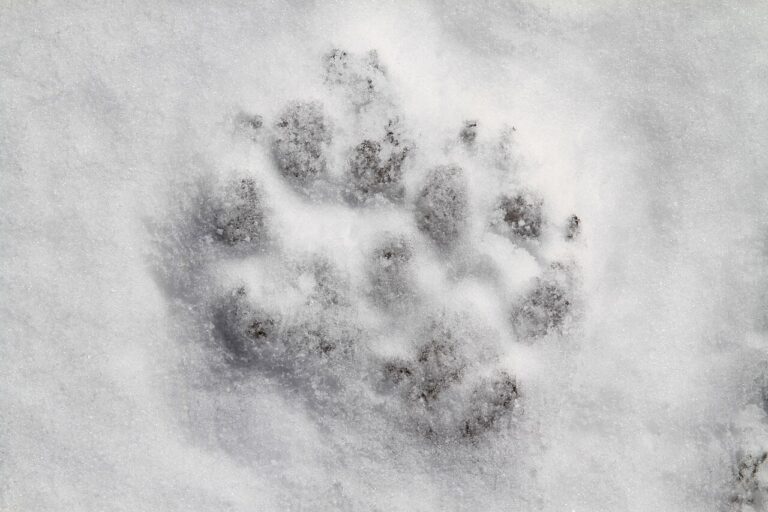
Chickadee tracks in snow are tiny paired prints, each one about 1 to 1.4 in (2.5 to 3.5 cm) long, with three slim toes pointing forward and one pointing straight back. They almost always come in side by side pairs, because a chickadee hops rather than walks, and the trail usually ends in a pair of faint wing sweeps where the bird lifted off.
Finding them is mostly a matter of looking in the right place. Chickadees spend their day between cover and food, so the best surfaces are fresh powder under a feeder, wet mud at the edge of a puddle, and fine dust or sand along a woodland road. Each surface records a different amount of detail, and snow records the most.
A chickadee track is roughly 1 to 1.4 in (2.5 to 3.5 cm) long and 0.5 to 0.75 in (1.3 to 1.9 cm) wide, with three forward toes and one rear toe. Prints appear in side by side pairs spaced 1 to 4 in (2.5 to 10 cm) apart from the hopping gait.
What Chickadee Tracks Look Like
The shape is called anisodactyl, the standard songbird foot: three toes forward in a shallow fan, one hallux trailing behind. The middle front toe is the longest, and the outer two angle away at roughly 40 degrees each. Toe impressions are thin lines rather than pads, because the foot carries almost no weight.
A black-capped chickadee (Poecile atricapillus) weighs about 0.4 oz (11 g), so the track is faint and shallow. Claw marks register as small dots at the end of each toe in mud and wet snow. In dry powder you often get only the forward toes, with the hallux lost entirely.
| Feature | Measurement |
|---|---|
| Track length with hallux | 1 to 1.4 in (2.5 to 3.5 cm) |
| Track width | 0.5 to 0.75 in (1.3 to 1.9 cm) |
| Toes | 3 forward, 1 back |
| Gait | Hop, prints paired side by side |
| Distance between pairs | 1 to 4 in (2.5 to 10 cm) |
| Trail length | Usually under 3 ft (90 cm) |
| Extra marks | Wing sweeps, seed hull debris |
How Big Are Chickadee Tracks?

Expect a track about the length of a thumbnail and a half. Measure from the tip of the hallux to the tip of the middle front toe, not from heel to toe as you would with a mammal, since the bird’s visible “heel” is actually the base of the toes.
Size alone will not finish the job, because many small songbirds overlap. A house sparrow, junco, or titmouse track falls within 0.2 in (0.5 cm) of a chickadee’s. That is why the gait and the context matter more than the ruler here, and why a single clean print is weaker evidence than a short trail.
Reading the Hop: Gait and Stride

Chickadees hop, which means both feet land together and leave a matched pair of prints at the same level. The pattern looks like a row of tiny double stamps marching across the surface. Distance between pairs ranges from 1 to 4 in (2.5 to 10 cm), tightening when the bird is feeding and stretching when it is moving with purpose.
Birds that walk, including crows, starlings, and pigeons, leave alternating left and right prints in a line. If you see alternating prints, you can rule out a chickadee immediately. The ground feeding chicken track pattern shows that walking stride clearly at a larger scale.
Chickadee Tracks in Snow

Snow is the best surface, and winter is the best season, since chickadees come to the ground far more often when food is short. Look for them 2 to 6 ft (0.6 to 1.8 m) out from a feeder, under shrubs, and around the base of conifers where hulls and dropped seed collect.
The ideal snow is about 0.5 in (1.3 cm) of fresh, slightly damp powder over a firm crust. Deep, dry powder swallows the bird and leaves only a crater. In old crusted snow you may see no toe detail, only the paired dimples, which still identify the hop and the size class.
Chickadee Tracks in Mud
Mud at the edge of a puddle, pond, or birdbath records more detail than any other surface, including individual claw points and the narrow ridge of skin along each toe. Chickadees come to mud to drink and bathe, usually at midmorning, and they leave short trails of two to six pairs before flying up.
Fine silt holds the sharpest print. Coarse, sticky clay distorts the toes and tends to overstate the track width. If a muddy print looks unusually fat, check the trail for consistency before deciding on a larger bird, because one smeared print will mislead you.
Chickadee Tracks in Sand and Dust
Dry sand and road dust give the weakest records. The toes collapse inward and you may get little more than three short dashes and a scuff. Early morning, when dew has firmed the surface, produces far better prints than midday, and so does the damp sand right at a shoreline.
Dust bathing complicates things. Chickadees occasionally flutter in dry dust to dislodge parasites, and the result is a messy bowl with wing marks and overlapping prints rather than a readable trail. That pattern is still useful: it tells you small birds are using the spot regularly.
Chickadee Tracks vs Junco and Sparrow Tracks
Dark-eyed juncos and house sparrows are the two most common mix ups at feeders, and both are heavier birds that leave deeper, slightly longer prints, often 1.3 to 1.8 in (3.3 to 4.6 cm). Juncos also hop, so the paired pattern matches; the difference is depth and a stockier toe impression.
Volume helps. Juncos and sparrows feed on the ground for long stretches and leave sprawling networks of prints across an entire feeder apron. A chickadee grabs one seed and flies to cover to open it, so its trail is short and ends in wing marks. Long, wandering trails are rarely chickadee.
Chickadee Tracks vs Nuthatch and Titmouse Tracks
White-breasted nuthatch tracks are close to identical in size but show a noticeably longer, stronger hallux, since the bird uses that toe to hang head down on bark. Nuthatches also visit the ground less often, so finding their tracks in open snow is uncommon.
Tufted titmouse tracks run slightly larger than chickadee tracks and tend to sit a little farther apart, 2 to 5 in (5 to 13 cm) between pairs. In practice, these three species share the same feeder and the same snow, and separating them from prints alone is guesswork. Watch which bird lands where, then check the prints. Our guide to what chickadees eat explains why the chickadee leaves so quickly.
Bird Tracks vs Mouse and Vole Tracks
Mice also bound and leave paired prints in snow, which fools people constantly. The giveaways are toe count and the tail: mice show four toes on the front feet and five on the hind, usually with a thin drag line running between the sets. Birds never leave a tail drag.
Voles tunnel instead of hopping and leave pressed runways under the snow rather than clean prints. Larger mammals rule themselves out on size, as the comparisons in rabbit tracks, deer tracks, and coyote tracks show. If paired prints have a center line behind them, think rodent, not songbird.
What Do Chickadees Do in the Winter?
Chickadees stay put all winter rather than migrating, which is exactly why their tracks are a cold weather find. They cache thousands of seeds in autumn, remember the locations for weeks, and grow extra brain tissue in the hippocampus seasonally to manage that memory, as researchers at the Cornell Lab of Ornithology have documented.
At night they roost alone in tree cavities or dense conifers and drop into regulated hypothermia, lowering body temperature by about 18 degrees F (10 degrees C) to save fuel. By dawn they need food urgently, which is when ground foraging, and therefore track making, peaks.
Where to Look for Chickadee Tracks
Start under a feeder the morning after a light snow, then check the drip line of evergreens, the lee side of brush piles, and any spot where you scatter seed. Chickadees move through the yard in loose winter flocks with nuthatches and titmice, so one good surface often records several species at once.
Scatter a thin handful of sunflower seed on fresh snow in the open and check it an hour later. You will get clean prints, hull debris, and the wing sweeps of departure in the same frame. Mammal visitors show up on the same patch, which makes it a useful place to compare against possum tracks and other yard regulars.
Frequently Asked Questions
What do rabbit paw prints look like?
Cottontail prints form a tall triangle: two large hind feet landing ahead of two smaller front feet set one behind the other. Hind tracks run 3 to 4 in (7.6 to 10 cm) long in snow. No toe pads show clearly, since the soles are furred, and the trail bounds rather than hops.
Can I see a picture of a chickadee?
Yes. A black-capped chickadee has a black cap and bib, bright white cheeks, gray back and wings, and buff sides, about 5 in (13 cm) long. The photos on this page show the bird itself, which helps when you want to match the track maker to the animal at the feeder.
Where do birds hide during snow?
Small birds shelter in tree cavities, dense conifer branches, brush piles, roost boxes, and even snow pockets at the base of shrubs. Chickadees prefer cavities and will use old woodpecker holes. They pick spots on the lee side of wind and often return to the same roost every night.
Why put a potato in your bird feeder?
This is a social media myth with no benefit. Raw potato is low in usable energy for birds, green skin and sprouts contain solanine, and a wet tuber in a feeder grows mold fast. Sunflower seed, suet, and peanut pieces serve winter chickadees far better.
How long do chickadee tracks last in snow?
Usually a few hours. Shallow bird prints fill with blowing snow, soften in sun, and vanish entirely in a thaw. Tracks laid in the first hour after snowfall stop and read best at dawn. In a sheltered spot under conifers they can survive a full day.
Do chickadees spend much time on the ground?
Not much. They feed mainly in branches and on bark, dropping down briefly for spilled seed, grit, or water. That habit is why chickadee trails are short, scattered, and frequently end in wing marks rather than running for several feet like a junco trail does.