Elk Tracks: How to Identify Them in Snow, Mud and Sand
An elk track is a two toed, teardrop shaped print 3.5 to 4.5 in long (9 to 11.5 cm), roughly twice the area of a deer track and noticeably more rounded at the tip. Reading elk tracks comes down to three things: size, the blunt shape of the toe tips, and whether the dewclaws left a mark behind the main print.
Snow is the best classroom, because it records the dewclaws, the drag marks and the direction of travel that bare ground hides. Mud preserves the cleanest outline. Sand and dust distort size and blur the edges, which is where most misidentifications happen. Each surface gets its own section below, along with the three animals whose prints get confused with elk most often.
Elk tracks are cloven prints 3.5 to 4.5 in long (9 to 11.5 cm) and 3 to 3.5 in wide (7.5 to 9 cm), with two blunt rounded toes that curve inward and a gap down the center. Two dewclaw marks appear behind the print in snow or soft mud. Bulls leave larger, more splayed tracks than cows.
What Elk Tracks Look Like
An elk (Cervus canadensis) walks on two toes, so every print is a matched pair of crescents separated by a narrow channel. The front edge of each toe is rounded and slightly squared off rather than sharply pointed, which is the most reliable way to separate elk from deer. The outer walls of the hoof press deeper than the center, so in firm ground you often get two crescent rims and almost nothing between them.
Front hooves are larger and wider than hind hooves, because they carry more weight and splay further under load, and in a walking trail the hind foot lands in or just ahead of the front print on the same side. Behind the toes sit the dewclaws, two vestigial toes that register only when the elk sinks in, appearing as short oval punches 1 to 2 in (2.5 to 5 cm) behind the hoof. Dewclaw marks are a strong elk signal, since deer rarely leave them outside deep snow.
Elk Track Size, Stride and Gait

The spacing between prints tells you the gait. A calm elk walks an almost straight line; a spooked elk trots and then lopes, and the prints spread into groups with long gaps. Straddle, the width of the whole trail, runs 10 to 16 in (25 to 40 cm) at a walk, wider than any deer trail.
| Gait | Step length between prints | Pattern on the ground | What it means |
|---|---|---|---|
| Slow walk, feeding | 18 to 26 in (45 to 66 cm) | Wandering line, prints at varying angles | Browsing, unhurried, near forage |
| Steady walk | 26 to 36 in (66 to 90 cm) | Straight line, hind print over front | Traveling between bedding and feed |
| Trot | 40 to 60 in (100 to 150 cm) | Evenly spaced, deeper toe impressions | Alerted but not panicked |
| Lope or gallop | Groups 6 to 12 ft apart (1.8 to 3.7 m) | Clusters of four prints, dirt thrown back | Fleeing, often with dewclaws showing |
| Herd movement | Not measurable | Churned trail, prints overlapping | Several animals, counting is unreliable |
Elk Tracks in Snow
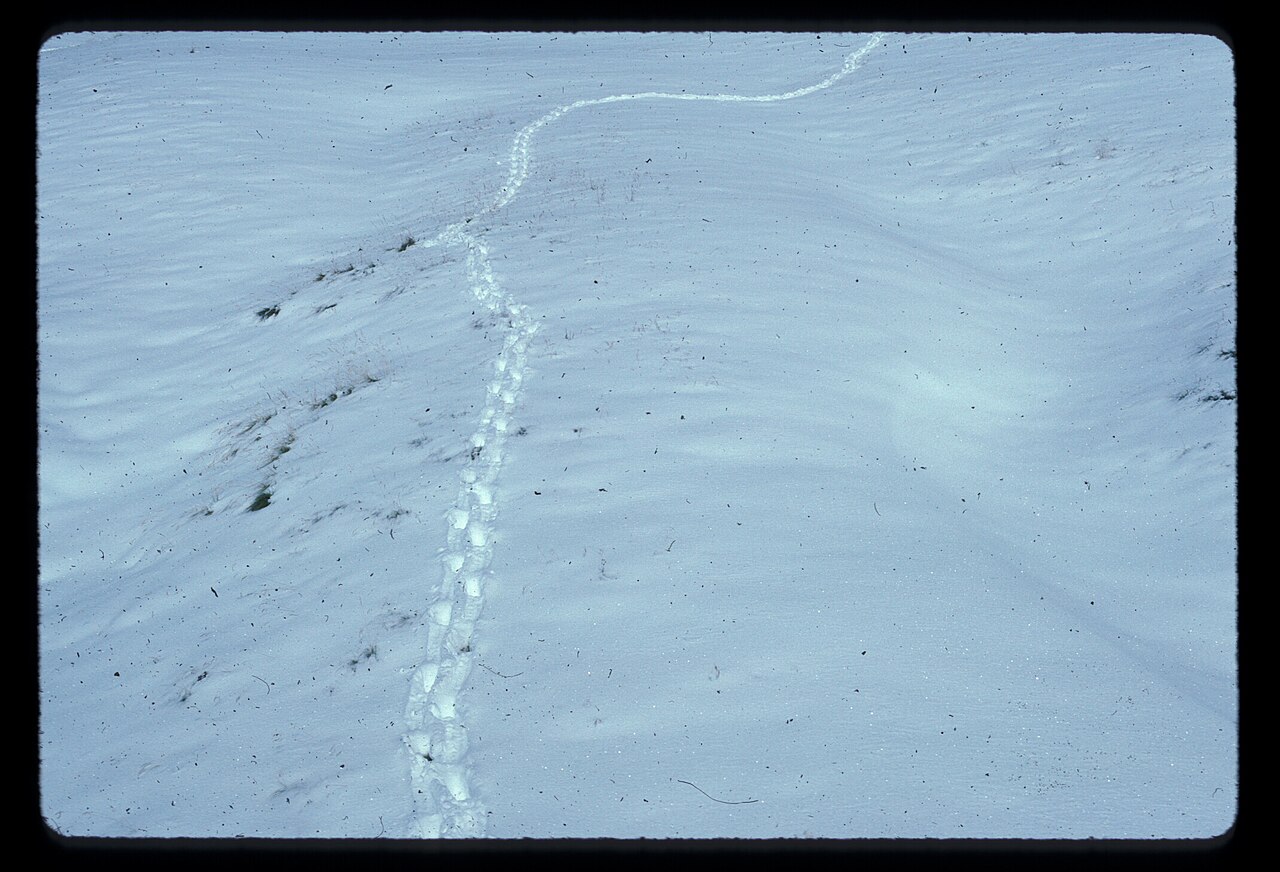
Snow is where elk tracking actually works, and winter is when most people look, because elk drop to lower elevations and concentrate on south facing slopes. In 2 to 6 in (5 to 15 cm) of fresh snow you get a near perfect cast: both toes, the dewclaws, and often the texture of the hoof wall. Measure in the firmest part of the print, not at the melted rim.
Deeper snow changes the read. Above about 12 in (30 cm) elk plow rather than step, leaving connecting troughs that point backward from each print and give you direction of travel. Age the track by its edges: under an hour old in cold dry snow it has sharp walls and loose crystals inside, while sun and wind round the rim. A refrozen track with an icy shell is at least a day old.
Elk Tracks in Mud
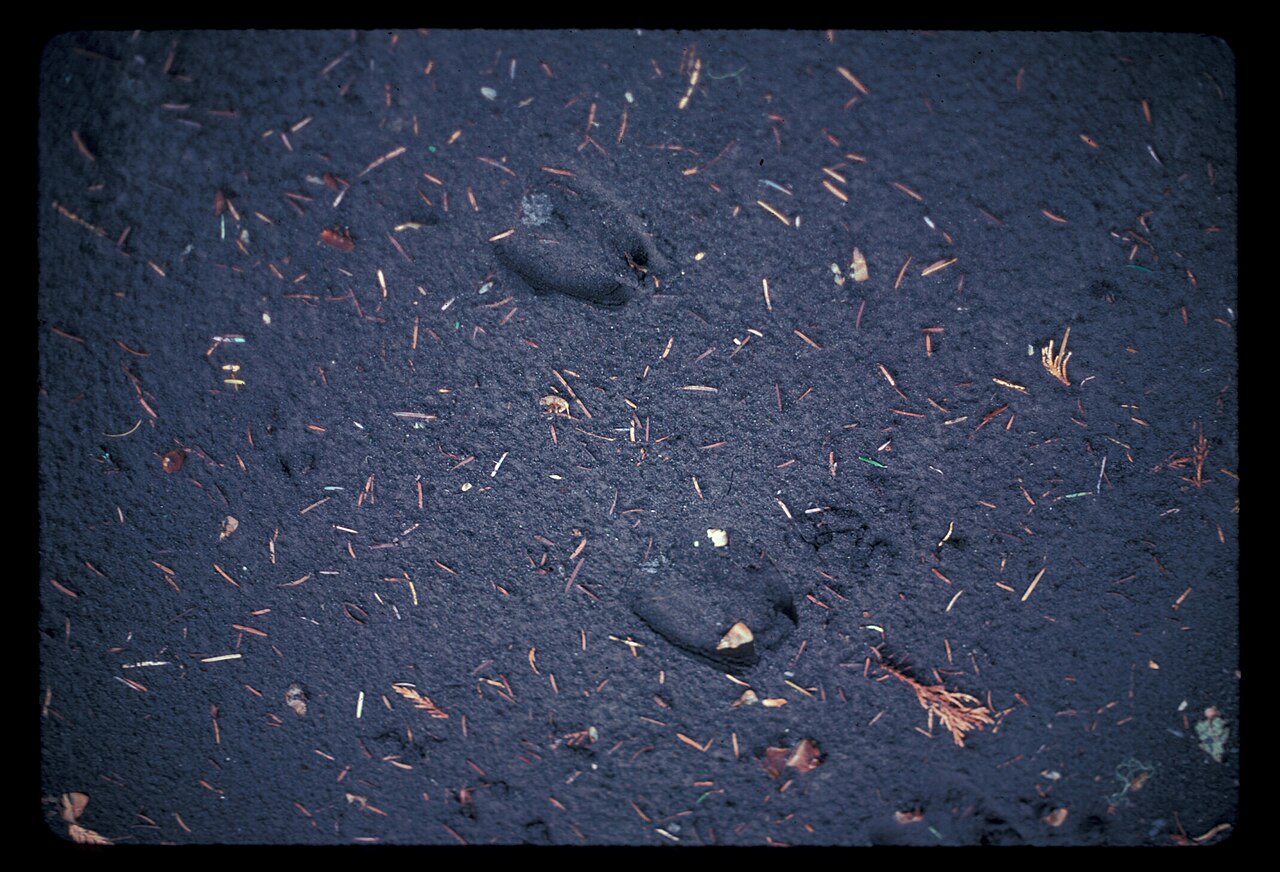
Mud gives the most accurate outline of any surface. In firm mud at a wallow, stream crossing or spring seep, elk leave crisp walled prints that hold detail for days and usually preserve the dewclaws. Wallows are the places to check in September and October, when bulls roll in mud during the rut and leave torn ground and a strong smell behind.
Soft or saturated mud exaggerates size. The hoof sinks, the toes spread, and the print fills from the sides as the foot lifts, so a cow elk track can measure 5 in (13 cm) in slop. Look at the toe tips instead of the overall length: even in deep mud the rounded elk tip stays rounded. The same correction applies when reading deer tracks on the same trail.
Elk Tracks in Sand, Dust and Hard Ground
Dry sand is the hardest surface to judge because it has no cohesion. Walls collapse inward almost immediately, the dewclaws vanish, and what you get is an oval depression with a vague center split. On sandy river bars and dune edges, work from the trail rather than the print: step length, straddle and the number of animals carry more information than the outline does.
Dust on a road or a two track behaves better and often preserves the inner rim of each toe, so look in the compacted wheel track rather than the loose dust between them. On hard packed ground or gravel, elk may leave nothing but scuff marks, chipped stones and a pale scratch where a hoof skated across rock.
Elk Tracks vs Deer Tracks
Deer and elk separate on size and shape. Mule deer tracks run 2.5 to 3.5 in (6 to 9 cm), white-tailed deer 2 to 3.25 in (5 to 8 cm), and both come to a distinct point at the front with a narrow heart shaped outline. Elk tracks are 3.5 to 4.5 in (9 to 11.5 cm), blunt tipped and chunkier, and a deer print will sit inside an elk print with room to spare.
Elk Tracks vs Moose Tracks
Moose go the other direction. A moose track is 4.5 to 7 in long (11.5 to 18 cm), longer than it is wide, with pointed toes that splay dramatically in soft ground and an obvious cleft between them. The key differences between elk and moose footprints are length and tip shape: moose prints look like oversized deer prints, while elk prints look rounded and squat.
Range narrows it further, since moose and elk overlap only in parts of the northern Rockies, Wyoming, Montana and Idaho. If the prints belong to a predator rather than a hoofed animal the shape changes entirely: coyote tracks and fox tracks show four toes and claw marks, bobcat tracks four toes without claws, and bear tracks five. Bison tracks are the one cloven print that rivals elk for size, and those are rounder still.
Elk Tracks vs Cow and Horse Tracks
Cattle are the most common false positive on public land in the West, and the two overlap in size. Cow tracks measure 3.5 to 5 in (9 to 13 cm) and are nearly as wide as they are long, giving a round or square outline, with broad flat crescent toes that splay apart even at a walk and leave a wide center gap. Elk toes stay closer together and the whole print is longer than it is wide.
Behavior separates them further. Cattle wander in loose groups near water, fences and roads, their trails are churned and aimless, and their droppings are flat pats. Elk move in purposeful lines and leave pellet groups. Horses are easy once you look: a shod hoof is a single rounded print with a metal rim and nail marks, and an unshod horse leaves one solid oval with a V shaped frog mark, never two toes. The National Park Service publishes regional track and sign material through nps.gov that is worth reading before a trip into unfamiliar country.
Frequently Asked Questions
How can you tell the difference between a deer track and an elk track?
Size and toe shape. Elk tracks are 3.5 to 4.5 in long (9 to 11.5 cm) with blunt rounded tips, while mule deer tracks reach 3.5 in (9 cm) and white-tailed deer 3.25 in (8 cm) with sharply pointed, heart shaped outlines. An elk print also shows dewclaws more often. If a deer print fits inside the print you are measuring, it is elk.
What is the typical size of an elk track?
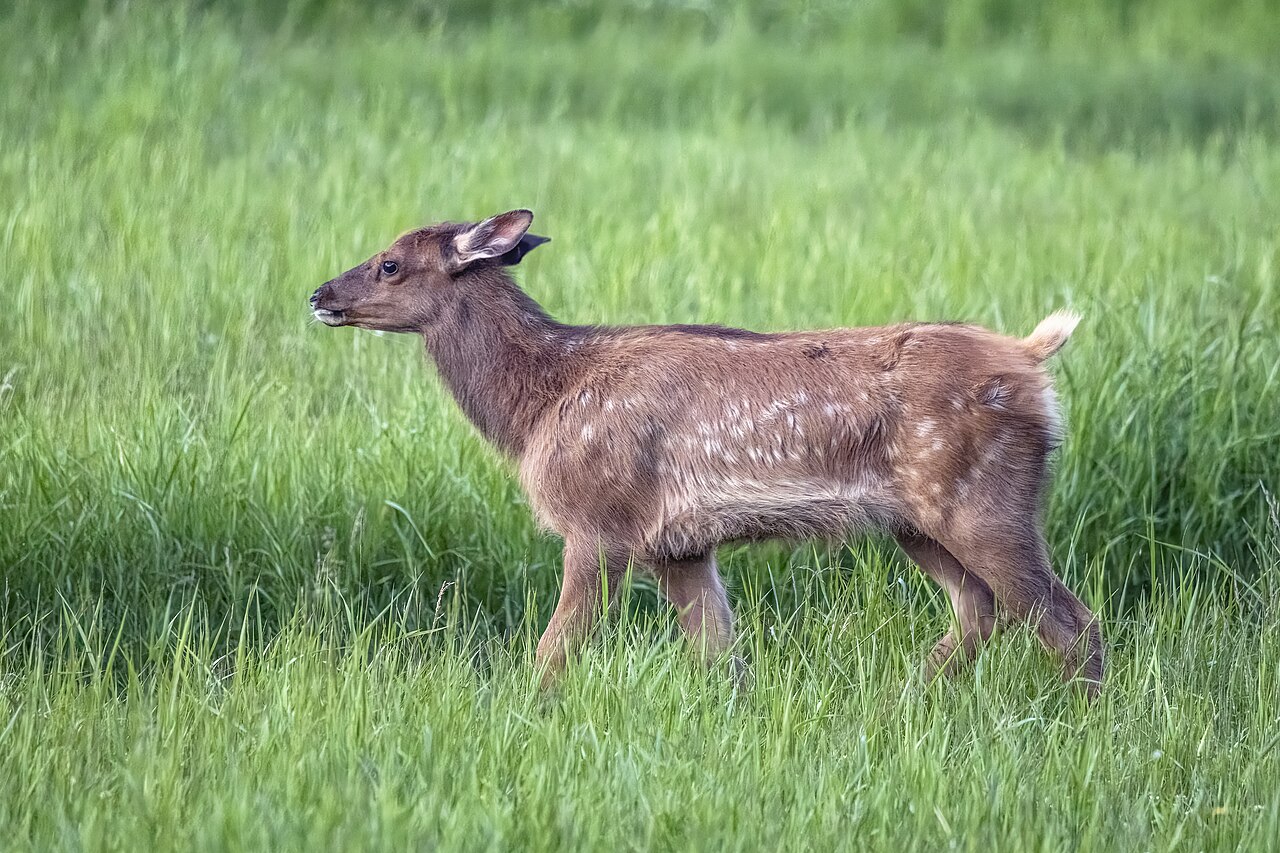
A typical adult elk track is 3.5 to 4.5 in long (9 to 11.5 cm) and 3 to 3.5 in wide (7.5 to 9 cm), measured on the hoof outline without the dewclaws. Mature bulls reach about 4.75 in (12 cm) and leave wider, more splayed prints. Calves in summer fall in the deer range, which is a common source of error.
What do cow tracks look like?
Cow tracks are large cloven prints 3.5 to 5 in long (9 to 13 cm) that are nearly as wide as they are long, with broad flat crescent toes that splay apart and leave a wide central gap. The outline reads round or squarish rather than teardrop shaped. Cattle trails are churned and meandering, usually within half a mile of water or a fence line.
How can you tell which direction an elk was traveling?
The pointed end of each toe faces the direction of travel, and the print is deepest at the tip where the hoof pushed off. In snow or loose soil, material is thrown backward behind the print and drag marks lead into it from behind. On a walking trail the hind print lands ahead of the front print on the same side.
Can you tell a bull elk track from a cow elk track?
Not with certainty, but the odds favor size. Bull prints are generally larger, blunter and more rounded, often over 4.25 in (11 cm), with a wider straddle and deeper impressions from the extra weight. Cow prints are smaller and more pointed. A large bull in wet ground also tends to show dewclaws at a walk, which cows usually do not.