Pink Butterfly: 7 Real Pink Species and Why Most Are Moths
A pink butterfly is real, but in the United States it is almost always a moth. The pink fliers people photograph in a backyard are the rosy maple moth, the primrose moth and the bella moth, and the true butterflies that carry pink here wear it as a trim or a flush rather than as a full coat. Nothing on this list bites, stings or needs to be handled with care.
That matters because the search for a pink butterfly turns up a wall of stock art, toys and edited photographs. Sorting the living animals from the digital ones is mostly a matter of knowing which species actually produce pink scales, which shade each one shows, and when in the year they fly. Nine species cover nearly every genuine sighting in North America.
No butterfly native to the United States is solidly pink. The strongest pink belongs to moths: the rosy maple moth (Dryocampa rubicunda), the primrose moth (Schinia florida) and the bella moth (Utetheisa ornatrix). Among true butterflies, the pink edged sulphur and the painted lady show pink trim, while fully pink butterflies such as the pink cattleheart live in the tropics.
| Species | Moth or butterfly | Pink shade | Wingspan | Where in the US |
|---|---|---|---|---|
| Rosy maple moth (Dryocampa rubicunda) | Moth | Candy pink with lemon yellow | 1.25 to 2 in (32 to 50 mm) | East, wherever maples grow |
| Primrose moth (Schinia florida) | Moth | Deep magenta and cream | 1 to 1.4 in (25 to 35 mm) | Most states with evening primrose |
| Bella moth (Utetheisa ornatrix) | Moth | Rose pink hindwings | 1.2 to 1.8 in (30 to 45 mm) | Southeast, strongest in Florida |
| Pink spotted hawkmoth (Agrius cingulata) | Moth | Pink bands on body and hindwings | 3.5 to 4.7 in (90 to 120 mm) | South, wandering north in late summer |
| Pink edged sulphur (Colias interior) | Butterfly | Pink wing edge and antennae | 1.4 to 2 in (35 to 50 mm) | Northern states and the Rockies |
| Painted lady (Vanessa cardui) | Butterfly | Salmon pink wash | 2 to 2.9 in (50 to 73 mm) | All 48 contiguous states |
| Pink cattleheart (Parides photinus) | Butterfly | Bright pink blocks on black | 3.1 to 3.9 in (80 to 100 mm) | Not in the US, Mexico southward |
Is There a Butterfly That Is Pink?
Yes, outside the United States. Several cattleheart swallowtails in the genus Parides carry large blocks of true pink, and a few Asian and African species do the same. Inside the US, the honest answer is that pink shows up on butterflies as an edge, a fringe or an angle dependent wash, never as the main color of the wing.
The reason is chemistry. Butterfly pinks and reds come from pterin and ommochrome pigments, and the brightest pinks in the group concentrated in lineages that never colonized temperate North America. Pink is also a poor fit for a temperate butterfly’s two main jobs, which are hiding on bark or dead leaves and warming up in sunlight.
Moths picked up the color instead, usually for camouflage against flowers and fresh foliage rather than for display. That is the twist in the whole question: the pinkest animals in an American garden fly at dusk and sit still all day.
Rosy Maple Moth (Dryocampa rubicunda)
This is the animal behind most genuine pink sightings east of the Rockies. The forewings are pink with a broad cream to yellow band, the legs and thorax are woolly pink, and the whole moth looks closer to a confection than an insect. Wingspan runs 1.25 to 2 in (32 to 50 mm), with northern individuals paler and sometimes nearly all yellow.
It is a silkmoth, part of the same family as the luna and the cecropia, and adults have no functioning mouthparts. They live about a week, do not feed, and exist only to mate and lay eggs on maples, where the caterpillars grow into green larvae with black side stripes. Nothing about them is harmful to people or to a healthy tree.
Look for them on porch screens and under lights between May and August, and in the south across two or three overlapping generations. A rosy maple moth found in daylight is usually resting on a maple trunk within a few feet of where it emerged.
Primrose Moth (Schinia florida)

The primrose moth is the most saturated pink of the group and the easiest to find on purpose. The forewings are deep magenta with a clean cream border, the hindwings are pale, and the moth is small at 1 to 1.4 in (25 to 35 mm) across.
During the day it wedges itself head down inside the closed flower of a common evening primrose (Oenothera biennis), where the pink sits against yellow petals in plain sight. Check a roadside primrose patch at mid morning in July and you may find several plants occupied, often with the moth’s rear end sticking out of the bloom.
Caterpillars feed on the flowers and seed capsules of the same plant, which makes the species a tidy example of a one host specialist. The Xerces Society treats these flower specialists as priority pollinator species precisely because they disappear with their host plant.
Bella Moth (Utetheisa ornatrix)

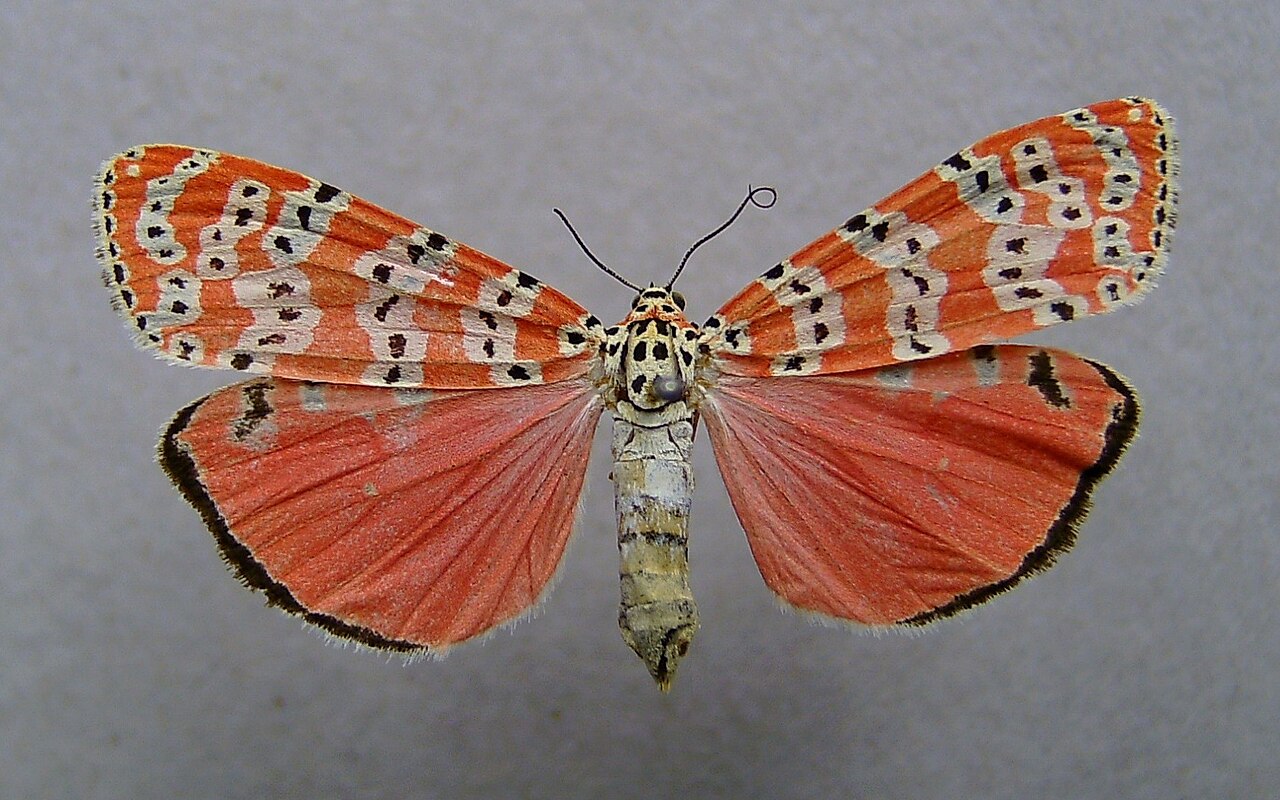
Also called the rattlebox moth, this one flies by day and is routinely reported as a pink butterfly in Florida and along the Gulf. The hindwings are rose pink with a black border, and the forewings are orange pink marked with rows of white and black spots that look stitched on.
Its caterpillars eat rattlebox plants in the genus Crotalaria and store the plant’s alkaloids, which the adult keeps as chemical defense and even passes to its eggs. Birds learn to leave it alone, which is why the moth flies slowly and openly in daylight instead of hiding.
Males also convert those alkaloids into a courtship pheromone, so a chemistry lesson is built into the mating system. For a flier that is unusually easy to approach and photograph, it is one of the most interesting insects in the southeast.
Pink Spotted Hawkmoth (Agrius cingulata)

The largest pink flier on the list reaches 3.5 to 4.7 in (90 to 120 mm) across. The forewings are marbled gray, which makes the animal nearly invisible on bark, and the pink only appears when it moves: rose bands down each side of the abdomen and a pink flush across the hindwings.
It hovers at long throated flowers after dusk with a tongue that can exceed 3 in (76 mm), and people who glimpse it at a feeder often report a hummingbird first. Resident in the deep south, it wanders north through the Midwest and occasionally to New England in late summer.
The caterpillar is the sweet potato hornworm, a minor pest in southern fields. Adults are harmless, cannot sting, and the thick body and feathery antennae mark it out as a moth even in a quick photo.
Underwing Moths With Pink Hindwings
Several moths in the genus Catocala keep rose pink hindwings folded under bark patterned forewings, with Catocala concumbens a widespread northern example. At rest on an oak or a poplar the animal is invisible; flushed into the air it flashes pink and then vanishes again the moment it lands.
That is the point of the color. A bird that chases a pink target through the canopy and then loses it entirely has been given a false search image, and the trick works well enough that the genus has repeated it dozens of times with pink, orange, yellow and banded hindwings.
Look for them from July to October, on tree trunks by day and at bait or lights at night. They are large, heavy bodied moths and none of them is a butterfly, however bright the flash of pink is.
Pink Edged Sulphur (Colias interior)
This is the clearest case of pink on a genuine North American butterfly. The wings are clear lemon yellow and the outer margin is lined in rose pink, with pink antennae and pink legs to match. Wingspan is 1.4 to 2 in (35 to 50 mm).
It flies from June to August across the northern tier of states, through the Great Lakes, New England and the Rockies, in blueberry barrens, bogs and openings in conifer forest. Caterpillars feed on lowbush blueberry, so the butterfly follows the berry rather than the garden.
Its close relative the clouded sulphur also shows pink wing fringes, which means a yellow butterfly with a pink edge is worth a second look before it gets filed as the common species. Compare that restrained trim with the flat blocks of color on a blue butterfly and the difference between pigment and structural color becomes obvious.
Painted Lady (Vanessa cardui)
The most common butterfly you will see described as pink is the painted lady, whose upper wings run salmon orange with a pink cast in low sun. In worn individuals late in the season the scales thin out and the pink reads more strongly than the orange.
It occurs in all 48 contiguous states, migrates in large numbers in some years, and uses thistles and mallows as host plants. Spread the wings flat in afternoon light and the pink largely disappears, which is the test for separating a true pink from a warm orange.
If the animal is unambiguously orange with black blocks, it is a different species altogether, and the field marks for those are covered under orange butterflies. The same angle trick explains why an iridescent black and blue butterfly can photograph purple or violet.
Pink Cattleheart (Parides photinus)
For a butterfly that is pink without qualification, you have to leave the country. The pink cattleheart is a velvety black swallowtail with bold pink blocks on the hindwings, 3.1 to 3.9 in (80 to 100 mm) across, and it ranges from Mexico through Central America in wet mid elevation forest.
Like other cattlehearts it feeds as a caterpillar on pipevines (Aristolochia) and carries the plant’s toxins into adulthood, so the pink doubles as a warning. Males gather at damp ground to take up minerals, which is where photographers usually find them.
North American butterfly houses display cattlehearts regularly, so a vivid pink and black swallowtail in the US is realistically either a captive specimen or a tropical photo with no location attached.
How Rare Is It to See a Pink Butterfly?
Seeing a true pink butterfly in the wild in the United States is effectively a non event, because no resident species qualifies. Seeing a pink moth, on the other hand, is a matter of a few nights with a porch light in the right month. Rosy maple moths turn up at lit windows across the whole eastern half of the country.
Pink trimmed butterflies such as the pink edged sulphur are locally common inside their range and absent outside it, so the apparent rarity is really a question of habitat. Anyone standing in a northern blueberry barren in July has a good chance at one.
Bright pink pigment is genuinely uncommon among butterflies worldwide, which is why the handful of pink species are so heavily photographed and so often reproduced as art. That gap between how little pink there is and how much of it appears online is what makes the question hard to answer with a search, and the same holds for the handful of species behind every green butterfly report.
What Does a Pink Butterfly Mean?
Symbolically the pink butterfly is read as love, tenderness, joy and a gentle new beginning, combining the general butterfly meaning of transformation with the softer associations of pink. In the United States it has also become an informal emblem of breast cancer awareness and of remembering someone who has died.
None of that is biology, and the animal in front of you is doing none of it on purpose. The pink serves camouflage, warning or courtship depending on the species, which is a better story than the greeting card version in most cases.
Interpretations like these travel the same route as other wildlife omens, from a pink bird crossing a road to a pink ladybug landing on a hand. Worth knowing, not worth confusing with what the species is actually doing.
Frequently Asked Questions
Is there a butterfly that is pink?
Not in the United States. Tropical cattleheart swallowtails such as Parides photinus are genuinely pink, and a few US butterflies including the pink edged sulphur and the painted lady show pink edges or a pink wash. Fully pink specimens photographed in American yards are nearly always moths.
What is the rarest color of a butterfly?
True pigment based blue and violet are the rarest, which is why almost every blue butterfly produces its color structurally from layered scales rather than from dye. Bright pink pigment is the next rarest, concentrated in a few tropical groups. Green, yellow, orange and brown are the common ones.
How can I tell a pink moth from a pink butterfly?
Check the antennae first. Butterflies carry thin antennae with a club at the tip, while moths have feathery or tapered ones. Moths also rest with wings tented or flat over a thick furry body, fly mostly at dusk and after dark, and look woolly rather than smooth.
Which color butterfly is lucky?
That depends entirely on the tradition. Yellow butterflies are read as good fortune and prosperity in parts of Asia and Latin America, white ones as a visiting spirit in several European and Native American traditions, and black ones as a warning in some and a blessing in others. No color carries a universal meaning.
What is a butterfly’s favorite color?
Nectar feeding butterflies respond most strongly to purple, violet, yellow and red flowers, and feeding trials repeatedly put purple at or near the top. Scent and flower shape matter as much as color. Planting blazing star, coneflower, milkweed and zinnia will outdraw any single color choice.
Where do I find a rosy maple moth?
Anywhere maples grow in the eastern US, from late spring into late summer. Check porch lights, lit windows and white walls shortly after dark, and look on maple trunks and low foliage during the day. Leaving a dim white light on near a maple is the simplest way to attract one.