Bugs That Look Like Boxelder Bugs: 6 Lookalikes and One to Avoid
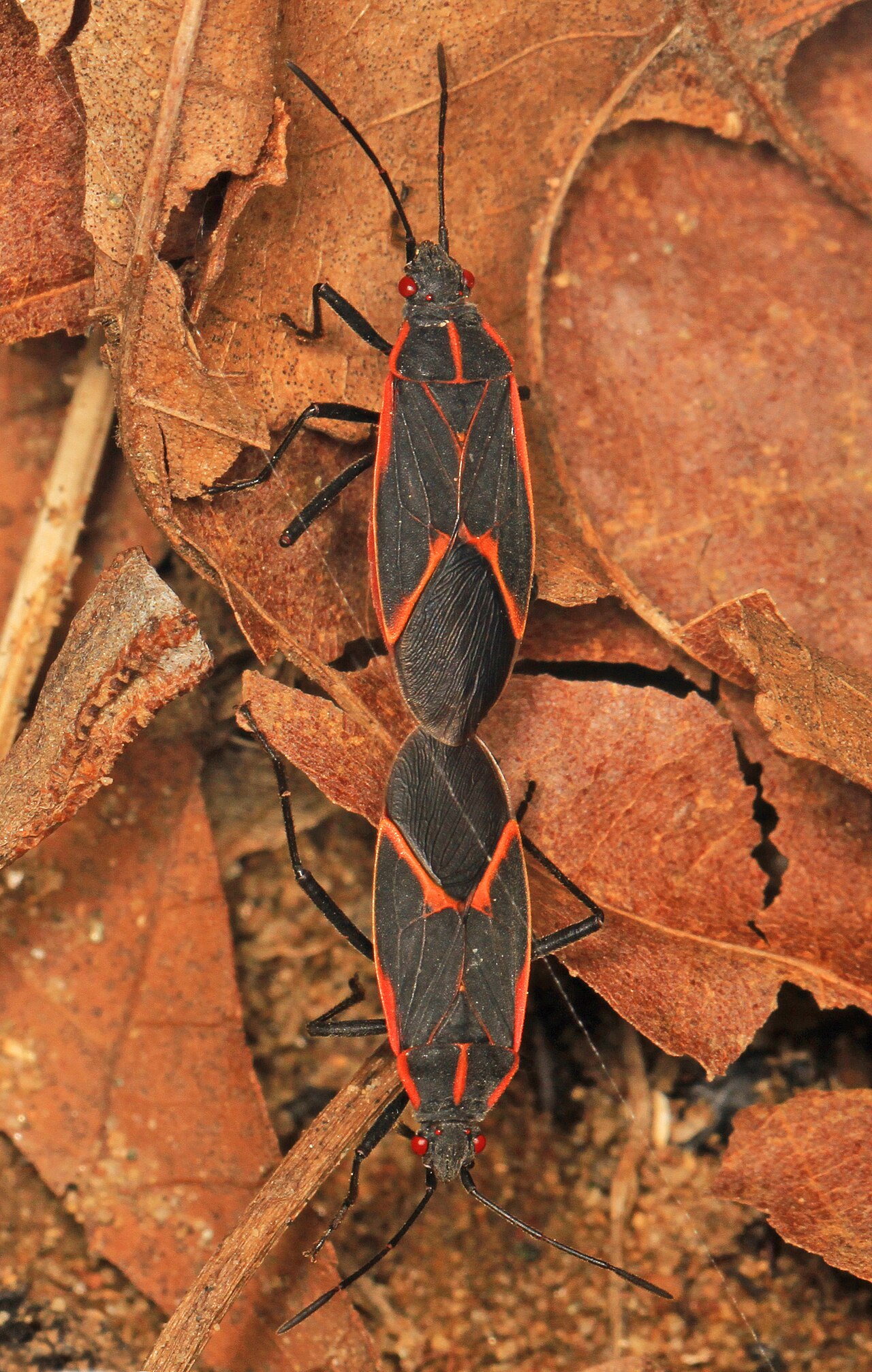
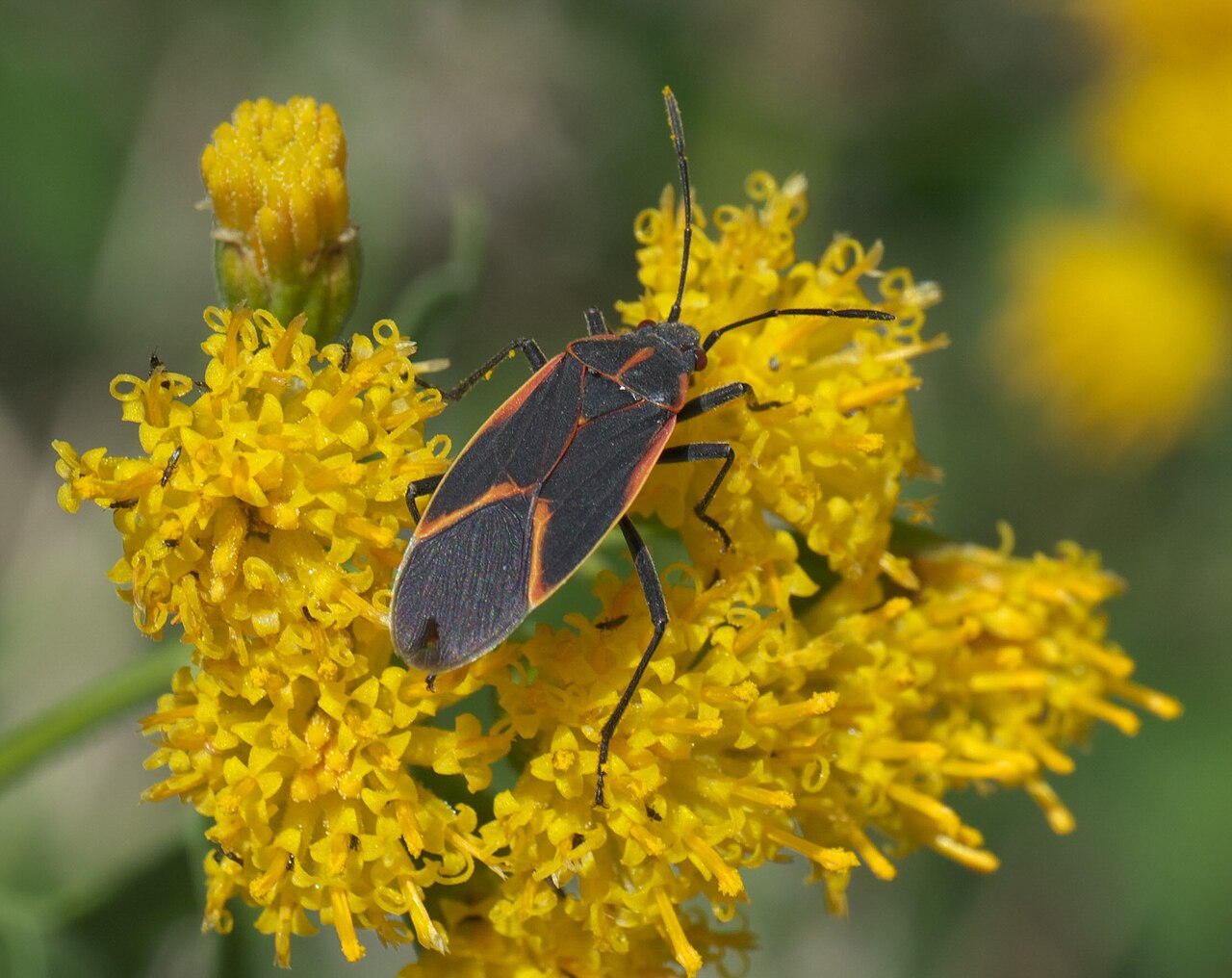
Several red and black insects get called boxelder bugs every fall, and only one of them is. The true boxelder bug (Boisea trivittata) is a flat, half-inch insect with three thin red lines across the thorax and red veins forming a narrow X on the folded wings. Its lookalikes are the red-shouldered bug, two milkweed bugs, the western conifer seed bug, and, in southern states, the kissing bug.
That last one is why identification matters. Kissing bugs can carry the parasite behind Chagas disease, while every other insect here is harmless. Settle the safety question first, then work through the markings.
Bugs that look like boxelder bugs are mostly harmless seed feeders: the red-shouldered bug, the large and small milkweed bugs, and the western conifer seed bug. None bite or sting. The one dangerous lookalike is the kissing bug, which is larger, has orange blocks around the whole edge of the abdomen, and bites at night.
| Feature | Boxelder bug | Kissing bug |
|---|---|---|
| Length | 0.5 in (13 mm) | 0.6 to 1.2 in (15 to 30 mm) |
| Red marking | Three thoracic stripes, X on wings | Band of orange spots around abdomen edge |
| Head | Short, blunt | Long, cone shaped, narrow beak |
| Legs | Thin, uniform black | Long, often banded |
| Active when | Day, on sunny walls | Night, near sleeping areas |
| Bites people | No | Yes |
| Found on | Boxelder and maple trees | Wood piles, kennels, rodent nests |
How can I tell the difference between a kissing bug and a boxelder bug?
Look at the head and the outline of the abdomen. A kissing bug (Triatoma species) has a long, narrow, cone shaped head with a straight piercing beak, and its orange markings form a row of blocks around the entire rim of the flattened abdomen. A boxelder bug has a blunt head and keeps its red to three thoracic stripes plus the wing X.
Size and behavior finish the job. Most kissing bugs run 0.6 to 1.2 in (15 to 30 mm), clearly bigger than the uniform 0.5 in (13 mm) boxelder bug, and they are nocturnal, solitary blood feeders, while boxelder bugs mass by the hundreds on sunlit siding in daylight. Kissing bugs occur mainly in the southern third of the country near wood piles, coops, and dog kennels, and the CDC asks that specimens be collected without bare hands and sent to a state health department. For a closely related question, see our guide to animals that look like beavers. For a closely related question, see our guide to bugs that look like fleas.
Red-shouldered bug: the closest match of all

The red-shouldered bug (Jadera haematoloma) fools entomologists at a glance. It matches the boxelder bug in size and shape and clusters on the same walls, but its red is restricted to two narrow shoulder patches along the front edge of the thorax, with no stripes and no wing X. The eyes are red as well.
Host plants separate them in the yard. Red-shouldered bugs feed on golden rain tree, chinaberry, and soapberry seeds, so infestations sit under those trees rather than under boxelders and maples. They are common across the South and in plantings as far north as Kansas, and they do not bite, breed indoors, or damage structures. For the shield shaped invaders at the same October windows, see bugs that look like stink bugs.
Large and small milkweed bugs

The large milkweed bug (Oncopeltus fasciatus) is brighter orange and carries a bold black band straight across the middle of the back, reading as two orange bars rather than stripes. At 0.7 in (18 mm) it turns up on milkweed seed pods rather than on houses.
The small milkweed bug (Lygaeus kalmii) is misidentified more often, since at 0.5 in (13 mm) it matches the boxelder bug exactly and its red forms an X on the forewings. Look for the red band across the thorax behind the head and a pair of white wing spots, neither of which a boxelder bug has. Both species are harmless and both overwinter outdoors, unlike the insects in bugs that look like cockroaches.
Western conifer seed bug and other fall invaders
The western conifer seed bug (Leptoglossus occidentalis) is the brown lookalike people report. At 0.75 in (19 mm) it is much larger, with flared, leaf shaped hind legs and faint orange zigzags instead of clean stripes, and it enters homes the same way in October.
Small black bugs with a thin orange stripe are usually boxelder bug nymphs partway through development, bright red with darkening wing pads and no working wings. If your insects are slender, fast, and silver instead, compare bugs that look like silverfish, and for wood damage check bugs that look like termites or bugs that look like spiders before treating.
Why shouldn’t you squish a boxelder bug, and how can I get rid of them?
Crushing one releases a defensive compound that smells strongly and leaves a reddish orange stain on siding, curtains, and carpet. The fluid is harmless, but the stain is permanent on light fabric and the odor draws more bugs to the same spot, which is the practical reason to leave them intact.
Vacuum them and empty the canister outdoors. Soapy water at about 1 tablespoon of dish soap per quart (1 liter) kills them on contact outside. For the long term, seal gaps around window frames, siding joints, and soffits in late summer, before the bugs look for overwintering sites. Wall sprays give short results and kill predators, including the species in birds that eat stink bugs, which is why extension programs such as Colorado State University Extension favor exclusion.
Frequently Asked Questions
What is the name for a small black bug with an orange stripe on its back?
It is usually a boxelder bug nymph or an immature red-shouldered bug. Both start out mostly red and darken as black wing pads develop, leaving a striped look. If the bug is under 0.25 in (6 mm) and wingless, it is a nymph, and adults of the same species are nearby.
Are boxelder bugs harmful?
No. Boxelder bugs do not bite, sting, spread disease, damage wood, or breed in homes. They feed on boxelder and maple seeds with a slender beak that cannot pierce human skin. The only real complaints are stains from crushed bugs and the sheer number clustering on warm walls.
Do boxelder bugs bite?
Boxelder bugs do not bite in any meaningful sense. There are scattered reports of a weak probe when one is pressed against skin, producing a pinprick sensation with no welt and no venom. Any red, itchy bite appearing overnight points to bed bugs, fleas, or mosquitoes instead.
What do boxelder bug nymphs look like?
Nymphs are bright scarlet with short black legs and no working wings, about 0.06 in (1.5 mm) at hatching and growing to near adult size through five molts. They gather in dense groups on trunks and seed pods, and the red gives way to the adult three stripes and wing X.