Armadillo Tracks: How to Identify Them (Toes, Claws, Trail)
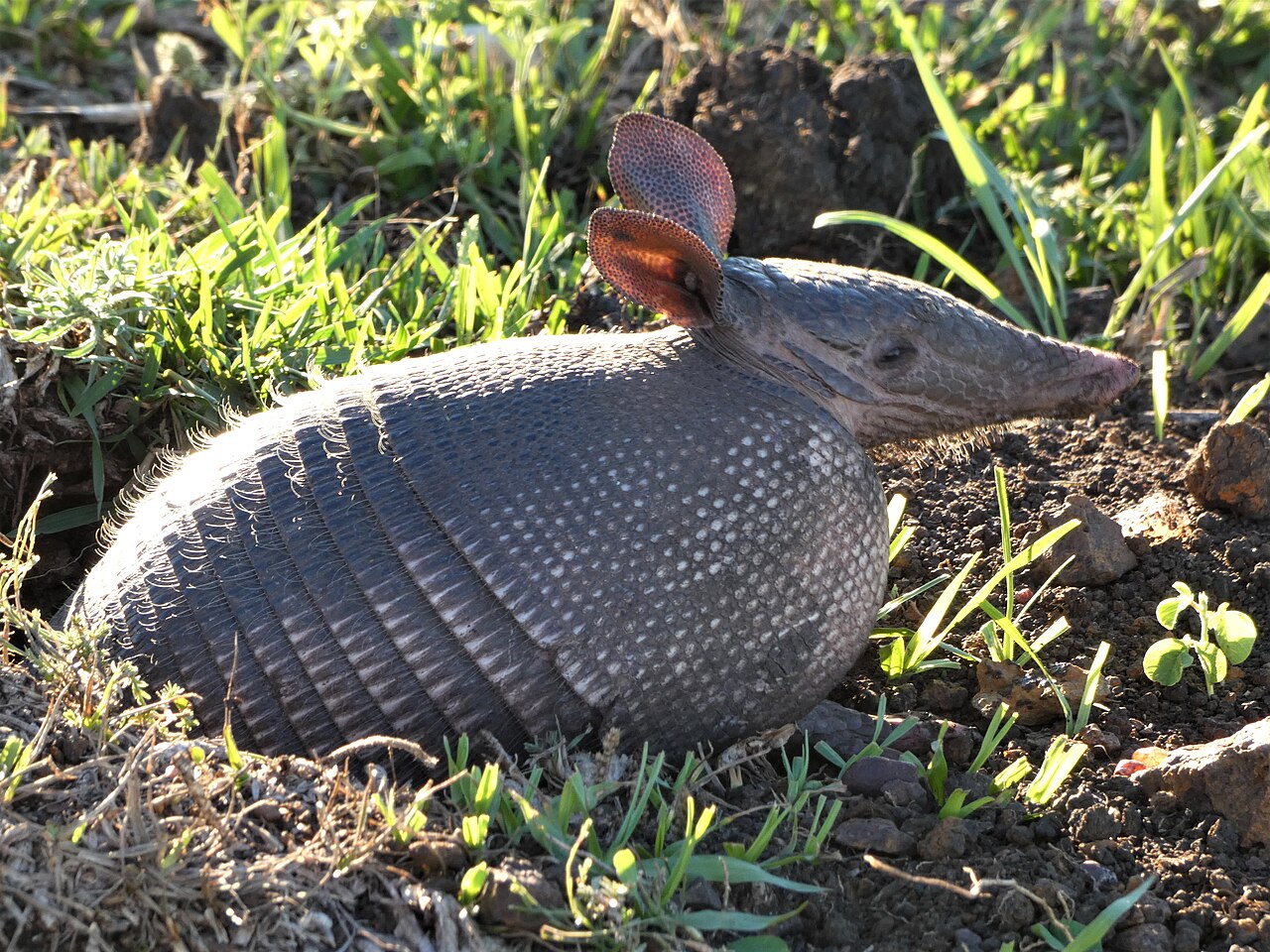
Armadillo tracks show a pointed front print with two long middle toes, deep claw marks and a weaving trail. Fresh prints next to a rooted-up lawn or a muddy creek bank raise one question, armadillo or lookalike. In the US the answer is the nine-banded armadillo (Dasypus novemcinctus), the only armadillo species living north of Mexico.
Armadillo front prints show two long middle toes and deep pointed claws, with a five-toed hind print and a weaving trail. Check four things in order, toes and group, claws, trail, then nearby signs like cone-shaped feeding holes or a burrow. Opossum, raccoon, dog, cat and badger prints each fail one step.
What Armadillo Tracks Look Like
An armadillo front print looks pointed, almost like a bird track, because two long middle toes dominate it. The front foot shows four toes. The feet themselves are short and stout, built for digging, with thick curved claws that are longest on the two middle front toes. The outer pair of toes is short and leaves a faint mark or none. Each toe ends in a deep, pointed claw mark set well ahead of the toe.
The hind print is broader and blunter. It shows five toes in a rounder outline, with three long middle toes and two short outer ones. Heavy claws on both feet push deep into soil, and that depth invites confusion with other diggers. Badger tracks carry similar long claws but show five toes in a wider fan.
How to Identify Armadillo Tracks in 4 Steps
Identify armadillo tracks with four checks in order, toes and group, claws, trail and nearby signs.
- Toes and group. Armadillo prints belong with the digging mammals, with no round carnivore pad and no tiny rodent hands.
- Claws. They leave deep, pointed gouges, not the rounded nail dots of a dog.
- Trail. It follows a weaving path, with a thin tail line in soft ground.
- Nearby signs. Fresh rooting holes or a burrow sit close by.
Armadillo Tracks vs Opossum, Raccoon, Dog, Cat and Badger
Animal track groups sort prints into canines, felines, rodents, hand-shaped walkers and diggers. Armadillos sit with the diggers, opossums and raccoons with the hand-shaped walkers, dogs with the canines.
| Animal | Front toes in print | Claw marks | Trail clue |
|---|---|---|---|
| Armadillo | 4, often only the two long middle toes register | Deep and pointed | Weaving line with a thin tail drag |
| Opossum | 5, spread like a star | Short, often visible, none on the thumb | Thumb-like hind toe, tail drag only sometimes |
| Raccoon | 5, long and finger-like | Small dots at the fingertips | Hand-like prints in side-by-side pairs |
| Dog | 4 around a large pad | Blunt dots close to the toes | Straight, even line |
| Cat | 4 around a three-lobed pad | None, claws retract | Neat line, hind print in the front print |
| Badger | 5 in a wide fan | Long, set far ahead of the toes | Wide, pigeon-toed trail |
Armadillo Tracks in Mud, Sand and Snow
Mud holds armadillo tracks best, with clear toe and claw detail. Check puddle edges, ditches and creek banks first. A print in drying mud keeps its pointed shape much longer than one in sand.
Sand blurs the toes into pointed dents, but claw drags between steps stay visible. Snow prints are rare. Armadillos wait out hard cold in their burrows and come out again when the ground softens.
Muddy prints near water get mistaken for raccoon prints. Raccoon tracks look like small human hands with five long fingers, and the raccoon (Procyon lotor) leaves them in pairs. An armadillo print stays narrow and pointed.
Armadillo Trail Pattern, Gait and Tail Drag
A walking armadillo leaves a weaving trail where the hind print lands on or near the front print. The body sways as the animal noses along, so the line zigzags instead of running straight. A thin groove between the prints is the tail. It shows best in soft mud or sand.
A startled armadillo bolts in short bursts. The prints stretch apart, then bunch up where it stops to listen or dig again.
Opossum tracks can also show a tail line, but the hind foot of the Virginia opossum (Didelphis virginiana) shows a thumb-like toe pointing sideways. No armadillo print has that thumb.
Other Armadillo Signs Like Holes, Burrows and Scat
Small cone-shaped feeding holes are the strongest sign that goes with armadillo tracks. They line the trail like probe marks where the snout pushed in after grubs and insects. Overturned mulch and rooted strips of lawn follow the same route as the prints.
Burrows often have two or more entrances and sit under brush, porches or banks. Fresh soil at the mouth and tracks leading in mean the burrow is in use. Never touch an armadillo or handle a burrow barehanded. Chagas disease spreads through contact with the droppings of infected triatomine bugs, which can shelter in animal burrows, so wear gloves and leave any insects there alone.
Armadillo poop is small, cylindrical and crumbly, with insect parts and some soil. Find it near the burrow or along the feeding route.
When and Where Armadillo Tracks Appear
Fresh armadillo tracks appear overnight. Feeding starts around sunset and runs into the early morning hours. In cool weather the schedule shifts, and armadillos feed in the warmer afternoon hours. Moist ground after rain shows the clearest and freshest prints.
Texas holds the largest population, and the range covers the southern US from Texas to Florida, spreading north into Missouri, Illinois and Indiana. Rustling in the leaf litter at night means a fresh set of tracks by morning. Check the spot at first light, before sun and foot traffic flatten the edges.
Frequently Asked Questions
Are possums and armadillos related?
No. Armadillos belong to the Xenarthra, with sloths and anteaters, while opossums are marsupials that carry their young in a pouch.
Should you fill in armadillo holes?
Yes, but only once the burrow is empty. Stuff loose leaves into the entrance and check it each morning. If the leaves stay undisturbed for several nights, nothing is using it, and you can fill the hole with soil. Feeding holes in the lawn can be pressed back and watered right away.
Do armadillo burrows have two entrances?
Yes, many armadillo burrows have two or more entrances. Fresh soil and tracks at an entrance show which openings are in use.
Can you make a plaster cast of an armadillo track?
Yes. Mud prints cast well, so mix plaster to a pancake-batter thickness and pour it gently from the side. On firm sand, mist the print lightly with water first so the grains hold their shape. Let the cast set fully before lifting it, then brush off the soil once it is dry.
Sources
- CDC, Chagas Disease
- Missouri Department of Conservation, Nine-Banded Armadillo
- Mississippi State University Extension, How to Identify Raccoon and Opossum Tracks