Black and Yellow Bee: What It Is and Does It Sting?
That big black and yellow bee by the porch or in the flower bed is most likely a bumble bee or a carpenter bee. Wasps and hoverflies wear the same colors, so fuzz, waist shape and flight pattern tell you more than color. The insect that pesters people at a picnic is a wasp such as a yellow jacket, not a bee.
Most black and yellow bees in US yards are bumble bees or carpenter bees. Females sting only when grabbed or when their nest is disturbed, and male carpenter bees cannot sting at all. A hairless look-alike with a narrow pinched waist is a yellow jacket, which defends its nest far more readily.
Which Black and Yellow Bees You Are Likely Seeing
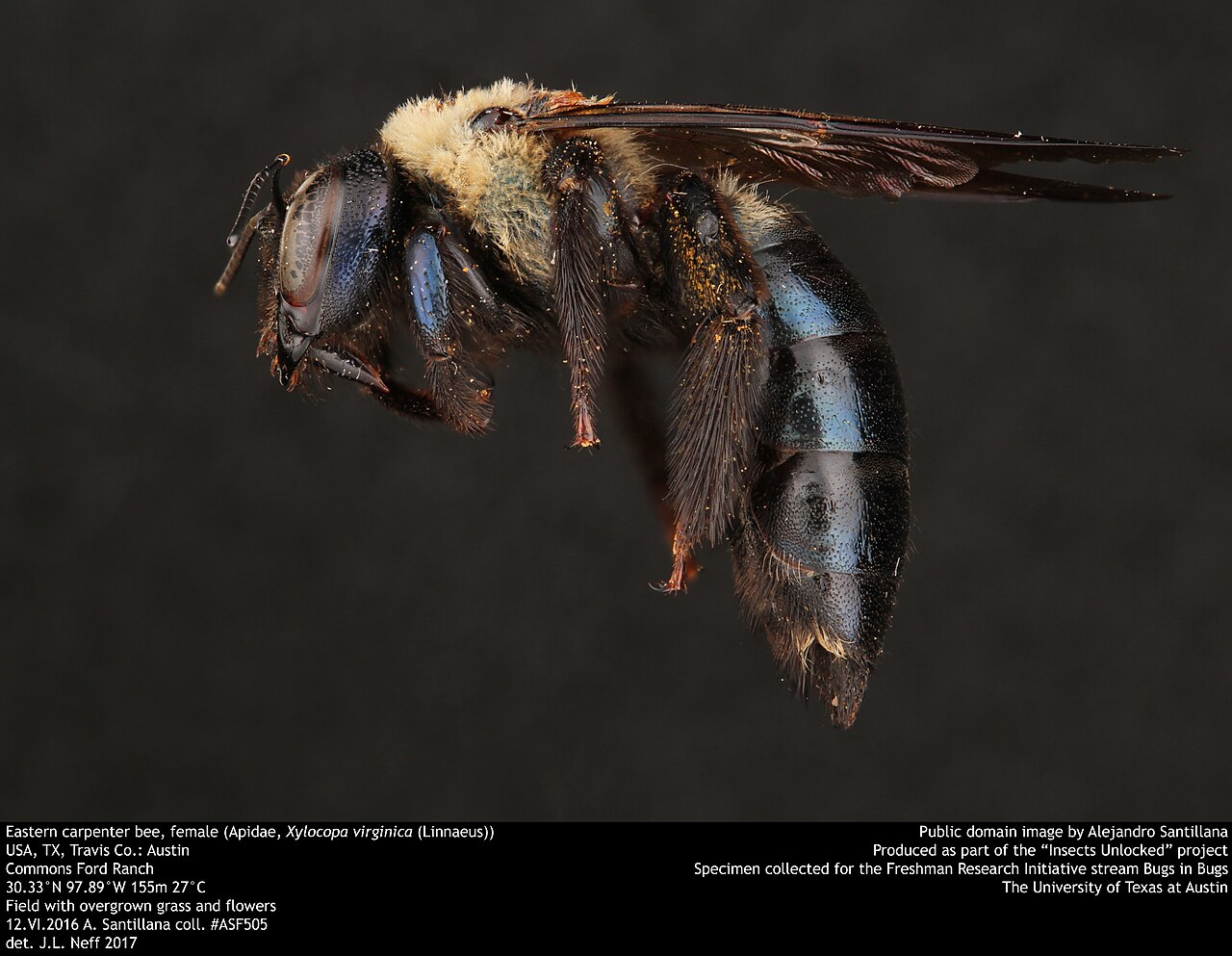
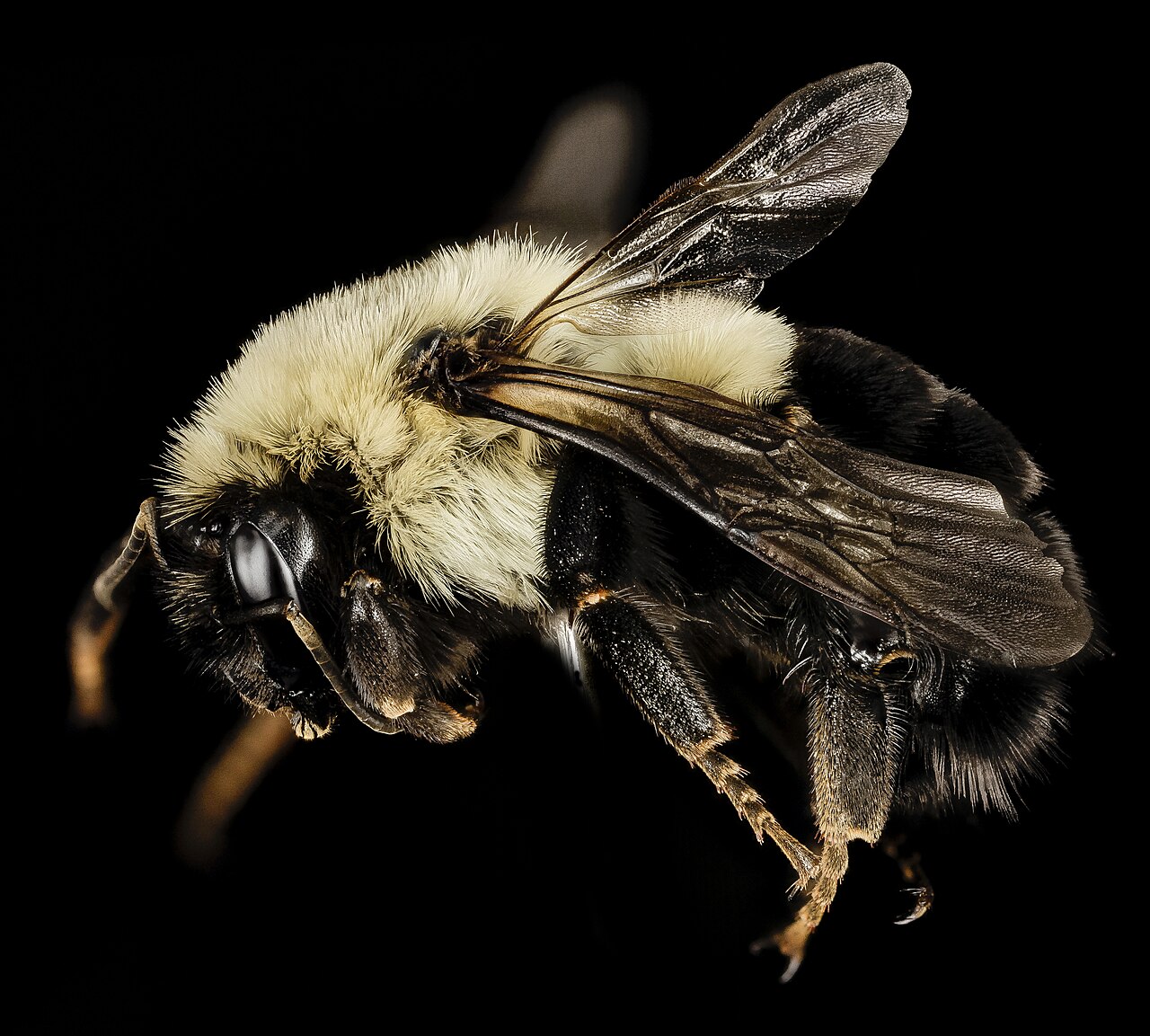
In most of the US, and especially in the East, the two big black and yellow bees in yards are bumble bees (genus Bombus) and the eastern carpenter bee (Xylocopa virginica), which does not occur in the West. Bumble bees are round and densely fuzzy all over, with yellow bands on both the thorax and the abdomen. Carpenter bees look similar from a distance, but the abdomen is bald, black and shiny. Only the thorax carries yellow fuzz.
Honeybees (Apis mellifera) are smaller and slimmer. Their bands run amber and brown rather than crisp black and yellow, so the contrast looks soft. A small black and yellow bee on a flower can be a sweat bee, a mason bee or a leafcutter bee. Mostly yellow bees form a separate group with their own look-alikes.
Location is a strong clue. Carpenter bees hover at eaves, fascia boards and deck rails, where females bore round holes into bare wood. Carpenter bee nests are tunnels inside those boards, and the clean round entrance is the giveaway. Bumble bees work flowers low in the garden and move between blooms in a steady, heavy flight.
Bee or Wasp? Telling Black and Yellow Look-Alikes Apart
Fuzz is the fastest clue, and the thorax is the place to check. A fuzzy thorax usually means bee, even on a carpenter bee with a shiny abdomen, while a wasp is smooth and glossy from head to tail. Some sweat bees are fairly smooth and some flies are fuzzy, so check the waist and wings too. Bees collect pollen, and their branched hairs trap it, so many carry yellow or orange loads on the hind legs or under the belly. Wasps hunt or scavenge and typically show no pollen loads on their legs.
Yellow jackets (genus Vespula) are hairless, with sharp yellow markings and a narrow, pinched waist. Paper wasps (genus Polistes) are slimmer still and fly with long legs dangling below the body. Both build nests from chewed wood fiber. Neither carries the soft, rounded outline of a bee.
Hoverflies (family Syrphidae) copy the bee pattern but have one pair of wings instead of two. Huge eyes cover most of the head, the antennae are short stubs, and the fly hangs motionless in the air before darting off. Hoverflies cannot sting. Bugs that look like bees include several more mimics, from robber flies to clearwing moths.
| Insect | Social or solitary | Typical nest site | Can it sting? |
|---|---|---|---|
| Bumble bee | Social, small annual colony | Ground cavities, old rodent burrows | Females, if handled or at the nest |
| Carpenter bee | Solitary | Tunnels bored into bare wood | Females only, if handled |
| Honeybee | Social, large perennial colony | Hollow trees, managed hives | Workers, once |
| Yellow jacket | Social, annual colony | Underground holes, wall voids | Yes, repeatedly |
| Paper wasp | Social, small colony | Open combs under eaves | Yes, near its comb |
| Hoverfly | Solitary | No nest, larvae develop on plants or decaying matter | No |
Do Black and Yellow Bees Sting? How They Act Around People
Yes, female bumble bees, carpenter bees and honeybees can sting, but a bee away from its nest stings only when it is grabbed, swatted or pressed against skin. A foraging bee on a flower is busy with nectar and calm enough to watch from close range.
The loud bluffer is the male carpenter bee. He hovers at face height near nest boards, dives at people and pets, and chases other insects, yet he has no stinger. Penn State Extension describes males with a white to pale yellow patch on the face and females with a black face. A carpenter bee sting comes only from a female.
Bumble bees defend their nests in the ground, such as old rodent burrows or under thick grass. Workers guard the entrance and will chase an intruder, so keep a few steps back from any hole with steady bee traffic. Ground bees that dig small soil mounds in a spring lawn are solitary mining bees and rarely sting.
Will Bumble Bees Remember You?
Bumble bees do not recognize individual people, but they learn fast: foragers remember flower colors, routes and the scent marks other bees leave on drained blooms. In a 2005 lab study, honeybees even learned to tell photos of human faces apart.
Frequently Asked Questions
Do orange belted bumblebees sting?
Yes, female orange-belted bumble bees (Bombus ternarius) can sting, but they are generally docile and sting mainly to defend the nest or when handled or pressed. The species carries a bright orange band across the middle of the abdomen and visits flowers in the northern states and Canada.
What attracts carpenter bees?
Bare, unpainted softwood attracts nesting females. Fascia boards, deck rails, fence posts and eaves made of pine or cedar are favorite targets because the wood is soft and easy to bore. Paint or stain makes a surface far less appealing, and old tunnels draw new females to reuse them.
Sources
- Penn State Extension, The Eastern Carpenter Bee: Beneficial Pollinator or Unwelcome Houseguest
- University of Minnesota, Bumble Bee Nesting 101 (Bumble Bee Nest Quest)
- University of Nebraska-Lincoln, Paper wasps and Yellowjackets
- University of Wisconsin Entomology, Wisconsin Bumble Bees: Tri-colored Bumble Bee