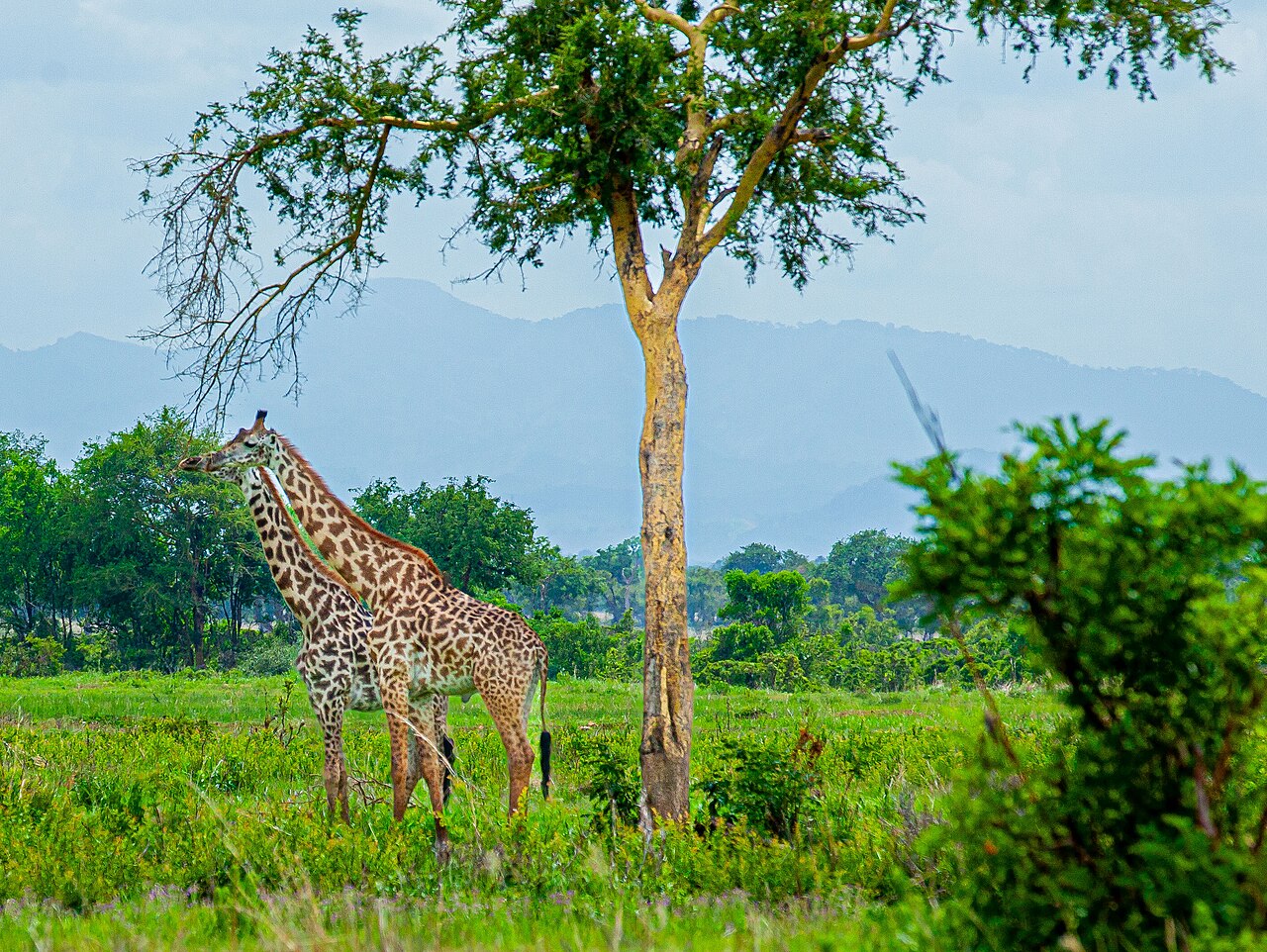
What Do Giraffes Eat? Diet, Acacias, and Feeding Habits
Giraffes eat leaves, and mostly the leaves of acacia trees. They are browsers rather than grazers, spending 16 to 20 hours a day feeding on foliage, shoots, buds, flowers, seed pods, and occasional fruit from trees and tall shrubs. An adult bull consumes around 75 lb of vegetation per day, and acacia species make up the largest single share of it across most of their range.
Their entire anatomy is built around that diet. A prehensile tongue 18 to 20 in long strips leaves from between thorns, thick saliva coats anything sharp that gets swallowed, and a four-chambered ruminant stomach extracts nutrition from material most animals cannot process. This guide covers the full diet, the chemical arms race between giraffes and acacias, how much they drink, why they chew bones, and what zoo giraffes are fed instead.
| Quick Facts | Giraffe Diet |
|---|---|
| Feeding type | Browser, eats from trees and shrubs |
| Daily intake | About 75 lb of vegetation for an adult bull |
| Time spent feeding | 16 to 20 hours per day |
| Preferred food | Acacia leaves, plus over 100 other plant species |
| Tongue length | 18 to 20 in, prehensile and dark colored |
| Water needs | Can go days or weeks without drinking |
What Do Giraffes Eat in the Wild?
Leaves dominate. Giraffes are obligate browsers, meaning they feed on woody plants rather than grass, and their diet is built around the foliage of trees and tall shrubs across African savanna and woodland. Acacia species, now largely reclassified into the genera Vachellia and Senegalia, are the staple across most populations.
The full plant list is much longer than the reputation suggests. Giraffes have been recorded feeding on more than 100 species, including Combretum, Terminalia, Commiphora, and various Mimosa relatives, and they take flowers, seed pods, buds, young shoots, and fruit alongside leaves. Seed pods in particular become important in the dry season when foliage thins.
Feeding height is the defining ecological advantage. A giraffe browses at 6 to 18 ft, a band no other African herbivore can reach, which effectively removes it from competition with everything below. Even within a herd there is separation, since bulls typically feed with the neck fully extended while cows browse lower and often bend to reach into the middle of a canopy. Comparable dietary specialization shows up in our guide to what koalas eat.
Acacia Trees and the Chemical Arms Race
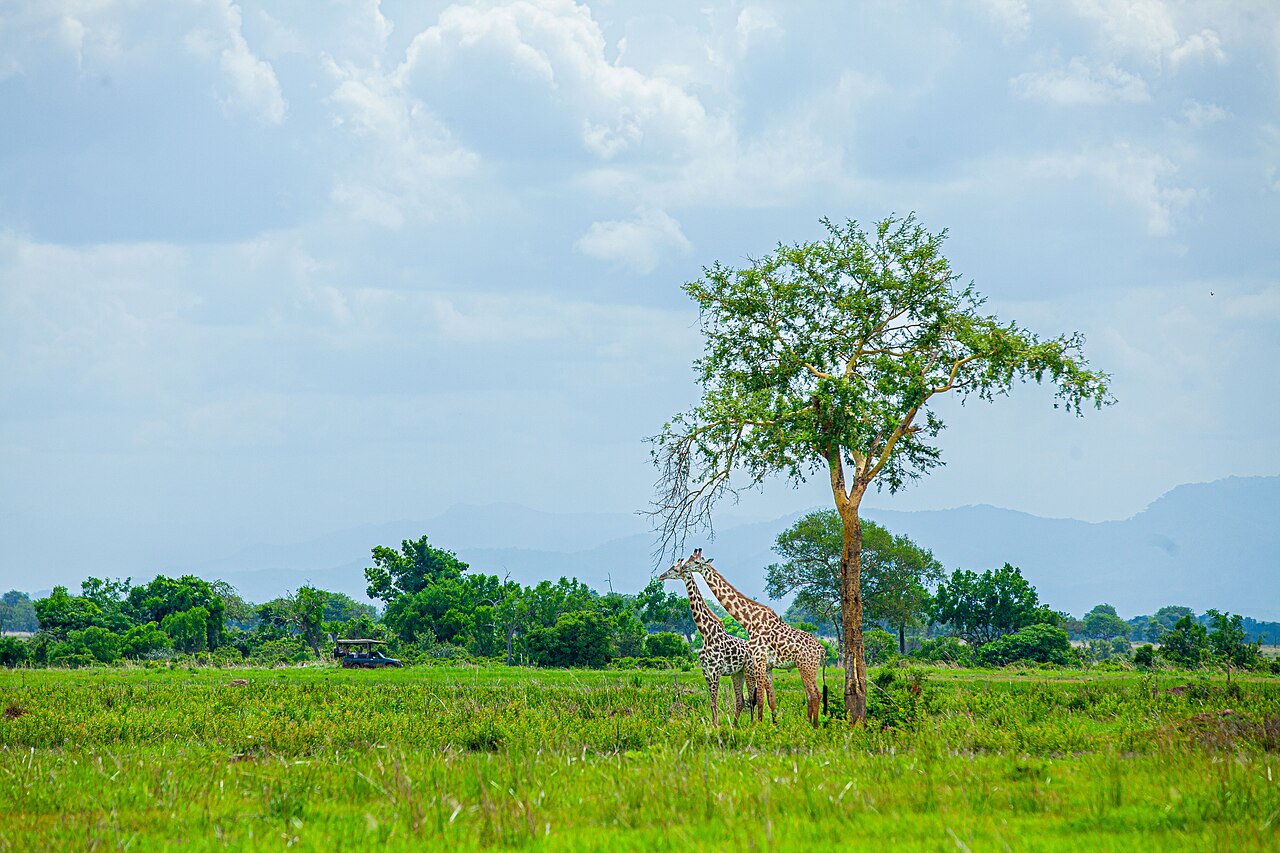
Acacias do not surrender their leaves willingly, and the defenses are layered. Long white thorns are the visible layer, and some species host aggressive ants in swollen thorn bases that swarm anything disturbing the branch. Giraffes work around both, using the tongue and lips to strip leaves between thorns and simply tolerating the ants.
The chemical defense is more sophisticated. When a giraffe browses heavily, the tree increases tannin production in its leaves within minutes, making them bitter and reducing protein digestibility. Tannins bind proteins in the gut, so a browser that keeps feeding on a defended tree extracts progressively less nutrition from the same volume of leaves.
Some acacias also release ethylene gas that drifts downwind, and neighboring trees respond by raising their own tannin levels before the giraffe arrives. Giraffes counter this behaviorally rather than physiologically. They feed on a single tree for only a few minutes, then move on, and where wind direction is a factor they often work upwind so they reach trees that have not yet received the warning. Their saliva also contains tannin-binding proteins that partially neutralize the defense.
The Tongue That Does the Work
A giraffe’s tongue reaches 18 to 20 in and is fully prehensile, capable of wrapping around a branch and stripping it clean in a single pull. Combined with mobile lips and a narrow muzzle, it lets the animal select individual leaves from between thorns with surprising precision.
The color is not incidental. Giraffe tongues are dark blue-purple to nearly black at the front, and the pigmentation is widely interpreted as protection against sun damage during the many hours per day the tongue is exposed. The rear portion, which stays inside the mouth, is pink.
Two further adaptations handle the thorns. The tongue and lips are covered in tough papillae that resist puncture, and the saliva is unusually thick and viscous, coating any thorn that does get swallowed so it passes without injuring the gut. Giraffes also lack upper incisors, using a dental pad against lower teeth to tear vegetation rather than cutting it, a trait shared with cattle and deer that produces the ragged browse damage described in our guide to deer droppings and browse sign.
How Much Do Giraffes Eat Per Day?
An adult bull eats around 75 lb of vegetation daily, while cows typically take in less, often around 45 to 55 lb, reflecting their smaller body size. Actual intake fluctuates substantially with season, since dry-season browse is both scarcer and lower in quality.
Feeding occupies 16 to 20 hours of the day, concentrated in the early morning and late afternoon with continued browsing through the night. That leaves remarkably little time for anything else, and it is the main reason giraffes sleep so little, averaging around 30 minutes to 4.5 hours per day, usually in short bouts of a few minutes standing up.
Leaves are the reason for the time budget. Foliage is bulky and low in energy relative to its volume, so a large browser has to process an enormous quantity to meet its needs. Bulls and cows also partition the resource by height, with bulls stretching upward and cows feeding at shoulder level, which reduces direct competition within a herd.
Do Giraffes Drink Water?
They do, but rarely. Giraffes obtain most of their water from the leaves they eat, and acacia foliage can be up to 70 percent water, which means a well-fed giraffe in green season may go weeks without drinking. During the dry season they visit water every few days where it is available.
Drinking is the most vulnerable moment in a giraffe’s day. To reach the surface the animal must splay its front legs wide or bend them, lowering its head 15 ft or more, a position from which standing up quickly is impossible. Lions target giraffes at waterholes for exactly this reason, and giraffes typically approach in groups with some animals staying alert.
The cardiovascular system makes the movement possible at all. A giraffe’s heart generates roughly twice the blood pressure of most large mammals to push blood up the neck, and a network of elastic vessels along with valves in the jugular veins prevents a catastrophic surge to the brain when the head drops. That system is one of the more remarkable pieces of engineering in mammal physiology.
Rumination and the Four-Chambered Stomach
Giraffes are ruminants, the same digestive category as cattle, deer, and antelope. Food passes first into the rumen, where microbes ferment cellulose that no mammal can digest on its own, then moves through the reticulum, omasum, and abomasum, the last functioning like a conventional stomach.
Cud chewing does the mechanical work. The animal regurgitates a bolus of partially fermented material, chews it thoroughly, and swallows it again, which increases the surface area available to gut microbes. Giraffes ruminate while standing and while walking, and they often do it at night between feeding bouts, which is one way they fit so much processing into a day.
Efficiency is what makes the diet viable. Rumination lets a giraffe extract usable energy and protein from leaves that would pass through a simple stomach largely intact, and the microbial population itself becomes a protein source as it is digested further down the tract. Without it, the sheer volume of leaves required would be impossible to consume.
Why Giraffes Chew Bones
Giraffes practice osteophagia, the deliberate chewing of bones, and it surprises almost everyone who sees it. A giraffe will pick up a bone, hold it in the mouth, and manipulate and gnaw it for extended periods, sometimes many minutes, before dropping it.
The behavior is nutritional rather than predatory. Bones supply calcium and phosphorus, both of which a browsing diet can run short on, and the demand is substantial in a species that must build and maintain an extremely heavy skeleton. Pregnant and lactating females and bulls growing large ossicones appear to do it most.
Giraffes do not swallow the bones, which is worth stating clearly, since they cannot digest them. They extract minerals through prolonged chewing and drop the remainder. The behavior is documented in other herbivores including cattle, deer, and tortoises for the same reason, and it is a normal response to mineral scarcity rather than a sign of illness. Mineral hunger drives feeding behavior across many species, as our guide to what elephants eat describes for animals that dig for salt.
What Do Giraffes Eat in Zoos?
Captive diets aim to reproduce the nutritional profile of wild browse without access to African acacias. The base is typically alfalfa hay, supplemented with a specialized high-fiber ruminant pellet formulated for browsers rather than grazers, since standard cattle feed is too starchy and causes digestive problems.
Browse is the part that matters most and is hardest to supply. Zoos cut branches from acceptable species such as willow, mulberry, elm, and maple, and many maintain dedicated browse plantations. Fresh browse supports normal rumen function, provides the tongue and jaw work the animal is built for, and reduces stereotypic behaviors that appear when a giraffe cannot browse.
Produce plays a smaller role than visitors expect. Carrots, lettuce, and similar items are used mainly for training and enrichment rather than nutrition, and institutions including the Smithsonian’s National Zoo limit them because a diet too rich in sugars and too poor in fiber leads to poor rumen health and dental disease. Getting captive giraffe nutrition right has been a decades-long research effort, and it remains one of the harder husbandry problems in zoos. The same principle of matching diet to digestive anatomy runs through our guides to what possums eat and what snails eat.
Frequently Asked Questions
What do giraffes eat?
Giraffes are browsers that eat leaves, shoots, buds, flowers, seed pods, and fruit from trees and tall shrubs. Acacia species are the staple across most of their range, though they feed on more than 100 plant species in total. An adult bull eats around 75 lb of vegetation per day.
How do giraffes eat thorny acacia leaves?
They use an 18 to 20 in prehensile tongue and mobile lips to strip leaves from between the thorns, and both are covered in tough papillae that resist puncture. Their saliva is thick and viscous, coating any thorn that gets swallowed so it passes without injuring the digestive tract.
Do giraffes drink water?
Yes, but rarely. Most of their water comes from leaves, which can be up to 70 percent water, so a well-fed giraffe may go days or weeks without drinking. Drinking requires splaying the front legs and lowering the head, which is the most vulnerable position in a giraffe’s day.
Why do giraffes chew bones?
To obtain calcium and phosphorus, minerals that a leaf-based diet can be short of and that a giraffe needs in quantity to build and maintain a very heavy skeleton. The behavior is called osteophagia. Giraffes do not swallow the bones, they chew them and drop the remains.
How long do giraffes spend eating?
Between 16 and 20 hours a day, concentrated in early morning and late afternoon with continued browsing at night. Leaves are bulky and low in energy, so a large browser must process an enormous volume, which is also why giraffes sleep as little as 30 minutes to 4.5 hours daily.
Do giraffes eat meat?
No. Giraffes are strict herbivores with a four-chambered ruminant stomach adapted to fermenting plant fiber. Bone chewing is sometimes mistaken for meat eating, but they are extracting minerals from dry bones rather than consuming flesh.
What do zoo giraffes eat?
Alfalfa hay plus a specialized high-fiber pellet formulated for browsers, supplemented with fresh cut browse from species such as willow, mulberry, elm, and maple. Produce like carrots and lettuce is used mainly for training and enrichment, since too much sugar and too little fiber causes rumen and dental problems.