What Do Ants Eat? Diet by Species and Colony Role
Ants eat almost anything that carries energy or protein, but what do ants eat most often? In the wild, the bulk of an average colony’s diet is sugar: honeydew farmed from aphids, floral nectar, ripe fruit, and plant sap. Alongside that sugar stream, workers hunt and scavenge protein in the form of insects, spiders, carrion, seeds, and eggs. The split is not random. Adult worker ants can only swallow liquids and tiny particles, so sugar fuels them directly, while solid protein goes to the larvae that need it to grow.
Diet varies enormously between the roughly 14,000 described ant species. Leafcutters farm fungus, harvester ants store seeds, army ants hunt in swarms, and the sugar ants raiding your kitchen counter want exactly what their name suggests. Understanding those differences explains both what ants eat outdoors and why they suddenly appear indoors.
| Question | Quick Answer |
|---|---|
| Main food source | Sugars: honeydew, nectar, fruit, plant sap |
| Protein sources | Insects, spiders, carrion, eggs, seeds |
| Diet type | Mostly omnivorous, some species specialized |
| What larvae eat | Solid protein pre-processed by workers |
| What ants drink | Water, dew, honeydew, and other liquids |
| Common kitchen targets | Sugar, syrup, grease, pet food, crumbs |
The Ant Diet at a Glance: Sugars, Proteins, and Fats
Most ant species are omnivores that shift their diet with the season and the colony’s needs. Carbohydrates dominate day to day because worker ants burn sugar for the constant foraging, digging, and nest maintenance that keeps a colony running. That sugar arrives mainly as honeydew, the sweet waste that aphids, scale insects, and mealybugs excrete after feeding on plant sap. Many ant colonies actively protect these insects from predators in exchange for a reliable sugar supply, a partnership that entomologists at land grant universities have documented across dozens of species.
Protein plays a different role. Adult workers barely use it, but the developing larvae inside the nest need large amounts to build tissue. When a colony has many larvae in spring and early summer, foragers swing hard toward hunting and scavenging. When brood production slows in late summer, the same colony shifts back toward sugar. This is why a bait that ants ignore in May can suddenly work in August, and why pest control advice often recommends offering both a sweet and a protein based bait.
Fats and oils fill a third niche. Grease spots, nut fragments, seed oils, and pet food kibble all attract certain species strongly. Grease ants, sometimes called thief ants, specialize in exactly this. The practical takeaway is that no single food describes the ant diet. A colony behaves like a flexible supply chain, sending scouts out to sample everything and then concentrating on whatever nutrient it currently lacks.
What Insects and Animals Do Ants Eat?
Ants are among the most significant invertebrate predators in almost every terrestrial habitat. Their prey list includes caterpillars, termites, fly larvae, aphids that have wandered off protection duty, springtails, small beetles, crickets, spiders, and the eggs and nymphs of dozens of other insects. Larger colonies routinely take prey many times the size of an individual worker because they attack in coordinated groups, immobilize the target, and cut it into transportable pieces.
Scavenging matters just as much as hunting. A dead beetle on a sidewalk, a squashed caterpillar, a fallen nestling, or roadkill remains will all be found and stripped by ants within hours in warm weather. This cleanup role is a genuine ecosystem service. Colonies recycle nitrogen from carcasses back into the soil and reduce the number of decaying insects accumulating in gardens and lawns.
Some species take predation much further. Army ants form raiding columns that flush and consume everything in their path, including other ant colonies, scorpions, and occasionally small vertebrates that cannot escape quickly. Tropical species such as the bullet ant hunt live arthropods and also collect nectar high in the canopy. At the other end of the scale, tiny thief ants sneak into neighboring nests specifically to steal brood, meaning some ants genuinely do eat other ants.
Do Ants Eat Plants, Leaves, Grass, and Flowers?
Ants interact with plants constantly, but most of them do not eat leaf tissue directly. What they usually want is the liquid: nectar from flowers, extrafloral nectar from specialized glands on stems and leaf bases, sap seeping from wounds, and honeydew produced by sap feeding insects on the plant. That is why you see trails of ants running up rose stems and along milkweed without any obvious feeding damage. The plant itself is intact; the ants are collecting sugar from the aphid colony near the growing tips.
Leafcutter ants are the famous exception, and even they do not eat the leaves they carry. Workers slice fragments of foliage and haul them underground, where the colony uses the plant material as a growing medium for a specialized fungus. The fungus is the actual food, and the colony tends it like a crop, weeding out contaminants and feeding it fresh trimmings. A mature leafcutter nest can defoliate a tree while never digesting a single leaf.
Grass is generally safe. Ants do not graze on turf, though nest building can leave bare patches and mounds that damage a lawn indirectly. Harvester ants do consume plant material in the form of seeds, which they collect, store in underground granaries, and process into a paste called ant bread. Seed eating makes them important dispersers for many wildflowers and grasses, and it puts them in the same functional group as many seed eating birds, such as the species covered in our guide to what birds eat.
What Do Carpenter Ants Eat? Hint: Not Wood
Carpenter ants have one of the most persistent myths attached to them. They excavate wood to build nest galleries, but they do not digest cellulose and they gain no nutrition from it. Sawdust like shavings, called frass, pile up beneath their entry points precisely because the wood is being discarded rather than eaten. Termites eat wood; carpenter ants merely remodel it.
Their actual diet is standard omnivore fare with a strong sugar bias. Outdoors, carpenter ants rely heavily on honeydew from aphids and scale insects, supplemented with nectar, fruit juice, and living or dead insects. Indoors, they go after syrup, jelly, honey, pet food, meat scraps, and grease. Because a large satellite colony can send foragers well over a hundred feet from the parent nest, seeing them in a kitchen does not necessarily mean the nest is in your kitchen wall.
Moisture is the real predictor of a carpenter ant problem. They prefer wood that has already been softened by a leak, condensation, or ground contact, which is why infestations cluster around window frames, roof edges, sill plates, and bathroom walls. Fixing the moisture source removes the nesting habitat, while sweet and protein baits handle the foragers. Treating only the visible ants without addressing damp wood usually means they return the following season.
What Do Fire Ants and Red Ants Eat?
Red imported fire ants are aggressive generalists with an unusually broad diet, which is a large part of why they spread so successfully across the southern United States. Texas A and M AgriLife Extension research describes them consuming insects, earthworms, ticks, spiders, small vertebrates, carrion, seeds, honeydew, and plant sap. Colonies also raid the nests of native ants, so their arrival tends to reduce local ant diversity sharply.
Like other ants, fire ant workers cannot swallow solid food. They liquefy prey outside the body or carry solids to the fourth instar larvae, which are the only colony members able to digest solids. Those larvae process the material and return it as a liquid the rest of the colony can share, a nutrient exchange called trophallaxis. This dependency is exactly what granular baits exploit: a slow acting toxicant carried inside a soybean oil coating gets shared through the entire colony, including the queen.
Other red ants behave differently. Red harvester ants are seed specialists that clear a bare disc around the nest entrance and stockpile grass and forb seeds underground. Little red pavement ants forage on almost anything organic, including the plant material stink bugs feed on and insect carcasses on driveways. Identifying which red ant you actually have matters, because seed eaters, generalists, and honeydew specialists all respond to different baits.
What Do Sugar Ants and Other Kitchen Invaders Eat?
The ants that show up on countertops are overwhelmingly after two things: sugar and moisture. Odorous house ants, Argentine ants, pavement ants, and the various small species lumped together as sugar ants all follow the same pattern. A scout finds a spill, a sticky jar rim, an unsealed cereal bag, or a pet bowl, and returns to the nest laying a pheromone trail. Within hours a full column can form along that exact route.
Grease and protein pull in a second group. Pharaoh ants and thief ants target meat scraps, cheese, peanut butter, cooking oil residue behind the stove, and dry pet food. Because these species nest in wall voids and under appliances rather than outdoors, they are the hardest to eliminate with surface sprays. Baiting works far better, since foragers carry the bait back and distribute it through trophallaxis.
Prevention is mostly about removing the reward. Wipe surfaces with soapy water to destroy pheromone trails, store sugar, honey, and cereal in sealed containers, empty pet bowls between feedings, and fix dripping taps that supply the water ants need in dry weather. The same logic applies outdoors: if ants are swarming a nectar feeder, apply the physical barriers described in our guide to keeping ants out of hummingbird feeders rather than spraying near the feeding station.
What Do Queen Ants and Ant Larvae Eat?
A queen ant does not forage. After the mating flight she sheds her wings, seals herself into a starter chamber, and in most species raises her first brood entirely on her own body reserves. She metabolizes her now useless flight muscles and stored fat to produce eggs and to feed the first larvae with glandular secretions. Those first workers emerge unusually small because the resources were so limited, and their only job is to break out, find food, and start supplying the nest.
From that point on, the queen is fed by workers through trophallaxis. Foragers fill their social stomach, called the crop, with liquid food and regurgitate it to nest mates, including the queen, nurse workers, and larvae. This mouth to mouth transfer moves nutrition, enzymes, and chemical signals through the colony, which is also why colony wide baiting works so well.
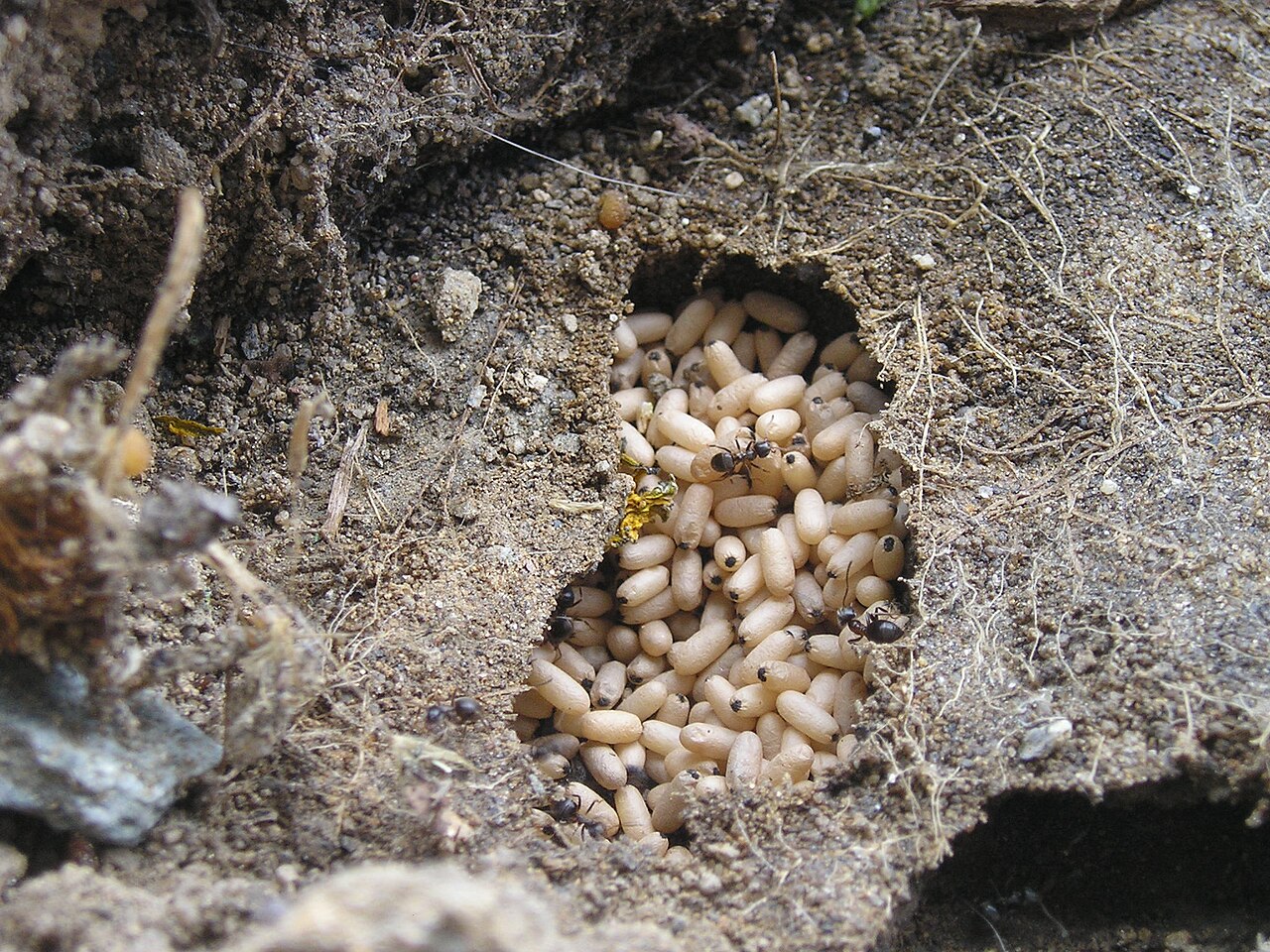
Larvae get the protein. Nurse workers place solid fragments of insect prey directly against the larval mouthparts, and in many species the older larvae do the actual digesting for the colony. Some species also lay unfertilized trophic eggs specifically as larval food when prey is scarce. The overall pattern is worth remembering: adults run on sugar, brood runs on protein, and the queen runs on whatever the workers deliver.
What Do Ants Drink and How Do They Find Water?
Ants need water constantly, and most of it arrives dissolved in the liquids they already collect. Honeydew, nectar, fruit juice, and the body fluids of prey all supply hydration alongside calories. When those sources dry up, foragers go looking for free water at dew on foliage, condensation on pipes, pet bowls, sink drains, and the damp soil around potted plants. A sudden indoor ant invasion during a hot dry spell is usually a water problem rather than a food problem.
Desert species have refined this further. Some harvester ants obtain nearly all their water metabolically, by breaking down the fats and carbohydrates in stored seeds, and can survive long stretches without drinking at all. Others restrict foraging to the cooler hours near dawn and dusk to reduce water loss through their cuticle.
Anyone keeping an ant farm should treat water as seriously as food. A cotton plug in a test tube of water, or a small water gel source, prevents desiccation, which kills captive colonies far more often than starvation does. For feeding, a few drops of sugar water plus a small piece of insect protein a couple of times a week suits most beginner species. Avoid oily processed foods, which mold quickly and foul the nest, and never leave uneaten protein in the enclosure for more than two days. The same care applies to feeding any small captive animal, from ants to the insect eating pets covered in our guide to what lizards eat.
Why Ant Diets Matter in Your Yard
Because ants eat so broadly, they sit at the center of the backyard food web in ways that are easy to overlook. They consume large numbers of pest insects, disperse seeds, aerate soil, and recycle carcasses. Studies of soil invertebrates repeatedly find that ant activity improves water infiltration and nutrient cycling in ways comparable to earthworms in many soil types.
They are also food themselves. Woodpeckers, flickers, wrens, and towhees hunt ants heavily, as do lizards, toads, spiders, and beetle larvae. When you see a flicker probing a lawn repeatedly, it is almost certainly working an ant colony. Predatory beetles and the aphids ladybugs feed on both intersect with ant activity too, since ants defending honeydew producers will actively drive ladybugs away from an aphid colony.
That last point explains the one real garden conflict. Ants protecting aphids can suppress the natural enemies that would otherwise control them, so heavy ant traffic on a plant often signals a growing aphid population underneath. The practical response is to treat the aphids and to band tree trunks rather than to wage war on the ants themselves. Removing ants from a healthy yard removes a predator, a scavenger, and a soil engineer all at once.
Frequently Asked Questions
Do ants eat bread?
Yes. Bread contains starch that breaks down into sugars, and many household species will carry crumbs back to the nest. Sweet breads, cake, and anything with jam or icing attract them far faster than plain bread. Crumbs in a toaster tray or under an appliance are one of the most common indoor ant attractants.
What do ants like to eat the most?
For most species the strongest single attractant is a simple sugar solution such as honeydew, nectar, syrup, or jelly. Adult workers can only swallow liquids, so sweet liquids are both the easiest and the most energy dense option. Colonies raising brood will switch preference toward protein and grease for several weeks at a time.
Do ants eat grass?
No, ants do not graze on grass blades. Damage attributed to ants in lawns comes from tunneling and mound building, which dries out roots and smothers turf in patches. Harvester ants do collect grass seeds, and leafcutters may cut grass blades to feed their fungus gardens, but neither digests the plant material itself.
What do ants eat in the wild?
Wild colonies live mainly on honeydew from aphids and scale insects, floral and extrafloral nectar, insect prey, carrion, seeds, and fungal material. The exact mix depends on species and season. Predatory species hunt more, seed harvesters store grain, and honeydew specialists may get most of their calories from a handful of tended aphid colonies.
Do ants eat other ants?
Yes, frequently. Army ants raid other colonies for brood, thief ants specialize in stealing larvae from neighboring nests, and many species kill and consume rival workers during territorial fights. Colonies also consume their own dead and, when starving, may cannibalize eggs and larvae to conserve resources for the queen.
What do army ants eat?
Army ants are obligate predators that hunt in massive coordinated swarms rather than building permanent nests. Their raids consume other insects, spiders, scorpions, other ant colonies, and occasionally small vertebrates that cannot flee. A single large raid can capture tens of thousands of prey items in one day.
Do ants eat plant roots?
Ants rarely eat roots directly, but they can damage them indirectly by tunneling around the root zone and by transporting root feeding aphids and mealybugs from plant to plant. Cornfield ants are well known for moving root aphids between grasses. If a potted plant declines with heavy ant traffic, check the soil for these sap feeding insects.