Polyphemus Moth: Identification, Caterpillar, and Cocoon
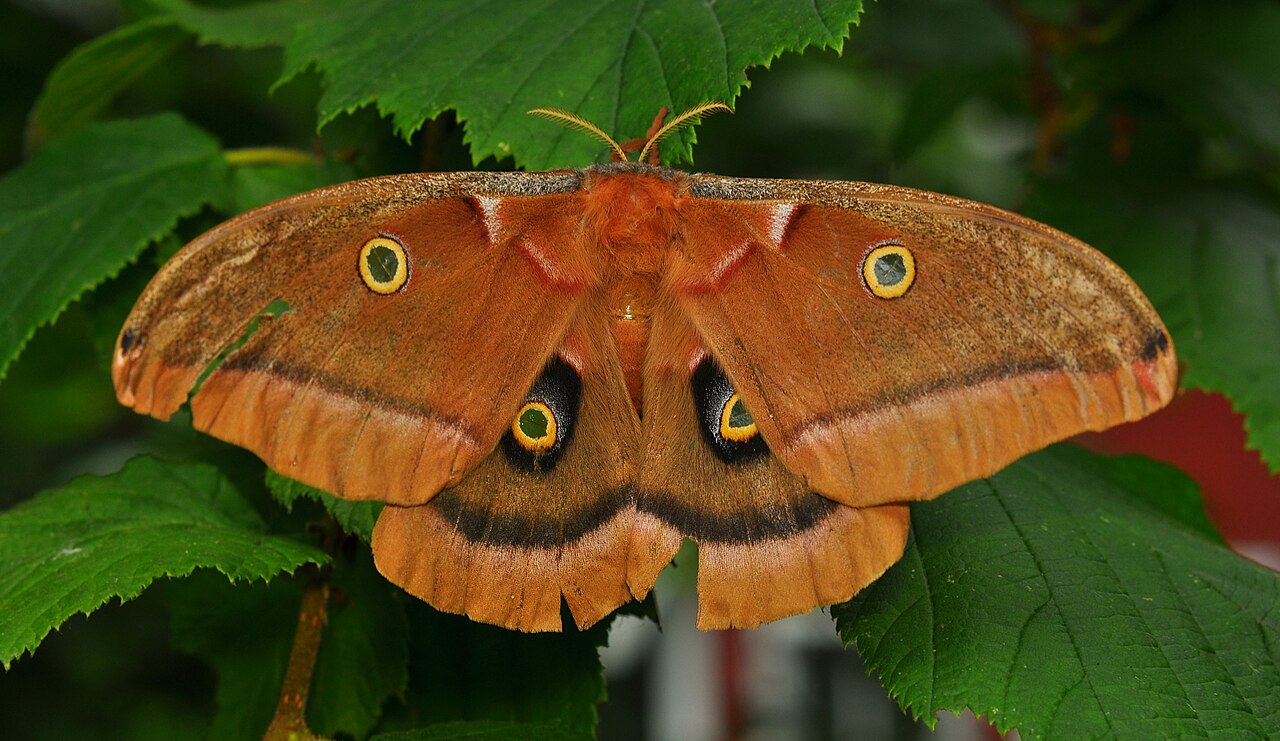
The polyphemus moth is a giant silk moth with a wingspan of 4 to 6 inches and a large transparent eyespot on each hindwing, ringed in yellow, black, and blue. Its scientific name is Antheraea polyphemus, and both the common and scientific names come from Polyphemus, the one-eyed Cyclops of Greek myth. It is one of the most widespread large moths in North America, found from southern Canada through most of the United States and into Mexico.
Adults cannot eat. They emerge without functional mouthparts, live roughly four days to a week, and spend that time doing nothing but finding a mate. Almost everything interesting about this species happens in the caterpillar and cocoon stages, which last far longer than the adult moth people actually notice.
| Feature | Details |
|---|---|
| Scientific name | Antheraea polyphemus, family Saturniidae |
| Wingspan | 4 to 6 inches |
| Adult lifespan | About 4 to 7 days, no feeding |
| Caterpillar | Bright green, up to 3 inches, red and silver tubercles |
| Host plants | Oak, maple, birch, willow, hickory, elm and many others |
| Overwinters as | Pupa inside a silk cocoon, usually in leaf litter |
| Danger to people | None, it cannot bite or sting at any stage |
What Is a Polyphemus Moth?
Polyphemus moths belong to Saturniidae, the giant silk moth family that also contains the luna, cecropia, promethea, and io moths. Members of this family share a set of traits: very large size, feathery antennae, heavy furred bodies, and adults that live only long enough to reproduce. The polyphemus is the most widely distributed of the North American giants, occurring in almost every state.
The species name refers to the eyespots. Polyphemus was the Cyclops blinded by Odysseus, and the single large eye marking on each hindwing gave the moth its name. Those markings are not simple color patches. The center of each spot is a clear window where scales are absent, so light passes through the wing membrane, which makes the eye look wet and alive.
Despite its size, this is not a rare moth. It is simply nocturnal, short lived as an adult, and easy to overlook when it rests against tree bark during the day. Most encounters happen by accident when a moth comes to a porch light overnight and is still sitting on the wall at breakfast. The equally impressive cecropia moth shares that habit and often appears in the same yards.
How to Identify a Polyphemus Moth
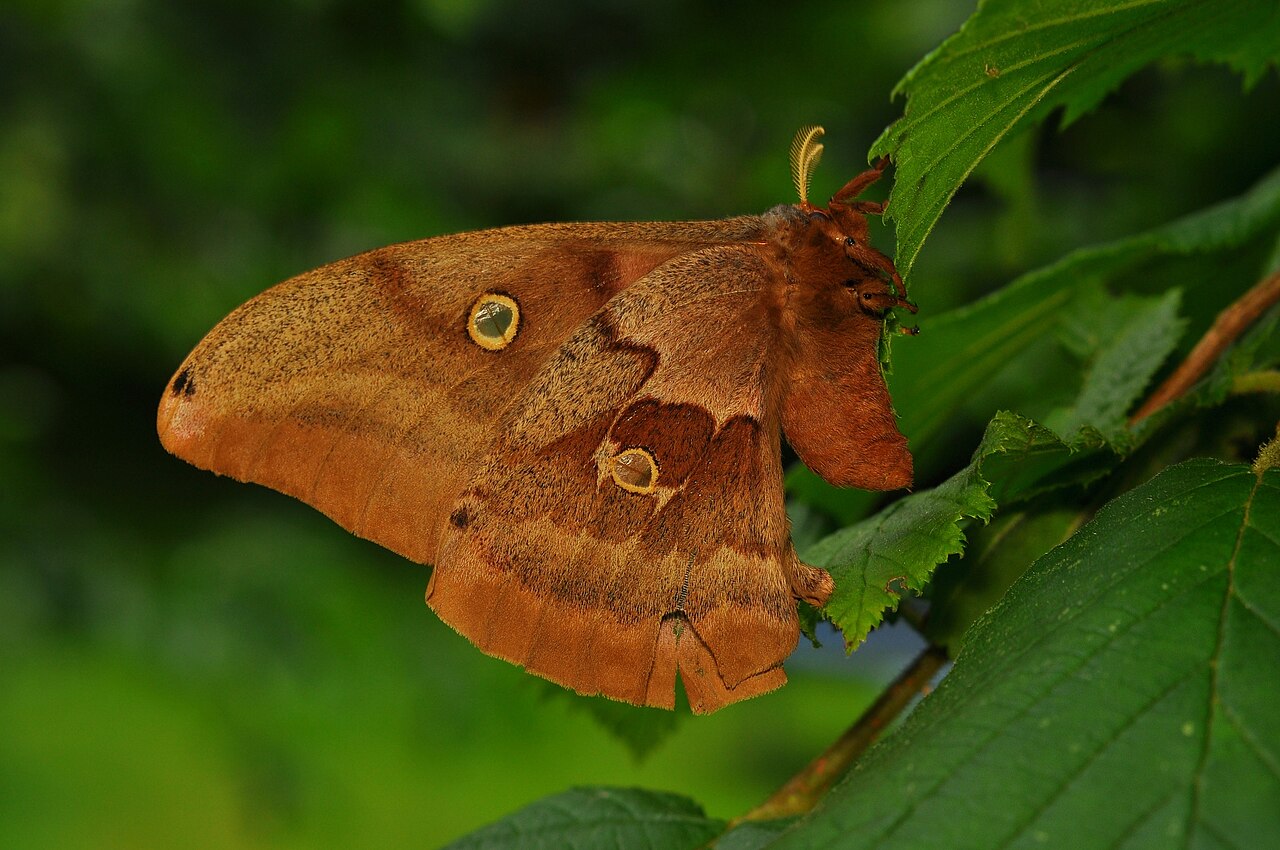
Start with the eyespots, which are diagnostic. Each hindwing carries a large yellow oval with a clear center and a black and blue border, and the forewings carry a much smaller version of the same mark. No other North American moth combines that pattern with a wingspan over 4 inches, so a confident identification takes seconds once the wings are open.
Wing color ranges from tan to reddish brown to a deep russet, with individual variation across regions and between broods. A pale pink and white line crosses both wings, and the outer margin often carries a darker band. The body is thick, densely furred, and the same color as the wings, and the legs are short and tucked under when the moth is resting.
Size alone narrows the field quickly. Very few moths in North America reach a 6 inch wingspan, and the ones that do are almost all in this same family. If you are working through a general identification of large moths in your area, our overview of giant moths covers how the major species differ, and the smaller imperial moth is the yellow and purple species most often confused with the polyphemus at a distance.
Male vs Female Polyphemus Moth
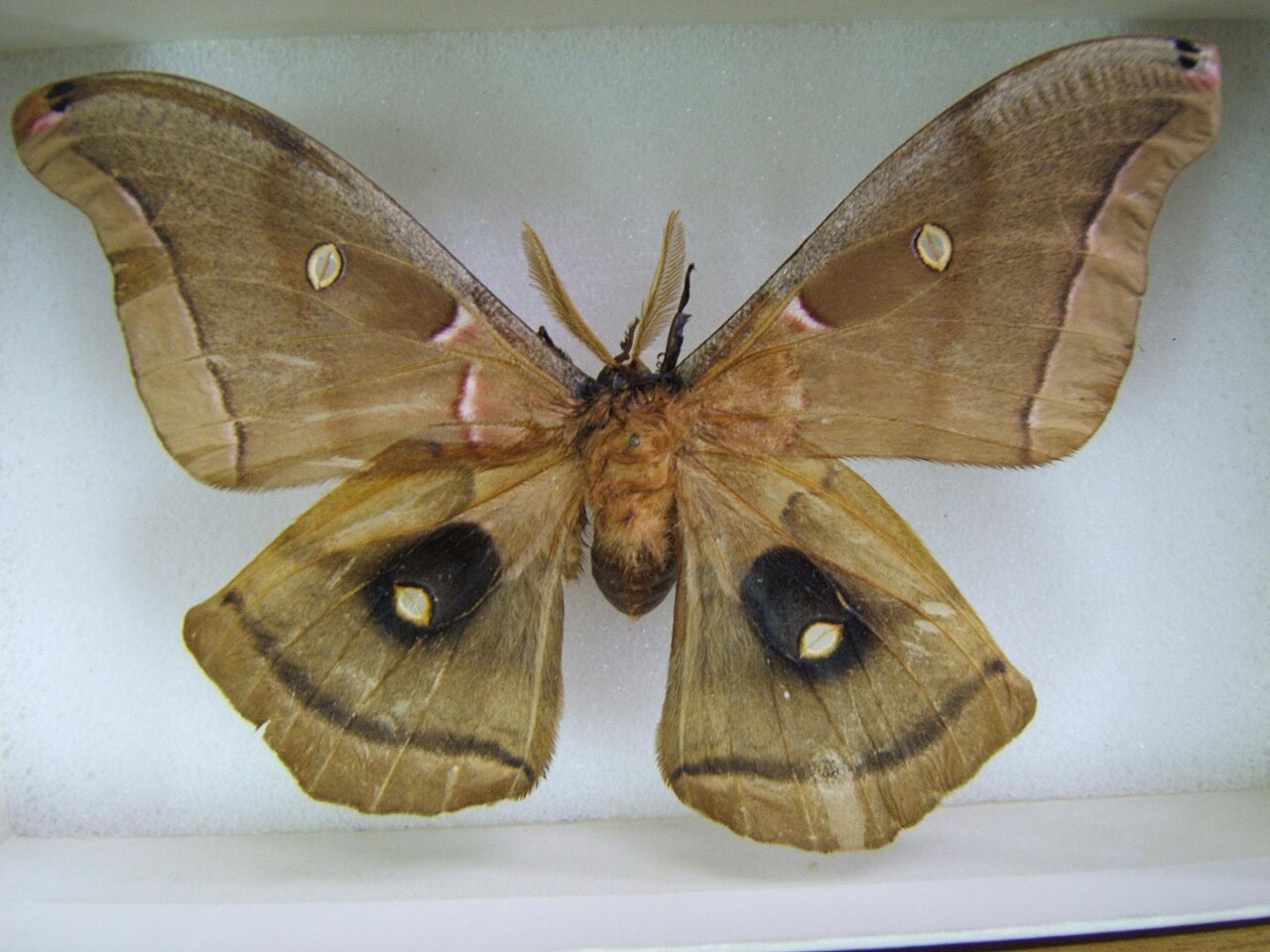
Antennae give the fastest answer. Male polyphemus moths have broad, deeply feathered antennae that look like two miniature ferns, built to hold an enormous surface area of chemical receptors. Females have noticeably narrower antennae with much shorter branches. Hold the two side by side and the difference is unmistakable, and it is visible even in photographs.
Body shape is the second clue. Females carry a heavy abdomen packed with eggs and appear bulkier overall, while males are slimmer with a more tapered rear. Females also tend to be slightly larger in wingspan. Behavior separates them too, since a moth flying actively and erratically at night is usually a male searching, while a female often sits still on vegetation and calls.
That calling is the reason for the antennae. A female releases a pheromone plume from a gland at the tip of her abdomen, and males detect it at extraordinary distances. Research on giant silk moths has documented males orienting to females from well over a mile away, tracking the plume upwind through the night. It is one of the most sensitive chemical detection systems known in animals.
The Polyphemus Moth Caterpillar
The caterpillar is as striking as the adult. It is a bright apple green, deeply segmented so the body looks like a stack of accordion folds, and reaches roughly 3 inches when fully grown. Each segment carries small orange or red tubercles tipped with silver, and a pale yellow diagonal line runs along each side. The head is brown and comparatively small.
Host plants are unusually broad. Oak, maple, birch, willow, hickory, elm, ash, and many fruit trees all work, which is a major reason the species is so widespread. A female typically lays eggs singly or in small groups on leaves, and hatchlings begin feeding immediately. The larva passes through five instars over about five to six weeks in summer conditions.
The growth rate is the detail entomologists like to quote. A polyphemus caterpillar consumes something on the order of 86,000 times its own birth weight during larval development, a figure that appears in university extension entomology materials and reflects just how much leaf tissue a giant silk moth needs to build a 6 inch adult. If you find one, leave it on its tree, since moving it to a different plant species can kill it. Our guide to the fuzzy caterpillar group covers the very different hairy species people are more likely to worry about.
The Life Cycle From Egg to Moth
Eggs are flat, round, and brown-rimmed, and hatch in about 10 days. The tiny first-instar larva is yellow-green and heavily marked, and it changes appearance at each molt, becoming greener and plumper as it grows. By the fifth instar the caterpillar is unmistakable and heavy enough to bend a thin twig.
Once feeding stops, the caterpillar spins a dense, oval silk cocoon. Most are wrapped in a leaf and either stay attached to the twig through winter or drop to the ground when the leaf falls. The pupa inside is dark brown and immobile. Adults emerge in the morning, pump fluid into their wings over about an hour, and wait for the wings to harden before their first flight at dusk.
Brood timing depends on latitude. Northern populations produce a single generation each year, with adults flying from late spring into early summer. Southern populations fit in two broods, typically one in April and May and a second in July and August. In the far south a third partial brood is possible. Either way, the winter is spent as a pupa inside the cocoon.
Cocoons and How to Overwinter One
Polyphemus cocoons are easy to recognize once you know the shape. They are firm, oval, roughly the size of a large egg, and usually wrapped in a curled leaf held together with silk. People most often find them raking leaves in autumn or spotting one still hanging from a bare branch in winter. A cocoon that rattles gently when tilted contains a live pupa.
If you want to overwinter one properly, place it in a ventilated container with a stick for climbing, keep it outdoors in a sheltered spot protected from mice and squirrels, and add a light mist of water every few weeks so the pupa does not desiccate. Release the adult the evening it emerges, near the trees it will use as host plants. Raking every leaf out of a yard destroys far more cocoons than most people realize, which is why leaving leaf litter under trees is standard advice from conservation groups such as the Xerces Society.
How Long Does a Polyphemus Moth Live?
The adult stage lasts about four to seven days, and occasionally up to ten. That short window is not an accident or a sign of a weak insect. It is the direct result of an evolutionary trade in which the moth invests everything in the caterpillar stage and nothing in adult feeding.
Adults have vestigial mouthparts and no functional proboscis. They cannot drink nectar, sip water, or take any food at all, so every bit of energy the adult uses was stored as fat by the caterpillar. All of that energy goes into flight, mate location, and egg laying. A female may carry more than 200 eggs and lay most of them within her first two nights.
The full life cycle tells a different story. Counting the egg, five larval instars, and the long pupal rest, an individual can exist for ten months or more. Seen that way, the giant moth on your porch light is the final few days of a much longer life, which is also true of the nectar-feeding species covered in our guide to what moths eat, where adult feeding does happen.
Are Polyphemus Moths Dangerous or Poisonous?
No. Polyphemus moths cannot bite, sting, or inject anything at any stage. The adult has no mouthparts capable of breaking skin, and it carries no toxins in its body. Handling one is entirely safe, though the wings are fragile and scales rub off easily, so gently coaxing the moth onto a stick is better than picking it up.
The caterpillar is also harmless. The small orange tubercles look like they might sting but they are blunt, and the species has no urticating hairs or venom glands. A disturbed larva may click its mandibles audibly and regurgitate a green fluid, both of which are defensive bluffs aimed at birds rather than people.
Confusion usually comes from other members of the same family. The io moth caterpillar, which is green with rows of branched spines, does deliver a painful sting, and several unrelated species carry irritating hairs. The rule is simple: smooth green caterpillars with knob-like tubercles are safe, while bristling spines deserve caution.
Polyphemus vs Luna Moth vs Cecropia Moth
These three species are the giant silk moths people most often try to tell apart, and each has a clear signature. The luna moth is pale sea green with long sweeping tails on the hindwings and is unmistakable in flight. The cecropia is the largest moth in North America, gray-brown with red and white crescents and a banded body. The polyphemus sits between them in size and is defined by the transparent eyespots.
The three overlap heavily in range and season across the eastern United States, and all three come to lights. They also share the same basic biology: non-feeding adults, short adult lives, feathery male antennae, and overwintering pupae. Cecropia cocoons are attached lengthwise along a branch, while polyphemus cocoons are usually wrapped in a leaf, which is a useful winter distinction.
Habitat preferences differ slightly. Luna moths favor deciduous woodland with hickory, walnut, and sweetgum. Cecropias are more common near maple, cherry, and shrubby edges. Polyphemus moths are the generalists of the group, which is exactly why they show up in suburban yards more often than the other two. The white moth species people report are almost always something else entirely, since none of these giants are white.
Where to Find Polyphemus Moths and How to Attract Them
The reliable method is a light. Males in particular come to porch lights, streetlights, and lit windows, and the best conditions are warm, still, moonless nights in late spring or midsummer. A white sheet hung near a light gives the moth somewhere to settle where you can see it, and this simple setup is the backbone of most moth surveys.
Habitat matters more than any single trick. Native oaks and maples in the yard supply host plants, and unsprayed trees mean caterpillars survive to adulthood. Leaving leaf litter under those trees over winter protects the cocoons already there. Reducing all-night outdoor lighting helps as well, because excessive light draws moths away from breeding and leaves them exposed to predators at dawn.
Expect the season rather than the individual. Any given adult is on the wing for less than a week, so the way to see polyphemus moths is to check the same lit wall repeatedly through the flight period rather than hoping for luck on one evening. Anyone tracking large night-flying insects across the season will also want our guide to the hawk moth, a fast-flying family that shares the same nights but behaves nothing like a silk moth.
Frequently Asked Questions
Are polyphemus moths rare?
They are not rare, just hard to notice. The species occurs across most of North America and is common in wooded and suburban areas with oak, maple, or birch. Adults are nocturnal and live only a few days, so sightings feel unusual even where the population is healthy.
Do polyphemus moths bite or sting?
No. Adults have no functional mouthparts and cannot bite, and no member of this species stings at any stage. The caterpillar’s orange tubercles are blunt and carry no venom. Handling is safe, though the wings damage easily, so it is better to let the moth walk onto a stick or your hand on its own.
What do polyphemus moth caterpillars eat?
Leaves from a wide range of deciduous trees, including oak, maple, birch, willow, hickory, elm, ash, and several fruit trees. Individual caterpillars stay on the plant where they hatched, so moving one to a different tree species can kill it. Adults eat nothing at all.
How long does a polyphemus moth live?
The adult lives about four to seven days, occasionally up to ten, because it cannot feed. Counting the egg, the five larval stages, and the overwintering pupa, the full life cycle can run ten months or more, with the vast majority of that time spent inside the cocoon.
What does it mean when you see a polyphemus moth?
Across many folk traditions large eyespotted moths are read as symbols of transformation, night vision, and watchfulness, and the polyphemus is often interpreted that way because of its false eyes. Practically speaking, a sighting usually means there are mature host trees nearby and a light that pulled the moth off course.
How can you tell a male from a female polyphemus moth?
Look at the antennae. Males have broad, feathery antennae for detecting female pheromone, while females have much narrower ones. Females also have a heavier abdomen and are often slightly larger. Males are the ones flying actively at night, so most moths that arrive at a porch light are male.
Can you raise a polyphemus moth at home?
Yes, and it is a common school and hobby project. Keep caterpillars on cuttings of the same tree species they were found on, provide fresh leaves daily, and give them space to spin a cocoon. Overwinter the cocoon outdoors in an unheated, ventilated container, then release the adult the evening it emerges.