Mountain Lion Scat: Identification and What It Means
Mountain lion scat is a segmented, tubular dropping four to six inches long and roughly one to one and a half inches thick, dark brown to black, with blunt rounded ends and dense fur packed throughout. It is the largest cat scat in North America, noticeably thicker than a bobcat’s, and like all cats the mountain lion often scrapes soil, leaves, or pine needles over its droppings or leaves them on a deliberate scrape at a travel route as a territorial marker.
Finding it is genuinely uncommon, which is worth saying plainly, because most reported mountain lion scat turns out to be coyote or large dog. Mountain lions live at very low densities, one adult may hold a range of 50 to 150 square miles, and they cover their droppings more often than not. This guide covers what mountain lion scat actually looks like, how to separate it from coyote, bobcat, and dog droppings, what the accompanying sign looks like, and what to do if you are confident you have found the real thing.
Mountain lion scat is a segmented tubular dropping 4 to 6 inches long and 1 to 1.5 inches thick, dark and packed with fur and bone fragments, with blunt ends. Mountain lions frequently bury it or leave it on a scrape as a territorial marker. It is thicker than bobcat scat and lacks the tapered, twisted point and plant matter of coyote scat.
| Feature | Mountain Lion Scat |
|---|---|
| Length | 4 to 6 in, in segments |
| Diameter | 1 to 1.5 in |
| Ends | Blunt and rounded |
| Contents | Dense fur, bone chips; no seeds or plants |
| Placement | Often buried, or on a scrape at a trail |
| Vs bobcat | Roughly twice the diameter |
| Vs coyote | Coyote tapers to a twist and contains berries |
What Does Mountain Lion Scat Look Like?
Mountain lion scat is a thick tubular dropping that breaks into distinct segments, each two to three inches long, with blunt rounded ends where each segment separated from the next. Total deposit length is four to six inches and diameter one to one and a half inches, which is the single most useful measurement, since it exceeds every other wild cat in North America and matches only large dogs and the biggest coyotes.
Fresh scat is dark brown to black with a moist surface and a strong odor, drying over a week or two to gray-brown and becoming crumbly. The segmentation comes from an obligate carnivore’s digestive tract processing a meal of fur and bone, and the segments are often constricted at intervals like linked sausages. Some segments show a slight taper where the deposit ended, but there is never the twisted, hair-wrapped point that finishes a canid dropping.
Content is uniformly animal. Mountain lions eat deer above all, along with elk calves, javelina, raccoons, rabbits, porcupines, and domestic livestock and pets where those are available, and their scat is packed with compressed fur and small bone fragments. Deer hair is distinctive under a hand lens: thick, hollow, crinkled, and it snaps rather than bends. There are never seeds, berries, grass, nuts, or insect parts, and finding any of those rules out a cat entirely.
Mountain Lion Scat vs Coyote Scat
This is the comparison that matters most, because coyote scat is common and mountain lion scat is rare, so nearly every misidentification runs in this direction. Three features separate them. Coyote scat tapers at one or both ends and typically finishes in a twisted point wrapped with hair. Mountain lion scat has blunt, rounded ends on every segment. That difference alone settles the majority of cases.
Content is the second check. Coyotes are omnivores and their scat frequently contains berry seeds, apple or persimmon skins, grass, corn, insect parts, and even bits of trash mixed with the fur. Mountain lion scat is fur and bone only. If you can see anything plant-derived in the dropping, it is not a cat.
Size is the least reliable test, since a large coyote and a small mountain lion overlap. A typical coyote dropping is three quarters to one and a quarter inches thick, so anything consistently over an inch and a quarter with blunt ends is worth taking seriously, but do not identify on diameter alone. The coyote poop guide covers the tapered form in detail, and comparing the two side by side once makes the distinction permanent.
Mountain Lion Scat vs Bobcat Scat
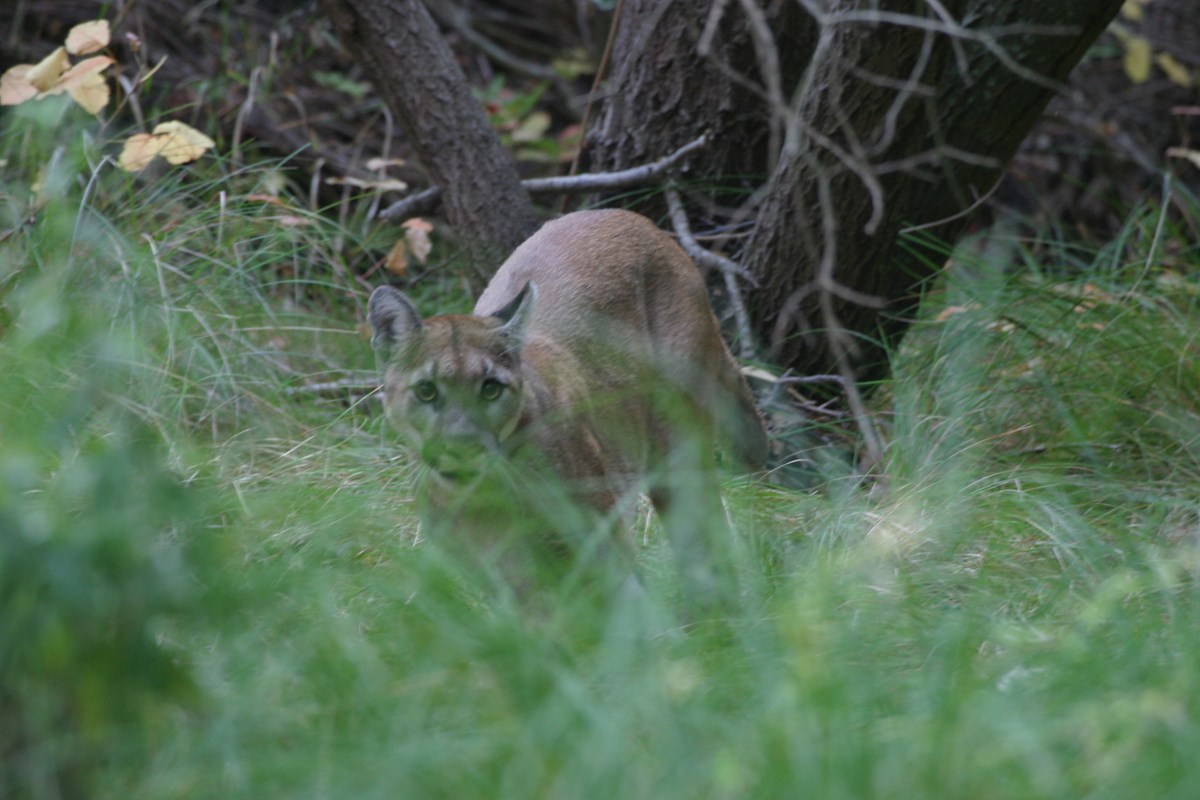
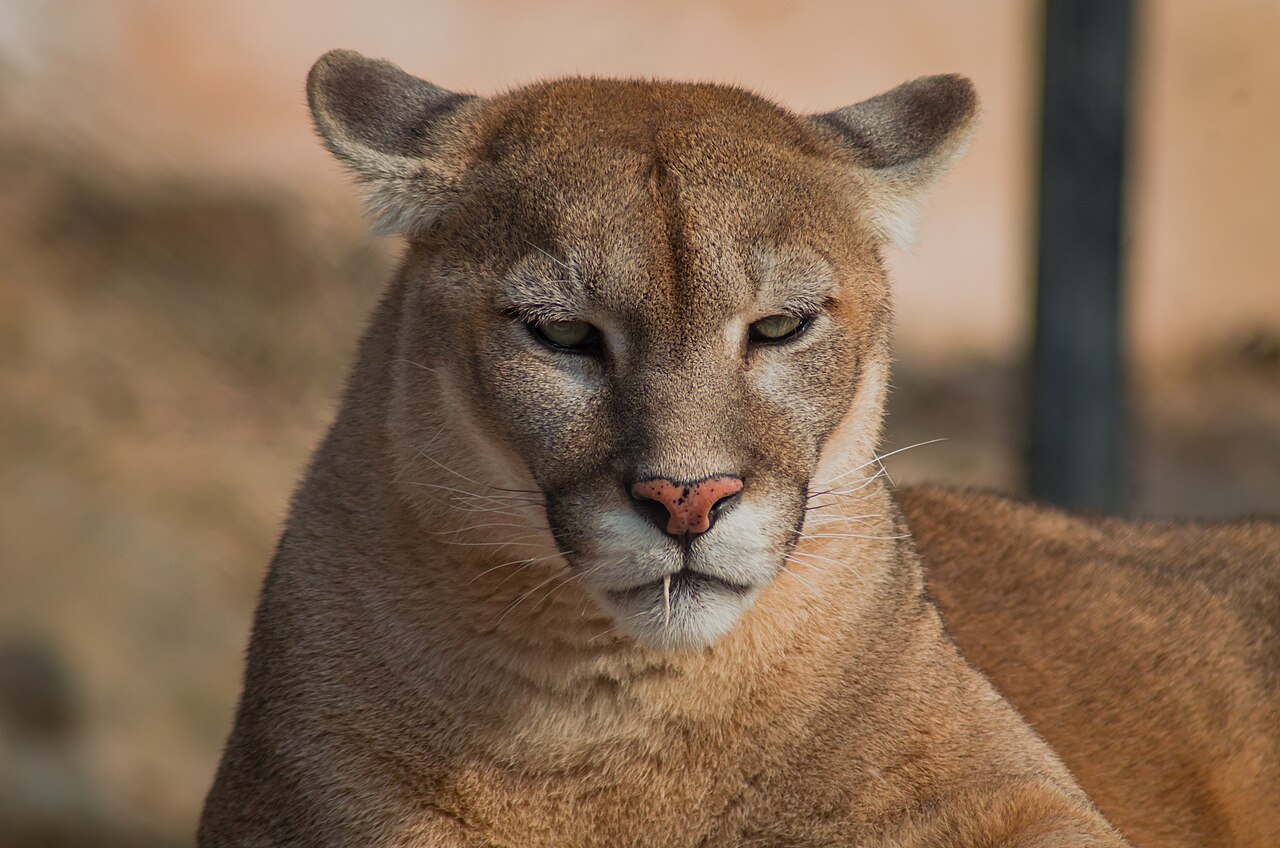
Mountain lion and bobcat scat share the same structure, because both animals are cats with the same digestive anatomy, and the difference is size. Bobcat scat is half an inch to an inch thick and three to five inches long. Mountain lion scat is one to one and a half inches thick. A mountain lion weighs 80 to 180 pounds and a bobcat 15 to 35, and the droppings scale accordingly.
Both species bury scat within their core range and leave it exposed at territory boundaries, and both make scrapes with their hind feet. The scrapes differ in scale: a bobcat scrape is a few inches of raked litter, while a mountain lion scrape can be a foot or more long and several inches deep, often with urine or scat deposited at the upslope end. Scrape size is frequently a better discriminator than the scat itself.
Tracks settle any remaining doubt. Mountain lion tracks are three to four inches wide and round, with four toes, no claw marks because the claws are retractable, and a heel pad with two lobes at the leading edge and three at the trailing edge. Bobcat tracks are the same shape at roughly two inches. Dog and coyote tracks are oval, show claw marks, and have a smaller, simpler heel pad. The bobcat poop guide covers the smaller cat in full.
Why Do Mountain Lions Bury Their Scat?
Mountain lions bury scat within the core of their range for the same reasons a house cat does: covering waste reduces the scent signal that would advertise their presence to competitors and to prey. A mountain lion is an ambush hunter that depends on remaining undetected, and a range saturated with its own scent works against that. Burying also reduces parasite transmission within a heavily used area.
At the edges of a home range the calculation reverses. Along boundaries and on regularly used travel corridors, mountain lions deposit scat and urine prominently, often on a constructed scrape, precisely so that other lions encounter it. These scrapes are the classic mountain lion sign: a mound or pile of raked-up soil and duff, roughly the size of a dinner plate, usually on a ridge, a saddle, a game trail, or beneath an overhanging tree.
The practical consequence for anyone looking is that finding exposed scat means you are probably on a travel route rather than in the middle of a lion’s territory. It also means scat surveys underestimate mountain lion presence, since buried droppings are invisible. Researchers therefore rely on scrapes, tracks, trail cameras, and increasingly on scat detection dogs trained to find buried samples for genetic analysis.
How Rare Is It to Find Mountain Lion Scat?
Genuinely rare, and setting that expectation is the most useful thing this guide can do. Mountain lion densities across the western United States typically run one to five adults per 100 square kilometers, and an adult male may hold a home range of 50 to 150 square miles. That is a small number of animals producing a small number of droppings across an enormous area, most of which are buried.
Coyotes, by contrast, may occur at densities dozens of times higher, and they deposit scat deliberately in the open on trails and at junctions where people walk. Domestic dogs contribute enormously on any trail near a trailhead. The base rate strongly favors both, which is why wildlife agencies receiving reported mountain lion scat photographs confirm only a small fraction.
None of this means mountain lions are not present. They are far more common than sightings suggest, and they live close to people across much of the West, including in the hills above major cities. Confirmed populations exist across the western states, in Florida as the endangered Florida panther, and individuals occasionally disperse enormous distances east; one male tracked from South Dakota was killed in Connecticut in 2011 after a journey of roughly 1,500 miles. The animals are simply very good at not being seen. The mountain lion sounds guide covers the screams and calls that more often reveal them.
What Other Mountain Lion Sign Should You Look For?
Scat is one piece of a pattern, and the most diagnostic mountain lion sign is a cached kill. Mountain lions kill a deer roughly every week to ten days, drag it to cover, feed, and then cover the carcass with leaves, pine needles, dirt, and branches, returning over several days. A partly covered deer carcass with a neatly buried appearance is unmistakable, and it is also the most dangerous thing you can walk up on, since the lion is likely nearby and will defend it.
Scrapes are the second key sign. A mountain lion scrape is a pile of debris raked backward with the hind feet, typically 6 to 18 inches long, often with urine or scat at one end, placed on ridgelines, saddles, and trail junctions. They are made repeatedly at the same locations over years, and finding one means you are on an established travel route.
Tracks in mud, dust, or snow are the most reliable confirmation, given the round shape, absent claw marks, and distinctive three-lobed heel pad trailing edge. Claw marks on trees are less common than with bears but do occur. Bedding sites are shallow depressions under rock overhangs or in dense brush with a commanding view. Any combination of these with a large blunt-ended fur-filled dropping is a strong case.
Is Mountain Lion Scat Dangerous?
Mountain lion scat carries the same risk profile as any wild cat’s, principally Toxoplasma gondii. All felids are definitive hosts for Toxoplasma and shed infectious oocysts in their feces, and those oocysts become infectious after a day or more and can survive in soil for over a year. For healthy adults, toxoplasmosis usually causes mild flu-like symptoms or none, but it is a genuine risk for pregnant women and immunocompromised people.
The Centers for Disease Control and Prevention (cdc.gov) advises pregnant women to avoid handling cat feces and potentially contaminated soil, and the guidance applies to wild cats as much as to a litter box. If you need to remove scat from a property, wear disposable gloves, mist it first so no dust rises, bag it, and wash thoroughly afterward. Do not compost it.
The far more important safety consideration is the animal itself. Fresh scat, a covered carcass, or a scrape with wet urine means a lion may be close. In that situation, do not run, do not crouch or turn your back, make yourself look large, speak firmly, pick up small children, and back away slowly while facing the animal. Attacks are very rare, with roughly 25 fatal attacks recorded in North America over the last century, but the correct response is well established and worth knowing before you need it.
What Mountain Lion Scat Tells Researchers
Scat is one of the most valuable tools in mountain lion research precisely because the animals are so hard to observe. Diet studies based on scat analysis across the western states consistently show deer as the dominant prey, often 60 to 80 percent of biomass consumed, with elk, feral hogs, raccoons, porcupines, and smaller mammals filling out the rest. Regional variation is substantial, and in some areas domestic livestock and pets appear at meaningful rates.
Genetics has transformed what scat can reveal. DNA extracted from cells shed in the droppings identifies individual animals, determines sex, establishes relatedness, and allows population estimates without capture or collaring. This matters enormously for a species whose numbers are otherwise estimated by modeling. Scat detection dogs, trained to locate droppings including buried ones, have made large-scale genetic surveys practical across roadless terrain.
Scat also records health. Parasite loads, exposure to rodenticides through prey, and stress hormone levels can all be measured from droppings, and anticoagulant rodenticide accumulation has been documented in mountain lions in southern California, where the isolated Santa Monica Mountains population faces both poison exposure and severe inbreeding from freeway barriers. That population is the reason the Wallis Annenberg Wildlife Crossing over Highway 101 was built.
Frequently Asked Questions
What does mountain lion scat look like?
Mountain lion scat is a segmented tubular dropping 4 to 6 inches long and 1 to 1.5 inches thick, dark brown to black with blunt rounded ends, packed with fur and bone fragments. It contains no seeds, berries, or plant matter.
How do you tell mountain lion scat from coyote scat?
Mountain lion scat has blunt ends and contains only fur and bone. Coyote scat tapers to a twisted point and usually contains berry seeds, fruit skins, or grass. Coyote scat is also thinner and far more commonly encountered.
What is the difference between mountain lion and bobcat scat?
Size. Mountain lion scat is 1 to 1.5 inches thick and bobcat scat half an inch to an inch. Both are segmented with blunt ends. Scrape size also differs, with mountain lion scrapes reaching a foot or more.
Is it rare to find mountain lion poop?
Yes. Mountain lions live at very low densities, one adult may range over 50 to 150 square miles, and they frequently bury their droppings. Most reported mountain lion scat turns out to be coyote or large dog.
How big is mountain lion scat?
Typically 4 to 6 inches long in segments, with a diameter of 1 to 1.5 inches. That diameter is the most useful single measurement, since it exceeds every other wild cat in North America.
Why do mountain lions bury their scat?
To avoid advertising their presence in the core of their range, since they hunt by ambush and depend on going undetected. At range boundaries they do the opposite, leaving scat prominently on scrapes as territorial markers.
Is mountain lion scat dangerous?
It can carry Toxoplasma gondii like any cat feces, which matters most for pregnant women and immunocompromised people. Wear gloves and wet it before removal. The greater concern is that fresh scat means a lion may be nearby.