Orange and Black Bird: Species Identification Guide
An orange-and-black bird at a feeder or in a treetop is most often a male oriole, but several other species share enough of the same color combination to cause real confusion, especially since only the males of most of these species show the bold pattern at all. Getting the identification right often comes down to a handful of quick checks: bill shape, feeding behavior, and whether the bird is working a feeder or foraging on the ground.
This guide covers the orange-and-black birds most commonly spotted across the US, how to tell them apart by range and habitat, and why the females so often look nothing like the bird that brought you here searching.
The most common orange-and-black bird in US yards is the male Baltimore oriole in the east or Bullock’s oriole in the west, both bright orange with black heads and wings. American redstarts, spotted towhees, and black-headed grosbeaks also show orange-and-black patterning but differ in size, shape, and range.
| Species | Range |
|---|---|
| Baltimore Oriole | Eastern and central US |
| Bullock’s Oriole | Western US |
| Orchard Oriole | Eastern and central US, smaller and duller than Baltimore |
| American Redstart | Eastern US and Canada, migratory warbler |
| Spotted Towhee | Western US, ground-feeding |
| Black-Headed Grosbeak | Western US |
| Varied Thrush | Pacific Northwest, uncommon east of the Rockies |
How to Tell These Orange-and-Black Birds Apart
Size and shape narrow the list quickly. Orioles are slim, medium-sized songbirds with a sharp, pointed bill built for nectar and fruit, while grosbeaks carry a noticeably thicker, seed-cracking bill. Towhees feed almost entirely on the ground with a distinctive double-scratch hop, unlike the tree-canopy habits of orioles and redstarts. Range is often the fastest tiebreaker of all, since Bullock’s oriole and Baltimore oriole rarely overlap outside a narrow hybrid zone in the Great Plains, making geography alone enough to separate the two in most sightings. Behavior adds one more layer: orioles and grosbeaks readily visit feeders, redstarts almost never do, and towhees generally ignore hanging feeders entirely in favor of foraging directly on the ground below them.
Baltimore Oriole
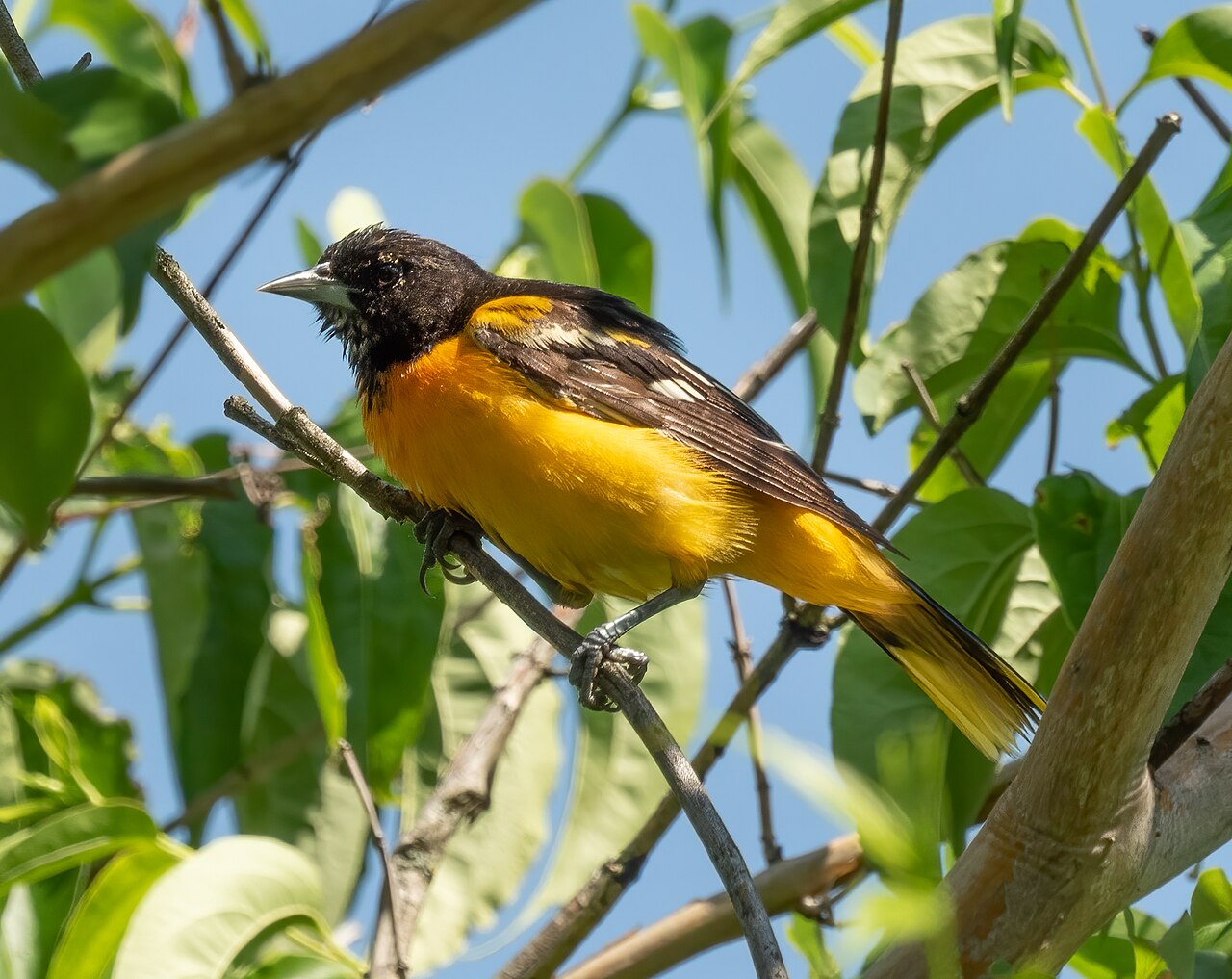
The male Baltimore oriole, the species this bird is named for, shows bold flame-orange underparts and rump against a black head, back, and wings, with a single white wing bar. It’s the most commonly reported orange-and-black bird across the eastern and central US, and it readily visits yards offering orange halves, grape jelly, or nectar feeders during spring migration and summer breeding season. The species takes its name not from the city but from the coat of arms of Lord Baltimore, whose family colors happened to match the bird’s black-and-orange pattern almost exactly, a coincidence noted by early colonial naturalists.
Bullock’s Oriole
Bullock’s oriole fills the same ecological role west of the Great Plains, sharing the orange-and-black pattern but with a distinctive black eye-line and a larger white wing patch than its eastern counterpart. The two species were once considered a single species, called the northern oriole, until genetic and behavioral differences prompted ornithologists to split them back apart in the 1990s. Where their ranges meet in the central Plains, occasional hybrids show a blend of both patterns, complicating identification in that specific corridor, and birders in that narrow overlap zone often need more than plumage alone to confidently call a bird one species or the other.
Orchard Oriole
Orchard orioles show a notably darker, more chestnut-orange tone than the flame-orange of a Baltimore oriole, paired with an overall smaller body size that can make them easy to underestimate at a distance. Among the orioles found in the US, this species is one of the earliest to migrate south each year, often departing by late summer while Baltimore orioles are still actively nesting. Female orchard orioles are yellow-green rather than chestnut, close enough to a Baltimore oriole female that range and the company of a confirmed male are often the deciding factors in a mixed flock.
American Redstart
The male American redstart flips the typical proportions, mostly black with bold orange patches on the wings, tail, and sides rather than an orange body with black accents. It’s a small, active warbler that fans its tail and flicks its wings almost constantly while foraging, a behavior thought to startle insects into moving and giving away their position, sometimes described as the bird using its own tail as a hunting tool. Unlike the orioles on this list, redstarts are almost never seen at feeders, favoring dense foliage and active insect-hunting instead, which means the best way to spot one is scanning shrubby forest edges rather than watching a backyard feeder.
Spotted Towhee
Spotted towhees show black upperparts with bold white spotting and rufous-orange flanks, a pattern that reads as orange-and-black from a distance even though the underlying pattern is more complex up close. Unlike the canopy-dwelling species on this list, towhees feed almost entirely on the ground, using a distinctive backward double-scratch with both feet to kick up leaf litter and expose insects and seeds, a sound that’s often heard before the bird itself is spotted rustling through dry undergrowth. Their bright red eye is a useful confirming detail once you get a clear look, distinguishing them from the closely related eastern towhee at the edges of their overlapping range.
Black-Headed Grosbeak
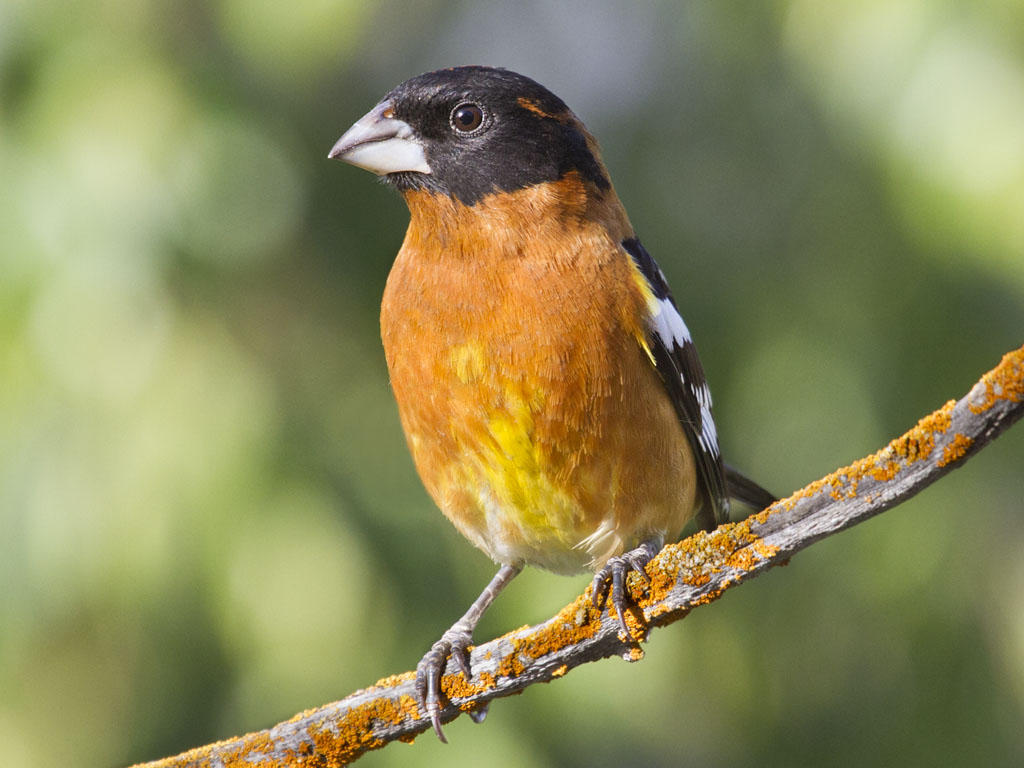
The male black-headed grosbeak pairs a solid black head with warm orange underparts and streaked black-and-white wings, giving it a bold, almost costume-like appearance at a feeder, easily one of the most striking visitors a backyard seed feeder can attract. Its heavy, conical bill is built for cracking sunflower seeds and other hard-shelled food, a clear visual difference from the slender, probing bill of any oriole species on this list. The species also has a surprisingly musical, almost robin-like song, delivered from a high perch, which is often how birders first notice one is nearby well before spotting the bird itself.
Varied Thrush
Varied thrushes bring a moodier, more muted orange-and-black pattern than the birds above, with a slate-gray to blackish back, an orange breast crossed by a dark band, and orange eyebrow markings. They’re a Pacific Northwest specialty, breeding in dense, wet coniferous forest and only occasionally wandering east of the Rockies during irruption years when food is scarce in their usual range. Their song is unusually eerie for a songbird, a single held, buzzy note pitched slightly differently each time, often described as sounding more electronic than organic, and it’s frequently the first clue a birder gets that one is nearby in dense forest cover.
Red-Winged Blackbird: A Common Mix-Up
The male red-winged blackbird is mostly glossy black with a red-and-yellow shoulder patch rather than true orange, but in certain light or at a distance that patch can read as orange, which sends some searches for “orange and black bird” toward this species by mistake. The reliable difference is location of the color: red-winged blackbirds show their color only as a shoulder patch on an otherwise all-black bird, while every oriole and grosbeak on this page shows orange across a much larger portion of the body, typically the entire underside.
Male vs Female: Why Only Some Look Orange and Black
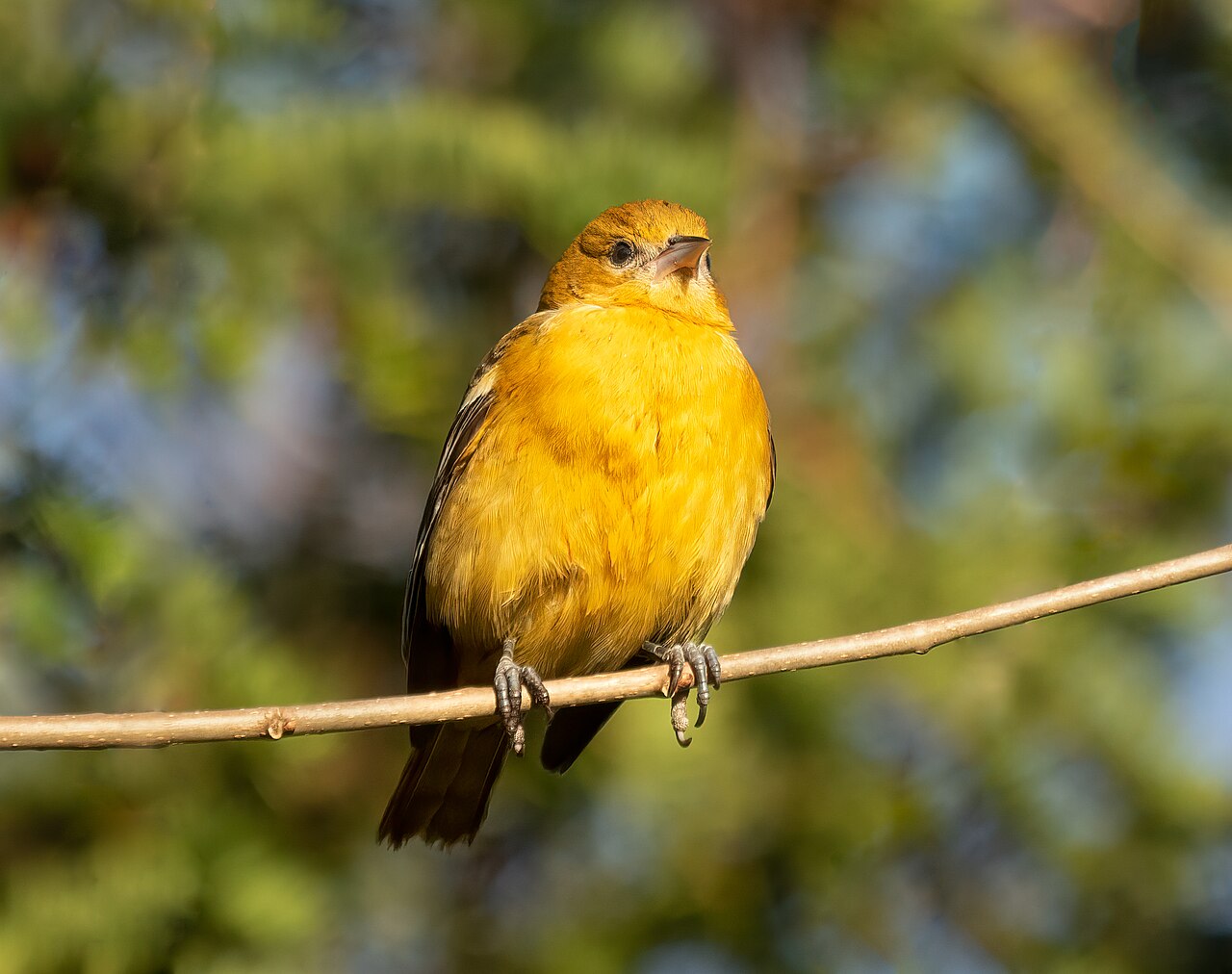
In every species on this page, females show a noticeably duller version of the male’s pattern, often replacing black with olive or grayish-brown and orange with a muted yellow or tan. This gap exists because male coloring in these species evolved largely for mate attraction and territory display, while females benefit more from camouflage while incubating eggs on an exposed nest. The Cornell Lab of Ornithology notes that this kind of sexual dimorphism is especially pronounced in orioles, where a female can look so different from a male that new birders often assume they’re seeing two entirely separate species. Juvenile males typically resemble females for their first year, only molting into the full adult orange-and-black pattern in time for their first breeding season, which means a partially colored bird in late summer or fall is often simply a young male still transitioning.
Best Time and Place to Spot One
Spring migration, generally April through May depending on latitude, is the single best window for spotting most of these species, since males arrive first and in their brightest breeding plumage to establish territory before females follow. Mature trees with open canopy are the most reliable habitat for orioles and redstarts, while towhees are better looked for in brushy undergrowth and grosbeaks favor forest edges bordering open feeding areas. Early morning, within the first two hours after sunrise, tends to produce the most sightings, since that’s when territorial males are most vocally and visually active, singing from exposed perches to advertise territory before the day’s foraging begins in earnest.
What Attracts Them to Your Yard
Attracting orioles specifically usually comes down to offering cut oranges, grape jelly, or a dedicated nectar feeder with slightly larger feeding ports than a typical hummingbird feeder. Grosbeaks respond well to sunflower seed at a standard platform feeder, while towhees are more likely to show up if a yard has brushy, undisturbed ground cover rather than open manicured lawn. General feeder placement tips apply across all of these species too, positioning near cover but with a clear flight path tends to draw more visits than a feeder stuck in the open or buried too deep in dense brush. Mature, flowering, or fruiting trees do more long-term work than any single feeder, since they provide natural nectar, fruit, and insect prey that keeps birds returning well beyond whatever’s currently stocked at a feeding station.
Related reading: Blue Bird with Orange Chest.
Frequently Asked Questions
What are the black-and-orange birds called?
Depending on the exact pattern and region, they’re most often orioles, though American redstarts, spotted towhees, and black-headed grosbeaks all share enough orange-and-black coloring to cause confusion, especially at a quick glance or in poor light.
What does it mean if you see an oriole?
There’s no factual significance beyond migration timing, orioles arriving in spring simply means their breeding season has begun, though the bird carries positive folk symbolism of joy and renewal in some traditions and is considered a welcome sign of the season by many birders.
Are oriole birds rare?
No, Baltimore and Bullock’s orioles are both fairly common across their respective ranges during breeding season, though seeing one still often feels special given how brightly colored and comparatively brief their yard visits tend to be before they move on to forage elsewhere.
What attracts orioles to a yard specifically?
Cut oranges, grape jelly, and dedicated nectar feeders are the three most effective offerings, especially when set out as soon as orioles are expected to arrive in spring, since early feeders often catch the first scouting males before they settle on a territory.
Do female orioles look orange and black too?
No, females of every oriole species are noticeably duller, typically showing olive-yellow tones rather than the male’s bold orange and black, which is a common source of confusion for anyone assuming both sexes match.
How can I tell an oriole from a black-headed grosbeak?
Bill shape is the fastest tell, orioles have a slim, pointed bill while grosbeaks have a thick, conical seed-cracking bill, and grosbeaks also show more black-and-white streaking on the wings than a typical oriole’s cleaner wing pattern.