Swan Sounds: 8 Calls Explained and What Each One Means
Swans make eight sounds you can learn to tell apart: a trumpeting bugle, a hiss, a snort, a grunt, a soft whistle, a cygnet peep, a throaty croak and the rhythmic throb of their wings in flight. Which one you hear depends almost entirely on the species in front of you, because the three swans found across North America have very different voices.
Swan sounds carry meaning that is easy to read once you know the pattern. A hiss is a boundary. A bugle is a contact call across distance. A soft grunt between two adults on the water is reassurance. This guide walks through each call, what it sounds like, the time of year and day you are most likely to hear it, and the animals people confuse with swans at a distance.
Swans make trumpeting bugle calls, hisses, snorts, grunts, soft whistles and high peeps from young birds. Trumpeter Swans bugle loudly, Tundra Swans produce a high yelping whistle, and Mute Swans are the quietest, relying on hisses, snorts and loud wingbeats. A hiss always means the bird feels crowded and wants space.
What Types of Sounds Do Swans Make?
Swans use a small vocabulary with a wide emotional range. Across the three North American species, the sounds fall into five groups: long-distance contact calls, close-range conversational sounds, threat sounds, family contact calls between parents and young, and non-vocal noise made by the wings and feet.
Species matters more than situation. A Trumpeter Swan (Cygnus buccinator) carries more than a mile on still air, while a Mute Swan (Cygnus olor) at 20 ft may give you only a hiss and the slap of its feet.
| Sound | Species | Sounds like | What it means |
|---|---|---|---|
| Bugle | Trumpeter Swan | oh-OH, like a car horn or French horn | Contact, location, excitement |
| Yelping whistle | Tundra Swan | woo-ho, woo-woo, like distant hounds | Flock contact in flight or on water |
| Hiss | All, mainly Mute Swan | a long sssssss, like an angry goose | Back off, you are too close |
| Snort | Mute Swan | a sharp nasal grunt or bark | Mild alarm or annoyance |
| Soft grunt | All | low muffled mumbling | Pair and family reassurance |
| Peep | Cygnets | thin repeated whistling cheeps | I am here, where are you |
| Wing throb | Mute Swan | rhythmic whoo-whoo-whoo | Flight, no vocal sound needed |
What Sounds Do Trumpeter Swans Make?

Trumpeter Swans make a deep, resonant, two-note bugle that genuinely sounds like a horn, which is where the name comes from. The call is usually written as oh-OH, with the second note higher and stronger, and it can carry well over a mile across open water or marsh.
The sound comes from an extra loop of windpipe coiled inside the breastbone, an anatomical trombone that no other North American swan has. Trumpeters bugle on takeoff, on landing, when a mate returns, and when a rival pair drifts into their territory. Near the nest the same bird adds softer grunts and a nasal, almost conversational mutter.
Listen for Trumpeters from October through March on open water in the upper Midwest, the Rockies and the Pacific Northwest, and year round in Alaska and Greater Yellowstone. Dawn and the hour before dusk are the loudest windows. Cornell’s All About Birds archive of Trumpeter Swan sounds has clean reference recordings.
The Hiss: A Swan’s Clearest Warning

A hiss is the one swan sound almost everyone has heard, and it means exactly one thing: you are too close. The bird lowers its neck, opens its bill, arches its wings over its back and pushes out a long, dry sssssss that sounds more reptile than bird.
Mute Swans hiss the most freely, at dogs, kayaks, cyclists and anyone who stops for a photograph. The hiss is a courtesy, not a bluff: ignore it and a cob guarding cygnets may follow with a rush, a wing strike and a bite that bruises. Give the bird 50 ft and it stops.
Hissing peaks from April through July, when nests and small cygnets are on the water. A hissing swan on land between you and the water is the single most dangerous situation to walk into, because you are standing in its escape route.
Mute Swan Sounds: Snorts, Grunts and Wingbeats

Mute Swans are badly named. They are not silent, they are just quiet, and most of their noise is not made with the voice at all. The common vocal sounds are a nasal snort, a short bark, a low grunt between pair members, and a soft mewing whistle that two adults exchange at the nest.
Their loudest and most recognizable sound is mechanical. In flight the wings produce a slow, pulsing whoo-whoo-whoo that can be heard several hundred yards away and has no equivalent in the other species. Birders use it as an identification feature in poor light: if a big white bird passes overhead throbbing and not calling, it is a Mute Swan.
On city ponds they also give a flat, open-mouthed grunt at anyone carrying bread, a learned begging sound with none of the deception in a blue jay’s mimicry.
Tundra Swan Sound: The Whistling Chorus
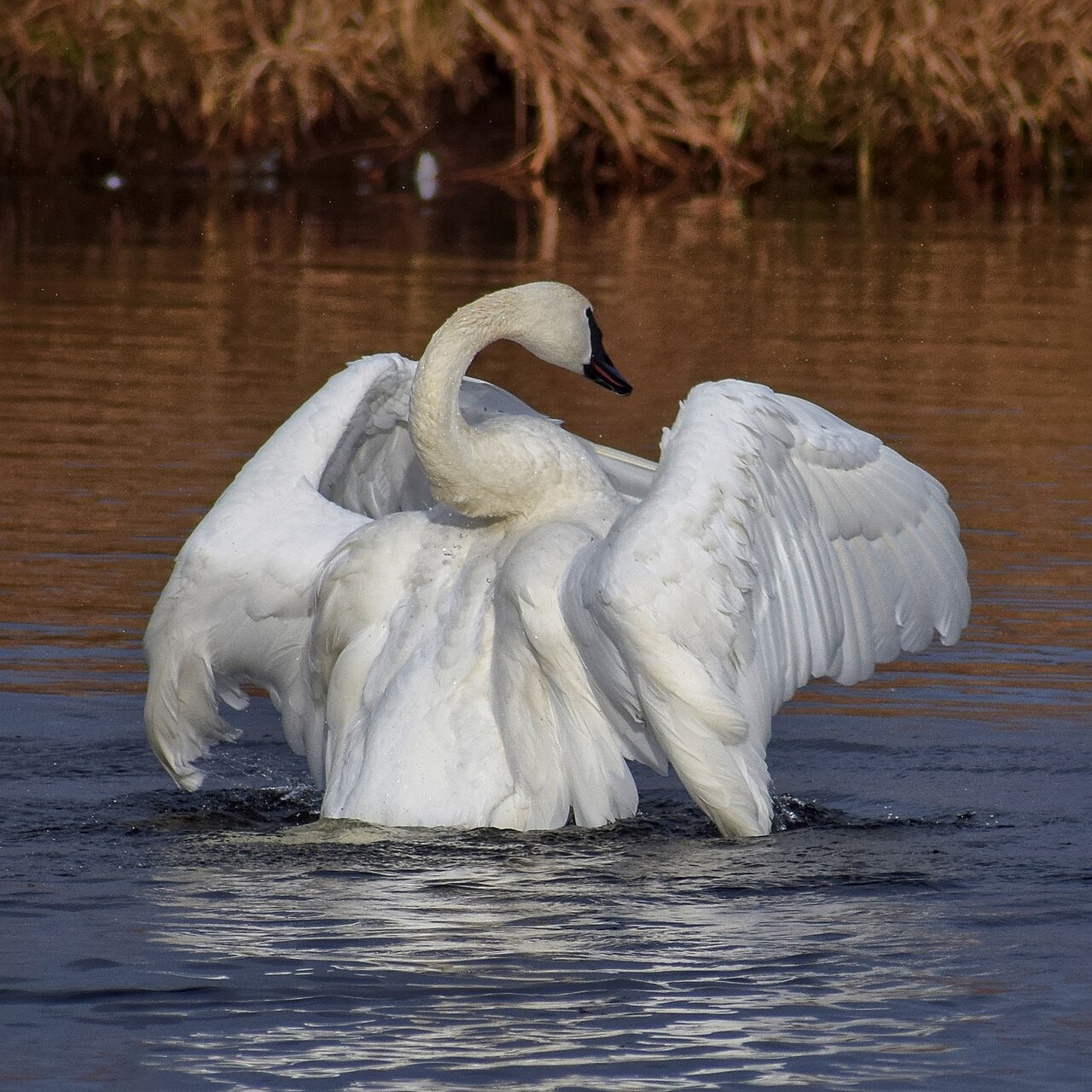
Tundra Swans (Cygnus columbianus) produce a high, yelping, slightly quavering whistle, usually in a chorus rather than alone. A flock passing overhead at night sounds like a distant pack of hounds or a crowd of children shouting across a field, a wavering woo-ho, woo-woo that rises and falls as individual birds answer each other.
The old American name for the species was Whistling Swan, taken from the thin whistle of the wings rather than the voice. The vocal chorus is the sound most people actually notice, because it travels and because Tundra Swans migrate in large, noisy flocks.
Peak season is November through March, over the Chesapeake, the Central Valley of California, the Great Lakes flyways and the Carolina sounds. Much of the calling happens at night on migration, which is why so many people describe first hearing Tundra Swans without ever seeing them.
What Does a Black Swan Sound Like?
A Black Swan (Cygnus atratus) makes a far-carrying, musical bugle that is higher and more broken than a Trumpeter’s, often described as a slow, nasal crooning. The sound is weaker and more plaintive than the horn blast of a Trumpeter, and the bird frequently calls while raising its neck and fluttering its wings in a greeting display.
Black Swans are native to Australia. In the United States they turn up only as escaped or released ornamental birds on park lakes and private estates in Florida, California and parts of the Northeast, so hearing one in the wild in North America is unusual and worth reporting to a local records committee.
They also hiss, snort and grunt like other swans, and a nesting pair is every bit as willing to defend a shoreline.
Swan Sounds in Flight
Swan sounds in flight come in two layers: the call and the wings. Trumpeters bugle steadily as they fly, Tundra Swans whistle and yelp in chorus, and Mute Swans are usually voiceless, letting the pulsing throb of their wingbeats announce them instead.
Takeoff adds a third layer. A swan needs a running start of 50 to 100 ft across the surface, and the slapping of big webbed feet on water, combined with the first heavy wingbeats, produces a sound like someone beating a rug. On a quiet morning that takeoff is often what makes people look up.
Flying swans call most on migration and on local flights between roosting and feeding water, which means the first and last light of the day. Overhead flocks at night are normal and not a sign of anything wrong.
Cygnet Sounds: Peeps, Whistles and Contact Calls
Young swans sound nothing like their parents. Cygnets make thin, high, repeated peeps and soft whistles, a sound closer to a duckling than to an adult swan, and they keep up an almost constant stream of it while swimming behind the family line.
The peeping is a contact call. It tells the parents where each cygnet is, and a cygnet separated from the brood raises the volume and the rate until an adult answers with a low grunt. The voice begins to break and deepen at around four to five months, and by the first winter a young Trumpeter is already attempting a rough, cracking version of the adult bugle.
Expect cygnet sounds from May through September on any pond with a breeding pair. A full account of the first year is in our guide to how swans grow from cygnet to adult.
What Do Swans Do When Happy? Greeting and Triumph Displays
When swans are content and reunited, they perform a greeting ceremony: the pair face each other, raise and quiver their wings, bob and wave their necks, and call together in a rhythmic duet of bugles or soft trumpeting. Biologists call this a triumph display, and it typically follows a successful defense of territory or the return of a mate.
Quieter contentment is almost silent. A relaxed swan family makes low muffled grunts between bites while feeding, preens with soft bill clapping, and rests with the head tucked back without calling at all. Loud, repeated sound from a swan is excitement, defense or contact, never comfort.
Both birds in a pair take part in the display, which makes it a useful sign that a territory is held by an established couple rather than a drifting single bird.
What Do Swan Noises Mean?
Swan noises mean one of four things: where I am, who I am with, stay back, or feed me. Contact calls like the bugle and the whistled chorus answer the first two. The hiss and the snort cover the third. The flat grunt on urban ponds is learned begging and belongs only to birds used to people.
Context does most of the work. The same soft grunt that is reassurance between mates on open water becomes an answer to a lost cygnet when the brood is scattered. A bugle at dawn is a flight call; the same bugle with a wing-quivering display in front of a partner is a greeting.
A swan that genuinely intends to escalate goes quiet, lowers its neck and comes at you with wings arched. Sound is the warning stage, and it is the stage to respect.
When and Where You Hear Swans: Time of Day and Season
Dawn and dusk are the loudest hours in every season, because that is when swans shift between roosting water and feeding fields. Night calling is normal on migration, and a Tundra Swan flock crossing a city at 2 a.m. is simply using calm air.
Autumn through early spring is the noisy half of the year across the lower 48 states, with migrant Tundra and Trumpeter Swans massed on lakes, bays and flooded fields. Late spring and summer narrow it to resident pairs: hissing adults, peeping cygnets, little else.
Swans do not come into attics, walls or crawl spaces, so a nighttime noise indoors is something else entirely, usually a mammal. The sorting guide for those is in our rundown of the sounds bats make in roofs and walls, and nocturnal noise around a pond edge more often belongs to a beaver working the bank or a calling bullfrog than to any bird.
Frequently Asked Questions
Does a swan croak or hiss?
Swans hiss far more than they croak, and the hiss is the sound people mean when they say a swan croaked at them. Mute Swans do add a short, throaty, almost croaking grunt at close range, especially at the nest, but it is quiet and only audible within about 30 ft.
What is the swan sound called?
There is no single name. The loud two-note call of a Trumpeter Swan is a bugle or trumpeting, the Tundra Swan’s call is a whistle or yelp, and the threat sound is a hiss. Older bird books use honk for swans, which is better reserved for geese.
Where do swans sleep at night?
Swans sleep on open water, on small islands, or on the bank close to water, usually with the head tucked over the back. Open water is preferred because it keeps foxes and coyotes at a distance, and large flocks often raft together in the middle of a lake.
What is a female swan called?
A female swan is a pen, the male is a cob, and the young are cygnets. Pens are slightly smaller with a less pronounced bill knob in Mute Swans, and they do most of the incubating while the cob guards the nest and does most of the hissing.
What is a sad fact about swans?
A swan that loses a long-term mate may go a full season or more without breeding, and some birds leave the territory entirely. Lead poisoning from old fishing weights and shot also remains a major cause of death in swans feeding on lake bottoms.
Can I find swan sounds mp3 files to compare?
Yes. Free reference recordings and sound effect clips are published by Cornell’s Macaulay Library and by the xeno-canto archive, both searchable by species. Compare your phone recording against two or three clips of each candidate species rather than one, since individual swans vary.
Once you can separate a bugle from a whistle, the rest of the pond gets easier. Our guides to the surprisingly thin call of a bald eagle and the birds that get mistaken for owls after dark cover the two mistakes that come up most often around swan water.