
Cow Symbolism: Sacred Meaning, Abundance and Signs
Cow symbolism centers on giving. A cow turns grass into milk that feeds a family, raises her calf with fierce care and moves through the day without hurry, so she stands for plenty, nurture and calm. Nowhere is that meaning more alive than in Hindu India, where many families feed a cow before they eat themselves.
Cow symbolism stands for abundance, motherly nurturing and calm patience. In Hindu India the cow is honored as Go Mata, a sacred, giving mother fed and decorated at Gopashtami. Egypt linked her to Hathor, the Bible to plenty and purification, and in popular belief a cow sighting is a call to slow down.
What Does a Cow Symbolize?
A cow symbolizes abundance first. The domestic cow (Bos taurus) gives milk for most of the year after she calves, and in traditional farming one animal could help feed a household with milk, butter and cheese. That steady supply made her a symbol of plenty in farming cultures.
She is also a mother symbol. A cow guards her calf, calls for it and stays close until it is weaned. Patience is the third meaning. A cow grazes slowly and chews her cud for hours, and that rhythm stands for calm, unhurried progress. Deer chew the cud as well, since they are ruminants like cattle.
Cows rest in the present. Their stillness stands for grounding and contentment. A herd of cows grazes and rests as one group, so cows also stand for belonging and safety in community.
Cow Gods and Goddesses in Mythology
Hathor is the best known cow goddess. Egyptians showed her as a cow or crowned with cow horns around a sun disk. She ruled love, music, joy and motherhood. The Egyptian Book of the Heavenly Cow goes further and shows the sky goddess Nut as a great cow arching over the earth, her belly covered in stars.
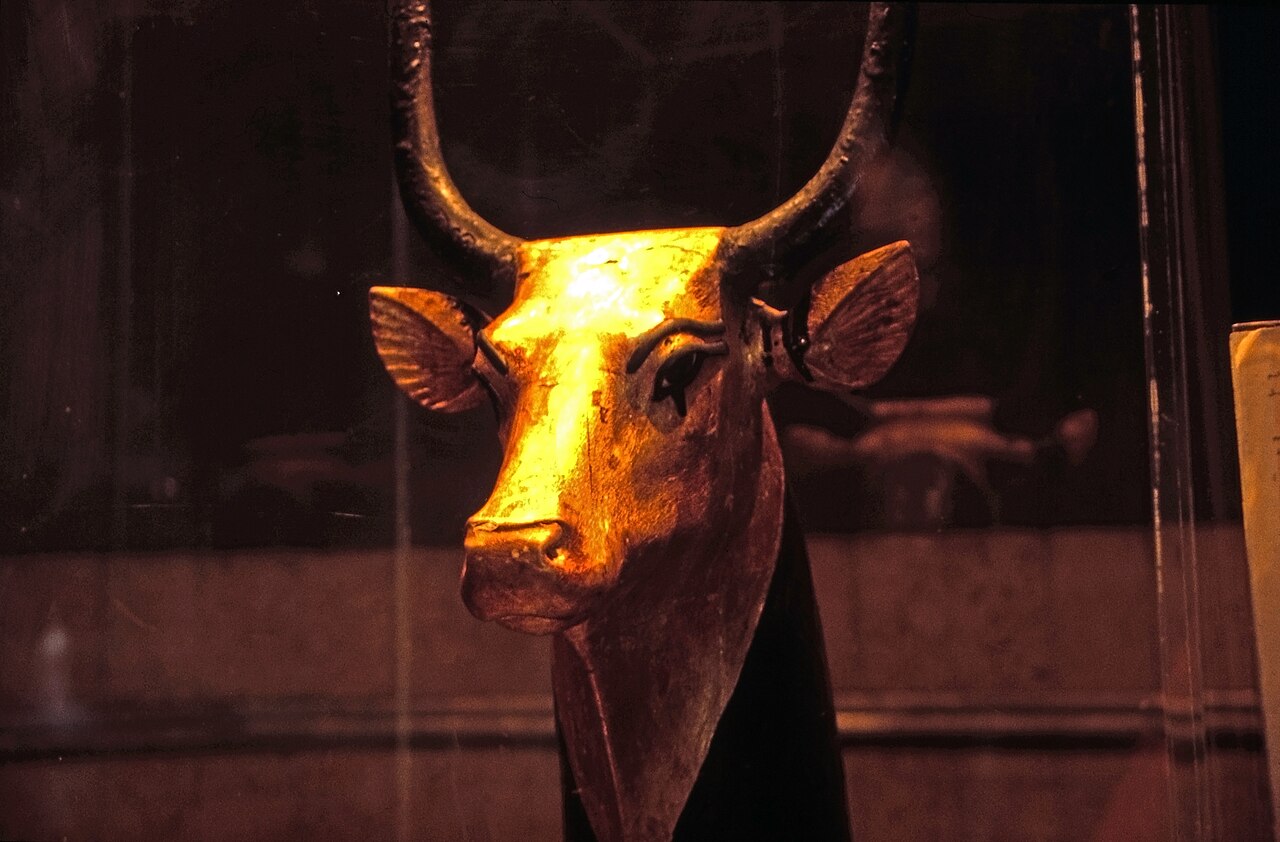
In India the divine cow is Kamadhenu. She rose from the churning of the ocean of milk and grants every wish of the one who keeps her. Elephants share that origin in Hindu myth, since Airavata, the white elephant of Indra, rose from the same churning as Kamadhenu. Krishna carries the name Govinda, the cowherd of Vrindavan. He grew up among cows and lifted Govardhan Hill to shelter them and their herders from a storm.
Cow myths reach far beyond Egypt and India. Bison, wild relatives of cattle, hold a sacred place for the Lakota through the story of White Buffalo Calf Woman.
| Culture and place | Cow figure | What it stands for |
|---|---|---|
| Norse, Iceland | Audhumla | Creation and first nourishment, her milk fed the giant Ymir |
| Ancient Greece | Hera and Io | Hera, called cow-eyed (boopis) by Homer, claimed the heifer Io, her priestess whom Zeus had turned into a cow |
| Celtic Ireland | Glas Gaibhnenn | Endless plenty, a cow whose milk never ran dry |
| Zoroastrian Iran | Geush Urvan | The soul of the cow, a plea to protect living things |
The Sacred Cow and How Cows Are Honored in Daily Life
The cow is sacred in Hindu India, and Hindus call her Go Mata, mother cow, for everything she gives. Milk, ghee, yogurt and dung serve both the kitchen and the ritual fire. Article 48 of the Indian Constitution directs the state to protect cows and calves, and most Indian states ban cow slaughter.
Gopashtami falls on the eighth day of the bright half of Kartik and marks the day young Krishna first took the cows out to graze. On that day families wash their cows, paint the horns, hang garlands around their necks and feed them sweets. Many Hindu households also set aside the first roti of the day for a cow. The bread goes to the animal before anyone at home eats.
What Do Cows Symbolize in Christianity and the Bible?
In the Bible cows symbolize provision and its loss. In Genesis 41 Pharaoh dreams of seven fat cows eaten by seven lean ones. Joseph reads them as seven years of plenty followed by seven of famine.
Numbers 19 gives the red heifer a role in purification. Her ashes, mixed with water, cleansed people who had touched the dead. Cattle offerings across the Old Testament were among the costliest gifts a family could give God. Goats appear among those offerings as well, as the smaller gift.
The ox is one of the four living creatures around God’s throne in Ezekiel 1 and Revelation 4. Nativity scenes place an ox at the manger, drawn from the opening chapter of Isaiah and its line about the ox that knows its owner. Isaiah 11 uses the cow for the coming peace, “the cow and the bear shall feed; their young ones shall lie down together.”
Seeing a Cow in Dreams, Encounters and Crossing Your Path
In modern popular interpretation, a cow in a dream or on your road points to provision and timing.
Dreaming of a Healthy or Milking Cow Many dream interpreters read a healthy cow as provision on the way. Milking her stands for drawing on resources you already have.
Dreaming of a Thin or Sick Cow A thin or sick cow is widely read as a drained resource. Money, energy or a relationship needs feeding before it gives more.
A Cow Crossing Your Path A cow crossing your path is commonly read as a cue to slow down and stop forcing outcomes.
A Cow Staring at You A cow that holds your gaze is a nudge to look after yourself. Refill before you give more.
A Herd Blocking the Road A herd on the road is read as a sign to wait.
Cow Spirit Animal and Totem Meaning
In modern spirit animal readings, the cow stands for generosity, steadiness and protection of family. People with a cow totem look after others before themselves.
The lesson is to give freely and still set boundaries. A cow milked without rest grows thin, and so does a person who gives without limits.
Frequently Asked Questions
Are cows considered good luck?
Yes. In Hindu tradition, meeting a cow as you set out on a journey counts as an auspicious sign. Rural European folklore reads cows lying down in a field as a sign of coming rain, though healthy cows spend many hours a day lying down anyway.
What does a black cow symbolize?
There is no single traditional meaning for a black cow. Modern dream and spirit readings link her to mystery and unseen resources. Folklore around one Staffordshire herd, the Chartley cattle, held that a dark calf foretold a death in the Ferrers family.
What is the difference between cow and bull symbolism?
Cows stand for nurturing, abundance and patience, while bulls stand for strength, virility and drive. In Hindu tradition Nandi, the bull who carries Shiva, stands for devotion.
What does the golden calf mean in the Bible?
The golden calf stands for false worship. In Exodus 32, the Israelites grew impatient while Moses was on Mount Sinai and cast a calf from their gold earrings. The story warns against turning wealth and comfort into an idol.
What Greek deity is associated with cows?
Hera. Homer calls her boopis, cow-eyed, and Greeks offered her cattle at her great sanctuary near Argos. In myth she claimed Io, the priestess Zeus had turned into a heifer, and set the hundred-eyed Argus to guard her.
Sources
- CDC, Healthy Pets, Healthy People, Farm Animals
- Encyclopaedia Iranica, Gəuš Uruuan (Malandra)
- University of Wisconsin Extension, Forward Farm Safety Toolbox, Cow Handling