Praying Mantis Landing on You: Luck and 7 Situations
A praying mantis landing on you is read in most traditions as a call to stillness and patience, and as one of the luckiest insect encounters you can have. The posture does the work: an insect that sits with its forelegs folded looks like it is praying, and that resemblance pushed the praying mantis landing on you meaning toward prayer, focus and divine attention in Europe, Africa, China and parts of Native America alike. Where the grasshopper says jump, the mantis says wait and aim.
These are beliefs, not findings, and the sections below present them as beliefs. The traditions are kept separate, the situations people actually search for are handled one by one, and the last section covers how rare a mantis sighting really is and what to do with the insect itself.
In most traditions a praying mantis landing on you is a strong good omen that calls for patience, stillness and focused attention before you act. The folded forelegs are read as prayer, so the contact is taken as a sign that a decision deserves calm timing rather than speed, and in several cultures as luck.
What Does It Mean If a Praying Mantis Lands on You?
It means slow down and aim. That reading is remarkably consistent across sources, and it comes from how the animal hunts rather than from scripture. A mantis holds position for minutes at a time, tracks prey with a head that swivels nearly 180 degrees, and strikes once. Folk belief turns that into advice about timing: the strike works because the wait came first.
The second layer is attention from something larger. Because the posture reads as prayer, European and African traditions treated a mantis settling on a person as a sign of being noticed or watched over, and that is the strand modern spiritual writing uses most. It is usually framed as reassurance rather than warning.
The third layer is simply luck, and it is the least complicated. In Chinese tradition and in much of European folklore, an insect that chooses contact is bringing something rather than taking it, and the mantis gets a better reception than most insects do.
| Situation | Common folk reading |
|---|---|
| Lands on you outdoors | Be still, time your move carefully |
| In the garden | Protection of your work, a healthy season |
| At the front door | A decision or visitor arriving, pause before answering |
| Inside the house | Luck entering the home, a need for calm indoors |
| At night, near a light | Attend to something you keep postponing |
| Seen repeatedly | A message not yet acted on |
| Found dead | A cycle has closed, release the waiting |
Is Finding a Praying Mantis Lucky?

Finding a praying mantis is considered lucky in nearly every tradition that mentions it, which makes it unusual among insects. The strongest versions come from southern Africa, where the mantis carries sacred status among the San, and from China, where the insect is admired for its fighting posture and gave its name to a style of kung fu. European folklore is milder but still positive.
One widely repeated claim deserves correction: killing a praying mantis is not illegal in the United States, and no federal or state law protects the common species. The idea circulated for decades and still does, probably because people wanted a reason behind the taboo. The taboo itself is real in folklore, where harming the insect is said to reverse the luck.
Gardeners have a practical version of the same belief, since a mantis in a vegetable bed eats pest insects all season. The folk luck and the real benefit point the same way, which is unusual. For the broader record see whether praying mantises are good luck.
Praying Mantis Meaning in Native American Traditions

Mantis symbolism is thinner in Native American material than popular articles suggest, and it varies by nation rather than forming one meaning. Where the insect appears, it is usually tied to patience, careful hunting and quiet observation, the same qualities credited to a good tracker. Claims that present a single pan-Indian mantis meaning are not reliable.
Christian and Biblical Readings of the Praying Mantis
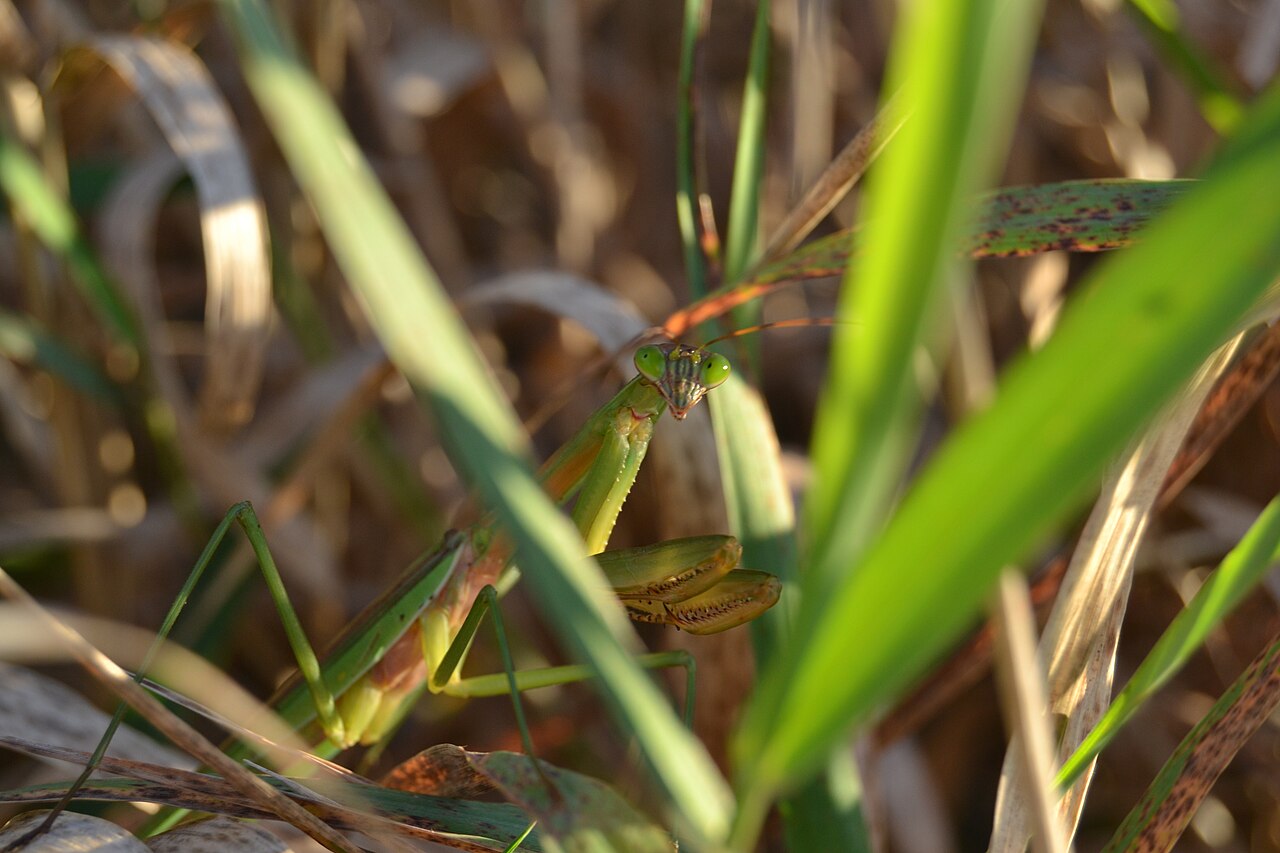
The Bible never mentions the praying mantis, so Christian readings rest on the posture alone. Medieval and early modern Europe took the folded forelegs as a devotional gesture, and some sources claimed a mantis would point a lost child toward home or a shepherd toward a stray. The modern reading is simpler: a prompt to pray, or a sign that a prayer was heard.
Celtic and European Folklore

European folk tradition treats the mantis as a guide and a warning against haste. French sources carry the lost traveler motif, and the insect’s names in several languages reference prayer directly. Because the mantis reaches the northern edge of its range in Europe, encounters there were rare enough to be noteworthy.
East Asian Beliefs: Courage and Persistence

Chinese tradition reads the mantis as courage, patience and refusal to retreat, and an old proverb about a mantis blocking a chariot describes doomed bravery rather than foolishness. Northern Praying Mantis kung fu was built on observing the insect’s strike. Japanese sources associate it with autumn and with persistence.
Is the Praying Mantis a Spirit Animal, Totem, or Omen?
The praying mantis is used as all three, and the words belong to different systems. A totem, in the traditions that use the term properly, is inherited by a clan or lineage. A spirit animal or power animal, in contemporary spiritual writing, is a personal guide chosen or encountered. An omen is a single event read for meaning, which is what a landing is.
As a guide figure the mantis carries one lesson above the others, which is that stillness is an action. People who claim it describe it as a corrective for rushing: gather information, hold position, strike once. The swiveling head adds a second theme about seeing a situation from more than one angle before committing.
The darker side gets mentioned too. Mantises are ambush predators and the females of some species occasionally eat the male, so a few writers read the mantis as a caution about what patience costs. That reading is uncommon but it is part of the record, and the female praying mantis is where the biology behind it sits.
A Praying Mantis in Your Garden or on Your Porch
A mantis in the garden is read as protection of work already underway, and it is the one reading with a straightforward practical basis. The insect eats flies, moths, crickets and caterpillars, so folk belief that it guards the plot matches what it does. In older European sources a mantis in a garden was taken as a sign the season would hold.
Porches produce most of the contact sightings in late summer. Mantises climb railings, posts and siding to hunt insects drawn by porch lights, and a person sitting still nearby becomes another vertical surface. The traditional reading of porch contact is that something close to home needs calm attention rather than a decision.
Late summer and early autumn is also when adults are largest and most visible, which is why garden sightings cluster in August through October across most of the United States.
What Does It Mean to Have a Praying Mantis at Your Front Door?
A praying mantis at your front door is read as something arriving that deserves a pause: a decision, an offer or a person. The threshold carries weight in most folk systems, so an insect that stops there rather than inside or outside is treated as a message about entry and timing. The standard advice attached is to answer slowly.
Variants exist and they are mild. Some sources read the door mantis as a guardian posted at the house, others as a prompt to settle something unresolved with family. None of the mainstream readings treat it as a bad sign, which separates the mantis from insects like the death watch beetle.
Why it is actually there is usually the porch light again, plus the warm surface of a door frame at dusk. Doors facing a garden or a lit path collect the most sightings.
A Praying Mantis in Your House, and What Attracts Praying Mantises to Your House
What attracts praying mantises to your house is not the house but the insects around it. Porch and window lights pull in moths, midges and flies all evening, and a mantis follows that food to the wall, the screen and sometimes through an open door. Potted plants brought indoors are the other common route, often carrying an egg case rather than an adult.
The folk reading of a mantis indoors is luck crossing the threshold, paired with a call for calm in the household. European tradition is specific that the insect should be carried out rather than killed, which is also the better outcome for the animal, since a house has nothing for it to eat and dry indoor air kills it within days.
If dozens of tiny mantises appear indoors in spring, an egg case hatched on a houseplant. That is a known event with a known fix, covered under praying mantis eggs and the hatchlings described under baby praying mantis.
A Praying Mantis Landing on You at Night
A mantis landing on you at night is read as the insistent version of the message, aimed at something you have been putting off rather than something new. Night omens carry extra weight in most folk systems, and an insect that finds you in the dark is read as deliberate.
Some sources add a dream and intuition layer here, on the logic that what arrives at night speaks to the part of the mind that is not arguing. The advice stays the same as the daytime version, which is to hold still, gather what you need and act once.
The real reason is light. Adult mantises fly at night, males far more than females, and lit porches and windows are exactly where they end up. Anyone standing in that light is a landing surface, and the insect is not choosing a person over a wall.
Seeing One Again and Again: What It Means to Be Visited by a Praying Mantis
To be visited by a praying mantis, in the traditional sense, is repetition rather than a single sighting: the same insect on the same railing for a week, or three encounters in a few days. One mantis is a coincidence in most systems. A pattern is where the reading sharpens, and the message is usually framed as something you were already told.
Repeated indoor sightings get read as a household matter, repeated garden sightings as work and patience, and repeated contact as a decision you keep reopening. Modern spiritual writing often adds that the visits stop once the person acts, which conveniently cannot be tested.
Seasonality is the honest counterweight. Mantis numbers and visibility peak from August into October, so a run of sightings in September says more about the calendar than about you. The same railing also tends to hold the same resident insect, which has a hunting spot and no reason to leave it.
Finding a Dead Praying Mantis, or Seeing One in a Dream
A dead mantis is read as a completed cycle rather than as bad luck. The usual framing is that a period of waiting is over and the posture can be released, and a minority of modern sources read it as a missed window. Neither reading treats it as a threat to the person who found it.
Dreams follow the waking symbolism. A still mantis is read as a call for patience, a striking one as a decision ready to be made, and a mantis on the dreamer as the same pause and aim prompt. Dream material is the least consistent part of this record and two sources will often disagree.
Biologically, dead mantises in autumn are routine. Adults live a single season, mate and lay their egg cases in late autumn, then die with the first hard frosts, so finding bodies in October and November is the normal end of the year rather than a sign.
Green and Brown Praying Mantis Meanings
Color readings here are modern and simple. A green praying mantis is read as growth, renewal and a season going well, and a brown one as grounding, practicality and the end of a cycle. Some sources treat the brown mantis as the more serious of the two, which fits its late season timing.
The biology does not support the split. Color in most species is set by conditions around the final molt, with humidity and background influencing whether the adult is green or straw brown, and both forms occur in the same species and often the same clutch. The Carolina mantis, Stagmomantis carolina, turns up in both, as does the larger Chinese mantis, Tenodera sinensis.
Genuinely colorful mantises are tropical, and the pink and white orchid mantis is the best known of them. No native United States species looks like that.
How Rare Is It to See a Praying Mantis, and What Should You Do?
Seeing a praying mantis is uncommon but not rare, and the odds depend on the month. Mantises are well camouflaged, sit motionless for long stretches and are small until midsummer, so most sightings happen from August to October when the adults are three to four inches long and moving to find mates. In spring and early summer the same gardens hold mantises that almost nobody notices.
What should you do if you see a praying mantis? Leave it where it is. The insect is harmless to people, does not sting and has no venom, and it eats pest insects where it sits. If it is somewhere it cannot survive, such as indoors or on pavement, move it onto a shrub with a flat hand. The National Park Service makes the same point about native insects generally, which is that observation beats handling.
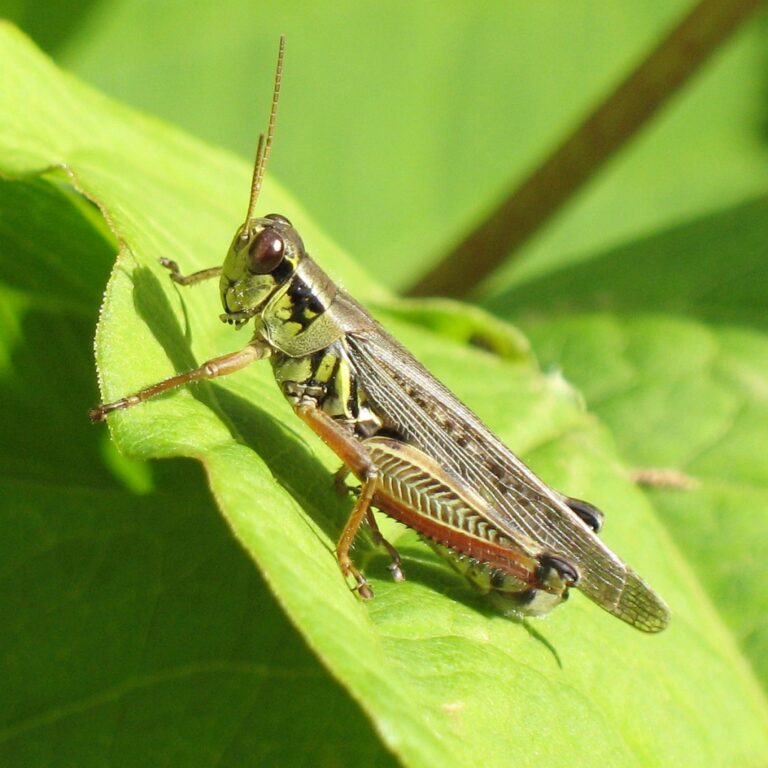
Two of the three common species in the United States are introduced, the Chinese and European mantises, and they compete with native ones such as the Carolina mantis. That is a reason not to buy and release commercial egg cases, which are almost always the Chinese species. For a contrasting omen, a grasshopper landing on you carries the opposite advice.
Related reading: Praying Mantis Symbolism.
Frequently Asked Questions
What does it mean if a praying mantis lands on you?
It is read as a call for patience and precise timing: hold still, look at the situation from more than one angle, then act once. The folded forelegs put prayer and divine attention into the reading, so the contact is treated as reassurance and good luck rather than as any kind of warning.
What does it mean to be visited by a praying mantis?
A visit, meaning repeated sightings rather than one, is read as a message you have heard but not acted on. Indoor visits point at the household, garden visits at work and patience. Sightings cluster in August through October for seasonal reasons, so the calendar explains most runs of encounters.
Is finding a praying mantis lucky?
Yes in nearly every tradition that records it, from San belief in southern Africa to Chinese admiration for its fighting stance. Folklore also says harming one reverses the luck. Despite the widespread claim, killing a mantis is not illegal anywhere in the United States, and no law protects the common species.
What attracts praying mantises to your house?
The insects your lights attract. Porch and window lamps pull in moths and flies, and a mantis follows the food to walls and screens, then occasionally through an open door. Potted plants carried indoors are the other route, usually bringing an egg case rather than an adult insect.
What month do praying mantises lay eggs?
Most lay in September through November, after mating in late summer and before the first hard frost. The female attaches a foam egg case, called an ootheca, to a stem, fence or wall, where it overwinters. Hatching follows in late spring, usually May or June depending on how warm the region is.
Is the praying mantis a spirit animal?
It is widely used as one in contemporary spiritual writing, where it stands for stillness, patience and acting only when the moment is right. The words totem and power animal appear for the same figure, although totem has a specific clan meaning in the traditions it comes from and is not a synonym.
Explore more: Insect Spiritual Meanings: 15 Bugs and What They Signal