5 Spiders That Look Like Brown Recluses: Count the Eyes
Most spiders that look like brown recluses are harmless, and the check that settles it takes one photograph. A true brown recluse (Loxosceles reclusa) has six eyes in three pairs, uniformly tan legs with no stripes or spines, and a smooth violin mark pointing back from the head. Every common lookalike fails at least two of those three tests.
The five species below account for nearly every misidentification in US homes: southern house spiders, wolf spiders, grass spiders, hobo spiders and yellow sac spiders. None of them causes the skin damage people fear, and genuine recluse bites are far rarer than the diagnoses suggest.
Brown recluses have six eyes, plain tan legs without spines and a dark violin shape on the head region. Lookalikes have eight eyes, patterned or spiny legs, and often markings on the abdomen instead. Southern house spiders and wolf spiders are the two mistaken most often, and both are medically harmless.
| Feature | Brown recluse | Common lookalikes |
|---|---|---|
| Eyes | Six, in three pairs | Eight |
| Legs | Plain tan, no spines, no bands | Spiny, banded or striped |
| Abdomen | Uniform, no pattern | Usually marked or mottled |
| Body length | 0.25 to 0.4 in (6 to 10 mm) | 0.2 to 1.2 in (5 to 30 mm) |
| Web | Loose, irregular, hidden | Funnel, sheet or none |
| Medically serious | Occasionally | No |
Southern House Spider: The Closest Match
The southern house spider (Kukulcania hibernalis) causes more recluse scares across the Gulf states and the Southwest than any other species. Males are leggy, uniformly tan to charcoal and roughly recluse sized at 0.4 in (10 mm) in body length, and they wander indoors at night in late summer.
Count the eyes and the case closes: eight, in a tight cluster, not six in pairs. Males also have long, forward reaching pedipalps that look like extra short legs, and the body lacks any violin outline. Females are darker, stouter and build dense sheet webs in wall cracks. Neither sex is dangerous. The full comparison sits in our guide to brown recluse versus house spider.
Wolf Spiders: Bigger, Hairier and Fast

Wolf spiders (Tigrosa, Hogna and related genera) are the bulkiest lookalike at 0.4 to 1.2 in (10 to 30 mm), brown with grayish stripes down the carapace that people read as a violin. They hunt on the ground, sprint when the lights come on, and often carry an egg sac at the rear or a mass of spiderlings on the back.
Their eye arrangement is unmistakable once you look: eight eyes in three rows, with two large forward facing eyes that shine back at a flashlight beam. Legs are thick and visibly spiny, nothing like the smooth recluse leg. Why shouldn’t you squish a wolf spider? A female carrying young scatters dozens of spiderlings across the floor, and the spider eats roaches and crickets. Catch and release beats a shoe. See wolf spider versus brown recluse for the side by side.
Grass Spiders: Funnel Webs and Striped Carapaces
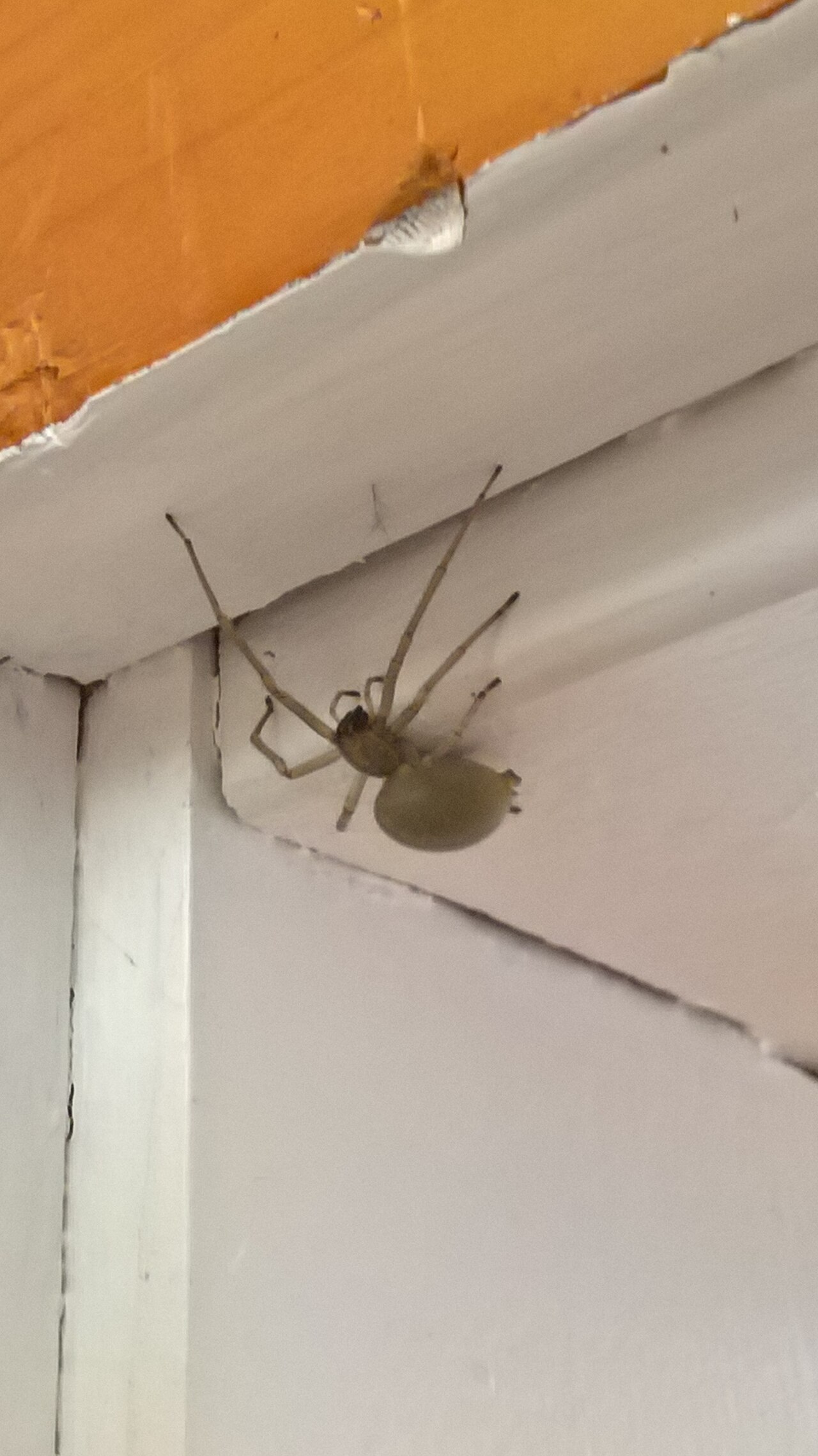
Grass spiders (Agelenopsis species) occur in every state and get mistaken for recluses when they wander indoors in fall. Body length runs 0.4 to 0.75 in (10 to 19 mm), the carapace carries two bold dark stripes, and two long spinnerets stick out visibly past the abdomen tip.
The key differences between a brown recluse spider and a grass spider are the eyes, the spinnerets and the web. Grass spiders have eight eyes, those projecting spinnerets, and they build flat sheet webs with a funnel retreat in lawns, shrubs and foundation corners. Brown recluses build nothing structured and never sit in the open on a web. Grass spider bites are trivial.
Hobo Spiders and Yellow Sac Spiders
Hobo spiders (Eratigena agrestis) in the Pacific Northwest are tan funnel weavers of 0.4 to 0.55 in (10 to 14 mm) with chevron markings on the abdomen and eight eyes in two rows. Their reputation for necrotic bites came from early studies that later work has not supported, and current medical consensus treats them as harmless.
Yellow sac spiders (Cheiracanthium species) are much smaller at 0.2 to 0.4 in (5 to 10 mm), pale yellow to tan with darker jaws, and they bite more readily than any spider on this list. The result is a stinging welt that fades in a few days, not a spreading wound. Both species lack the recluse violin and both have the standard eight eyes.
How to Identify a Real Brown Recluse
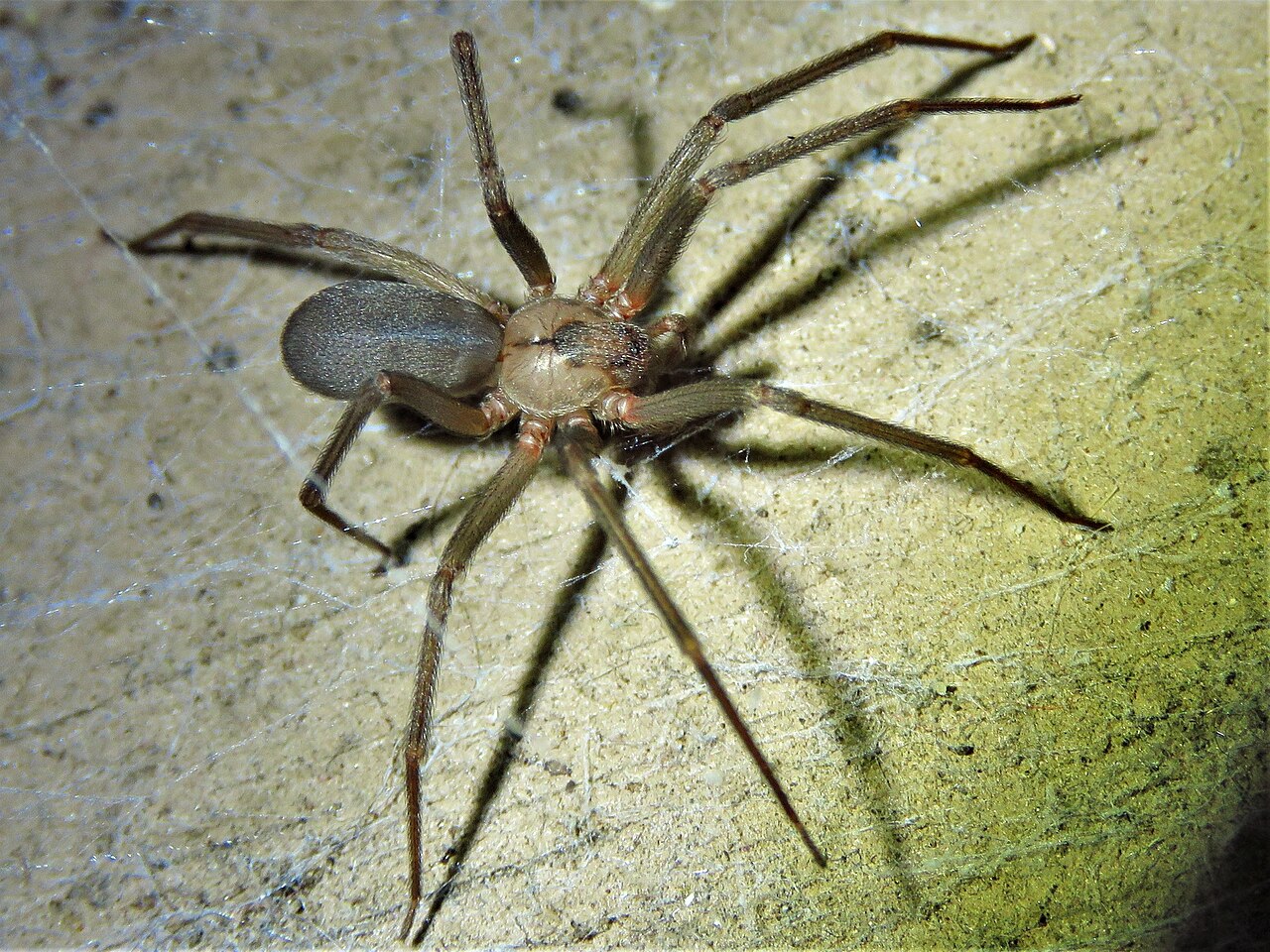
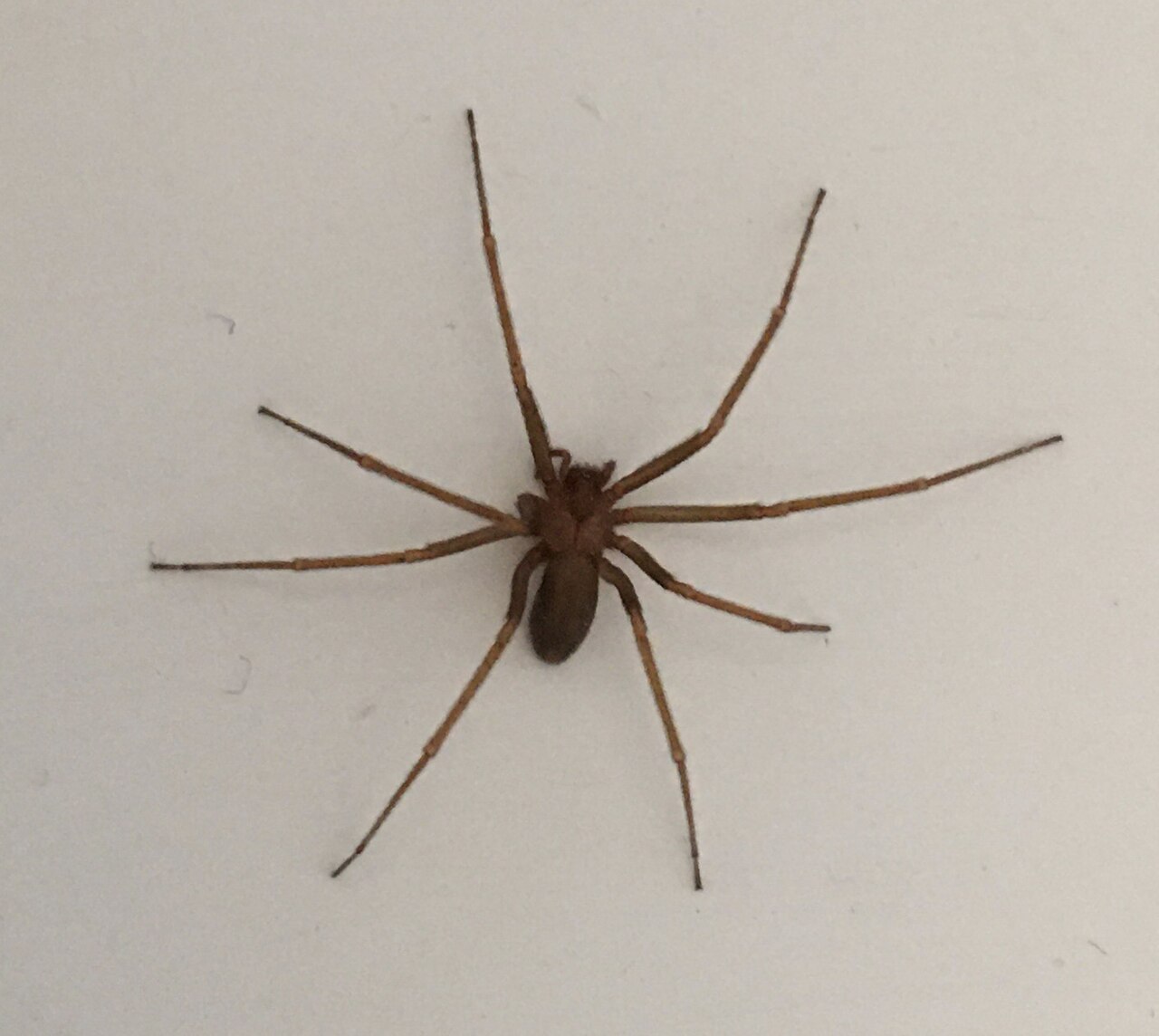
Three features must all line up. Six eyes in three widely spaced pairs is the only test that is fully diagnostic, visible with a phone macro shot or a hand lens. The legs must be plain tan, thin, smooth and free of bands or heavy spines. The violin mark, dark and smooth with its neck pointing toward the abdomen, supports the call but many other spiders carry violin like shading.
Range matters just as much. Brown recluses live in the south central United States, roughly Kansas and Nebraska south to Texas and east to Georgia and Kentucky, with scattered populations elsewhere. Outside that area, a plain brown spider is almost certainly something else. The Mayo Clinic covers bite symptoms and when to seek care at mayoclinic.org. For other confusions, see black widow lookalikes, insects mistaken for spiders and black and white spiders.
Frequently Asked Questions
How does a brown recluse spider bite look like?
Early on it looks like a small red mark, often with a pale center and a faint ring, and most bites heal on their own. A minority develop a blue gray sinking center over 24 to 72 hours that can break down into an open sore. Spreading redness with fever is more often bacterial infection than spider venom.
How soon will you know if you got bit by a brown recluse?
Usually not for several hours. The bite itself is typically painless, with stinging or aching starting 2 to 8 hours later and any tissue change appearing over the following day or two. That delay means the spider is rarely seen in the act, which is why confirmed bites require a captured specimen.
What month is brown recluse most active?
Activity peaks from April through October, with the most indoor sightings in July and August when males wander in search of mates. In heated homes they remain active year round at a lower level. Sightings cluster in basements, closets, garages and storage boxes rather than in open living space.
What attracts brown recluse spiders to your house?
Undisturbed clutter and prey, not food or moisture. Cardboard boxes, stacked firewood, seldom worn shoes, behind baseboards and inside wall voids all offer the dry, quiet shelter they prefer. Reducing cardboard storage, sealing gaps and shaking out clothing left on the floor does more than spraying. Natural predators matter too, as our look at birds that eat spiders shows.