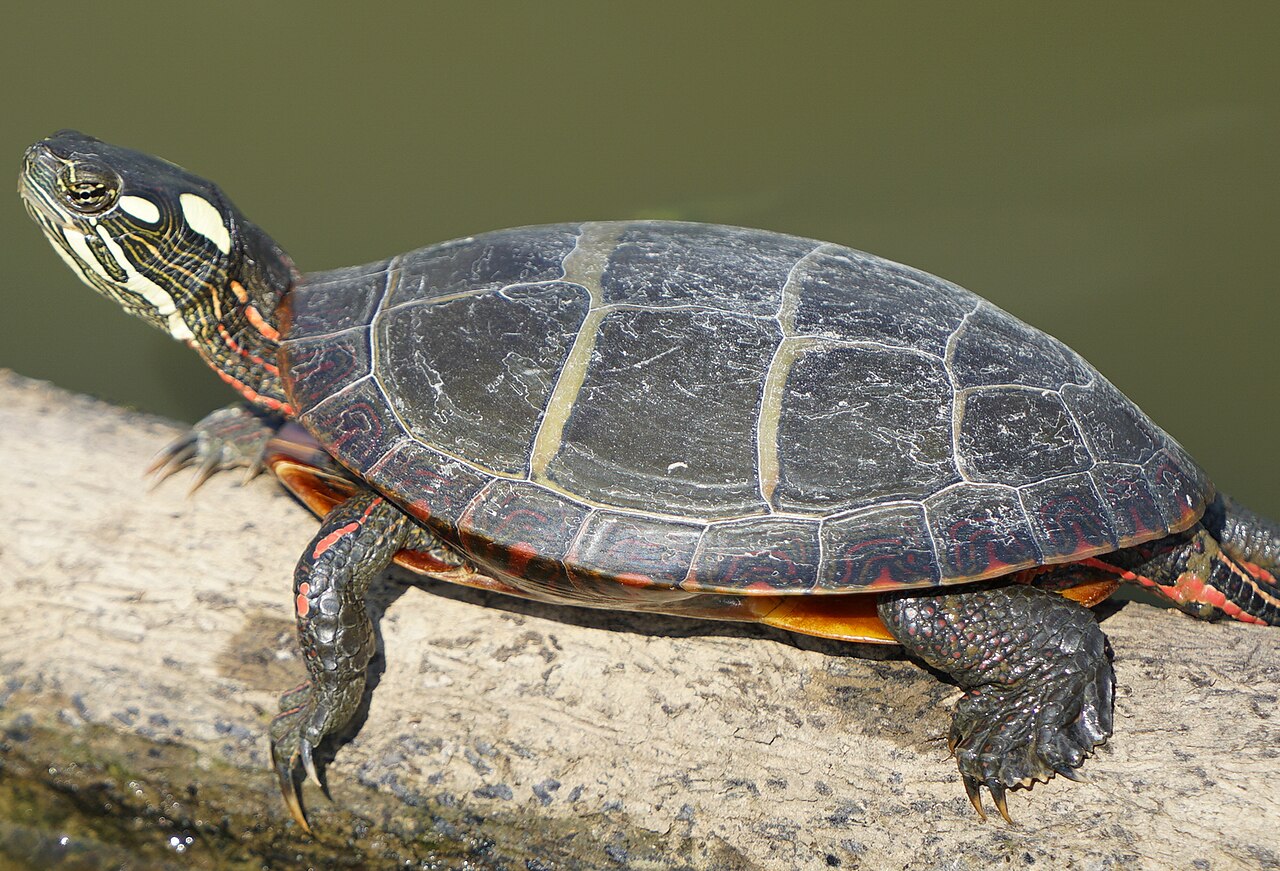
Painted Turtle Lifespan: 20 to 30 Years Wild, 50 With Luck
A wild painted turtle lifespan runs about 20 to 30 years, and animals that survive their first few seasons often push past 35. In captivity, a well kept painted turtle commonly reaches 25 to 30 years, with documented individuals passing 50. Long term field studies in Michigan have tracked marked females that were still nesting in their fifties, which puts this common pond turtle among the longest lived reptiles in North America.
Almost none of that lifespan is guaranteed. Fewer than one in ten hatchlings reaches adulthood, and the turtles that do live for decades are the ones that got past nest predators, road crossings, and their first two winters. Once a painted turtle is adult sized, its annual survival rate is very high, which is why the average age of a pond population keeps climbing.
Painted turtles live 20 to 30 years in the wild and 25 to 30 years in captivity, with verified individuals exceeding 50 years. Females outlive males because they mature later and grow larger. Survival is lowest in the egg and hatchling stage, when more than 80 percent are lost to predators.
| Life stage or group | Typical age or span | Survival note |
|---|---|---|
| Egg to hatchling | 72 to 80 days incubation | Most nests are dug up by raccoons and skunks |
| First year | Under 1 year | Roughly 10 to 30 percent survive |
| Male maturity | 2 to 4 years | Matures at 3 to 4 in (8 to 10 cm) shell length |
| Female maturity | 6 to 10 years | Matures at 4 to 5 in (10 to 13 cm) shell length |
| Wild adult | 20 to 30 years typical | Annual adult survival above 90 percent |
| Captive adult | 25 to 30 years typical | Depends almost entirely on UVB, heat, and water quality |
| Record ages | 50 to 61 years | Marked wild females in long term studies |
How Long Do Painted Turtles Live in the Wild?
A wild painted turtle (Chrysemys picta) that reaches adulthood usually lives 20 to 30 years, and a meaningful share of any established pond population is older than that. Mark and recapture work at long running sites in Michigan, Illinois, and Ontario keeps turning up animals first tagged in the 1970s and 1980s, still nesting and still gaining mass.
The reason is unusual for a small animal. Adult painted turtles show almost no increase in death rate with age, a pattern biologists call negligible senescence. A 30 year old female is about as likely to survive the next winter as a 12 year old one, so the population loses members to accidents and predators rather than to old age.
Climate shapes the number more than most owners expect. Northern populations grow slowly, mature late, and live longest, while southern turtles in Louisiana or Alabama grow fast, breed early, and burn through their years quicker. The same species can average 18 years in one state and 30 in another. If you want the full species picture beyond longevity, our guide to the painted turtle covers range, diet, and behavior.
How Long Do Painted Turtles Live in Captivity?

A captive painted turtle should live 25 to 30 years, and many fall far short of that. The animals that die at five or six years old almost never die of disease alone. They die of a tank that was too small, water that was never filtered, a basking spot that never reached 90 F (32 C), or a UVB bulb that stopped emitting useful output a year before anyone replaced it.
Captivity removes the two biggest wild killers, predation and road traffic, so a properly housed adult has a real shot at outliving its wild relatives. The trade is that every environmental variable now sits in your hands. Painted turtles are cold adapted animals with high oxygen tolerance, and they survive neglect long enough to hide the damage until organ failure shows up.
Expect a 55 gallon tank minimum for one adult, with 10 gallons added per additional turtle, plus a canister filter rated for double the water volume. That setup is the difference between a 6 year turtle and a 30 year one. Hatchlings need the same standards on a smaller scale, which we break down in our care notes on baby painted turtles.
Does Painted Turtle Lifespan Differ by Subspecies?

All four subspecies land in the same broad range, but body size and climate push them apart. The western painted turtle (C. p. bellii) is the largest, reaching 10 in (25 cm), and it holds most of the extreme age records because it occupies the coldest part of the range. Bigger and slower almost always means older in this genus.
The eastern painted turtle (C. p. picta) averages 5 to 7 in (13 to 18 cm) and lives 20 to 30 years, the standard figure quoted for the species. The midland form (C. p. marginata) sits between the two. The southern painted turtle (C. p. dorsalis) is the smallest at 4 to 6 in (10 to 15 cm), matures earliest, and tends toward the lower end at 15 to 25 years.
Regional detail matters if you are identifying a wild animal rather than buying one. The eastern painted turtle is the only subspecies with shell segments arranged in straight rows across the back, which is a useful field mark long before you start guessing at its age.
How Big Is a 10 Year Old Painted Turtle?

A 10 year old painted turtle is typically 5 to 7 in (13 to 18 cm) in carapace length if it is female, and 4 to 5 in (10 to 13 cm) if it is male. By that age most of the growth is finished. Painted turtles put on shell length fast for the first four to six years, then slow to a crawl, adding fractions of an inch per year for the rest of their lives.
Females are consistently larger, and the gap widens with age. Male painted turtles stop at around 6 in (15 cm) in most populations, while females of the western subspecies commonly clear 8 in (20 cm). A large turtle is therefore more likely to be old and female than simply old.
Diet and water temperature complicate this. A captive turtle fed heavily on pellets often outgrows a wild turtle of the same age by a full inch, which makes size a rough proxy for age at best. It is more reliable in the first decade than in the second.
Can You Tell How Old a Painted Turtle Is?

You can estimate a painted turtle’s age from the growth rings on its shell, but only for young animals. Each scute develops concentric ridges called annuli, laid down when growth pauses during winter. Counting the rings on a single scute gives a workable estimate for turtles under about 15 years old.
After that the method breaks down. Growth slows so much that new rings stop being distinguishable, and shell wear from basking rocks, algae, and shedding smooths the old ones away. A 40 year old turtle and a 20 year old turtle can show the same worn, ringless scutes.
Researchers get around this with long term marking programs rather than shell reading, notching the marginal scutes of turtles at first capture. That is how the 50 plus year records exist at all. For a pet whose hatch date you do not know, treat any age above 15 as an educated guess.
What Is the Number One Cause of Death for Turtles?
For turtles as a group, the number one cause of death is predation on eggs and hatchlings. Raccoons, skunks, foxes, and crows destroy 60 to 90 percent of painted turtle nests in most studied populations, often within 48 hours of the eggs being laid. Nothing else comes close in raw numbers.
For adults, the leading cause is human related: vehicle strikes on roads, especially in June when females travel overland to nest. Because the species depends on decades of adult survival to replace itself, losing breeding females to traffic damages a population far more than losing a hundred hatchlings.
In captivity the ranking changes completely. Vitamin A deficiency, respiratory infection from cold water, and metabolic bone disease from missing UVB account for most premature deaths. The United States Geological Survey and state wildlife agencies track road mortality data, and summaries are available through the USGS.
What Eats a Painted Turtle?
Raccoons are the single most important predator of painted turtles, taking eggs, hatchlings, and occasionally adults caught on land. Skunks, foxes, coyotes, and river otters follow, and otters are one of the few mammals that routinely kill adult turtles in the water.
From the air, great blue herons, crows, and gulls take hatchlings crossing open ground. In the water, largemouth bass, snapping turtles, and bullfrogs eat the young ones during their first year, when a hatchling is smaller than a silver dollar.
An adult painted turtle has few enemies left. The shell is high domed, fully ossified, and the animal can pull in completely, which is why the survival curve flattens so sharply at maturity. Semi aquatic relatives that spend more time on land, such as the eastern mud turtle, face a different mix of threats.
What Are the Signs That a Turtle Is Dying?
The clearest warning signs are refusal to eat for several weeks, lethargy with sunken or swollen eyes, and a soft or pitted shell. Painted turtles hide illness well, so by the time a turtle stops basking and sits on the bottom with its limbs slack, the underlying problem is usually advanced.
Respiratory infection shows as bubbles at the nostrils, open mouth breathing, and swimming lopsided because one lung has filled. Metabolic bone disease shows as a shell that flexes under thumb pressure and a jaw that no longer closes evenly. Both are treatable if caught early and fatal if ignored.
One trap worth knowing: a turtle that becomes still and unresponsive in cold water may be brumating, not dying. If you are unsure whether a slowdown is seasonal, our explainer on whether turtles hibernate walks through the difference between normal winter dormancy and a sick animal.
How to Give a Pet Painted Turtle a Full Lifespan
Four things decide whether your turtle sees 30 years: water quality, basking heat, UVB, and diet. Keep the water between 72 and 78 F (22 to 26 C) with a filter oversized for the tank, and change 25 percent weekly. Provide a dry basking platform at 88 to 95 F (31 to 35 C) with a UVB source rated for turtles.
Feed adults every other day, not daily. A diet of quality pellets plus leafy greens, with occasional earthworms or feeder fish, avoids the protein overload that causes shell pyramiding and kidney strain. Juveniles eat more animal matter, adults drift toward plants, and matching that shift keeps growth even.
Get a reptile veterinarian involved at the first sign of eye swelling or appetite loss rather than waiting. Painted turtles are hardy enough to mask problems for months, and the owners whose animals reach 30 years are almost always the ones who acted early. Keepers comparing species often look at the box turtle, which is longer lived still but far more demanding.
Frequently Asked Questions
Do painted turtles like to be held?
No. Painted turtles tolerate handling but do not enjoy it. Being lifted triggers a stress response, and frequent handling suppresses appetite and immune function. Keep contact to health checks and tank maintenance, and support the whole shell with both hands when you must pick one up.
Do painted turtles recognize people?
Yes, to a degree. Captive painted turtles learn to associate a specific person with food and will swim to the glass when that person approaches. This is conditioned recognition rather than affection, but it is real learning and it develops within a few months of consistent feeding.
How long do painted turtles live in a tank?
A painted turtle kept in an adequately sized, filtered tank with proper heat and UVB lives 25 to 30 years. In an undersized tank without a basking lamp, most die within 5 to 10 years from respiratory disease or metabolic bone disease. Tank size and lighting are the deciding variables.
Do female painted turtles live longer than males?
Generally yes. Females mature later, grow larger, and show higher adult survival, so the oldest documented individuals in long term studies are nearly always female. The trade is that nesting females cross roads each June, which makes them more vulnerable to vehicle strikes than males.
How long do baby painted turtles live?
Most do not survive their first year. In the wild, roughly 10 to 30 percent of hatchlings reach their first birthday, with nest predation and winter mortality taking the rest. A hatchling raised indoors with correct heat and UVB has normal life expectancy of 25 years or more.
What is the oldest painted turtle on record?
Wild females tracked in long running mark and recapture studies have been confirmed at 55 to 61 years old and were still reproducing. Captive records are lower, generally in the 30s and 40s, mostly because few pet turtles are kept under consistent conditions for that many decades.