Beaver Tracks: 5 ID Clues in Snow, Mud and Sand
Beaver tracks are identified by the hind foot: a broad, webbed print 5 to 7 inches (13 to 18 cm) long with five toes and visible claw marks, usually dragged over by a tail mark. The front foot is much smaller, about 3 inches (7.5 cm) long, and prints like a small hand with sharp claws. Almost no other North American animal leaves a webbed print that large.
In practice you rarely see a clean set. The American beaver (Castor canadensis) waddles, so the hind feet land on the front prints and smear them, and the tail erases part of the trail behind. Reading beaver sign means reading the whole package: print size, webbing, tail drag, and the muddy slide where the trail enters the water.
Beaver tracks show a webbed hind print 5 to 7 inches (13 to 18 cm) long and 3.5 to 5 inches (9 to 13 cm) wide with five toes and claws, plus a smaller front print 2.5 to 3.5 inches (6 to 9 cm) long. Stride is short at 6 to 10 inches (15 to 25 cm), the trail is wide, and a flattened tail drag often runs down the middle.
How to Identify Beaver Tracks
Start with the hind foot, because it carries the one feature nothing else shares at that size: webbing between all five toes. In firm mud the webbing registers as a smooth fan between the toe pads, and the print looks like a wide, slightly lopsided triangle. The inner toe is the shortest, the outer toes splay, and claw marks appear as short dashes beyond each pad.
The front foot is the opposite shape. It is compact and hand-like, 2.5 to 3.5 inches (6 to 9 cm) long, with five toes of which the innermost often fails to register, so it reads as four. Claws are long and prominent because beavers dig with these feet. Front prints are frequently destroyed by the hind foot landing on them, which itself is a clue.
Then read the trail. Beavers move in a slow walk with a wide straddle of 7 to 11 inches (18 to 28 cm), so the line of prints looks clumsy compared with the straight trail of a coyote.
Beaver Track Measurements at a Glance
| Feature | Measurement |
|---|---|
| Hind print length | 5 to 7 in (13 to 18 cm) |
| Hind print width | 3.5 to 5 in (9 to 13 cm), webbed, 5 toes |
| Front print | 2.5 to 3.5 in (6 to 9 cm), hand-like, long claws |
| Stride | 6 to 10 in (15 to 25 cm), slow walking pace |
| Trail width | 7 to 11 in (18 to 28 cm) |
| Tail drag | Flattened smear 5 to 9 in (13 to 23 cm) wide |
Claws always show, which rules out cat family prints immediately. If you are comparing against a retractile-clawed animal, bobcat tracks are the reference case.
Beaver Tracks in Snow
Winter is the best season for beaver sign, and snow records the tail better than any other surface. Look at pond edges, open channels, and the paths between a lodge and a feeding area. Beavers in deep snow often plow a trough rather than leaving discrete prints, so you see a continuous furrow 10 to 14 inches (25 to 36 cm) wide with toe scuffs on the sides.
In 1 to 3 inches (2.5 to 7.5 cm) of fresh snow the prints hold their shape but the webbing blurs, because snow collapses where mud would fill. Measure the hind print anyway: nothing else in that habitat leaves a 6 inch (15 cm) print with five claws. Fresh gnawed stems and cut saplings along the trail confirm it, and the sharp two-lobed prints of deer tracks crossing the same pond edge give you a useful size reference in the snow.
Next question: Beaver Poop: How to Identify It and 3 Common Look Alikes
Beaver Tracks in Mud
Mud at a pond or stream bank gives the clearest detail. Pick a spot where the animal climbed out of the water: the hind print there is pressed deep, the webbing prints cleanly, and the toe pads are distinct. Mud also records the slide, a polished chute 12 to 18 inches (30 to 46 cm) wide where the beaver pushed off back into the water.
Scent mounds are the best companion sign in mud. Beavers pile wet muck and vegetation into low cones along the bank and mark them, so prints cluster around them. Around the same banks you may find duck tracks, which are also webbed but under 3 inches (7.5 cm) long and show only three forward toes.
Beaver Tracks in Sand
Sand is the hardest surface for identification, because dry grains slump and swallow the toe detail. What survives is the overall outline and the tail drag, so measure the print length and trail width rather than hunting for claw marks. Damp sand at the waterline holds detail for a few hours and is worth the walk.
On sandbars and reservoir shorelines, beaver trails usually run perpendicular to the water and end at cut willows or cottonwoods. Follow the trail inland and you will find the feeding sign that a slumped print cannot give you.
Beaver Tracks vs Otter Tracks and Other Lookalikes
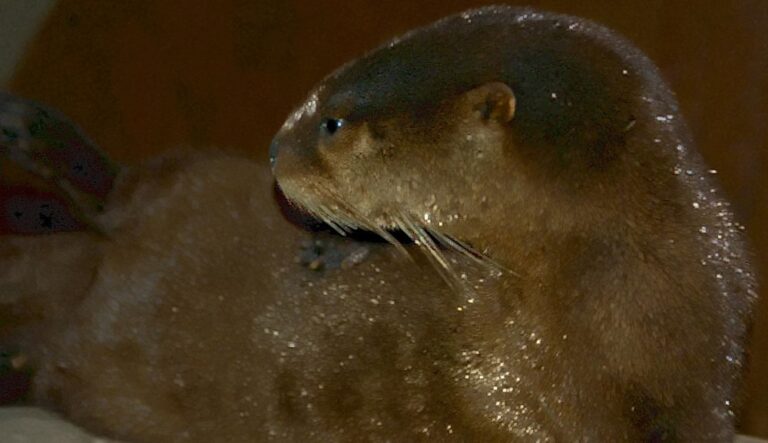
River otter (Lontra canadensis) is the main confusion, since both are webbed and both live at the water. Otter prints are round and 2 to 3.5 inches (5 to 9 cm) across, less than half the length of a beaver hind print, and the gait is the separator: otters bound and slide, leaving groups of prints with gaps between them, while beavers walk steadily. Otter slides are narrower, roughly 8 to 12 inches (20 to 30 cm).
Muskrat prints look like small beaver prints at 1 to 1.5 inches (2.5 to 4 cm) with a thin tail line instead of a broad smear. Raccoon prints are hand-like with five long fingers and no webbing. Opossum prints show a thumb-like inner toe on the hind foot that points sideways, which nothing else does. For dense-forest mustelid prints that sometimes turn up on the same banks, compare fisher tracks, and for the largest clawed print in the region, bear tracks.
Frequently Asked Questions
What is the difference between beaver tracks and otter tracks?
Size and gait. A beaver hind print is 5 to 7 inches (13 to 18 cm) long and comes from a steady walk with a tail drag, while an otter print is a round 2 to 3.5 inches (5 to 9 cm) and comes from a bounding gait with groups of prints and frequent slides. Otters also leave fish scale scat at the waterline.
How to tell otter vs beaver?
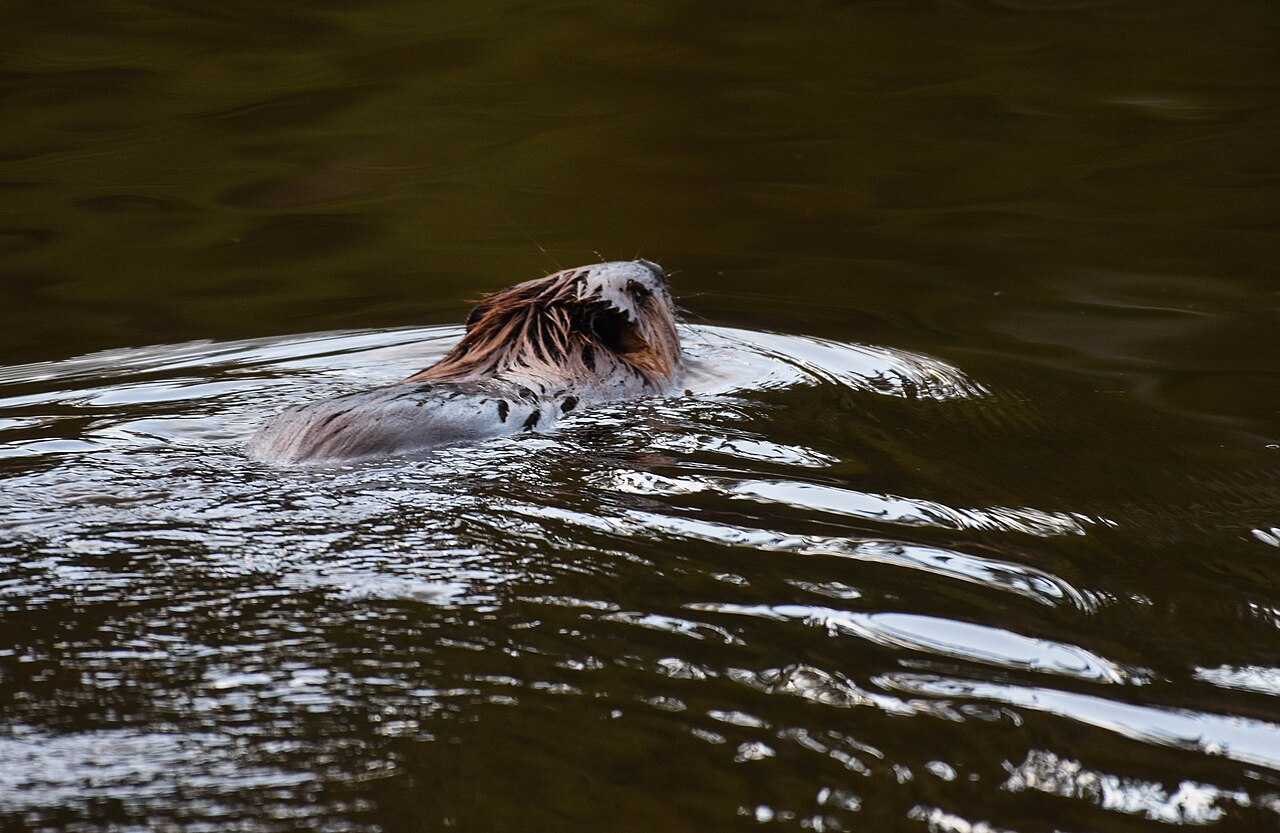
Watch the tail and the swimming profile. A beaver shows a broad flat tail and slaps it on the water as an alarm, and only the head rides above the surface. An otter has a thick tapered tail, swims with a visible rolling back, and travels in family groups. On land the otter lopes while the beaver waddles.
What gets mistaken for a beaver?
Muskrats most often, especially at a distance on a pond, since both swim with just the head showing. Nutria, groundhogs near water, and otters account for most of the rest. The tail settles it: flat and paddle-shaped for beaver, thin and rope-like for muskrat and nutria.
Is there an app that will identify animal tracks?
Several exist, and iNaturalist with a clear scaled photo gets you a community identification within a day or two, which is the most reliable free option. Dedicated track apps vary in quality, and none replaces measuring print length and trail width. Record both numbers before you ask any app.
What is the natural enemy of beavers?
Coyotes, wolves, bears, bobcats, and mountain lions take beavers on land, where the animal is slow and vulnerable, and river otters and large raptors take kits. Beavers are safest in water, which is why trails to feeding areas stay short. The US Fish and Wildlife Service covers beaver management and wetland impacts in more detail.