Duck Tracks: How to Identify Duck Footprints in Snow, Mud and Sand
Duck footprints are easy to name once you know what webbing looks like in the ground: three forward toes joined by a triangle of skin, a small rear toe that usually leaves nothing behind, and a track about as wide as it is long. A mallard print runs 2 to 2.5 in (5 to 6.5 cm) long, and the trail zigzags because ducks walk pigeon-toed with their feet angled inward.
Snow, mud and sand each record a different share of that information. Snow blurs the webbing and adds drag marks, mud holds the sharpest outline including the nail tips, and dry sand collapses into a dimple that tells you little more than the size. Reading the substrate first saves you from chasing details the ground never captured.
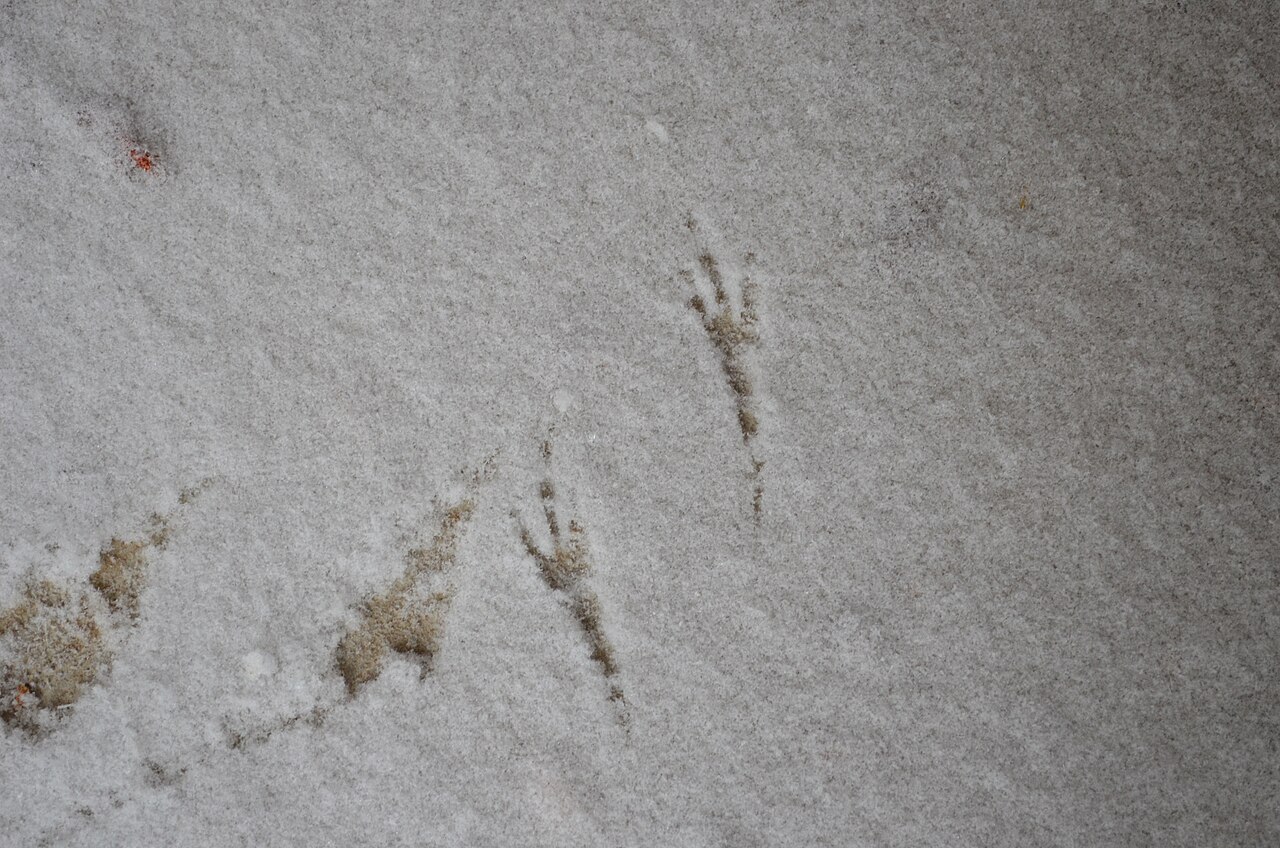
A duck footprint shows three forward toes connected by webbing in a fan or triangle shape, roughly 2 to 2.5 in (5 to 6.5 cm) long for a mallard, with faint nail marks at the tips and a small rear toe that rarely registers. The trail is a narrow alternating walk with the toes turned inward.
| Feature | Duck track detail |
|---|---|
| Forward toes | 3, fully joined by webbing (palmate) |
| Rear toe (hallux) | Present but raised, prints as a faint dot or not at all |
| Track length | 1.5 to 2.75 in (4 to 7 cm) depending on species |
| Track width | 1.75 to 2.75 in (4.5 to 7 cm), nearly as wide as long |
| Claws | Small blunt nail marks at each toe tip |
| Stride | 4 to 7 in (10 to 18 cm) between prints |
| Straddle and gait | 3 to 4 in (8 to 10 cm) wide, alternating walk, toes turned in |
What does a duck footprint look like?
A duck footprint looks like a small webbed fan. The middle toe points forward and is the longest, the two outer toes angle away from it at roughly 40 degrees each, and the webbing between them fills the gaps so the print reads as one solid shape rather than three separate lines. In firm mud you can see the webbing edge scalloped between the toe tips.
The fourth toe sits high on the back of the leg and only shows in deep, soft material. When it does register, it appears as a dot or short dash behind the center of the track, never as a long backward toe. That raised rear toe is one of the quickest ways to separate waterfowl from the songbird and wading bird tracks that press all four toes into the ground.
Duck track size and what it tells you
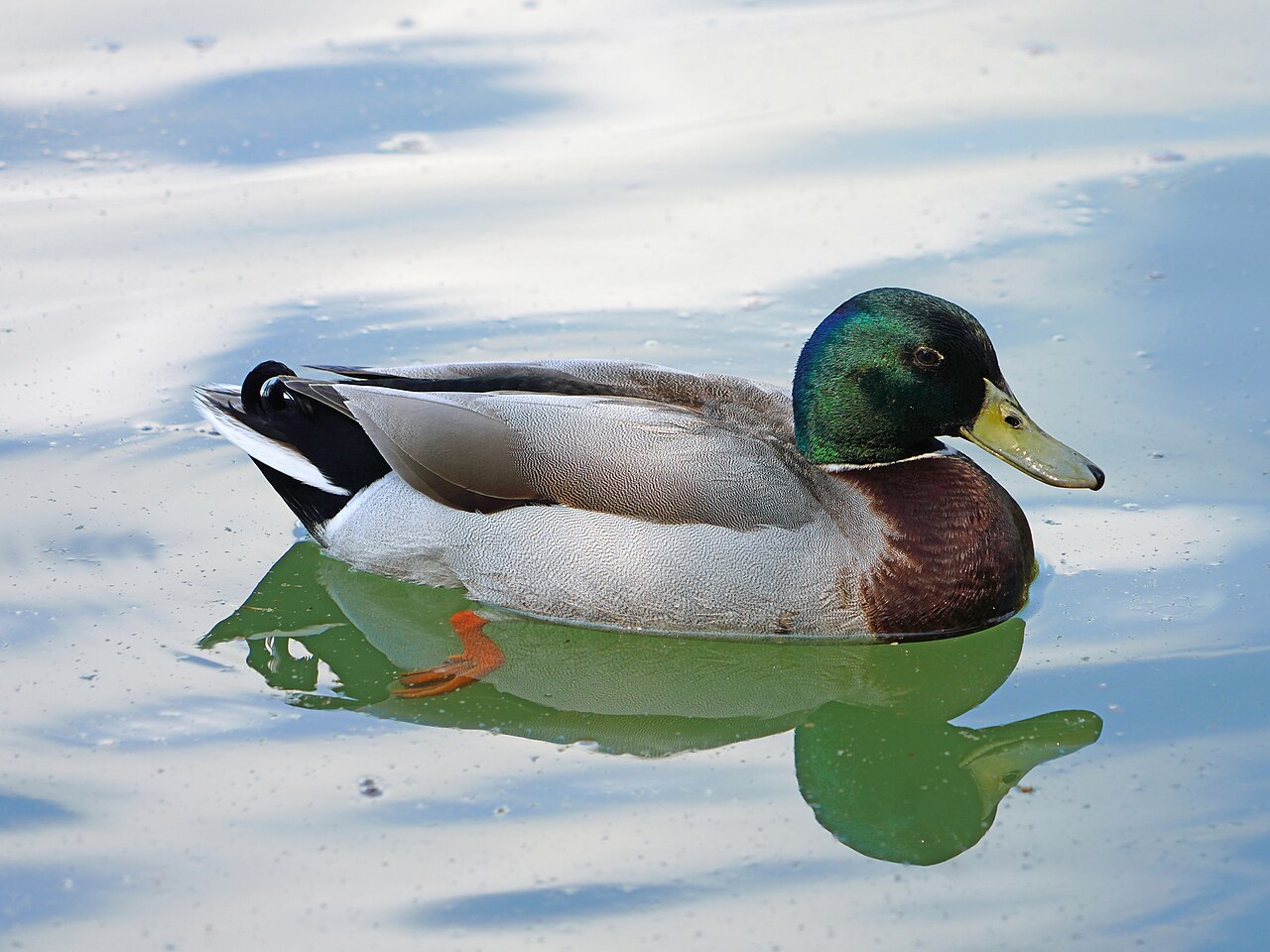
Size sorts ducks into three rough groups. Teal, bufflehead and wood duck tracks run 1.5 to 2 in (4 to 5 cm) long. Mallard, pintail, gadwall and most diving ducks fall between 2 and 2.5 in (5 to 6.5 cm). Large mergansers and eiders reach 2.75 in (7 cm).
Width matters as much as length. A duck track is nearly square in its proportions, while gull and shorebird tracks are usually longer than wide. Measure from the back of the heel pad to the tip of the middle toe without the nail mark, then measure across the two outer toes at their widest point, and write both numbers down before the track melts or dries.
Duck tracks in snow
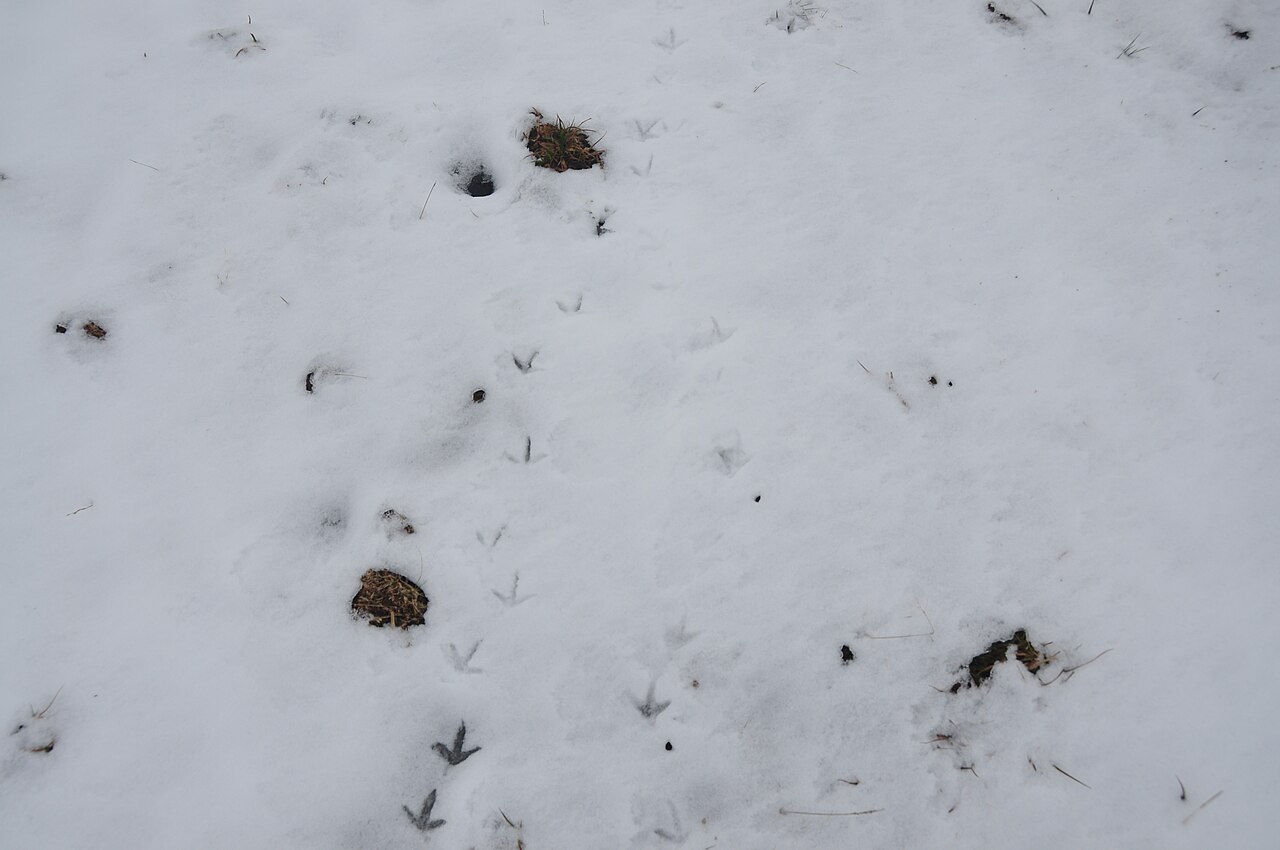
Snow is the season for tracking, and it is also the least honest substrate. In fresh powder under about 1 in (2.5 cm) deep, a duck track keeps its webbed outline well. Deeper than that, the walls collapse inward, the webbing disappears, and each print reads as a rounded hole with a tail where the foot dragged in and out.
Those drag marks are useful rather than a nuisance. Ducks have short legs and lift their feet barely clear of the surface, so a continuous pair of shallow furrows connecting round holes almost always means waterfowl. Look at crusted snow or a thin layer over ice near open water, where the detail survives longest. Low morning sun throws shadow into the webbing and makes it visible again.
Duck tracks in mud
Mud at the waterline is where duck footprints look like the field guide drawing. Soft, fine-grained mud with a little moisture left in it holds the webbing edge, the nail marks and sometimes the texture of the foot. Boat ramps, pond margins, flooded field edges and the mud flats behind beaver dams are the reliable spots.
Very wet mud overdoes it. The foot sinks past the toes, the print fills with water, and the track spreads 20 to 30 percent wider than the actual foot, which pushes a mallard into goose territory on your tape measure. If every print is flooded, measure the firmest track you can find rather than the clearest one, and treat the number as an upper bound.
Duck tracks in sand
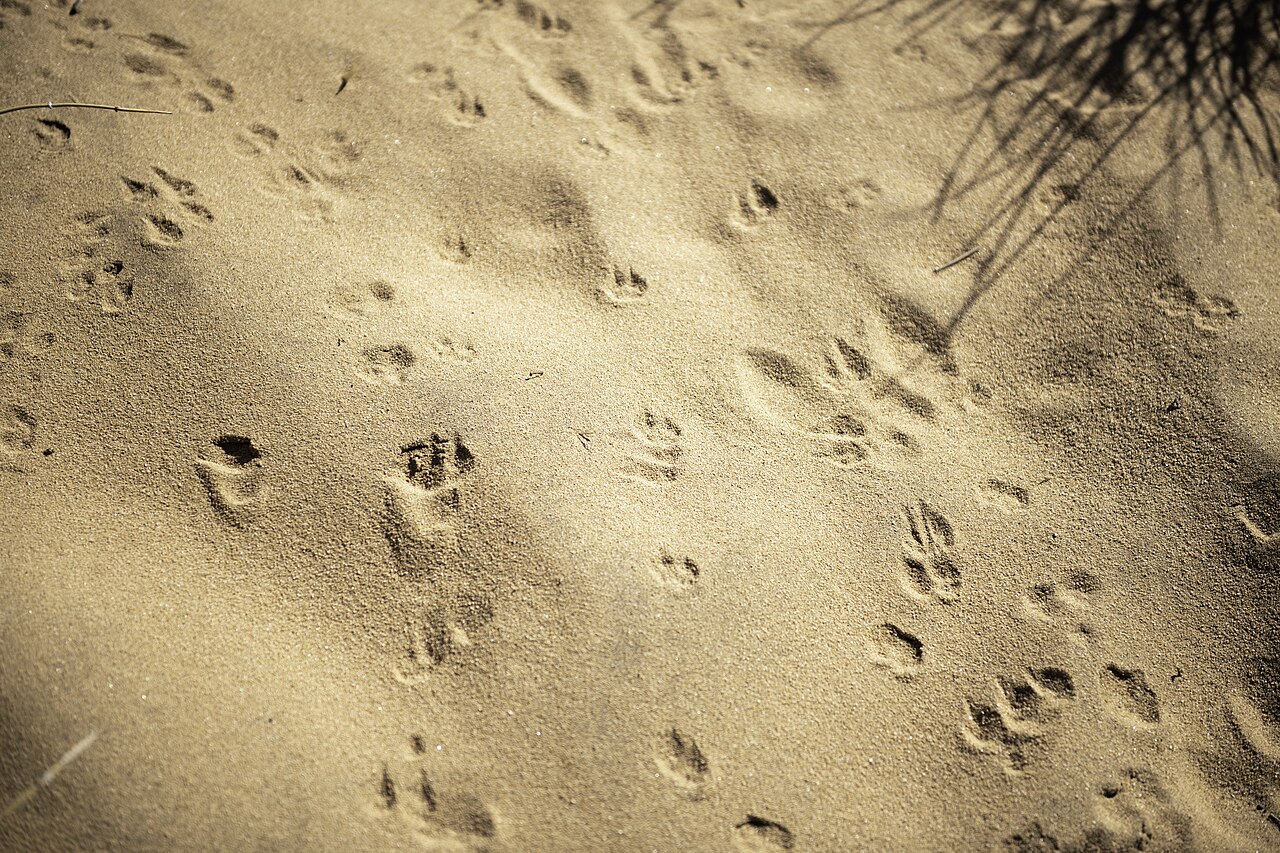
Dry sand records almost nothing. The grains have no cohesion, the walls slump the moment the foot lifts, and what remains is a round depression with no toes. On a dune or a dry beach, judge the trail instead: spacing, straddle and the inward foot angle still identify waterfowl even when the individual prints are useless.
Damp sand within a few feet of the waterline behaves like mud and gives clean prints. Wind is the other factor to check. A track in sand degrades within hours in a breeze, so a crisp print on an exposed beach is fresh, while a soft-edged one may be a day old. Compare a known fresh track, such as your own boot print, to calibrate.
Stride, straddle and gait
Ducks walk, they do not hop. The trail shows left and right prints alternating in two loose lines, with a stride of 4 to 7 in (10 to 18 cm) for a mallard and a straddle of 3 to 4 in (8 to 10 cm). When a duck hurries, the stride lengthens and the straddle widens as the bird rocks side to side.
The giveaway is the foot angle. Each print toes inward toward the center line by 10 to 20 degrees, a trait that gave the word pigeon-toed its meaning. Hopping trails with paired prints belong to perching birds. A trail that runs out in a long double skid mark toward open water is a takeoff or a landing, not a mystery.
Mallard tracks versus other duck tracks
Species identification from a single duck print is rarely possible, and honest trackers say so. The practical approach is to narrow by size, habitat and company. A 2.25 in (5.7 cm) track on a suburban pond in Ohio is a mallard by probability, since the mallard is the default duck across nearly all of North America according to the Cornell Lab species account.
Diving duck tracks run slightly larger relative to body size and the trail is clumsier, because their legs sit far back for swimming. Mergansers show a longer, narrower middle toe. Wood duck tracks turn up in unexpected places, such as mud under oaks well away from water, which fits what ducks eat in fall.
Duck tracks versus goose and swan tracks
Geese and swans leave the same palmate shape at a larger size, so this comparison is pure measurement. A Canada goose track runs 3 to 4 in (7.5 to 10 cm) long with a stride of 8 to 14 in (20 to 36 cm). A mute swan reaches 5 to 6 in (13 to 15 cm). Anything over 3 in is not a duck.
Goose tracks also sit heavier, with deeper heel impressions and a wider straddle from the rolling walk. Where a flock has fed, you get overlapping prints and clipped grass stems together, something ducks rarely produce away from water. Goose droppings nearby are firm green cylinders, while duck droppings are looser and often white-streaked.
Duck tracks versus gull and shorebird tracks
Gull tracks are the genuine confusion on a beach. They are webbed too, but the webbing is cut deeper between the toes, the middle toe is noticeably longer than the outer two, and the claws are sharper and leave clear points. A ring-billed gull track measures about 2 to 2.5 in (5 to 6.5 cm), overlapping mallard size exactly.
Use the trail instead of the print: gulls walk a straighter, wider-striding line and their feet point forward rather than inward. Sandpipers, plovers and other shorebirds have no full webbing at all, so their tracks show three thin separate toes. Coots look like ducks on the water but leave lobed, unwebbed toes, each one fringed rather than joined.
Duck tracks versus chicken and game bird tracks
Land birds give the cleanest contrast. Chicken tracks, turkey tracks and pheasant tracks show three slim forward toes with no skin between them and a strong rear toe that usually prints. A turkey track reaches 4 in (10 cm) long and looks skeletal next to the solid fan of a duck.
On farms the two overlap constantly around troughs and spilled feed. If the webbing question is ambiguous because the ground is hard, look for the rear toe: a long backward claw mark means a game bird, a faint dot or nothing means a duck. Mammal prints in the same mud are a different problem, since fox tracks and coyote tracks show four toes with pads.
Where and when to look for duck tracks
Work the transition line between water and land. Pond and lake margins, river sandbars, creek crossings, flooded corn and soybean stubble, drainage ditches and the muddy aprons of boat ramps all collect tracks because ducks loaf and preen on shore. Dawn and dusk are the active hours, so morning gives you the previous night’s record.
Winter concentrates everything. Open water shrinks, birds crowd onto the remaining patches, and snow or frozen mud holds prints for days. Spring is the second best window, when nesting hens walk overland and ducklings leave rows of 0.75 in (2 cm) prints beside the adult trail.
Frequently Asked Questions
What are duck footprints called?
Trackers call them palmate tracks, from the palmate foot that has three forward toes fully joined by webbing. You will also see them called webbed tracks or waterfowl tracks. Palmate separates ducks, geese and gulls from totipalmate birds such as cormorants, where all four toes are webbed.
What is the difference between duck feet and pigeon feet?
Duck feet are webbed with a small raised rear toe that often leaves no mark. Pigeon feet are anisodactyl: three thin forward toes, no webbing, and a long rear toe that prints clearly. A pigeon track looks like a thin arrow, a duck track like a filled fan.
How to identify a paw print?
Count toes and look for pads. Mammal paws show four or five toes around a central pad, with or without claw marks, and no webbing between toes. Bird tracks have slim toes radiating from a small heel and no pad. Cats retract their claws, dogs do not.
Is there an app to identify animal tracks?
Yes, though results vary. iTrack Wildlife holds a solid North American database, and iNaturalist or Seek will take a track photo and suggest options. Apps handle clear mammal prints reasonably well and struggle with bird tracks, so a tape measure and a field guide still beat them on waterfowl.
What do raccoon footprints and possum tracks look like?
Both look like small hands. Raccoon prints show five long slender toes with visible claw tips, the front foot resembling a human hand about 2 to 3 in (5 to 7.5 cm) long. Possum tracks also have five toes, but the hind foot has a thumb that points sideways, which nothing else leaves.
What do skunk and squirrel tracks look like?
Skunk tracks show five toes with long front claws set well ahead of the toe pads, roughly 1.5 in (4 cm) for the front foot, and the trail waddles. Squirrel tracks come in bounding pairs, four toes on the front feet and five on the hind, usually running tree to tree.