White Ladybug: 3 Pale Species and 2 White Lookalikes
A white ladybug is almost always one of three things: a newly emerged beetle that has not colored up yet, a genuinely pale species such as the twenty-spotted lady beetle, or an insect that is not a ladybug at all. None of them is dangerous, and none of them is an albino. If you are holding a cream or chalk white beetle with black spots, the identification below gets you to a name in a minute.
This guide covers the pale species that actually occur in the United States, with size, range and the markings that separate them, plus the two common white lookalikes that send people searching in the first place.
White ladybugs are harmless. Most are newly emerged ladybugs whose shells have not hardened or darkened yet, a process that takes a few hours to two days. The rest are pale species such as the twenty-spotted lady beetle (Psyllobora vigintimaculata) or the ashy gray lady beetle (Olla v-nigrum). No ladybug is venomous.
Are White Ladybugs Harmful?
No. White ladybugs do not sting, carry no venom and are not poisonous to people. A large beetle can pinch if you squeeze it, which feels like a pinprick and breaks no skin. The one real nuisance is reflex bleeding: a stressed ladybug releases a yellow fluid from its leg joints that smells sour and stains fabric and paint.
Pets are the only group worth a second thought, and only in volume. Dogs that lick up large numbers of Asian lady beetles can develop mouth ulcers from that same fluid, which is a chemical irritation rather than a poisoning. A handful of beetles in a yard poses no risk at all.
Twenty-Spotted Lady Beetle (Psyllobora vigintimaculata)

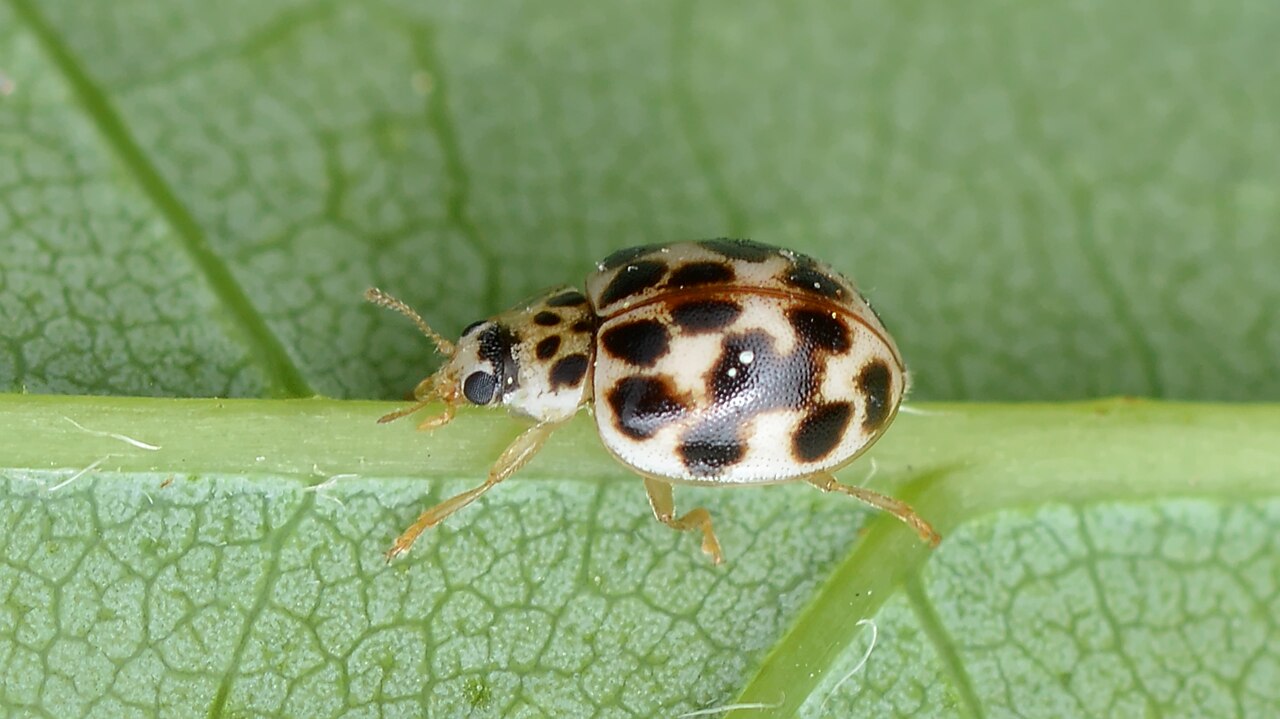
This is the real white ladybug, and it is tiny. Adults run 1/16 to 1/8 in (1.5 to 3 mm), with a cream to chalk white shell carrying irregular black spots that often smear together into blotches rather than staying round. The pale head and the wavy spot pattern are the quickest tells.
It ranges across most of the United States and southern Canada, and it is one of the few ladybugs that eats fungus rather than insects. Both adults and larvae graze powdery mildew on squash, lilac, grape and bee balm, so finding them means mildew is present. They are entirely harmless to the plant and to you.
Ashy Gray Lady Beetle (Olla v-nigrum)

The ashy gray lady beetle is the pale beetle most people mistake for a faded ladybug. Adults reach about 1/6 in (4 mm) and the common form is a smooth whitish gray with many small black dots spread evenly across the shell. A second form of the same species is glossy black with two red spots, so the two look like unrelated insects.
It occurs across the southern and eastern United States and west to California, often on pecan, hackberry and citrus, where it hunts aphids and psyllids. If your beetle looks more slate than white, compare it against the gray ladybugs before settling on this one, and the dark form against the black ladybugs.
Fifteen-Spotted Lady Beetle (Anatis labiculata)
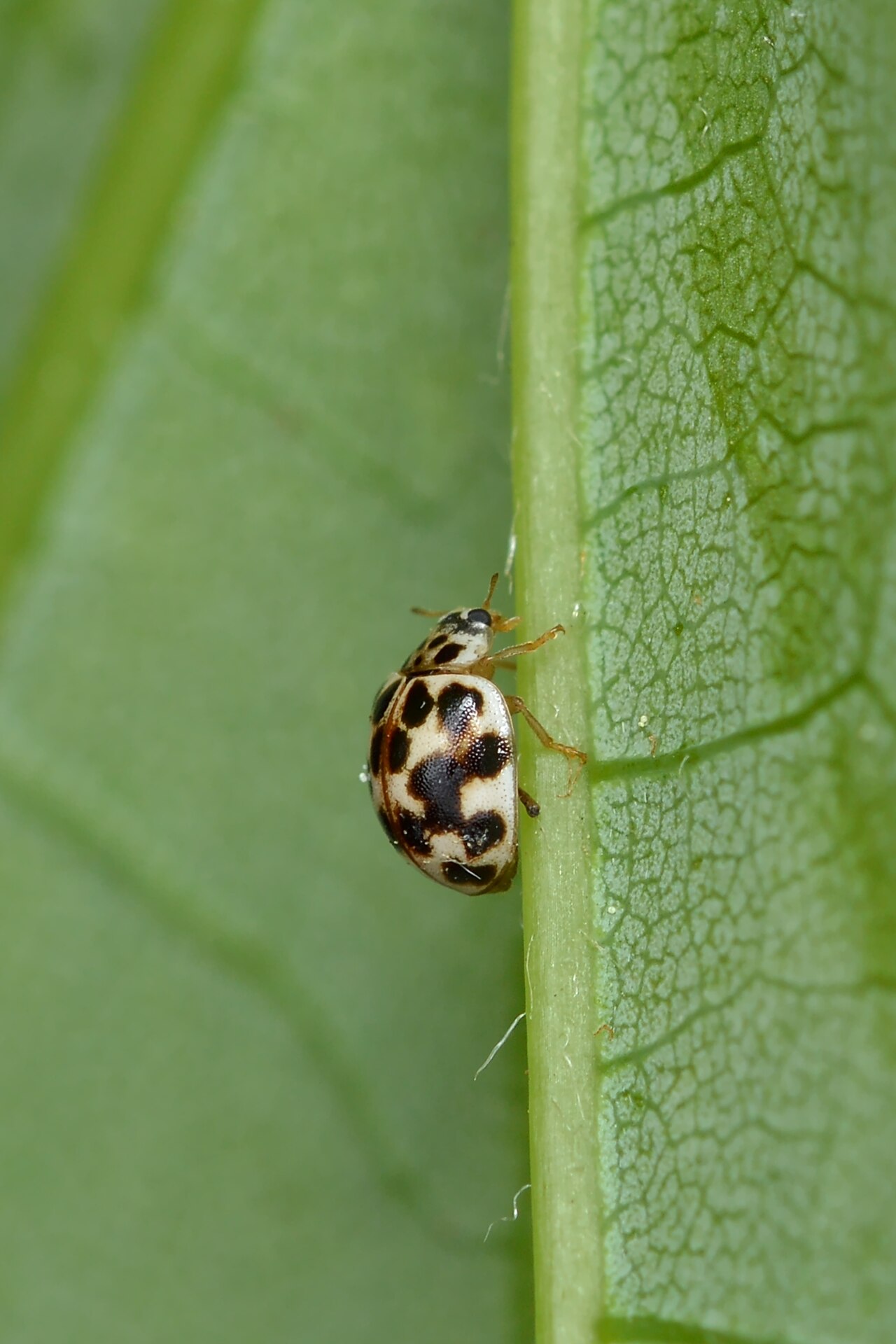
This is the largest pale candidate, at 1/4 to 1/3 in (6 to 8 mm), and it changes color as it ages. Fresh adults are cream to tan with fifteen black spots, and older individuals darken through purple gray to nearly deep violet, which makes a single species look like several. The size alone separates it from the twenty-spotted beetle.
It lives in eastern and central North America and favors trees, especially pine and oak, where it takes aphids and adelgids. Sightings on the ground or on siding are usually beetles moving to overwintering sites in autumn. Aging specimens overlap heavily with the brown ladybugs.
Newly Emerged Ladybugs: The Most Common White Ladybug

Most white ladybug photos online show a teneral beetle, meaning one that just left the pupal case. For a few hours to roughly two days the shell is soft, pale yellow to near white, and the spots are faint or completely absent. Pigment then develops and the shell hardens, so the same beetle looks normal by the next day.
Asian lady beetles (Harmonia axyridis) and the common seven spotted ladybug (Coccinella septempunctata) both pass through this stage, which is why pale beetles turn up on the same plant as fully colored ones. The giveaway is a soft, slightly translucent look and a beetle that barely moves. Leave it alone, because a teneral beetle damages easily.
White Lookalikes That Are Not Ladybugs

Two white insects get reported as white ladybugs more often than any beetle does. Mealybug destroyer larvae (Cryptolaemus montrouzieri) are ladybug larvae covered in white waxy filaments, so they look like walking tufts of cotton and are regularly mistaken for the mealybugs they eat. Woolly aphids produce the same white fluff but cluster motionless on stems.
The difference is movement and legs. A mealybug destroyer larva walks with purpose and has visible legs under the wax; mealybugs and woolly aphids drift slowly or sit still in colonies. Hard shelled white and black insects that are not ladybugs at all are covered under the black and white beetles, and anything with eight legs belongs with the white spotted spiders.
| Feature | Twenty-spotted lady beetle | Teneral ladybug |
|---|---|---|
| Size | 1/16 to 1/8 in (1.5 to 3 mm) | 1/6 to 1/3 in (4 to 8 mm) |
| Shell | Hard, matte cream | Soft, slightly translucent |
| Spots | Many, irregular, often merged | Faint or absent |
| Behavior | Active, grazes mildew | Nearly motionless |
| Lasts | Permanent color | Hours to 2 days |
| Food | Powdery mildew | Aphids once hardened |
Frequently Asked Questions
What is a white ladybug?
Usually a ladybug that emerged from its pupa within the last day or two and has not developed pigment yet. The other possibilities are genuinely pale species, mainly the twenty-spotted lady beetle and the ashy gray lady beetle, or a white waxy insect such as a mealybug destroyer larva that is not a ladybug.
Is there an albino ladybug?
No confirmed albino ladybug has been documented. Photos labeled albino almost always show a newly emerged beetle before its color set, or a naturally cream colored species. True albinism, meaning a complete absence of pigment, is not recorded in these beetles, and insect coloration does not work the way mammal pigmentation does.
How rare is it to see a white ladybug?
Not rare, just brief and easy to miss. Teneral beetles appear wherever ladybugs breed, but the pale stage lasts only hours to two days. The twenty-spotted lady beetle is common across North America and overlooked mainly because it is under 1/8 in (3 mm) long and sits on mildewed leaves.
Are white ladybugs poisonous or do they bite?
Neither. No ladybug in the United States is venomous or poisonous to humans, and a bite amounts to a weak pinch that does not break skin. The yellow fluid a disturbed beetle releases stains and smells unpleasant but is harmless on skin, and washing with soap removes it.