Insects That Look Like Grasshoppers: How to Tell Them Apart
Most insects that look like grasshoppers are katydids or crickets, and the quickest way to tell them apart is the antennae.
Grasshoppers, katydids and crickets all belong to the order Orthoptera, so they share the big hind legs, the chewing jaws and the habit of jumping when you get close. Body shape alone does not settle the ID.
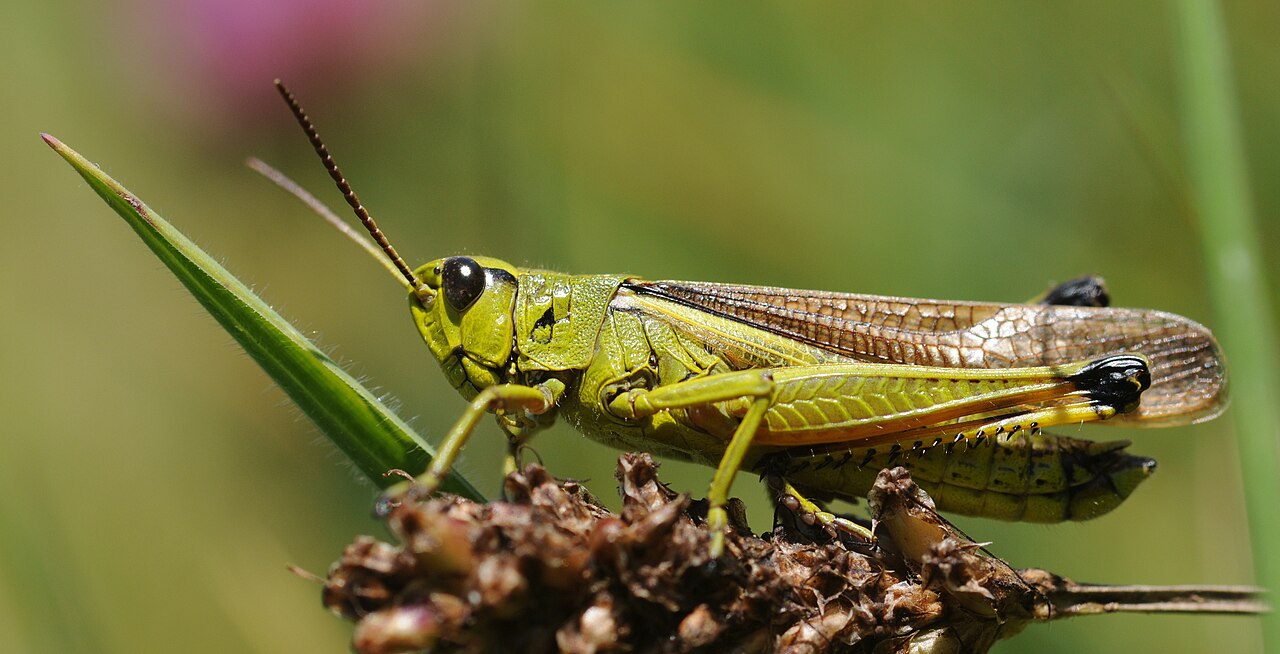
Katydids and crickets look most like grasshoppers, and locusts are grasshoppers in swarm mode. Grasshoppers have short, thick antennae, abdominal ears and short egg valves and call by day. Katydids and crickets have long antennae and front-leg ears (none on camel crickets) and call mostly after dark. Female katydids carry a sword, crickets a needle.
Grasshopper vs Katydid vs Cricket in 4 Quick Checks
Grasshopper antennae are stubby, thick and clearly shorter than the body. Katydid and cricket antennae trail back along the body like fine wire.
Ears come next, and they sit in odd places. A grasshopper hears through a pair of membranes on the first segment of the abdomen, behind the hind legs. Most katydids and crickets hear through small eardrums on the front legs, and camel crickets have none.
The ovipositor on a female gives a third check. Katydids carry a flat, curved blade shaped like a short sword. Crickets carry a straight needle. Grasshoppers have only short, blunt valves built for pushing eggs into soil. Activity and sound round it out. Many grasshoppers call in daylight by rubbing a hind leg against a wing, and band-winged species crackle in flight. Most katydids and crickets call after dark by rubbing one wing against the other, though field crickets and meadow katydids also sing by day, the same cricket vs grasshopper split you hear on any summer night.
| Insect | Antennae | Ears | Ovipositor | Active | Sound |
|---|---|---|---|---|---|
| Grasshopper | Short, thick | Abdomen | Short valves | Day | Leg on wing |
| Locust | Short, thick | Abdomen | Short valves | Day | Leg on wing |
| Katydid | Long, thin | Front legs | Curved blade | Night | Wing on wing |
| Field cricket | Long, thin | Front legs | Straight needle | Night and day | Wing on wing |
| Camel cricket | Long, thin | None | Long, upcurved | Night | Silent |
| Praying mantis | Medium, thin | Single ear between hind legs | None visible | Day | Silent |
| Cicada | Tiny bristles | Abdomen | Hidden blade | Day | Abdominal drum |
Katydids, the Leaf-Green Lookalike
A katydid is a long-horned relative of the grasshopper, and it is the big green grasshopper people report on shrubs. The wings give it away. They are shaped and veined like leaves, held tent-like over the body, and the long antennae sweep backward along them.
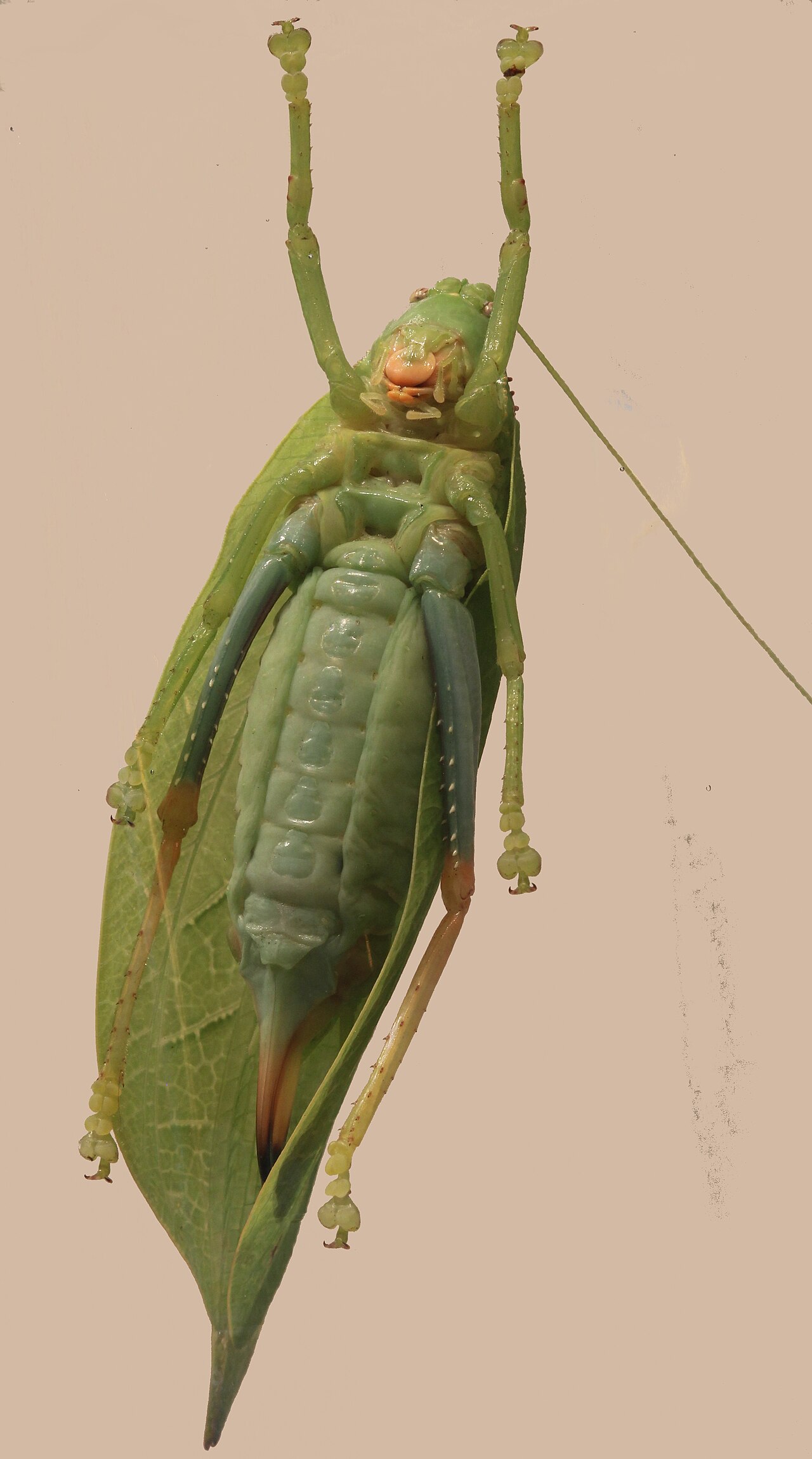
Katydids live in shrubs and the tree canopy, where their leaf camouflage works so well that you usually hear them long before you spot one.
Crickets are flatter and darker, with wings lying flat across the back instead of folded like a roof. A slender green insect with a vertical, leaf-shaped wing profile is a katydid. Our guide to the green grasshopper covers the true grasshoppers that wear that color.
Crickets, Camel Crickets and Mole Crickets
Crickets look like grasshoppers that have been pressed flat and painted brown or black. A field cricket (Gryllus species) has a dark, flattened body and two tail-like cerci behind.
Camel crickets startle people in basements. They are humpbacked, wingless and silent, with legs too long for the body. They leap unpredictably when disturbed, sometimes toward you, which makes them feel aggressive. They are not.
Mole crickets stay underground. The front legs are broad and shovel-like, built for digging tunnels through lawn and turf. Crickets are scavengers that eat plant matter, dead insects and household scraps, while grasshoppers stick to living plants.
Locusts Are Grasshoppers in Swarm Mode
Locusts are grasshoppers, not crickets and not a separate kind of insect. The word covers a handful of grasshopper species that can switch into a crowded, migratory phase. A desert locust (Schistocerca gregaria) alone on a stem is a large grasshopper and nothing more.
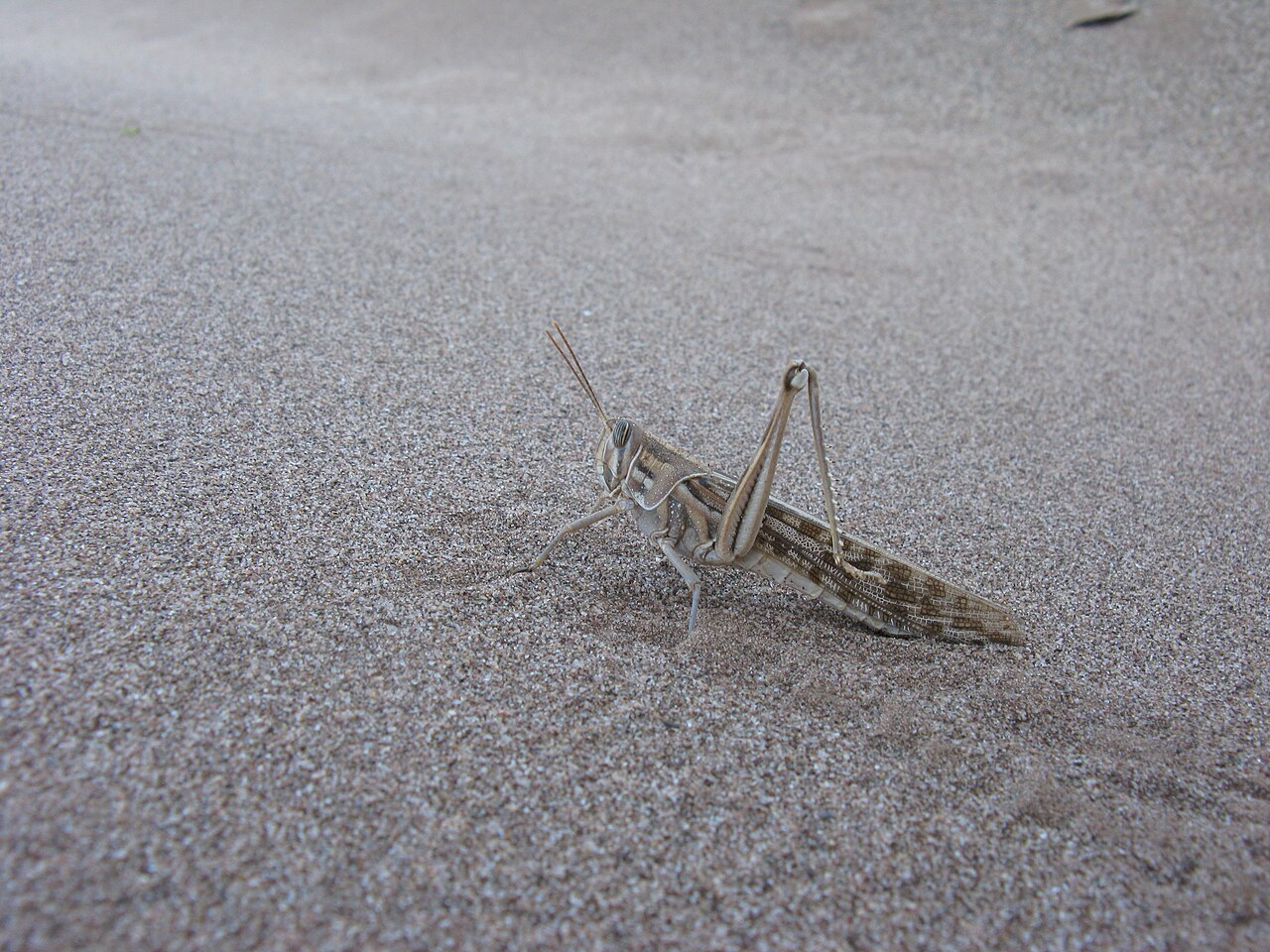
Crowding triggers the change. When nymphs are forced together on dwindling food, they darken or turn yellow, grow more active and begin moving as a group.
In the United States, the word locust gets borrowed for periodical cicadas, which are true bugs and only distantly related to grasshoppers. North America had its own swarming species, the Rocky Mountain locust, which has been extinct since the early 1900s. A swarming locust eats roughly its own weight in fresh plants every day, the same grasshopper diet multiplied by millions.
Praying Mantises, Stick Insects and Pygmy Grasshoppers
A praying mantis fools nobody up close. Mantises have spined, grasping front legs, a triangular head that swivels to follow you and no enlarged hind legs. A mantis walks or flies, though young wingless mantises can make short, precise hops. Grasshoppers are a staple mantis prey, one of many grasshopper predators.
Stick insects fail the same test from the other side. The body is twig-thin, the legs are long and slow, and it sways as it walks like a branch in wind. It cannot jump.
Pygmy grasshoppers are real grasshoppers, just small ones. The shield behind the head stretches back over the whole abdomen like a cloak, so the insect looks like a flake of bark.
Cicadas or Katydids, Who Is Singing at Night?
If the song comes after dark, you are hearing katydids or crickets, not cicadas. Cicadas buzz in the heat of the day and fade as the evening cools.
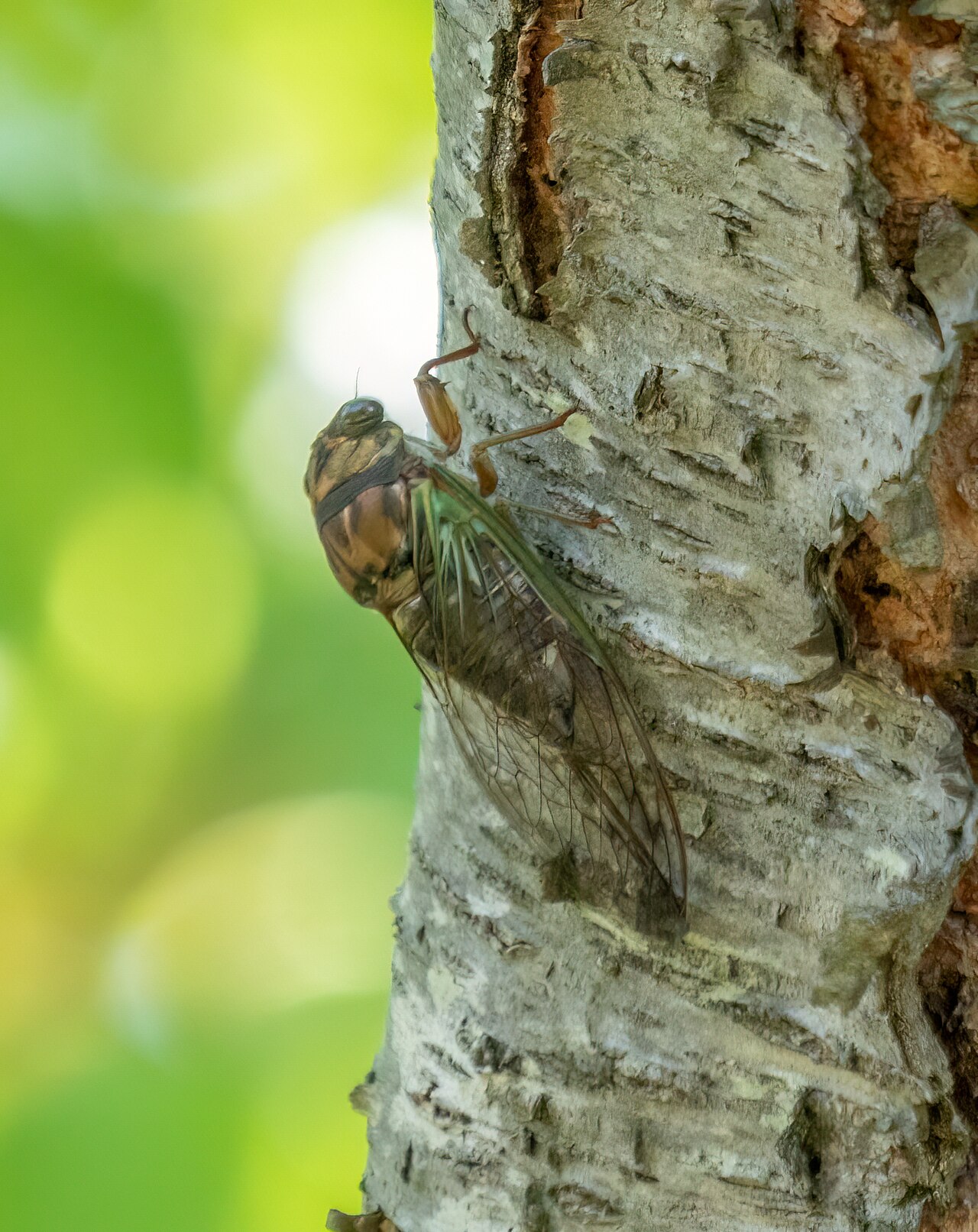
A cicada is a true bug with a stout body, wide-set eyes, clear veined wings and no jumping hind legs. A katydid is slender, green and built to leap.
A katydid rasps in a two or three beat rhythm that gave it the “katy-did, katy-didn’t” name. A cicada drones in a continuous whine. To shut out cicada noise, close the windows and run a fan or white noise. Insecticide sprays will not reach the males high in the canopy, and the chorus ends on its own when the adults die off after about 4 to 6 weeks.
Where You See Them in the House, Garden and Porch Light
The spot where you found the insect narrows the list.
Porch light at night. A green or brown jumper on the screen door after dark is a katydid or a cricket.
Basement or garage. A humpbacked, long-legged jumper in a damp corner is a camel cricket. They seek cool, moist spaces and arrive in numbers after wet weather.
Chirping indoors. A chirp from behind the baseboard is a house cricket (Acheta domesticus) or a field cricket that came in from outside.
Garden leaves by day. A small jumper on a sunlit leaf is a grasshopper nymph or a katydid nymph. Neither has full wings yet, so the antennae decide.
Frequently Asked Questions
Are pink katydids rare?
Yes. Pink katydids carry an inherited trait called erythrism, which replaces the normal green pigment with pink or orange. Pink stands out on green leaves, so pink nymphs are thought to fall to predators more often, which likely keeps adults rare.
Are katydids loud at night?
Yes. The common true katydid (Pterophylla camellifolia) is one of the loudest insects in eastern North America, and on warm August nights a single tree of calling males carries well beyond the yard. The chorus slows as the air cools, so late-night song is slower than the dusk song.
Do katydids or crickets bite?
Yes, a large katydid or cricket can pinch with its jaws if you squeeze it, but neither is venomous and the bite needs nothing beyond washing. They would rather jump away than fight, so handle them loosely or not at all.
When do katydids start singing?
July in the South and August in the North, once the nymphs that hatched in spring have matured into winged adults. The chorus builds through August and continues on warm nights until the first hard frosts kill off the singing males.
Can grasshopper lookalikes fly?
Yes, many of them. Most adult grasshoppers and many katydids can fly, though some are short-winged and barely do, and migratory locusts cover long distances in the air. Most crickets prefer to run or jump, though long-winged field crickets and house crickets fly to lights at night, and camel crickets have no wings at all.
Sources
- Smithsonian Institution, BugInfo on Cicadas
- Singing Insects of North America, Distinguishing Crickets, Katydids and Grasshoppers
- FAO Locust Watch, Desert Locust Information Service