Asian Lady Beetle
An Asian lady beetle is an invasive, ladybug-like beetle that was deliberately introduced to North America to control crop pests, only to become a fall-time nuisance that swarms homes by the hundreds. Scientifically known as Harmonia axyridis, it shares the same rounded, spotted look as a native ladybug, but it bites, releases a foul-smelling yellow fluid when disturbed, and gathers in huge numbers on sunny walls before slipping indoors for the winter.
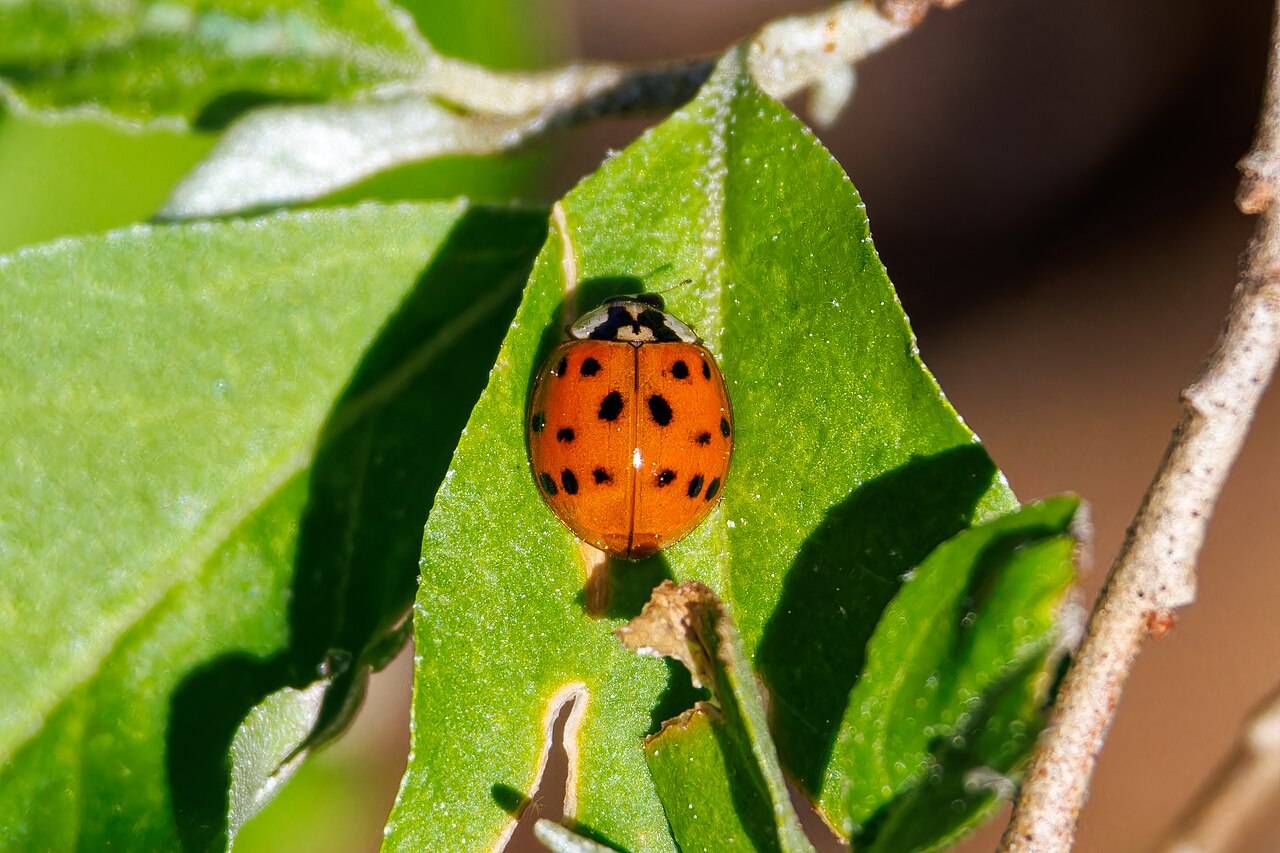
The clearest giveaway is a white marking shaped like the letter M or W just behind the head, a feature native ladybugs never show. Learning to tell the two apart matters, since one is a beneficial garden guest and the other is a genuine household pest.
| Quick Reference | Detail |
|---|---|
| Scientific Name | Harmonia axyridis |
| Also Called | Multicolored Asian lady beetle (MALB), “the bad ladybug” |
| Size | About 0.25 to 0.35 inches, slightly larger than most native ladybugs |
| Color | Pale yellow to deep orange or red, 0 to 19 spots |
| Key ID Mark | White M- or W-shaped marking behind the head |
| Diet | Aphids, scale insects, and other soft-bodied pests |
| Risk to Humans/Pets | Can bite; corrosive fluid can irritate skin, eyes, and a dog’s mouth |
What Is an Asian Lady Beetle?
The Asian lady beetle, Harmonia axyridis, is a beetle in the same family as native ladybugs, but it originally comes from eastern Asia. Its natural diet of aphids and scale insects made it attractive to agricultural researchers looking for a natural, pesticide-free way to protect crops from pest damage.
Adults are dome-shaped and roughly a quarter to a third of an inch long, similar in general silhouette to a native ladybug but typically a bit larger and slightly more oval rather than perfectly round. Coloring is highly variable, ranging from pale yellow-orange through deep red, and the number of black spots on the wing covers can be anywhere from zero to nineteen, which makes color and spot count alone an unreliable way to identify one.
The single most reliable identification feature sits on the pronotum, the small shield-shaped plate just behind the head: Asian lady beetles almost always show a bold black marking shaped like the letter M or W on a white background, a mark that native ladybugs simply do not have.
Asian Lady Beetle vs. Ladybug: Key Differences
Beyond the M or W marking, several other traits separate the two insects once you know where to look. Native ladybugs tend to be a consistent, bright red with a fixed number of evenly spaced black spots, most commonly seven, while Asian lady beetles show far more variation in both base color and spot pattern from one individual to the next.
Leg color offers another clue: Asian lady beetles typically have noticeably lighter, tan-colored legs, while native ladybugs usually show darker legs closer to their body color. Body shape differs subtly too, with Asian lady beetles running slightly longer and more oval than the nearly perfect circle of a typical native ladybug.
Behavior is where the contrast becomes impossible to miss. Native ladybugs shelter outdoors through winter and rarely bother entering homes, while Asian lady beetles actively seek out buildings each fall, squeezing through cracks around windows and doors in search of a warm place to spend the cold months.
Why Do Asian Lady Beetles Swarm Homes in the Fall?
As temperatures begin dropping in autumn, Asian lady beetles instinctively search out sheltered crevices to survive the winter, a behavior that mirrors what their ancestors did on cliff faces and rock outcrops back in Asia. In the absence of natural cliffs, the sun-warmed south and west-facing walls of a house make an appealing substitute, which is why swarms often show up on the same sunny side of a building every year.
Once a few beetles find a good crevice, they release an aggregation pheromone that signals other beetles to the same spot, quickly turning a handful of insects into a dense, visible cluster crawling across siding, window screens, and door frames. This chemical recruitment is a major reason infestations can escalate from a minor nuisance to hundreds of beetles within just a few days.
Once inside wall voids, attics, or crawl spaces, the beetles enter a dormant state for winter and typically stay hidden until a warm spell or the heat of the building tricks them into becoming active indoors, which is when homeowners usually notice them crawling across windows or ceilings.
Are Asian Lady Beetles Dangerous to Humans?
Asian lady beetles are not venomous, but unlike docile native ladybugs, they will bite defensively when handled or trapped against skin, and the bite can leave a small, mildly painful red mark. According to Poison Control, the beetles can also release a foul-smelling yellow defensive fluid, called reflex bleeding, when threatened or crushed, and this fluid has been linked to allergic symptoms such as itching, coughing, and eye irritation in sensitive individuals, along with worsened asthma symptoms during heavy infestations.
The safest way to handle an unwanted beetle is to gently encourage it away, for example by blowing on it, rather than crushing it, since crushing releases the strongest odor and the greatest amount of irritating fluid. Washing your hands after contact is a sensible precaution if you suspect you have been bitten or handled one directly.
Are Asian Lady Beetles Harmful to Dogs and Cats?
Pets are curious about small, brightly colored, moving insects, and that curiosity occasionally leads a dog to snap at or swallow several Asian lady beetles at once. Documented veterinary cases describe beetles becoming lodged against the roof of a dog’s mouth, where their corrosive defensive fluid can cause localized chemical burns, drooling, bad breath, and visible discomfort.
Most affected dogs recover fully once the beetles are removed and the mouth is gently rinsed, though a veterinarian may need to sedate a pet to safely extract beetles that are firmly stuck and to treat any resulting sores with medication. Watching for excessive drooling, pawing at the mouth, or a sudden foul odor from a dog’s breath after playing outside during beetle season is a reasonable precaution, and any of these signs are worth a call to a veterinarian.
How Asian Lady Beetles Ended Up in North America
Asian lady beetles were not an accidental invader in the usual sense; they were intentionally released across several southern and eastern states, including parts of California, Pennsylvania, Connecticut, and Maryland, by agricultural authorities during the late 1970s and early 1980s specifically to control aphids and other crop-damaging pests. Early release attempts largely failed to establish lasting populations, but the beetle eventually took hold and has since spread across almost the entire continental United States and into parts of Canada.
Ironically, the same qualities that made it a promising biological control agent, an adaptable diet, high reproductive rate, and a strong drive to seek shelter, are exactly what allowed it to outcompete some native ladybug species and become a widespread nuisance pest in its own right.
What Do Asian Lady Beetle Larvae Look Like?
Before becoming the familiar spotted adult, an Asian lady beetle spends time as a larva that looks almost nothing like the beetle it will become. The larvae are elongated, dark gray to black, and covered in small spiky projections along the body, with orange or yellow markings running down both sides, giving them a slightly alligator-like appearance that often gets them mistaken for an entirely different insect.
Like the adults, and much like what ladybugs eat in the garden, larvae are voracious predators of aphids and other soft-bodied pests, which is part of why the species was originally so appealing for pest control purposes before its downsides in the home became apparent. Larvae eventually pupate and emerge as the recognizable spotted adult beetle within a few weeks, completing a life cycle that can produce several generations in a single growing season.
How to Get Rid of Asian Lady Beetles
Sealing entry points before fall is the single most effective long-term strategy, since caulking gaps around windows, doors, siding, and utility penetrations blocks the beetles from reaching their favorite overwintering crevices in the first place. Repairing torn window screens and adding door sweeps closes off two of the most common entry routes into a house, the same routes that let in other autumn hitchhikers like jumping spiders.
For beetles that are already indoors, a vacuum with a disposable bag is far preferable to sweeping or squashing, since it collects the insects without triggering the release of their smelly defensive fluid onto walls or carpet. Once collected, sealing and disposing of the vacuum bag promptly prevents any lingering odor from settling into the home.
Homeowners who prefer a physical rather than chemical approach can install fine mesh screens over vents and attic openings, since these are common overlooked entry points where large numbers of beetles slip through unnoticed each autumn, alongside other unwelcome yard visitors like banana spiders and potato bugs.
Are Asian Lady Beetles Good or Bad for Gardens?
Outdoors and in agricultural settings, Asian lady beetles genuinely earn their keep, consuming large numbers of aphids, scale insects, and other soft-bodied pests that would otherwise damage crops and garden plants. In that outdoor context, they behave almost exactly like the beneficial predator they were originally imported to be.
The trouble is entirely a matter of location and timing: the same beetle that helps control pests all summer becomes an unwelcome houseguest the moment autumn arrives and it starts hunting for winter shelter indoors. Gardeners can appreciate the pest control benefit outside while still taking sensible steps to keep the beetles from moving into the house once the season turns.
Related reading: Asian Lady Beetle vs Ladybug.
Related reading: Hercules Beetle.
Frequently Asked Questions
How can I tell an Asian lady beetle from a regular ladybug?
Look for a white M- or W-shaped marking on the shield-like area just behind the head. Native ladybugs never show this mark, while Asian lady beetles almost always do, regardless of their body color or spot count.
Do Asian lady beetles bite humans?
Yes, unlike docile native ladybugs, Asian lady beetles will bite defensively when handled or pressed against skin, though the bite is not venomous and typically causes only mild, short-lived irritation.
Why are Asian lady beetles in my house?
They are seeking a sheltered place to spend the winter, and sun-warmed exterior walls attract large numbers before they slip through small cracks and gaps to reach wall voids and attics.
Are Asian lady beetles dangerous to dogs?
They can be, if a dog bites or swallows several at once. The beetles’ corrosive defensive fluid can cause mouth irritation or chemical burns, so a dog showing drooling or mouth discomfort after an encounter should be checked by a veterinarian.
How were Asian lady beetles introduced to the United States?
They were deliberately released by agricultural authorities in several states during the late 1970s and early 1980s as a natural way to control aphids and other crop pests, and the species has since spread across most of North America.
What do Asian lady beetle larvae look like?
The larvae are elongated, dark gray to black, with small spiky projections and orange or yellow side markings, giving them an alligator-like look that is very different from the rounded adult beetle.
What is the best way to remove Asian lady beetles from my home?
Vacuuming is the most effective method, since it avoids crushing the beetles and releasing their odorous defensive fluid. Sealing cracks and gaps around windows and doors before fall helps prevent them from getting in to begin with.