Emu vs Ostrich
The fastest way to tell an emu from an ostrich is size and location: the ostrich is the world’s largest bird, native to Africa and standing up to 9 feet tall, while the emu is smaller, native to Australia, and tops out around 6.2 feet. Both are flightless ratites with long necks and powerful legs, but once you know what to look for, they’re surprisingly easy to tell apart.
Beyond size, the two birds differ in speed, toe count, egg color, and even which parent takes charge of incubating the eggs, differences that go well beyond the superficial resemblance most people notice at first glance.
| Quick Reference | Emu | Ostrich |
|---|---|---|
| Native Range | Australia | Africa |
| Height | Up to 6.2 feet | Up to 9 feet |
| Weight | 80 to 130 pounds | Up to 300+ pounds |
| Top Speed | About 30 to 31 mph | Up to 43 mph (sprint) |
| Toes | 3 per foot | 2 per foot |
| Egg Color | Dark green | Cream / off-white |
| Egg Incubation | Male only | Shared, communal nests |
Emu vs. Ostrich at a Glance
Both emus and ostriches belong to a group of flightless birds called ratites, a family that also includes kiwis and rheas, and their shared body plan, long neck, powerful legs, small wings, explains why the two get confused so often, especially in photos or brief glimpses at a distance. The most reliable quick clue is simply size: an ostrich absolutely towers over an emu, standing up to 9 feet tall compared to an emu’s maximum of about 6.2 feet.
Geography offers an equally fast shortcut, since the two species never naturally overlap in the wild: ostriches are native to Africa’s savannas and semi-desert regions, while emus are found only in Australia. Any of these giant birds seen outside a zoo or private farm in the wild will always be one or the other, never both, depending entirely on which continent you’re standing on at the time.
Size: Which Is Bigger?
The ostrich is unambiguously the larger of the two, and in fact the largest living bird on Earth, with males reaching up to 9 feet tall and weighing as much as 300 pounds or more. Female ostriches run somewhat smaller, though still substantially larger than any emu, and even a young, still-growing ostrich chick can outsize a fully mature emu within its first year of rapid growth.
Emus max out around 6.2 feet tall and typically weigh between 80 and 130 pounds, making them noticeably lighter and more slender than an ostrich despite still being an enormous bird by any ordinary standard. Interestingly, female emus tend to be slightly larger than males, an unusual reversal compared to the ostrich, where males are generally the bigger sex. This size difference between the two species is substantial enough that side-by-side comparisons at wildlife sanctuaries or specialty farms tend to surprise visitors who assumed the birds were roughly similar in scale before seeing them standing next to one another in person.
Speed: Which Is Faster?
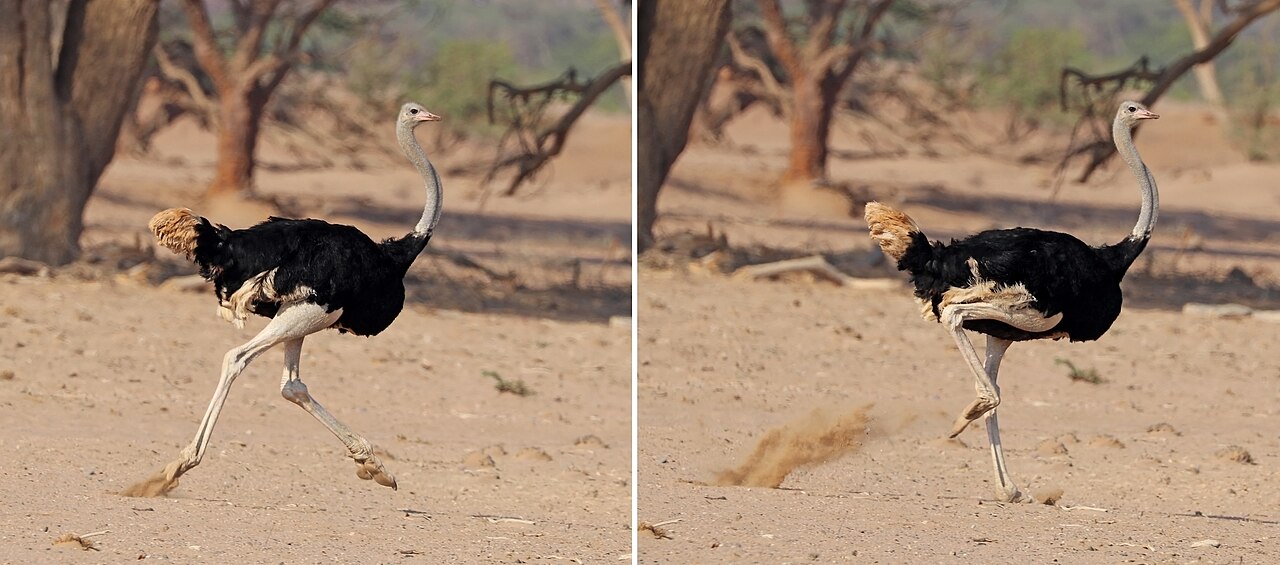
According to National Geographic, ostriches can sprint up to 43 miles per hour in short bursts and maintain roughly 31 miles per hour over much longer distances, making them the fastest running bird on the planet and one of the fastest two-legged animals of any kind, a stark contrast to the far more modest, ground-hugging pace of an ornamental bird like the golden pheasant. Their long, powerful legs cover up to 16 feet in a single stride, an almost unbelievable distance for a two-legged animal to clear in one motion.
Emus are still impressively fast for their size, reaching top speeds around 30 to 31 miles per hour, but they’re generally considered better built for sustained endurance across rough terrain than for outright sprinting. Where an ostrich relies on raw speed to escape predators across open savanna, an emu’s build favors steady, tireless travel across the varied landscapes of the Australian outback, covering long distances in search of food and water rather than making a single explosive dash from danger.
Toes and Legs: A Key Identifying Feature
One of the most reliable physical differences between the two birds, and one that holds true regardless of size or individual variation, is toe count. Ostriches have just two toes on each foot, an unusual adaptation among birds that improves running efficiency, with the larger toe functioning almost like a hoof to bear most of the bird’s weight while running at full speed across open terrain.
Emus, by contrast, have the more typical three toes per foot seen in most other bird species, including far smaller relatives like pheasants and other ground-dwelling game birds. This single anatomical detail is often the clearest confirmation for anyone examining tracks, photos, or an unclear view of a distant bird, since coloring and even size can sometimes be harder to judge accurately from far away or in poor lighting conditions.
Eggs: Color, Size, and Incubation Differences
Ostrich eggs are the largest of any living bird, typically cream to off-white in color, weighing around 3 pounds with an exceptionally thick, strong shell built to withstand the harsh African environment. Emu eggs are smaller, generally around 1 to 1.5 pounds, but instantly recognizable thanks to their distinctive dark green to nearly black-green coloring, a far cry from the plain, unassuming eggs of a typical backyard bird whose symbolism people love to discuss instead of its actual egg color.
Incubation duties differ sharply between the species too. Ostriches often nest communally, with a dominant female’s eggs taking the prime central position while several other females may contribute eggs to the same nest, and both sexes share incubation duties across day and night shifts, the male typically taking the night shift thanks to his darker feathers offering better camouflage in the dark. Emus take a completely different approach: after the female lays her eggs, the male takes over incubation entirely, sitting on the nest for roughly eight weeks without regularly eating, drinking, or leaving, then continuing to raise the chicks largely on his own afterward.
Where Do Emus and Ostriches Live?
Ostriches inhabit the open savannas, dry grasslands, and semi-desert regions of Africa, relying on excellent eyesight and raw speed to spot and escape predators across largely flat, exposed terrain. Their habitat rewards exactly the kind of high-speed sprinting ability ostriches are famous for, with visibility across miles of open ground giving them ample warning before a predator can close the distance.
Emus roam a wider variety of terrain across mainland Australia, from arid outback scrubland to open woodland and coastal plains, a landscape that favors their endurance-oriented build over pure sprinting speed across any single type of terrain. Both species have also been farmed commercially outside their native ranges, including in parts of the United States, for meat, leather, and oil, meaning an emu or ostrich encountered on a farm doesn’t necessarily reflect that species’ natural wild range at all.
Behavior and Parental Care
Beyond their strikingly different incubation strategies, emus and ostriches show other real behavioral differences worth understanding before assuming the two species act alike. Emus are generally curious and can become fairly comfortable around people on farms, while ostriches, particularly males during breeding season, are known for a more defensive, occasionally aggressive temperament, a far cry from the mostly ornamental, low-key presence of peacock feathers on a bird bred largely for visual display rather than speed or size.
Family structure also diverges once chicks hatch. Male emus continue as the primary caregiver well after hatching, often raising chicks from multiple different mothers over a single season, while ostrich chicks benefit from a more communal upbringing, with several adults in a group sharing watch duty over a combined creche of chicks from different nests, a cooperative arrangement that spreads the considerable burden of protecting vulnerable young across an entire group rather than just one or two parents.
Are Emus or Ostriches Dangerous?
Both birds are capable of seriously injuring a person, primarily through their powerful kicks, and neither should be approached or handled without proper experience and caution around their strength. Ostriches carry particular respect in this department, since a kick strong enough to injure or kill a lion is well within their physical capability, and males can become notably aggressive when defending a nest or mate during breeding season.
Emus are generally considered somewhat less prone to aggression than ostriches, though they can still deliver a painful kick and may act defensively if they feel cornered or threatened, particularly around their chicks. On farms and in sanctuary settings, both species are managed with a healthy respect for their size and strength, a level of caution worth remembering even around visually striking, seemingly docile exotic birds like the albino peacock, whose calmer temperament shouldn’t be assumed to extend to every large ornamental or farmed bird, regardless of how approachable it might look from a distance.
Frequently Asked Questions
What is the easiest way to tell an emu from an ostrich?
Size and location are the fastest clues: ostriches are larger, native to Africa, and have two toes per foot, while emus are smaller, native to Australia, and have three toes per foot on each leg.
Which is bigger, an emu or an ostrich?
The ostrich is significantly bigger overall, reaching up to 9 feet tall and 300 or more pounds, compared to an emu’s maximum of about 6.2 feet and 130 pounds.
Which is faster, an emu or an ostrich?
The ostrich is faster, capable of sprinting up to 43 miles per hour, while an emu tops out around 30 to 31 miles per hour over shorter distances.
Why do emu eggs look different from ostrich eggs?
Emu eggs are a distinctive dark green due to pigment deposited in the shell during formation, while ostrich eggs are cream to off-white; the color difference has no connection to diet and is simply a species trait.
Do male or female emus and ostriches incubate the eggs?
Male emus handle incubation almost entirely on their own, while ostriches share the job between males and females, often across a communal nest with contributions from multiple different females at once.
Are emus or ostriches dangerous to humans?
Both can injure a person with a powerful kick, and ostriches in particular can become aggressive, especially males defending territory and mates during breeding season each year on working farms and in sanctuary settings alike.
Are emus and ostriches related?
Yes, both belong to the ratite group of flightless birds, which also includes kiwis and rheas, though emus and ostriches themselves are not especially closely related within that broader family tree.