Orchid Mantis: Facts, Care, Size, and the Camouflage Myth
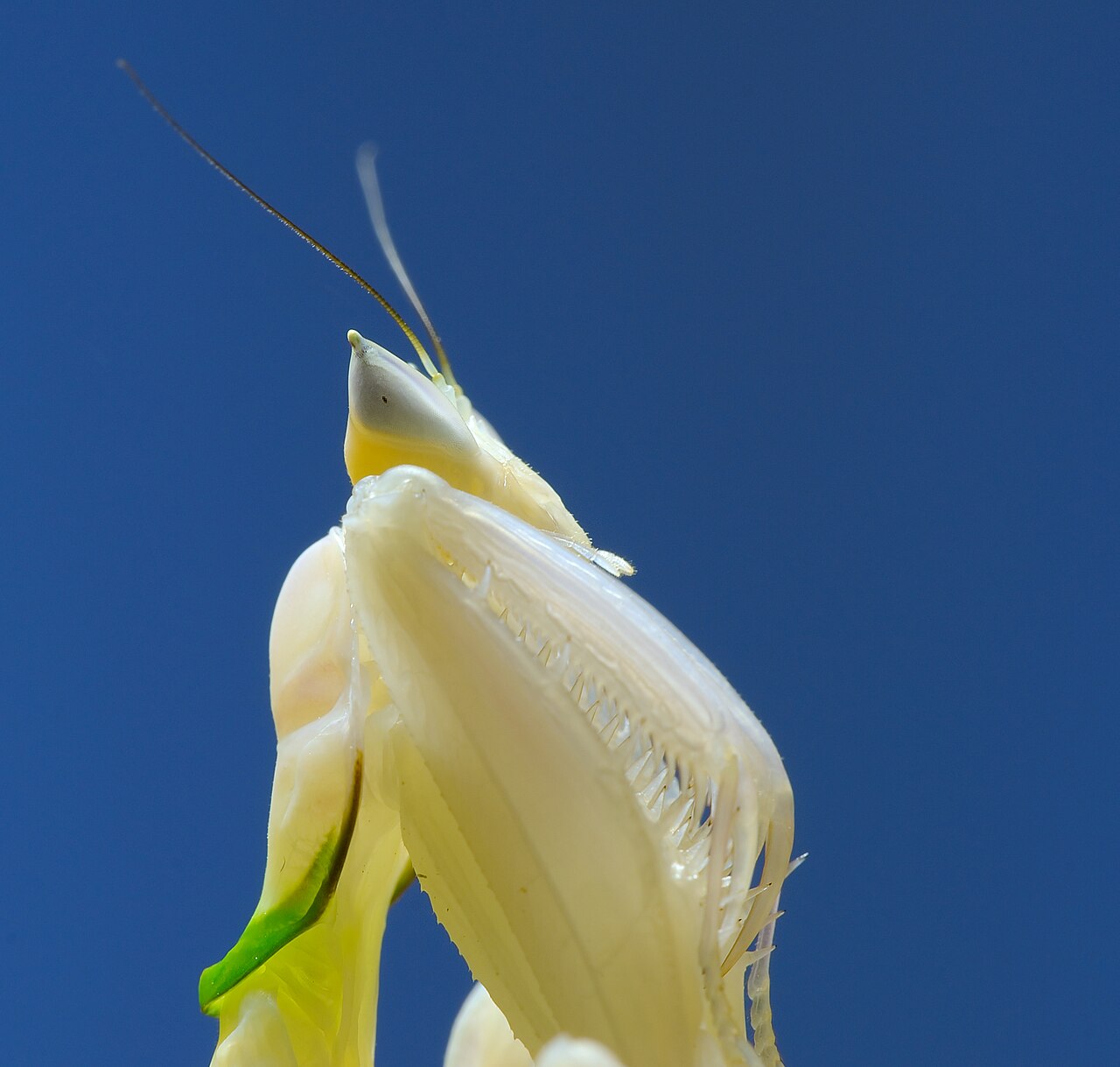
The orchid mantis (Hymenopus coronatus) is a white and pink praying mantis from the rainforests of Southeast Asia, with flattened lobes on its legs that resemble flower petals. Females reach 2.4 to 2.8 in while males stay under 1.2 in, one of the most extreme size differences of any mantis, and the species has become one of the most sought-after insects in the pet trade.
The famous story about it, that it hides among orchids waiting to ambush prey, turns out to be wrong in an interesting way. Field research published in 2014 showed that these mantises do not typically sit on orchids at all, and that pollinators are attracted to the mantis itself more strongly than to real flowers. This guide covers what the research actually found, the extreme sex differences, the life cycle, care requirements, and why the blue and purple orchid mantises circulating online do not exist.
| Quick Facts | Orchid Mantis |
|---|---|
| Scientific name | Hymenopus coronatus |
| Female size | 2.4 to 2.8 in |
| Male size | 0.9 to 1.2 in, roughly half the female |
| Range | Rainforests of Malaysia, Indonesia, Thailand, Sumatra |
| Lifespan | Females 8 to 9 months, males 5 to 6 |
| Temperature | 77 to 86 F with 60 to 80 percent humidity |
What Is an Orchid Mantis?
The orchid mantis is a member of the family Hymenopodidae, the flower mantises, and it lives in the humid lowland rainforests of Malaysia, Indonesia, Thailand, and Sumatra. Adults are white with varying amounts of pink or purple, and the coloration shifts with humidity, temperature, and light rather than being fixed.
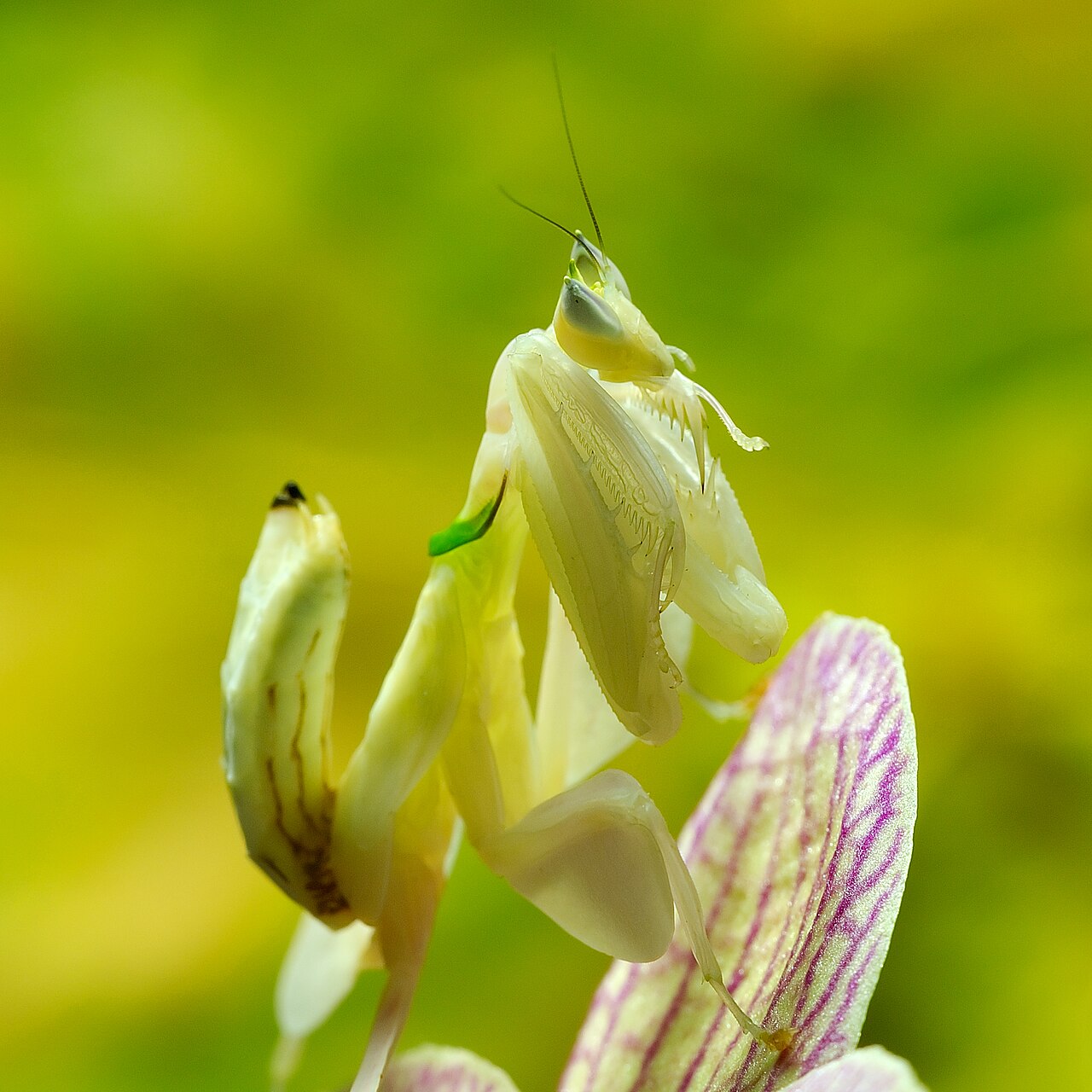
The petal effect comes from the legs. The four walking legs carry broad flattened lobes on the femurs that look convincingly like flower petals, while the raptorial front legs stay slim and functional for catching prey. Combined with a rounded abdomen and a body held in a characteristic posture, the whole animal reads as a flower rather than an insect.
They are ambush predators like all mantises, sitting motionless and striking with the front legs at anything that comes within range. What distinguishes this species is that it does not merely hide and wait. It actively draws prey toward itself, which is a different strategy entirely and the reason the species has attracted so much research attention. Other ambush hunters use quite different methods, as our guide to the jumping spider describes.
The Camouflage Myth
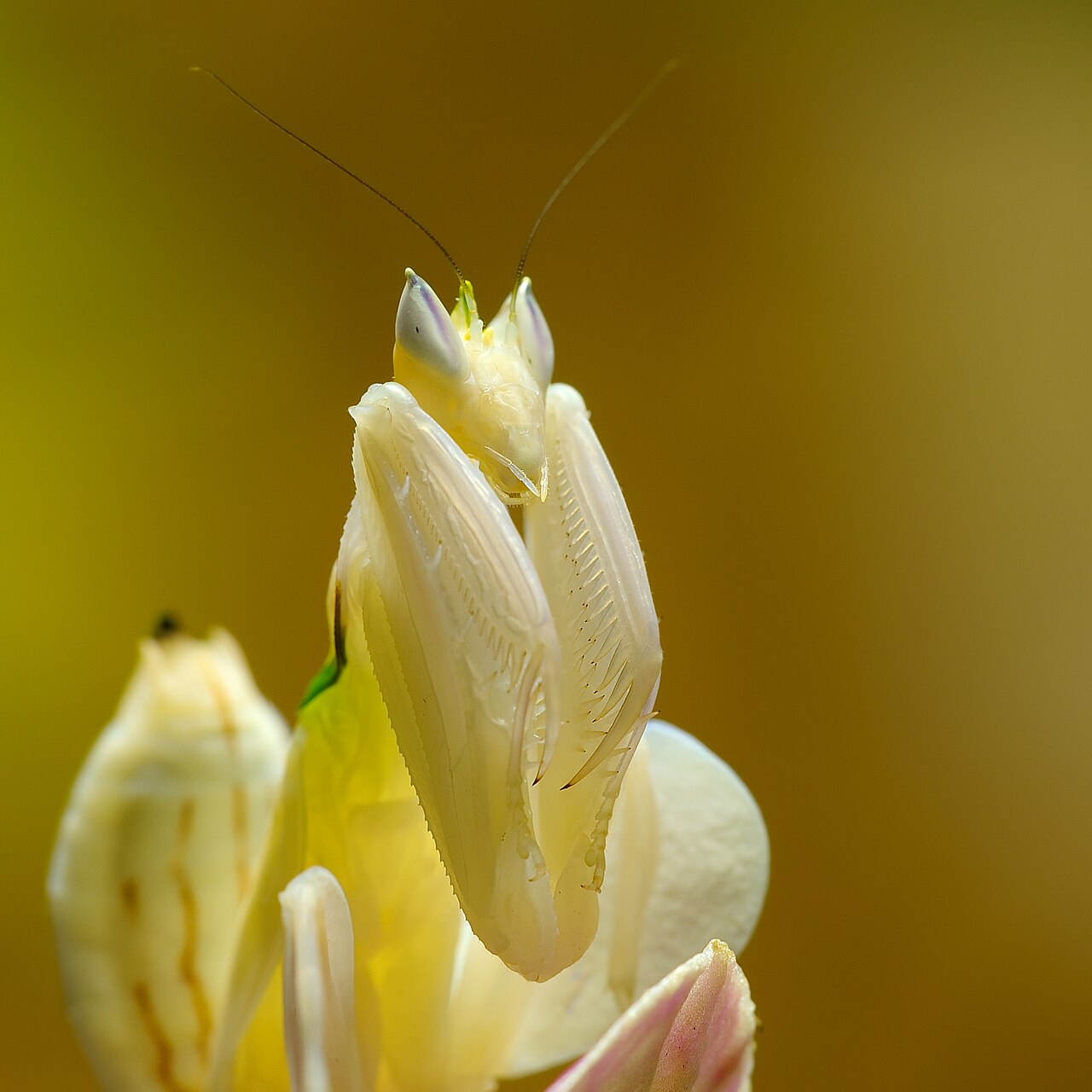
The standard account, repeated for more than a century, held that the orchid mantis hides among orchid blossoms and ambushes pollinators that arrive to feed. It is a satisfying story and it is largely wrong.
Field work led by James O’Hanlon and published in 2014 tested it directly. Researchers found that the mantises usually perch on green foliage rather than on flowers, and that they are rarely associated with orchids specifically. More strikingly, pollinating insects approached the mantis at higher rates than they approached actual flowers growing nearby, meaning the mantis is not blending in with a background but functioning as a lure in its own right.
The mechanism appears to be a generalized flower signal rather than mimicry of any particular species. The mantis reflects ultraviolet in a way bees find attractive and presents a color and shape combination that reads as a rewarding flower to a pollinator’s visual system, without copying any real bloom. Biologists call this aggressive mimicry, and the orchid mantis was the first documented case of an animal luring prey by imitating a flower generally rather than a specific model.
Male vs Female Orchid Mantis
Sexual dimorphism in this species is extreme even by mantis standards. Adult females reach 2.4 to 2.8 in and are bulky, while males stay around 0.9 to 1.2 in and are slender, meaning a female can be more than double the male’s length and many times his mass.
The males also look different. They are less ornate, with smaller leg lobes and a plainer white or cream coloration lacking the pink flush, and they fly readily while females are heavy and mostly sedentary. A male is easy to mistake for a different species entirely if you have only seen photographs of females.
Development timing follows from the size difference. Males mature after five or six molts while females need seven or eight, so males reach adulthood substantially earlier and die correspondingly sooner. Counting the abdominal segments distinguishes the sexes from an early nymph stage, with females showing six visible segments and males eight, which breeders use to sex animals long before size differences become obvious.
Life Cycle: From Ant Mimic to Flower
The first instar is the surprise. Newly hatched orchid mantis nymphs are red and black and look nothing like the adults, and the prevailing interpretation is that they mimic ants, which many predators avoid because ants bite, sting, and often taste bad. The resemblance disappears at the first molt, when the nymph turns white and pink.
Females deposit eggs in a foam case called an ootheca, attached to a branch or surface, containing dozens of eggs. Incubation runs about four to six weeks at typical temperatures, and nymphs emerge together and disperse quickly, since mantises are cannibalistic from the moment they hatch.
Adult lifespan is short and sex-dependent. Females live roughly eight to nine months in total, males five to six, with adulthood being only the final portion of that. Cannibalism during mating is real but less inevitable than folklore suggests, and keepers reduce the risk by feeding the female heavily before pairing and by supervising the encounter.
Are Blue and Purple Orchid Mantises Real?
No. Images of vivid blue, purple, and rainbow orchid mantises circulate widely, sometimes under invented names, and they are digitally edited photographs of ordinary white and pink animals. No naturally blue or purple orchid mantis exists.
Real color variation does occur and is worth understanding, because it explains why the fakes look plausible. Orchid mantises range from nearly pure white through cream to a strong pink or magenta flush, and individuals change over time and across molts. Humidity, temperature, and background color all influence how much pink an animal develops, so two mantises from the same ootheca can look quite different.
Sellers occasionally use these invented color names to justify inflated prices. Buying from established breeders who identify animals by species rather than by marketing labels avoids the problem entirely, and any listing offering a blue or purple orchid mantis is either mistaken or dishonest.
What Do Orchid Mantises Eat?
Flying insects make up the natural diet, which follows directly from the hunting strategy. Bees, flies, butterflies, moths, and other pollinators are the main prey, caught when they approach the mantis expecting a flower, including the pale night-flying species covered in our guide to the white moth. They also take crickets and other insects opportunistically.
In captivity, prey size follows the mantis. Nymphs start on fruit flies, moving to houseflies, blue bottle flies, and small crickets as they grow, and adult females can take prey nearly their own size. Flying prey is preferable to crawling prey because it triggers the strike response more reliably.
Feeding frequency runs every one to three days depending on age, with nymphs eating more often than adults. Appetite stops before each molt, and a mantis preparing to molt should not be offered food, since live prey can injure a soft, freshly molted animal. Feeder insects should be gut-loaded before use, and our guide to what crickets eat covers how to do that properly.
Orchid Mantis Care
Enclosure height matters more than floor space, and the rule is at least three times the mantis’s body length in height. Mantises molt hanging upside down, and insufficient clearance causes failed molts, which are the leading cause of death in captive mantises and are frequently fatal or crippling.
Conditions need to be warm and humid. Aim for 77 to 86 F and 60 to 80 percent humidity, achieved with light daily misting rather than a saturated substrate, since stagnant wet conditions cause mold and respiratory problems. Good ventilation is as important as the humidity itself, and mesh-sided enclosures work better than sealed glass.
House them individually after the second or third instar. Orchid mantises are cannibalistic, and communal keeping reliably ends with fewer mantises than you started with. Provide branches or mesh for climbing and hanging, avoid substrate that holds standing water, and handle sparingly, since the animals are fragile and stress easily. The general principles overlap with other invertebrate keeping, as our guide to the jumping spider enclosure shows.
Price, Availability, and the Wild Trade
Orchid mantises are among the more expensive mantises in the hobby, typically running from around 30 to well over 100 US dollars depending on age, sex, and source. Adult females command the highest prices because they are the showpiece animals and because they take longer to raise.
Captive breeding is well established, and buying captive-bred animals matters for two reasons. Wild-caught specimens often arrive stressed, parasitized, and near the end of their natural lives, and collection pressure on a species with a restricted tropical range is a genuine conservation question even where it is legal.
Import rules apply in the United States. Live non-native insects generally require USDA APHIS permits, and enforcement varies, so anyone buying should ask about the animal’s origin and legal status rather than assume. The same permitting question comes up with other exotic invertebrates, as our guide to the Hercules beetle explains.
Do Orchid Mantises Bite?
Not meaningfully. Orchid mantises have no venom and no sting, and their raptorial front legs are built to seize insects rather than to defend against large animals. A large female can grip a finger with the spines on her forelegs, which feels like a series of pinpricks, and she may attempt to bite, but neither causes injury.
They are far more likely to flee or to freeze. A threatened mantis typically drops from its perch, backs away, or holds a defensive posture with the forelegs raised and wings spread, which in this species amounts to a bluff from an animal with no real weapons.
The genuine risk runs the other way. Mantises are fragile, and handling causes falls, damaged limbs, and stress that shortens life, so the sensible approach is to observe rather than handle. If you must move one, let it walk onto your hand rather than grasping it, and keep the animal low over a surface in case it drops.
Related reading: Baby Praying Mantis.
Related reading: Female Praying Mantis.
Frequently Asked Questions
What is an orchid mantis?
A white and pink praying mantis (Hymenopus coronatus) from Southeast Asian rainforests, with flattened petal-like lobes on its walking legs. Females reach 2.4 to 2.8 in and males stay under 1.2 in, one of the most extreme size differences among mantises.
Do orchid mantises hide in orchids?
No. Research published in 2014 found they usually perch on green foliage rather than flowers and are rarely associated with orchids specifically. Pollinators approach the mantis at higher rates than they approach real flowers, so it works as a lure rather than as camouflage.
Are blue or purple orchid mantises real?
No. Images of blue, purple, and rainbow orchid mantises are digitally edited photographs of ordinary white and pink animals. Real color varies from near-white to strong pink depending on humidity, temperature, and light, and individuals change across molts.
How long do orchid mantises live?
Females live about eight to nine months in total and males five to six, with adulthood only the final portion of that. Males mature after five or six molts and females after seven or eight, so males reach adulthood earlier and die sooner.
What do orchid mantises eat?
Flying insects, mainly bees, flies, butterflies, and moths attracted by the mantis itself. In captivity, nymphs eat fruit flies and adults take houseflies, blue bottle flies, and crickets, every one to three days. They stop eating before each molt.
How do you tell a male from a female orchid mantis?
Adult females are more than twice the length of males and much bulkier, with stronger pink coloration and larger leg lobes. Before size differences appear, count abdominal segments: females show six, males eight, which works from an early nymph stage.
Do orchid mantises bite?
Not meaningfully. They have no venom or sting, and a large female gripping a finger with her foreleg spines feels like pinpricks without causing injury. The real risk runs the other way, since mantises are fragile and handling causes falls and stress.