Redear Sunfish: The Shellcracker Explained
The redear sunfish (Lepomis microlophus) is a large freshwater panfish known throughout the south as the shellcracker, and the nickname is literal. It has hardened grinding plates in its throat, called pharyngeal teeth, that crush snail and clam shells, which lets it exploit a food source almost no other panfish can touch.
That specialization also makes it bigger than its relatives. Redears commonly reach 8 to 11 in where bluegill of the same age would be smaller, and the world record stands above 5 lb. This guide covers identification against bluegill, the shell-crushing diet, spawning behavior, where they live, how to catch them, and their unexpected role against invasive mussels.
| Quick Facts | Redear Sunfish |
|---|---|
| Scientific name | Lepomis microlophus |
| Typical size | 8 to 11 in, 0.5 to 1.5 lb |
| World record | Over 5 lb |
| Key feature | Red or orange margin on the ear flap in males |
| Diet | Snails, clams, insect larvae, crustaceans |
| Native range | Southeastern US, widely stocked elsewhere |
How to Identify a Redear Sunfish
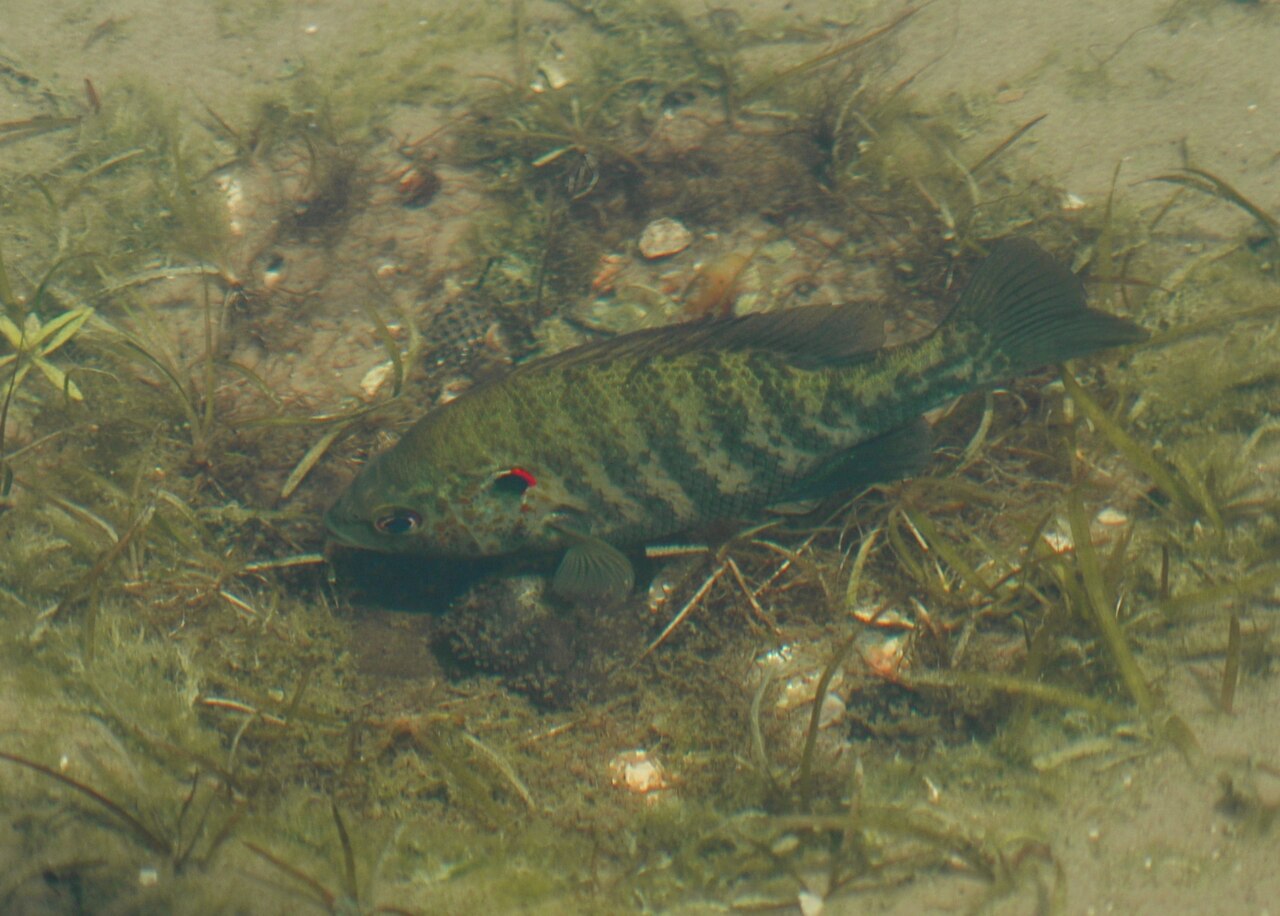
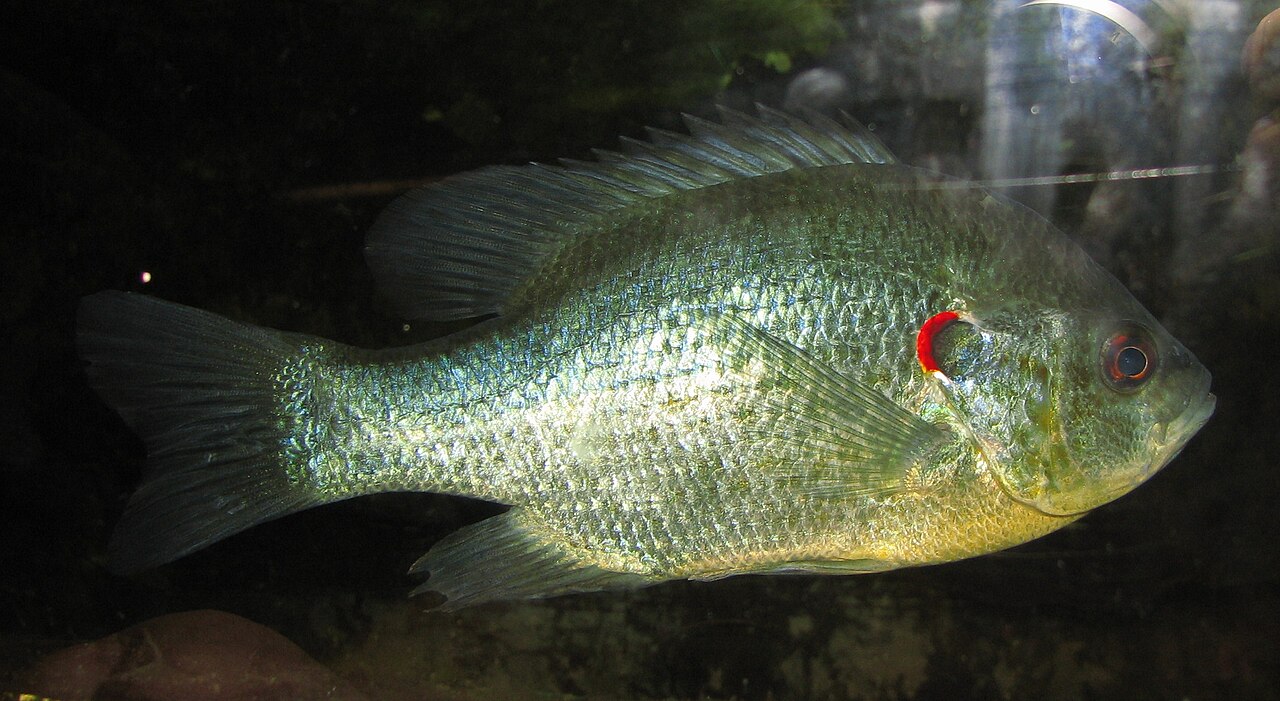
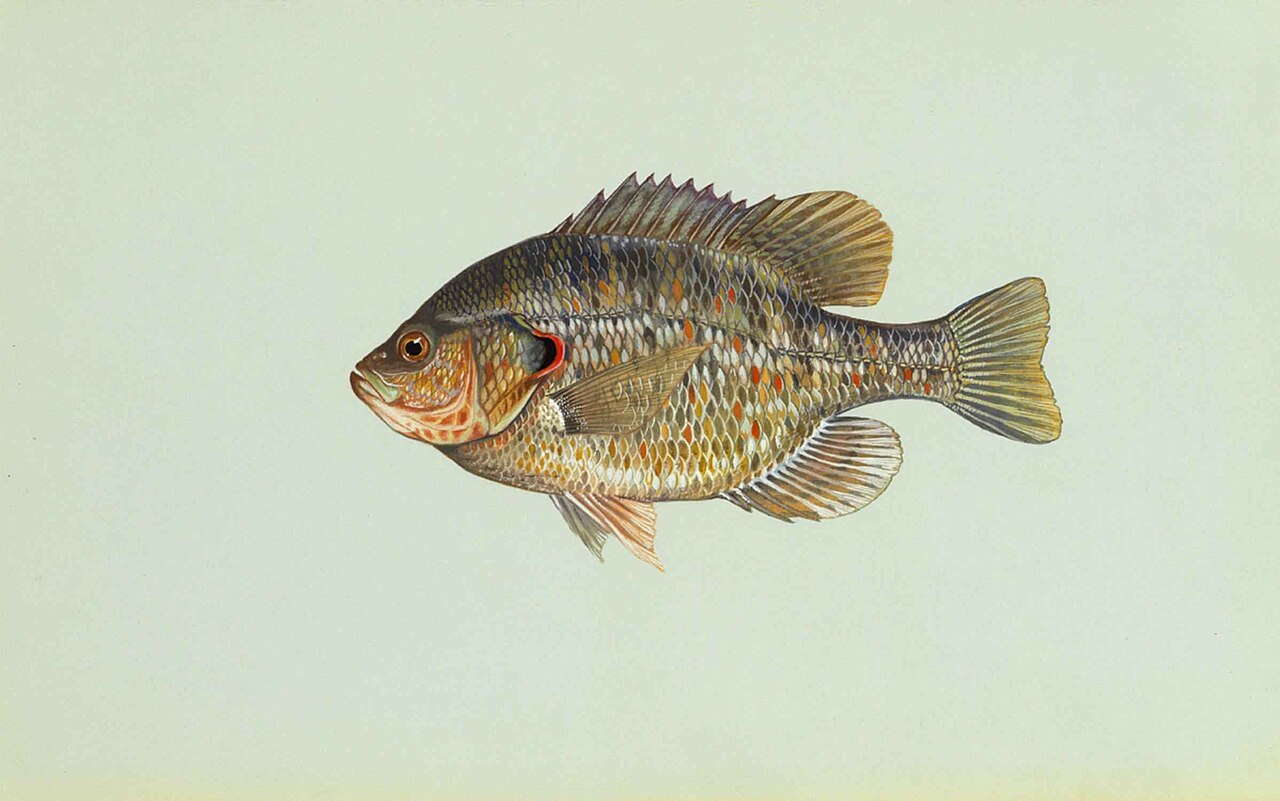
The ear flap gives the species its name and settles most identifications. The dark opercular flap behind the gill carries a bright red or orange margin in males and a paler orange edging in females, and no other common sunfish shows that combination.
Body coloring is more subdued than in its relatives. Redears are olive to golden with dark flecking and a pale belly, sometimes with faint vertical barring in younger fish, and they lack the strong blue and purple iridescence of a breeding bluegill. The body is deep and laterally compressed in the usual sunfish shape.
Fin structure follows the family pattern, with a spiny front section of the dorsal fin joined to a soft-rayed rear section, and a rounded tail. State wildlife agencies publish identification sheets for the group, which is worth checking because several Lepomis species hybridize where their ranges overlap and produce fish with intermediate features that fit no single description. Size and mouth help confirm it. Redears run noticeably larger than bluegill in the same water, and the mouth is slightly larger and more terminal, suited to picking hard-shelled prey off the bottom rather than snapping at plankton. Our guide to the sunfish covers the wider group, including the completely unrelated ocean species that shares the name.
Redear vs Bluegill
These two are the most commonly confused pair in North American fresh water and are often caught from the same spot. The ear flap is the fastest check: bluegill have a solid black flap with no colored margin, redears have that red or orange edge.
Fin markings differ too. Bluegill have a distinct dark blotch at the rear base of the dorsal fin, which redears lack or show only faintly. Breeding male bluegill are dramatically colored with deep blue gill covers and a rusty orange breast, while breeding redears stay comparatively plain.
Behavior separates them in practice. Bluegill feed throughout the water column and take insects at the surface readily, so they are the fish that pesters a bobber all afternoon. Redears feed almost exclusively on the bottom, ignore surface offerings, and are correspondingly harder to catch by accident. Anglers who complain that redears are scarce in a lake are often fishing the wrong depth.
The Shellcracker: Crushing Snails and Clams
The name shellcracker describes the defining adaptation. Redears have enlarged, hardened pharyngeal teeth, essentially grinding plates in the throat, powered by heavy jaw musculature, and they use them to crush the shells of snails and small clams before swallowing the soft contents.
This opens a food supply that most panfish cannot access. Aquatic snails are abundant in vegetated lakes and ponds and are largely ignored by other sunfish, so redears occupy a feeding niche with little competition, which is a large part of why they grow bigger than their relatives.
The diet extends beyond mollusks. Insect larvae, particularly midge and dragonfly larvae, along with amphipods, small crustaceans, and occasional fish eggs all feature, but snails dominate where they are available. The prey base connects directly to our guides to what snails eat and the aquatic insects in our guide to the baby dragonfly, both of which end up on the redear menu.
Spawning and Nesting
Redears spawn in late spring when water reaches roughly 66 to 75 F, typically earlier than bluegill in the same water, which is useful information for anglers timing a trip. In warmer southern waters they may spawn more than once per season.
Males excavate shallow circular nests in sand or gravel using their tails, usually in colonies, though redear colonies tend to be looser and in deeper water than the dense shallow bluegill beds. Nests often sit in 3 to 8 ft rather than the 1 to 3 ft bluegill prefer.
The male guards eggs and fry aggressively, fanning the nest to keep it oxygenated and driving off intruders many times his size. Eggs hatch within two to three days at spawning temperature. Because redears nest deeper and in looser groups, spawning beds are less visible from shore than bluegill beds, which is another reason the species is often assumed to be absent from lakes where it is doing well.
Where Redear Sunfish Live
The native range covers the southeastern United States, from Florida and the Gulf states north through the Mississippi valley to southern Illinois and Indiana. Extensive stocking has since established them far outside that range, including California, Arizona, New Mexico, and parts of the northeast.
Habitat preferences are consistent. They favor warm, clear, vegetated lakes, ponds, reservoirs, and slow rivers with sandy or gravelly bottoms, and they associate closely with submerged vegetation, stumps, and brush where snails concentrate.
They sit deeper than most panfish. Redears are typically found in 6 to 20 ft, moving shallower only during the spawn, and in summer they hold near thermoclines and structure. That depth preference is the single most useful piece of information for finding them, and it explains why they are underrepresented in casual shore catches.
Fishing for Redear Sunfish
Bottom presentation is the whole game. Live bait works best, with red wigglers, nightcrawler pieces, crickets, and small grubs all effective, fished on a small hook of size 6 to 10 with just enough weight to hold the bottom near cover.
Their bite is subtle. Redears take bait gently rather than attacking it, so a light rod and a sensitive presentation matter more than with bluegill, and many anglers miss fish simply by not registering the take. A slip float set to hold bait just above the bottom is a productive rig where the bottom is soft.
Timing pays. The spring spawn is the most productive window, when fish move into 3 to 8 ft and concentrate, and warm afternoons in early season find them shallowest. As table fare they are excellent, with firm white flesh, and they support significant recreational fisheries in the south. Local mercury and contaminant advisories apply as with any freshwater fish, and state agencies publish guidance by water body.
Redears and Invasive Mussels
The shell-crushing ability has found an unexpected application. Quagga and zebra mussels, invasive species that have colonized water bodies across North America, clog intake pipes, foul boats, strip plankton from the water column, and cost water utilities enormous sums.
Redear sunfish eat them. Research in the western United States, particularly in Arizona and Nevada reservoirs infested with quagga mussels, has documented redears consuming them in quantity, and stocking programs have been examined as a partial biological control measure.
The honest assessment is that it is a supplement rather than a solution. No fish population can clear an established mussel infestation from a large reservoir, and stocking a non-native fish to control a non-native mussel carries its own ecological risks that fisheries managers weigh carefully. What it does provide is meaningful local suppression in some settings, plus a popular sport fish, and that combination is why the approach continues to be studied.
Keeping Redear Sunfish in a Pond
Redears are a standard component of stocked farm ponds across the south, usually alongside bluegill and largemouth bass. The combination works because the three species use different food sources, with redears taking snails, bluegill taking insects and plankton, and bass eating both.
Stocking densities matter as much as species choice. A pond stocked too heavily with panfish and too lightly with predators produces stunted fish across every species, and the redear advantage in size disappears entirely when the population outruns the food supply. Most extension guidance recommends fixed ratios of predator to forage fish for exactly this reason. They also help with a specific problem. Snails in farm ponds host parasites including the flukes that cause swimmer’s itch and yellow grub in fish, and a healthy redear population reduces snail numbers and therefore parasite load. That practical benefit is often the reason a pond manager stocks them.
One limitation matters for pond owners. Redears reproduce less prolifically than bluegill and rarely overpopulate, which is an advantage for size quality but means they do not provide the same forage base for bass. Most stocking recommendations therefore use redears as a supplement to bluegill rather than a replacement, and periodic restocking may be needed. Anyone keeping fish in a more controlled setting will find quite different requirements in our guides to the oranda goldfish and betta fish.
Related reading: Walleye Teeth.
Related reading: World Record Smallmouth Bass.
Frequently Asked Questions
What is a redear sunfish?
A large freshwater panfish, Lepomis microlophus, native to the southeastern United States and widely stocked elsewhere. It is identified by the red or orange margin on the dark ear flap and commonly reaches 8 to 11 in, larger than bluegill in the same water.
Why is it called a shellcracker?
Because it crushes snail and clam shells with hardened grinding plates in its throat called pharyngeal teeth, powered by heavy jaw musculature. This gives it access to a food source most other panfish cannot use, which is part of why it grows larger.
How do I tell a redear from a bluegill?
Check the ear flap. Bluegill have a solid black flap, redears have a red or orange margin on it. Bluegill also have a dark blotch at the rear base of the dorsal fin, which redears lack, and bluegill feed throughout the water column while redears feed on the bottom.
How big do redear sunfish get?
Commonly 8 to 11 in and 0.5 to 1.5 lb, noticeably larger than bluegill of the same age. The world record exceeds 5 lb, and fish over 2 lb are realistic targets in productive southern and western waters.
What is the best bait for redear sunfish?
Live bait fished on the bottom, especially red wigglers, nightcrawler pieces, crickets, and small grubs on a size 6 to 10 hook near vegetation or gravel in 6 to 15 ft. They take bait gently, so a sensitive rod matters more than with bluegill.
Do redear sunfish eat invasive mussels?
Yes. Research in Arizona and Nevada reservoirs has documented redears consuming quagga mussels in quantity, and stocking has been studied as partial biological control. It provides local suppression rather than eradication, since no fish population can clear an established infestation.
Are redear sunfish good to eat?
Yes, they have firm mild white flesh and support significant recreational fisheries in the south. Standard state advisories on mercury and other contaminants apply, and guidance is published by water body.