Swallowtail Butterfly: Identifying 6 Common Species
Swallowtail butterflies form one of the most recognizable and diverse butterfly groups in North America, named for the distinctive tail-like extensions on their hindwings that resemble a swallow bird’s forked tail, a genuinely distinguishing physical feature that separates this family from essentially every other common backyard butterfly group and makes swallowtails among the easiest butterflies for beginning observers to correctly identify to at least the family level, even without knowing the specific species involved.
With multiple distinct species found across different regions of the United States, ranging from the widespread yellow-and-black eastern tiger swallowtail to the more specialized zebra swallowtail tied specifically to pawpaw trees, swallowtails as a group offer genuinely rich diversity in coloration, host plant relationships, and specific regional distribution worth understanding both for accurate species-level identification and for anyone hoping to attract these striking butterflies to their own garden. This guide covers the defining swallowtail features, the most common species found across different US regions, host plant relationships, and practical tips for attracting swallowtails specifically.
| Species | Key Identifying Feature |
|---|---|
| Eastern tiger swallowtail | Yellow with black tiger stripes |
| Giant swallowtail | Largest US butterfly, yellow spot bands |
| Black swallowtail | Black with yellow spot rows |
| Zebra swallowtail | White/pale, long tails, pawpaw-dependent |
| Pipevine swallowtail | Iridescent blue-black, toxic to predators |
| Spicebush swallowtail | Black with blue-green hindwing patch |
What Defines a Swallowtail Butterfly
The defining physical feature uniting all swallowtail species is the distinctive tail-like extension projecting from each hindwing, an elongated feature resembling a swallow bird’s forked tail that gives this entire butterfly family its common name, a structural feature genuinely unique enough among common backyard butterflies that spotting these tails alone reliably identifies a butterfly as belonging to the swallowtail family regardless of the specific species or color pattern involved.
Beyond the namesake tails, swallowtails generally rank among the larger butterfly species found in North America, with most common species spanning 3 to 6.5 inches depending on the specific species, making them considerably larger and more visually striking than many other common backyard butterflies, a size combined with their often bold, distinctive coloration that makes swallowtails particularly rewarding subjects for casual garden observation and photography alike.
Swallowtail caterpillars also share some general family characteristics worth recognizing, including a distinctive defensive structure called an osmeterium, a forked, fleshy organ that can be everted from just behind the head when the caterpillar feels threatened, releasing a foul-smelling odor meant to deter predators, a genuinely unique defensive feature specific to swallowtail caterpillars that distinguishes them from the caterpillars of other butterfly families entirely.
Eastern Tiger Swallowtail: The Classic Yellow Species
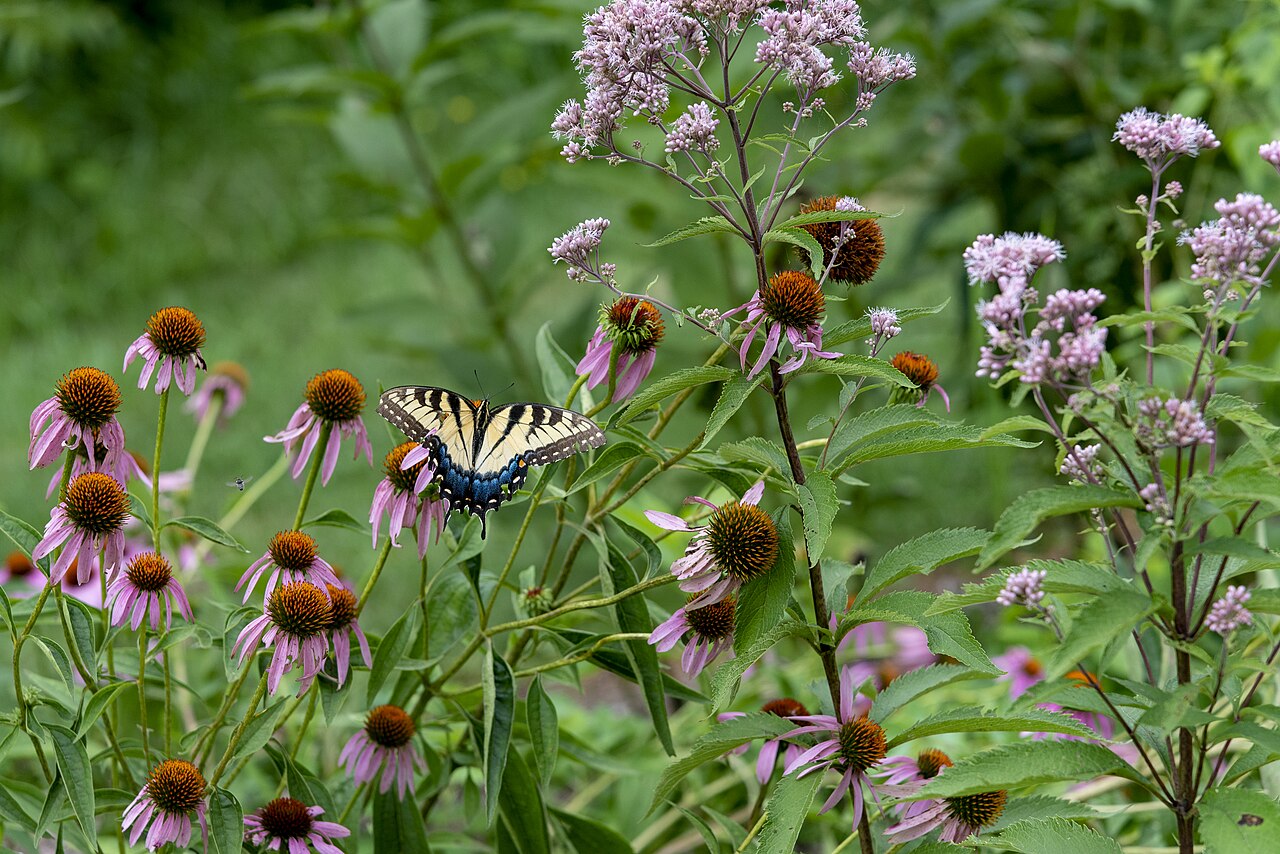
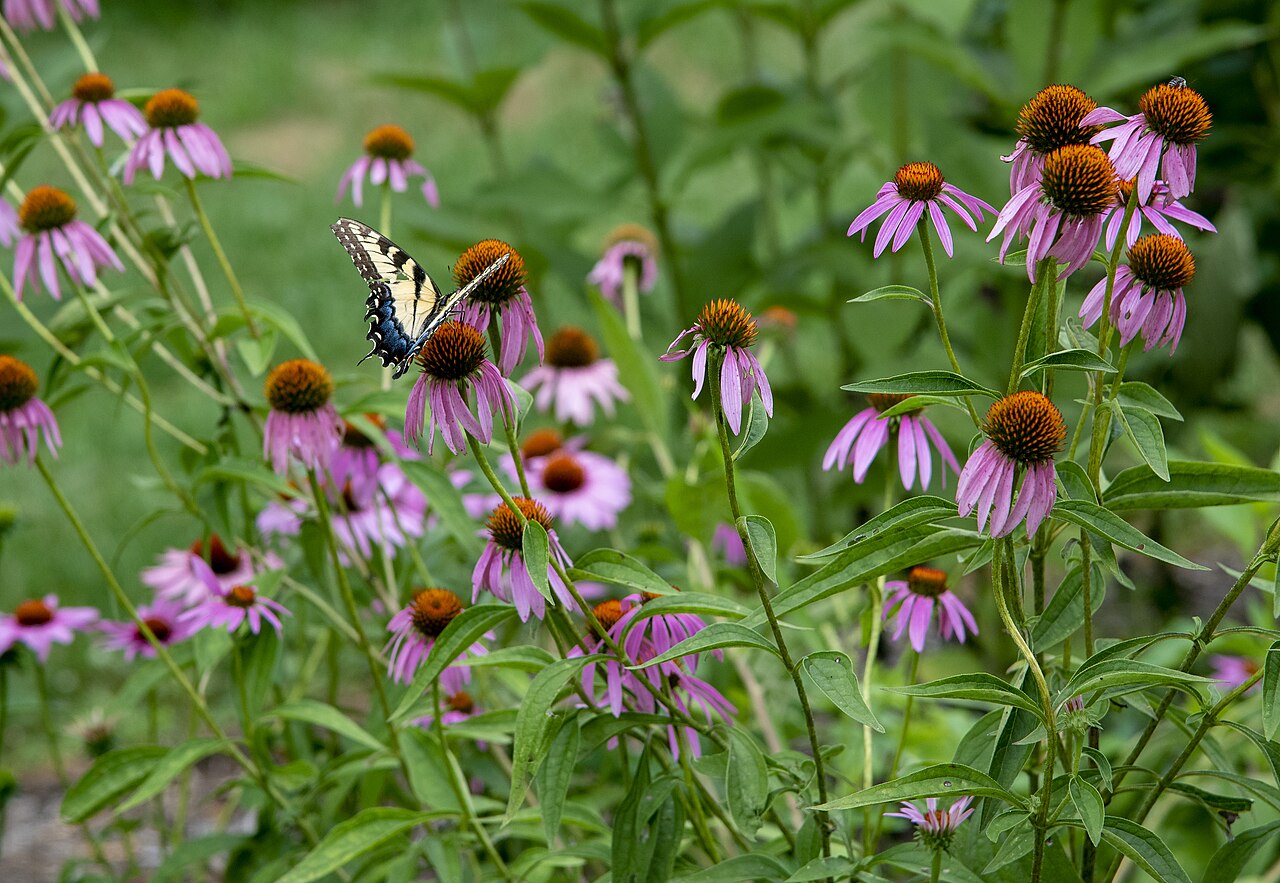
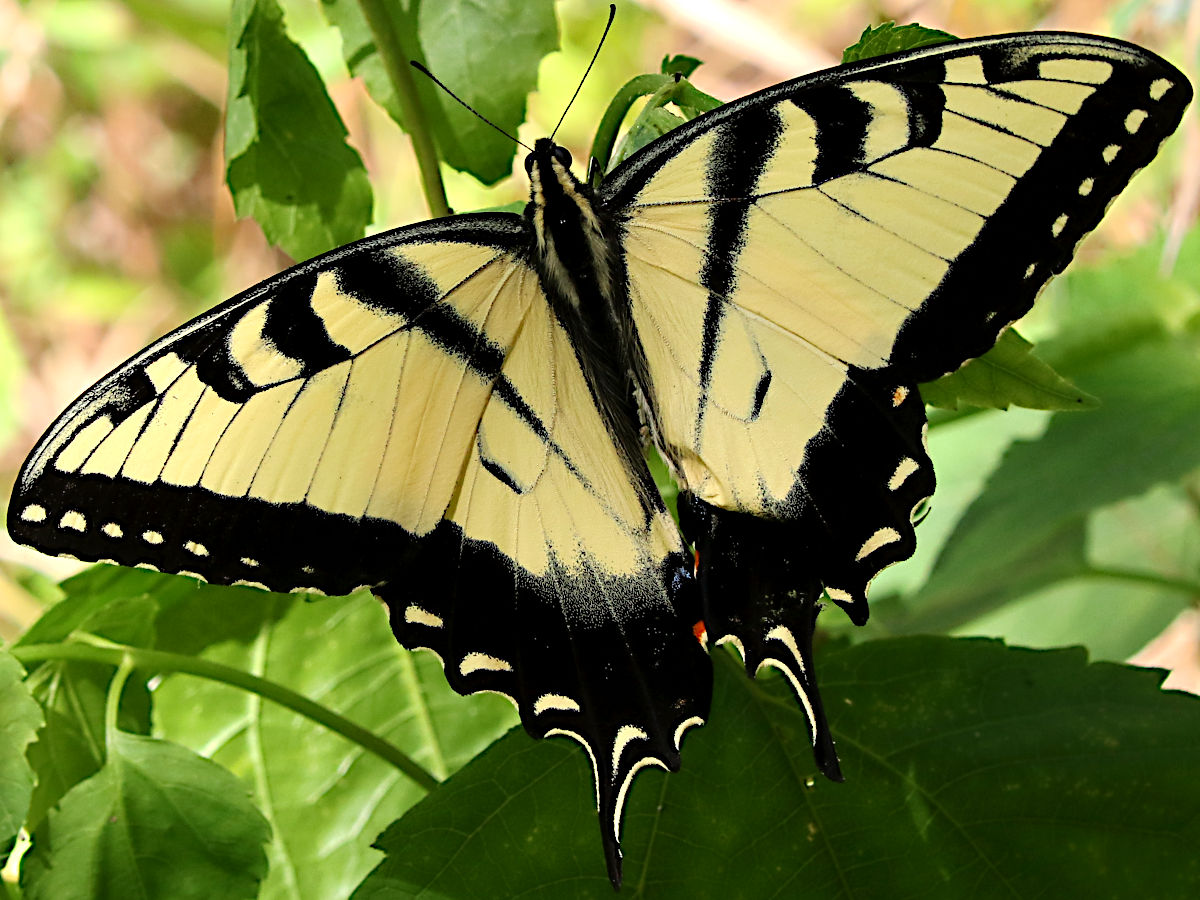
The eastern tiger swallowtail ranks among the most commonly recognized swallowtail species across essentially the entire eastern United States and well into the Midwest, displaying vivid yellow wings marked with bold, parallel black stripes running across both fore and hind wings, creating the striking tiger-inspired pattern that gives this species its common name and makes it one of the most instantly recognizable large butterflies throughout its extensive range.
This species shows a genuinely interesting complication specifically in females, which occur in two distinct color forms: the typical yellow-and-black pattern matching males, and a separate dark form appearing almost entirely black with only faint shadow-striping, a form believed to provide additional protection by mimicking the toxic pipevine swallowtail covered later in this guide, meaning encountering an all-black tiger swallowtail specifically indicates this particular female color variant rather than a different species entirely.
Eastern tiger swallowtail caterpillars feed on a range of broadleaf trees including wild cherry, tulip tree, and ash, making woodland edges and areas with these host trees particularly reliable places to encounter this species throughout its active season, which typically spans from spring through fall across multiple broods in the warmer portions of its range.
Giant Swallowtail: North America’s Largest Butterfly
The giant swallowtail holds the distinction of being the largest butterfly species found in North America, with a wingspan reaching up to 6.5 inches, displaying a notably different pattern arrangement than the tiger swallowtail: predominantly dark brown-black wings marked with a diagonal band of yellow spots, plus a distinctive yellow patch forming a rough X pattern visible specifically on the underside of the hindwing.
This species ranges primarily across the southern and eastern United States, with caterpillars feeding specifically on citrus family plants, including cultivated orange and lemon trees, earning the larval stage the common nickname orange dog among citrus growers dealing with occasional caterpillar feeding damage, a host plant relationship that ties this species’ distribution closely to areas where citrus and related plants grow either wild or cultivated.
Despite its impressive size, the giant swallowtail can sometimes be mistaken for other dark swallowtail species at a quick glance, though its considerably larger overall size combined with the distinctive underside X-mark pattern, visible when the butterfly rests with wings closed, generally allows for confident identification once these specific features are checked carefully against the more general dark coloration this species shares with several other swallowtail possibilities.
Black Swallowtail: The Vegetable Garden Visitor
The black swallowtail displays a genuinely distinct pattern compared to the yellow-dominant tiger swallowtail: predominantly black wings marked with two rows of yellow spots running roughly parallel to the wing edges, plus additional blue and orange markings near the hindwing tail that add further color complexity to this already visually striking species.
This species ranges very broadly across nearly all of the continental United States, considerably wider than either the tiger or giant swallowtail’s more regionally concentrated ranges, with caterpillars feeding on plants in the carrot family, including wild Queen Anne’s lace and cultivated garden vegetables like parsley, dill, carrots, and fennel, making black swallowtail caterpillars a genuinely familiar sight to many home vegetable gardeners specifically who grow these particular host plants.
Males and females show some difference in their specific yellow spotting pattern, with males generally displaying somewhat bolder, more extensive yellow markings than females, whose spots tend to run smaller and less prominent, though both sexes clearly share the same overall black-background-with-yellow-spot-rows pattern that distinguishes this species from the other common swallowtails covered throughout this guide.
Zebra Swallowtail: The Pawpaw Specialist
The zebra swallowtail stands out among common North American swallowtails for its distinctive pale, whitish-green base coloration marked with bold black zebra-inspired stripes, combined with dramatically long tail projections, considerably longer relative to body size than any other common native swallowtail species, giving this species an immediately recognizable silhouette even at a distance.
This species maintains an unusually specific host plant relationship, with caterpillars feeding exclusively on pawpaw trees, meaning zebra swallowtail distribution and local abundance follows pawpaw tree distribution specifically across the eastern and southeastern United States, making this species considerably more habitat-restricted than the more generalist tiger or black swallowtails covered in earlier sections.
Zebra swallowtails also show an interesting seasonal size and tail-length variation, with spring-generation individuals typically smaller with shorter tails compared to the larger, longer-tailed summer generation, a seasonal difference pronounced enough that early naturalists initially described the two seasonal forms as separate species before later recognizing them as generational variants of the same butterfly.
Pipevine Swallowtail: The Toxic Model
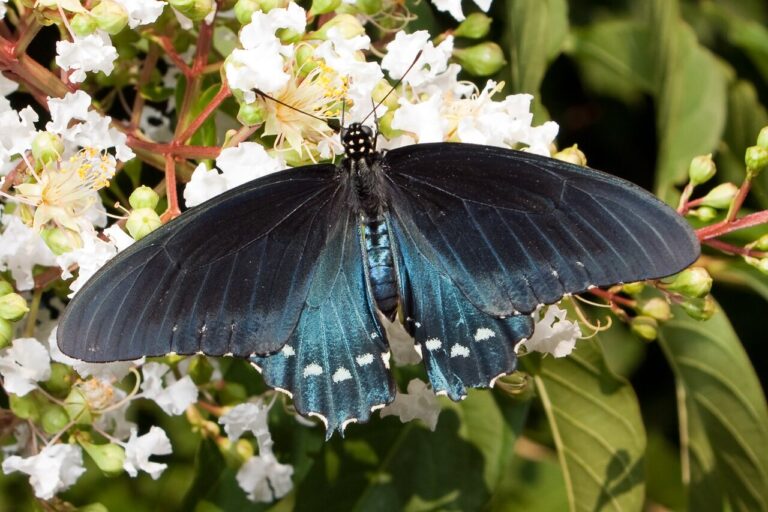
The pipevine swallowtail displays a genuinely different visual quality than the other swallowtails covered so far, showing black forewings and body with hindwings that shimmer an iridescent blue to blue-green depending on viewing angle, an optical effect produced by microscopic wing scale structure rather than pigment alone, covered in additional detail in our black and blue butterfly guide.
This species carries genuine ecological significance beyond its striking appearance, since caterpillars feed exclusively on toxic pipevine plants, rendering the adult butterfly genuinely unpalatable to most predators, a toxicity that has driven several unrelated butterfly species and color forms, including the dark-form female tiger swallowtail covered earlier, to evolve similar blue-black coloration through Batesian mimicry, gaining predator protection by resembling this genuinely toxic model species.
Ranging across most of the eastern and southern United States, pipevine swallowtails specifically require locating pipevine host plants to encounter breeding populations, making gardens and natural areas with established pipevine growth the most reliable locations for finding this ecologically significant species actively engaged in its full life cycle rather than simply passing through as an adult feeding at flowers.
Spicebush Swallowtail: A Close Relative
The spicebush swallowtail presents another commonly encountered dark swallowtail species, displaying black wings overall with a distinctive blue-green patch on the hindwing in males, or a somewhat more blue-toned equivalent patch in females, plus pale spots along the wing margins that help distinguish this species from the more uniformly dark pipevine swallowtail covered above.
This species also participates in the same pipevine-mimicry complex, its dark coloration and hindwing patch believed to provide predator protection through resemblance to the toxic pipevine swallowtail, despite spicebush swallowtail caterpillars actually feeding on spicebush and sassafras rather than any toxic host plant, making this species non-toxic itself despite benefiting visually from the protective association.
Ranging across much of the eastern United States, spicebush swallowtails favor woodland edges and understory areas where their namesake host shrubs and small trees grow, a somewhat different habitat association than the more varied garden and open-area settings where several other swallowtail species, tied to their own different host plants, tend to concentrate instead.
Swallowtails Within the Broader Butterfly Identification Picture
Placing swallowtails within the broader context of common backyard butterfly identification helps sharpen recognition further, since several color-based identification guides covering species that happen to be swallowtails, like our yellow and black butterfly guide covering the tiger swallowtail specifically, or our black and white butterfly guide covering the zebra swallowtail’s pale form, approach identification from a color-first angle rather than the family-first approach this guide takes.
Similarly, our purple butterfly guide covers another color-based identification approach in additional depth, while readers interested in the symbolic and cultural meanings sometimes associated with these visually striking insects can explore our butterfly tattoo meaning guide for that entirely different angle on butterfly appreciation.
Approaching butterfly identification from both the family-level structural features covered throughout this guide, tails, size, and general wing shape, and the color-first approach these related guides take, gives backyard observers a genuinely comprehensive toolkit for confidently identifying essentially any swallowtail species encountered, regardless of which specific feature happens to be most immediately noticeable during a given sighting.
How to Attract Swallowtail Butterflies to Your Garden
Because each swallowtail species depends on specific host plants for caterpillar development, attracting a particular species requires planting its specific host plant rather than relying on general nectar flowers alone, meaning gardeners hoping to attract zebra swallowtails need pawpaw specifically, while those hoping for black swallowtails should include parsley, dill, or fennel, and giant swallowtail enthusiasts in appropriate climates might plant citrus specifically.
Beyond host plants, providing nectar sources through flowering plants, particularly native wildflowers and garden perennials blooming across the full growing season, supports adult swallowtails feeding needs, while avoiding broad-spectrum insecticide use near any planted host plants protects the eggs and caterpillars that would otherwise be eliminated before ever reaching the adult butterfly stage most gardeners specifically hope to attract and observe.
Patience matters considerably in swallowtail gardening specifically, since establishing host plants, particularly slower-growing options like pawpaw trees for zebra swallowtails, may take considerable time before actually attracting breeding populations, though the reward of watching a full life cycle unfold, from egg through caterpillar, chrysalis, and finally emerging adult, on a plant you specifically provided offers a genuinely rewarding gardening experience beyond simply attracting adult butterflies passing through for nectar alone.
Related reading: Giant Swallowtail Butterfly.
Related reading: Zebra Swallowtail Butterfly.
Related reading: Spicebush Swallowtail Butterfly.
Related reading: Pipevine Swallowtail Butterfly.
Frequently Asked Questions
What makes a butterfly a swallowtail?
The distinctive tail-like projections on the hindwings, resembling a swallow bird’s forked tail, define this butterfly family, along with generally larger size compared to many other common backyard butterfly species.
What is the most common swallowtail butterfly in the US?
The eastern tiger swallowtail, recognized by its vivid yellow wings with bold black tiger stripes, found across essentially the entire eastern United States and into the Midwest.
Which swallowtail is the largest butterfly in North America?
The giant swallowtail, with a wingspan reaching up to 6.5 inches, identifiable by its dark background with yellow spot bands and a distinctive X-shaped mark on the underside of the hindwing.
Why do some swallowtails look toxic or dangerous with dark blue-black coloring?
This coloring belongs to the pipevine swallowtail, which is genuinely toxic to predators from its caterpillar diet of pipevine plants, and several other harmless species mimic this same coloring for protection.
What plants attract black swallowtail caterpillars?
Plants in the carrot family, including wild Queen Anne’s lace and garden vegetables like parsley, dill, carrots, and fennel, making black swallowtails common visitors to vegetable gardens growing these plants.
Why does the zebra swallowtail have such long tails?
This species has evolved notably longer tail projections than other common swallowtails, though the exact evolutionary reason remains less specifically documented than the species’ well-known dependence on pawpaw as its exclusive host plant.
How can I attract swallowtail butterflies to my garden?
Plant the specific host plant for the species you want to attract, such as parsley or dill for black swallowtails, alongside nectar-rich flowers, and avoid insecticides near these plants to protect eggs and caterpillars.