Baby Swan: What Cygnets Look Like and How They Grow
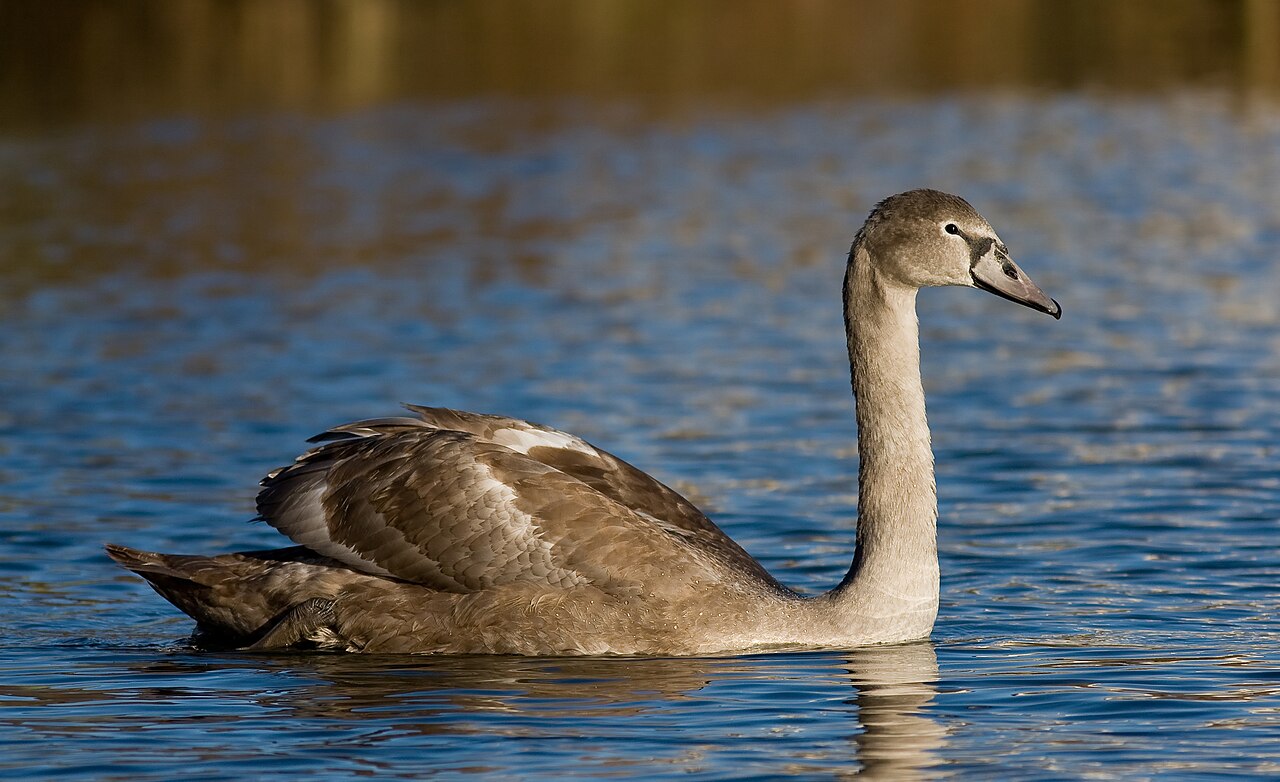
A baby swan is called a cygnet, pronounced “SIG-net,” and it hatches as a fluffy gray or grayish-brown chick weighing about 7 to 8 ounces, roughly the size of a large duckling, with a short dark bill and stubby legs. Cygnets leave the nest within a day or two of hatching, swim immediately, and spend their first several months trailing behind both parents, often climbing aboard a parent’s back to rest or stay warm. A baby swan keeps its gray down and then gray-brown feathers through its first winter and does not turn fully white until it is a year to eighteen months old.
All three swan species regularly seen in the United States, the native trumpeter swan and tundra swan and the introduced mute swan, raise their cygnets in broadly the same way, with a single brood per year hatched in late spring and cared for by both parents through the fall. This guide covers what a baby swan looks like at each stage, how many eggs a swan lays and how long they take to hatch, what cygnets eat, why they ride on their parents’ backs, when they leave the family, how to tell a cygnet from a duckling or gosling, and what to do if you find one alone.
| Feature | Baby Swan (Cygnet) |
|---|---|
| Name | Cygnet (from Latin cygnus, swan) |
| Hatching weight | 7 to 8 ounces (mute swan); slightly less in tundra swans |
| Down color | Gray to gray-brown; rare white “Polish” morph in mute swans |
| Eggs per clutch | 4 to 7 (mute), 4 to 6 (trumpeter), 3 to 5 (tundra) |
| Incubation | 35 to 41 days (mute); 32 to 37 days (trumpeter); 31 to 32 days (tundra) |
| Age at first flight | 4 to 5 months |
| Turns white | Gradually between 12 and 18 months |
| Leaves parents | 6 to 12 months, usually driven off the following spring |
A baby swan is called a cygnet. It hatches as a gray or grayish-brown chick weighing about 7 to 8 ounces, swims within a day or two of hatching, and keeps gray feathers through its first winter. Most cygnets are fully white by around one year old.
What a Baby Swan Looks Like
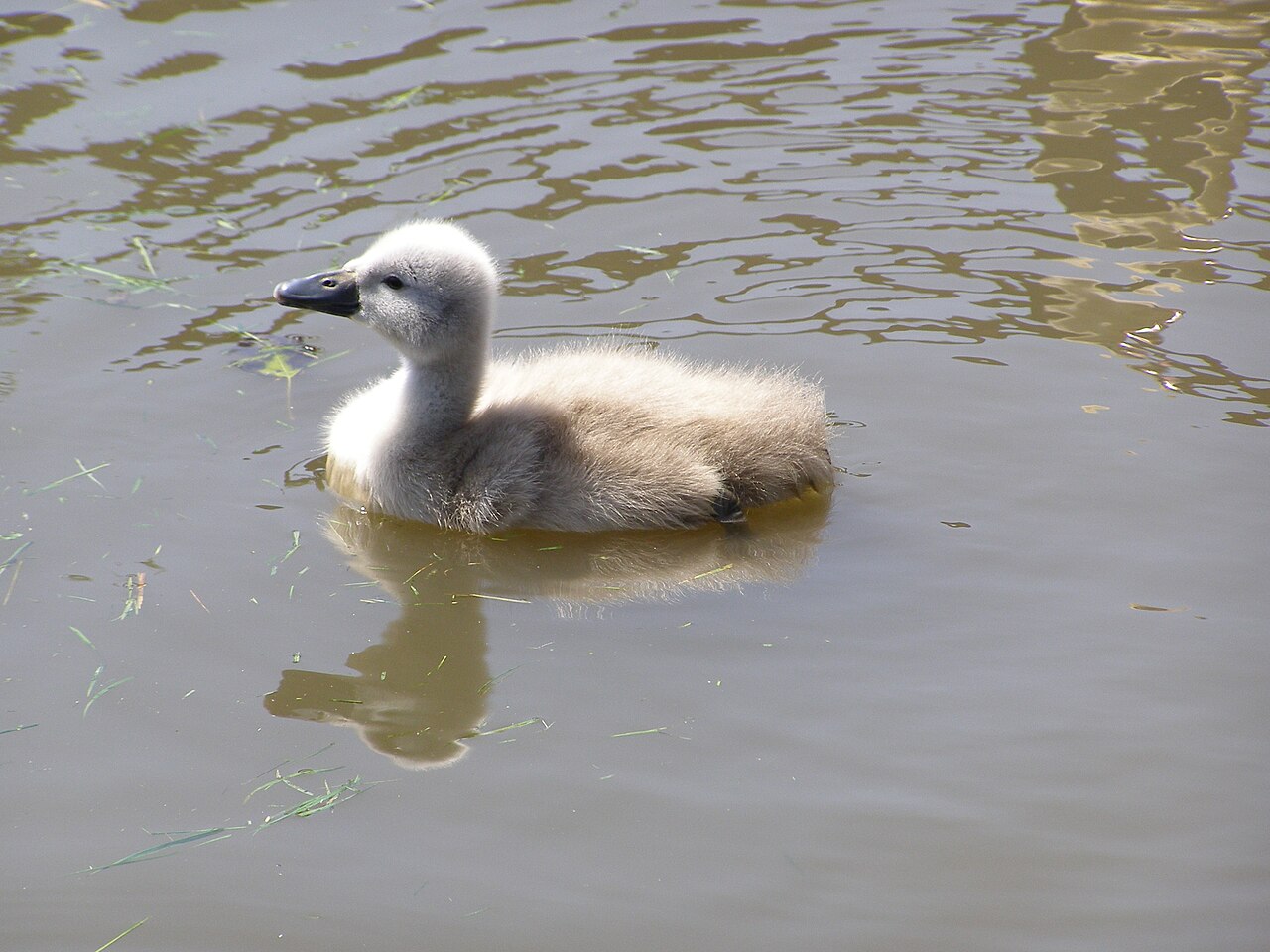
A newly hatched cygnet is covered in dense, soft down that is pale gray on the belly and darker gray or gray-brown on the back and head. The bill is short and dark, ranging from slate gray to black, with no hint of the orange or yellow that adult mute and tundra swans show. The legs and feet are gray to dark gray, the eyes are dark, and the neck is short and thick rather than long and curved. A cygnet looks like a plush, oversized duckling and weighs about twice as much as a mallard duckling on hatching day.
Mute swans occasionally produce a color variant known as a “Polish” cygnet, which hatches with white down instead of gray and has pinkish-gray legs rather than dark ones. This is a leucistic form controlled by a sex-linked gene, and Polish cygnets grow into normal white adults with slightly paler legs. They are not albinos, since their eyes are dark, and they are not a separate species. In a brood of gray cygnets, a single white chick is almost always a Polish morph rather than a duckling or goose that joined the family.
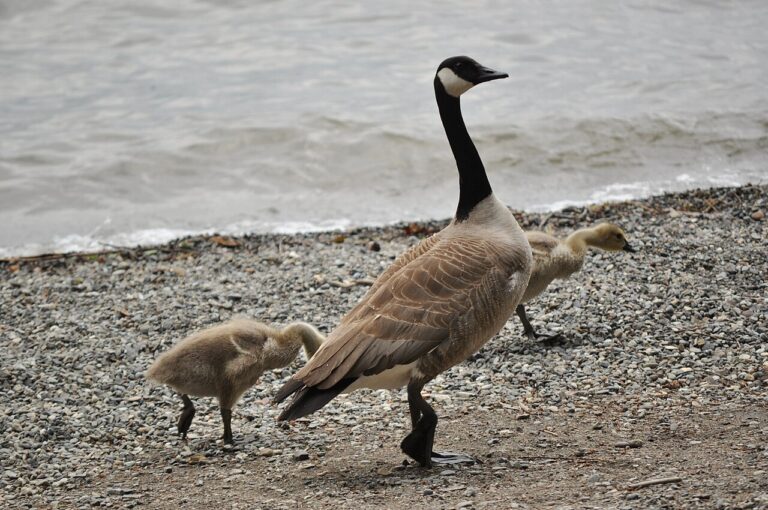
Over the first 2 to 3 weeks the down thickens and the cygnet roughly doubles in size, but the coloring stays gray. Distinguishing a cygnet from a gosling at this stage comes down to bill shape and size. A cygnet’s bill is broader and flatter with a slight downward slope, its body is noticeably heavier, and it is almost always in the company of two large white adults. Goslings are yellowish or olive-gray with a smaller, more pointed bill and travel in large mixed groups. A duckling is far smaller, usually yellow and brown, and moves in quick, darting bursts rather than the steady glide of a cygnet.
Swan Eggs, Nesting, and Hatching
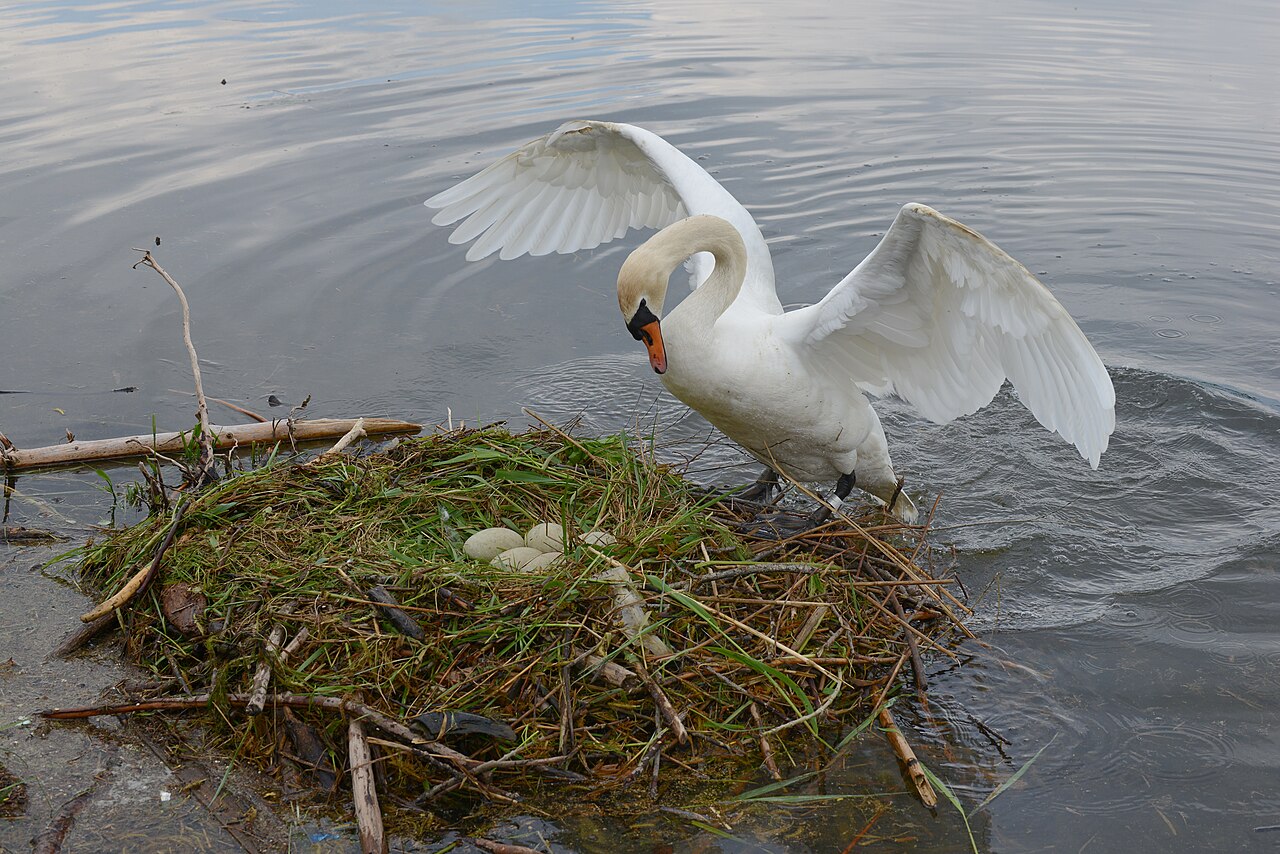
Swans nest once a year in early to mid spring. The female, called a pen, builds a large mound of reeds, cattails, and grasses at the water’s edge or on a small island, sometimes 5 to 6 feet across, and lines the shallow cup with down. Mute swans lay 4 to 7 eggs, occasionally up to 10, each pale green to blue-gray and about 4.5 inches long. Trumpeter swans lay 4 to 6 eggs and tundra swans 3 to 5, with tundra swans nesting on Arctic tundra far from most observers. According to the Cornell Lab of Ornithology’s All About Birds, mute swan eggs incubate for 35 to 41 days, trumpeter swan eggs for 32 to 37 days, and tundra swan eggs for 31 to 32 days.
The pen does nearly all of the incubating, sitting on the eggs for long stretches while the male, called a cob, patrols the territory and drives off intruders, including dogs, geese, and people who wander too close. Swans are famously aggressive during nesting, and a cob defending a nest will rush across the water with wings arched over its back in a display called busking. The eggs are laid roughly every other day, but incubation does not begin in earnest until the clutch is complete, so all the cygnets hatch within a 24 to 36 hour window.
Hatching takes each cygnet a day or more of pipping and struggling out of the shell. The chicks emerge wet and exhausted, dry off under the pen within a few hours, and are able to walk and swim by the following day. Unhatched eggs are usually abandoned within a day or two of the last hatch. In a good year 4 to 6 cygnets leave the nest with their parents. Swan pairs are strongly bonded, and the same two adults typically return to the same nest site year after year, a pattern covered in more detail in the guide to birds that mate for life.
What Baby Swans Eat
Cygnets are not fed by their parents the way songbird chicks are. From the first day on the water they pick up food themselves, starting with insects, insect larvae, small snails, tiny crustaceans, and tender bits of aquatic vegetation floating at the surface. This early diet is much higher in protein than the adult diet, which fuels the rapid growth of the first month. A cygnet that hatches at 8 ounces can weigh 4 to 5 pounds by 6 weeks of age.
The parents help indirectly. Adult swans feed by dabbling and by using their long necks to reach plants on the bottom, and they also paddle their large feet to stir up the sediment, bringing invertebrates and plant fragments to the surface where the cygnets can grab them. Parents will also pull up long strands of submerged pondweed and leave them floating for the young to pick apart. Within a few weeks the cygnets begin dabbling on their own, and by 2 to 3 months they eat mostly aquatic plants like the adults, along with grass grazed from the shoreline.
Feeding bread to cygnets is harmful. White bread has almost no nutritional value for a growing waterbird and can contribute to a deformity called angel wing, in which the wrist joint twists outward and the flight feathers stick out sideways, permanently preventing flight. Cornell Lab of Ornithology and Audubon both discourage feeding bread to waterfowl for this reason. If you want to offer food where it is permitted, small amounts of chopped lettuce, spinach, peas, or corn thrown onto the water are far safer, though a healthy pond provides everything a cygnet needs without human help.
Why Baby Swans Ride on Their Parents’ Backs
One of the most photographed swan behaviors is a line of cygnets climbing onto the back of a swimming parent and nestling between the folded wings. Both mute swans and the Australian black swan do this regularly, while trumpeter and tundra swans do it less often. The behavior is most common in the first 2 to 3 weeks, when cygnets tire quickly, cannot yet regulate their body temperature well, and are most vulnerable to cold water and predators lurking beneath the surface.
The back ride serves three purposes at once. It warms the chick, since the parent’s body heat and feathers trap warmth far better than the cygnet’s own down. It lets the chick rest while the family keeps moving to feeding areas. And it lifts the cygnet out of reach of the pike, large bass, snapping turtles, and mink that take a heavy toll on swan broods in the first weeks. A cygnet on its parent’s back is essentially untouchable to anything in the water.
Swans do not carry their young in their bills or under their wings on land, and they do not carry them while flying, a myth that comes up every year. Cygnets that cannot keep up simply get left behind for a few minutes while the parent circles back, or they climb aboard. By 3 to 4 weeks the cygnets are too heavy to ride comfortably and the parent will shrug them off, though a persistent chick will sometimes try well past the point where it fits.
From Gray Fluff to White Feathers: The First Year
A cygnet’s development follows a predictable timeline. In the first month the gray down thickens and the body grows fast, but the shape stays chick-like with a short neck. During weeks 4 through 8 the first true feathers push through the down, starting on the wings, tail, and shoulders, and these juvenile feathers are gray-brown, mottled, and duller than the down. By 2 months the neck has lengthened noticeably and the cygnet begins to look like a small, dingy swan rather than a big duckling.
By 3 to 4 months the cygnet is nearly adult-sized in body, fully feathered in gray-brown, and growing its flight feathers. First flight comes at about 4 to 5 months for mute swans, roughly 120 to 150 days after hatching, and slightly earlier for trumpeter swans in the wild, where the short Arctic and northern summers push cygnets to fledge before freeze-up. Early flights are clumsy, and the whole family often practices together, running across the water and lifting off in a line.
White feathers arrive gradually. Over the first winter the gray-brown juvenile plumage begins to be replaced patch by patch, and by spring a one-year-old swan is usually mostly white with scattered gray or brown feathers on the head, neck, and wings. Full white plumage is complete by 12 to 18 months in most birds, with a few stragglers keeping brownish tips into their second fall. The bill changes too: a mute swan cygnet’s dark bill turns pinkish at around 6 months and then orange with the black knob developing during the second year. A young swan of any species is therefore easy to age by how much gray remains.
When Baby Swans Leave Their Parents
Cygnets stay with both parents through the summer and fall and, in most cases, into the winter. The family unit stays together on the home pond or lake, or migrates together in the case of trumpeter and tundra swans, with the young learning feeding areas and migration routes by following the adults. This extended family period of 6 to 9 months is much longer than in ducks, where ducklings are on their own by 2 months, and is one reason swans have relatively high survival rates once they make it past the first month.
The break usually comes the following spring, when the adults begin preparing to nest again. The cob becomes increasingly aggressive toward last year’s young, chasing them off the territory with the same busking display he uses on rival swans. The now-mostly-white yearlings gather with other young swans in flocks of non-breeders on larger lakes and estuaries, where they spend the next 2 to 4 years growing to maturity and eventually pairing off. Mute swans first breed at 3 to 4 years old, trumpeters at 4 to 6.
Not every cygnet makes it that far. Roughly half of hatched cygnets die in the first year, most within the first few weeks from predators, cold, or getting separated from the family. Survivors face fishing line entanglement, lead poisoning from ingested shot and sinkers, collisions with power lines, and, for the introduced mute swan, active population control in several states where the species is considered invasive because of its damage to native wetland vegetation and aggression toward native waterfowl such as the Canada goose and native ducks.
Cygnet vs Duckling vs Gosling
Most people who find a “baby swan” have actually found a gosling, so the comparison is worth spelling out. Size is the first clue. A hatchling cygnet weighs 7 to 8 ounces; a Canada goose gosling weighs about 3.5 ounces and a mallard duckling under 1.5 ounces. Even at a distance, a cygnet is visibly chunkier and moves with a slower, more deliberate glide. Its head appears large for its body and its neck, while short compared with an adult swan, is proportionally longer and thicker than a duckling’s.
Color separates them next. Cygnets are a uniform soft gray to gray-brown with a paler belly and no facial pattern. Canada goose goslings are olive-yellow to greenish-gray with a darker crown and a yellowish face. Mallard ducklings are yellow below and dark brown above with a dark stripe through the eye. Domestic goose and duck young can be bright yellow. Only the rare Polish mute swan cygnet is white, and it is still bulkier and grayer-legged than any yellow domestic duckling.
Company is the final and most reliable clue. Cygnets are almost never far from two large white adults with long necks. Goslings travel with two brown-bodied, black-necked adults and frequently merge into large groups with other goose families. Ducklings follow a single mottled brown female duck with no male in attendance. If you see a gray chick alone with no adults of any kind nearby, it may be an orphan of any of these species, and the section below explains what to do.
What to Do If You Find a Baby Swan Alone
A cygnet that appears to be alone is usually not abandoned. Swan families spread out while feeding, and a parent is often within a hundred feet, hidden by reeds or around a bend in the shoreline. Watch from a distance for at least 30 to 60 minutes before doing anything. If the cygnet is swimming, calling, and looks alert, the odds are good the parents will reappear. Approaching it, and especially picking it up, can cause the cob to attack and can imprint a very young bird on humans.
Intervene only if the cygnet is clearly injured, tangled in fishing line, being attacked by a dog or gull, lying still on the shore and not responding, or has been alone for several hours with no adult swans anywhere on the water body. In those cases, contact a licensed wildlife rehabilitator or your state wildlife agency rather than trying to raise the bird yourself. Swans are protected under the Migratory Bird Treaty Act in the case of native trumpeter and tundra swans, and possessing one without a permit is illegal. Mute swans are not federally protected but are regulated by many states, and a rehabilitator will know the local rules.
If a rehabilitator asks you to contain the cygnet until they arrive, approach slowly, drape a towel over it, and lift it gently with both hands around the body and wings. Place it in a ventilated box lined with a towel in a quiet, warm spot away from pets and children. Do not offer food or water; a stressed chick can aspirate liquid, and it will not starve in the few hours before help arrives. Never try to return a cygnet to a swan family that is not its own, since adult swans will attack and often kill unfamiliar young.
How Many Cygnets Survive Their First Year?
Roughly half of all cygnets do not reach their first birthday, and in poor years the figure is worse. A typical clutch of four to eight eggs often produces two or three birds that survive to fly, which is why a pair seen with six cygnets in June may be down to two by autumn.
The losses cluster in the first weeks. Newly hatched cygnets are taken by pike, snapping turtles, large gulls, foxes and mink, and they are vulnerable to cold rain before their down waterproofs properly. That is the main reason they ride on a parent’s back, which keeps them warm, dry and out of reach from below. Later in the year the risks shift to collisions with power lines, lead and fishing tackle ingestion, and territorial attacks from other swans as young birds disperse.
Survivors that make it through the first winter do well, since adult swans have few natural predators and can live twenty years or more. Audubon’s Trumpeter Swan account covers clutch sizes and the fledging timeline in North American species.
Frequently Asked Questions
What is a baby swan called?
A baby swan is called a cygnet, from the Latin cygnus meaning swan. The term applies from hatching until the young swan molts into white adult plumage at around 12 to 18 months. Older gray-brown juveniles are also loosely called cygnets or simply juvenile swans.
What color is a baby swan?
Cygnets hatch with gray to gray-brown down, a paler belly, dark gray legs, and a dark bill. The rare Polish morph of the mute swan hatches white with pinkish-gray legs. Juvenile feathers are mottled gray-brown, and white plumage comes in gradually over the first year.
How long do baby swans stay with their parents?
Cygnets stay with both parents for 6 to 12 months, usually through their first winter. The adults drive them off the following spring when they prepare to nest again. The yearlings then join flocks of other immature swans for 2 to 4 years before breeding.
When do baby swans turn white?
The gray-brown juvenile feathers begin molting to white during the first winter. Most swans are mostly white by their first spring at about 12 months and fully white by 18 months, though a few keep scattered brown feathers into their second fall.
How many babies does a swan have?
Mute swans lay 4 to 7 eggs per clutch, trumpeter swans 4 to 6, and tundra swans 3 to 5. Swans raise one brood per year. Typically 4 to 6 cygnets hatch, and about half survive their first year, with most losses occurring in the first few weeks.
Why do baby swans ride on their parents’ backs?
Riding on a parent’s back keeps very young cygnets warm, lets them rest while the family travels, and lifts them out of reach of underwater predators such as pike, large bass, snapping turtles, and mink. The behavior is most common in the first 2 to 3 weeks and fades as the cygnets grow too heavy.
Can you tell a male cygnet from a female?
Not by appearance. Male and female cygnets look identical, and even adult swans are hard to sex without close inspection. In mute swans the male eventually develops a slightly larger black knob at the base of the bill, but this difference is subtle and only appears after the second year.