Pigeon Sounds: What the Cooing Actually Means
A pigeon’s sound is called cooing, a low rolling oo-roo-coo produced almost entirely by males. Rock pigeons have a small repertoire compared with songbirds, roughly five distinct vocalizations, and the differences between them are about rhythm and context rather than melody. Alongside the voice they produce two loud non-vocal sounds: a sharp wing clap on takeoff and during display flight, and a hissing wheeze from nestlings.
Most cooing people hear from a ledge, a bridge, or an air conditioning unit is a male advertising a nest site. It is directed at a female, it is repeated for long stretches, and it intensifies through spring and summer, though rock pigeons breed year round wherever food is reliable, which is why the noise never entirely stops in a city.
| Sound | Meaning |
|---|---|
| Perch coo | Male advertising, oo-roo-coo repeated |
| Bow coo | Courtship, given while bowing and turning |
| Nest call | Male at a chosen site, calling a female in |
| Alarm grunt | Short, sharp, given when startled |
| Wing clap | Non-vocal, takeoff and display flight |
| Squab wheeze | Nestling begging, hissing and rasping |
| Female voice | Present but quieter and far less frequent |
What a Pigeon Actually Sounds Like
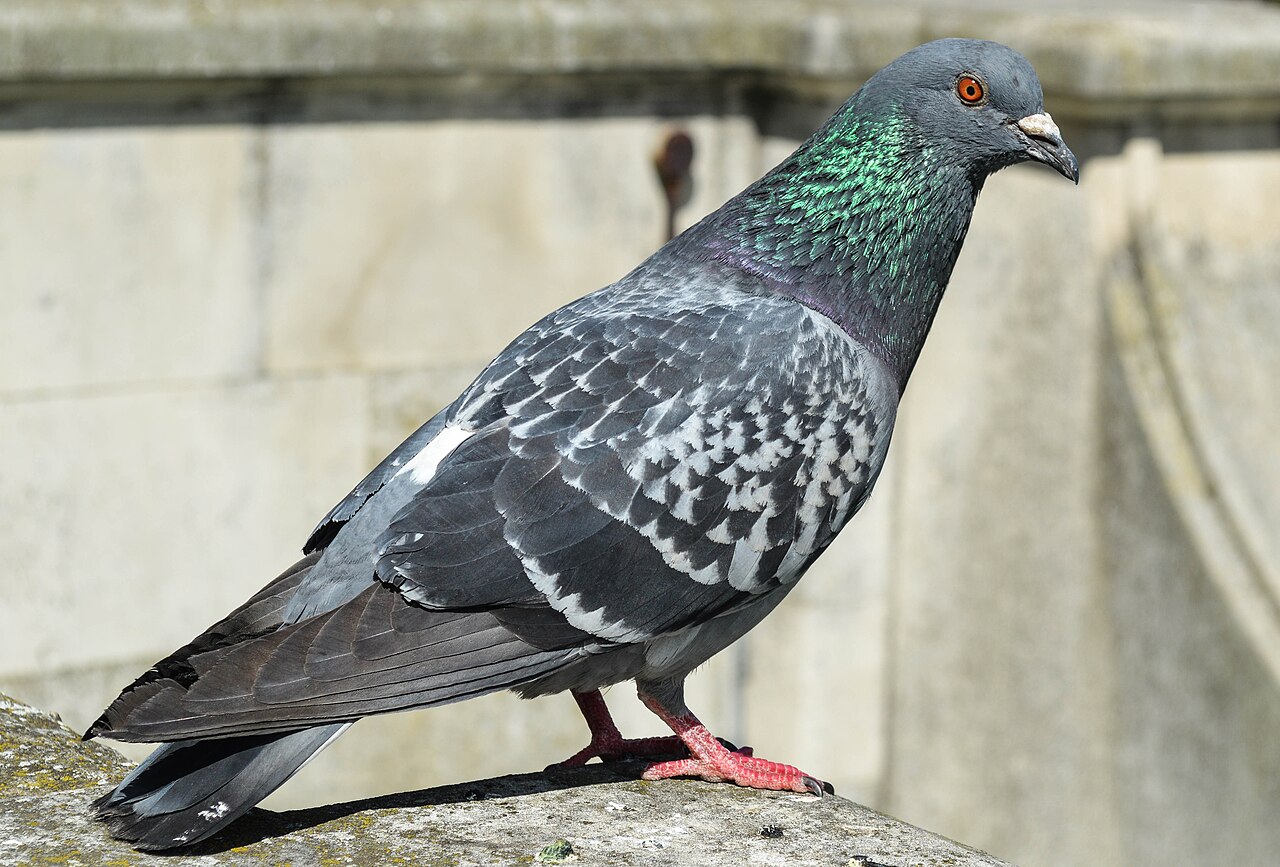
The rock pigeon, Columba livia, produces a low-frequency rolling coo that sits well below most songbird calls. Transcriptions vary, with oo-roo-coo and coo-roo-coo-coo both in common use, and the sound has a throaty, slightly gargling quality that distinguishes it from the clean mournful notes of a mourning dove.
Pigeons have a syrinx like other birds but use it in a much simpler way, producing sustained low tones rather than the rapid frequency modulation that gives songbirds their complexity. Air passes through while the bird holds the bill closed and inflates the throat, which is why a cooing pigeon looks like it is swallowing.
Volume is moderate but the low frequency carries through walls and windows unusually well, which is why a single pigeon on a ledge can be audible inside an apartment when a much louder songbird outside is not. The same physics gives large birds their long-distance reach.
The Perch Coo and the Bow Coo
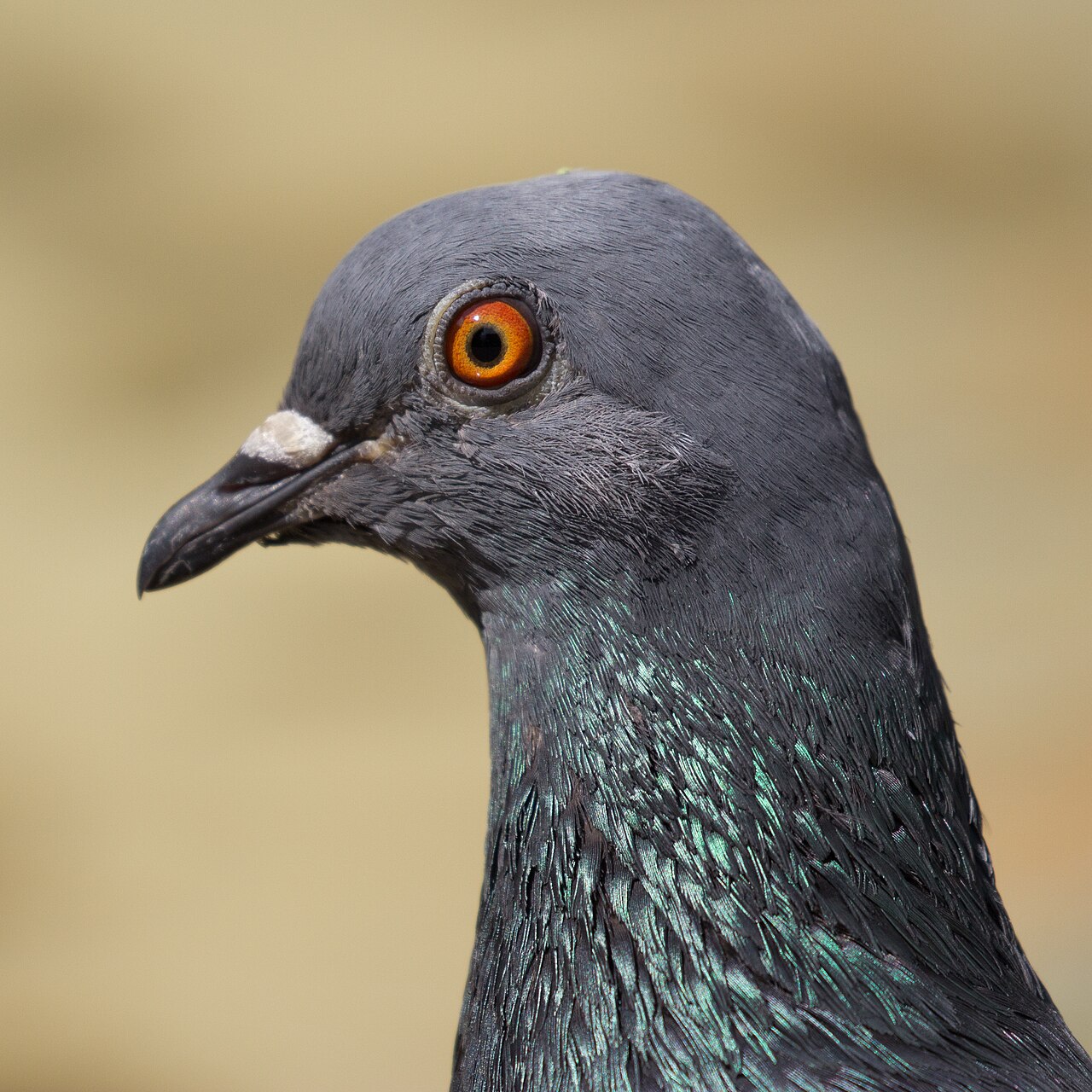
The perch coo is the advertising call. A male stands in an elevated position and repeats a long, even oo-roo-coo for minutes at a time, which functions to attract an unpaired female and to signal that he holds a site. It is the sound most people mean when they say pigeon noise.
The bow coo is the courtship display and looks as distinctive as it sounds. The male inflates the throat, lowers the head, fans the tail, and rotates in a tight circle while producing a deeper, more emphatic coo, often pursuing the female across a ledge. It is delivered at close range and is considerably more forceful than the perch coo.
Both are almost entirely male behaviours. Females do coo, particularly at the nest and in response to a mate, but they do it more quietly, less often, and without the display component. Anyone watching a group of pigeons on a building can identify the males within a minute by who is bowing and turning.
The Nest Call and How a Pair Forms
Once a male has chosen a nest site, usually a sheltered ledge, a beam, or a gap in a structure, he sits in it and gives a distinct nest call, a softer, more urgent coo, sometimes accompanied by wing twitching. The function is to bring a female to inspect the location.
If she accepts, the pair bond forms and is typically long-term, with rock pigeons frequently staying together for years and raising multiple broods a season. Both sexes incubate, both produce crop milk, and both feed the young, which is unusual among birds and is one of the reasons pigeons breed so successfully in cities.
Crop milk is worth noting because it explains the breeding schedule. Both parents produce a nutrient-rich secretion from the crop lining, so pigeons are not dependent on seasonal insect abundance the way most songbirds are. Given reliable food and shelter they will nest in any month, which is why urban populations grow so fast.
A pair typically raises two young per brood and can attempt six or more broods in a year under good urban conditions. The second clutch is often laid while the first pair of squabs is still in the nest, so a single ledge can hold overlapping generations. That overlap is part of why cooing from an established site rarely stops for long.
Alarm Calls and Wing Claps
The alarm sound is a short, harsh grunt, quite unlike the coo, given when a bird is startled at close range. It is often missed entirely because the wing clap that accompanies takeoff is far louder and grabs attention first.
The wing clap is mechanical rather than vocal, produced when the wings strike together above the back during a sharp takeoff. It functions as an alarm signal to the rest of the flock and is loud enough to be the main sound a person notices when a group of pigeons flushes from a pavement.
Males also use a slower, deliberate wing clap in display flight, climbing with exaggerated slow wingbeats that clap audibly, then gliding with the wings held in a shallow V. This is a courtship and territorial display rather than an alarm, and it is one of the more elegant things a feral pigeon does.
Squab Sounds
Young pigeons are called squabs, and they sound nothing like adults. Nestlings produce a wheezing, hissing, rasping noise when begging, which people who find a nest in a roof space or on a balcony frequently describe as sounding like a snake or an air leak rather than a bird.
The hiss also serves defensively. A squab approached in the nest will hiss and strike with a wing, and in a dark cavity the combination is convincing enough to deter some predators. Adults do not use this sound at all.
Squabs stay in the nest for roughly 25 to 32 days, considerably longer than most similarly sized birds, and they leave close to adult size. This is why people almost never see a small fledgling pigeon and why the persistent urban myth that nobody ever sees a baby pigeon exists. Our guide to the baby mourning dove covers the same pattern in a related species.
Pigeon Sounds vs Dove Sounds
Rock pigeons and mourning doves belong to the same family and both coo, but the calls separate easily by ear. A mourning dove produces a clean, mournful, evenly spaced coo-OO-oo-oo-oo with a plaintive quality that many people mistake for an owl the first time they hear it.
A rock pigeon coo is throatier, rougher, and more rolling, with a gargling texture that a mourning dove never produces. It also comes in longer unbroken sequences, while a mourning dove typically gives a short phrase and pauses. Our guide to mourning dove sounds covers the dove side in full.
Flight sound separates them too. Mourning doves produce a distinctive whistling from the wings on takeoff and landing, generated by air through modified outer primaries, while rock pigeons produce a clap rather than a whistle. Hearing whistle versus clap identifies the bird without a view. Our guide to types of doves covers the wider family.
Why Pigeons Are Noisy Where You Live
Cooing concentrated at one spot almost always means a nest site rather than casual perching. Air conditioning units, balcony corners, roof voids, bridge beams, and window ledges all provide the sheltered flat surface pigeons look for, and a male will advertise from that spot persistently once he has claimed it.
Timing tells you what is happening. Sustained cooing through the morning is advertising, and it will continue for weeks. Wheezing and hissing means squabs are already present, which changes the situation considerably since nests with eggs or young are protected in many jurisdictions and cannot simply be removed.
Exclusion is the only durable answer, and it means physically closing the space with mesh, bird spikes on ledges, or netting, done outside the breeding attempt. Feeding is the underlying driver of density, and reducing food access across a neighbourhood does more than any individual deterrent. Our guide to dove symbolism covers the cultural side of a bird that people alternately feed and evict.
Do Pigeons Recognise You?
Yes, and the research is solid. Studies in Paris and elsewhere found that feral pigeons distinguish between individual humans who had previously fed them and those who had chased them away, and they continued to avoid the hostile individual even when both people wore identical clothing.
Pigeons have also been trained in laboratory settings to distinguish paintings by different artists, to recognise letters of the alphabet, and to identify themselves in mirrors under some testing protocols. Their visual discrimination is genuinely impressive and has made them a standard subject in animal cognition research, alongside the corvids covered in our list of the smartest birds.
This matters practically for anyone trying to move pigeons off a property. Birds that have learned a location is safe and productive are difficult to discourage, and inconsistent deterrence teaches them which conditions are safe rather than driving them away. Consistency matters more than intensity.
It also explains why feeding creates lasting problems for neighbours rather than just for the feeder. Birds that learn a block supplies food return to it for years and nest nearby, and the effect persists well after the person feeding them stops. Any serious attempt to reduce numbers has to address food access across the whole area rather than one building.
Frequently Asked Questions
What is the sound a pigeon makes called?
Cooing, and the verb is to coo. Rock pigeons produce a low rolling oo-roo-coo with a throaty gargling quality. They also make two non-vocal sounds: a sharp wing clap on takeoff and a hissing wheeze from nestlings.
Why are pigeons making noise?
Sustained cooing from one spot is almost always a male advertising a nest site to attract a female. It continues for weeks and intensifies in spring, though rock pigeons breed year round where food is reliable. Wheezing or hissing means squabs are already in the nest.
What does a female pigeon sound like?
Similar but much quieter and far less frequent. Females coo mainly at the nest and in response to a mate, without the bowing and circling display that accompanies male calling. In a group of pigeons, the birds bowing and turning while cooing are males.
What sounds do pigeons make?
Five main ones: the perch coo used for advertising, the bow coo given during courtship display, a softer nest call from a chosen site, a short harsh alarm grunt, and the hissing wheeze of nestlings. The wing clap on takeoff is mechanical rather than vocal.
How is a pigeon coo different from a dove coo?
A rock pigeon coo is throatier, rougher, and more rolling, delivered in long unbroken sequences. A mourning dove coo is cleaner, more mournful, and given as a short phrase followed by a pause. Doves also whistle with their wings on takeoff while pigeons clap.
Why do you never see baby pigeons?
Because squabs stay in the nest for 25 to 32 days and leave at close to adult size. Nests are also tucked into ledges, roof voids, and structural gaps that are out of sight. By the time a young pigeon is visible in public it looks essentially like an adult.
Do pigeons recognise people?
Yes. Studies of feral pigeons found they distinguish between individual humans who fed them and those who chased them, and they continue avoiding the hostile individual even when both wear identical clothing. Their visual discrimination is strong enough that they are a standard subject in cognition research.