Moose Poop: What It Looks Like and How to Identify It
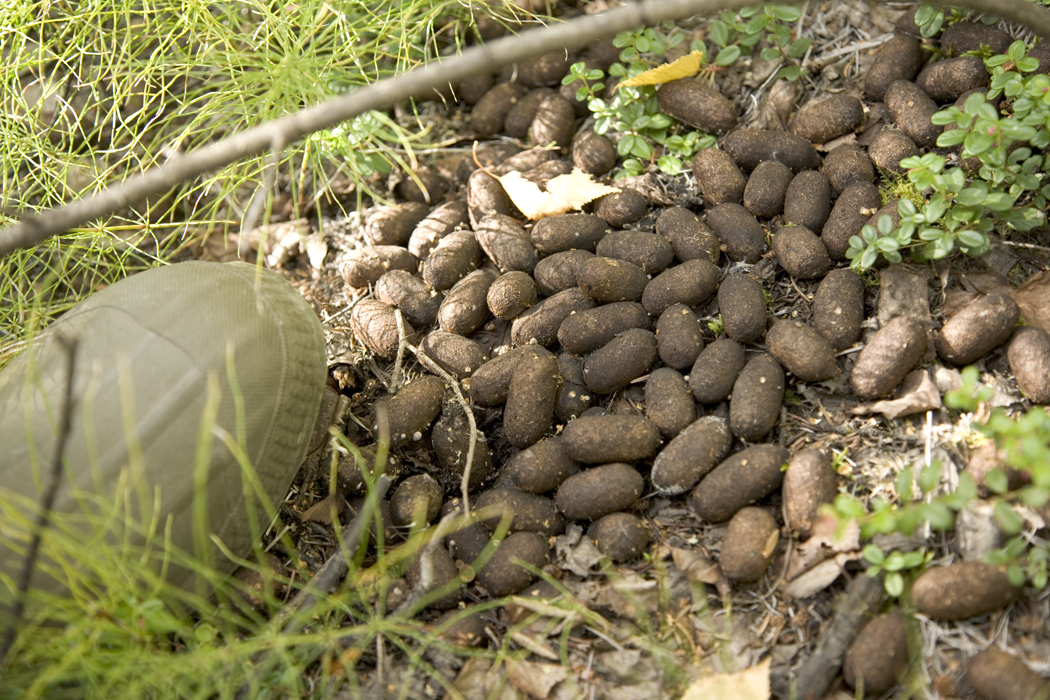
Moose poop looks like a pile of large oval pellets in winter, each roughly one to one and a half inches long, and like a loose brown patty in summer. That seasonal split is the single most important thing to know about moose droppings, because the two forms look like they came from different animals entirely. Winter pellets are dry, fibrous, and light brown, produced on a diet of woody twigs and bark. Summer scat is soft, dark, and formless, produced on lush aquatic plants and new leaves that carry far more water.
Moose poop is also the largest deer-family dropping in North America, which is the main way to separate it from elk and deer. A single moose defecates 10 to 20 times a day and can produce several pounds of pellets daily, so a fresh pile is substantial and hard to miss. This guide covers what moose droppings look like in each season, how to tell them from elk, deer, and bear scat, how to judge how fresh they are, what they mean about moose in the area, and the strange world of moose poop souvenirs.
Moose poop is a pile of large oval pellets in winter, about 1 to 1.5 inches long each, dry and light brown from a diet of twigs and bark. In summer it forms a soft dark patty because aquatic plants and green leaves carry much more water. Moose pellets are the largest of any North American deer, noticeably bigger than elk or deer droppings.
| Feature | Moose Poop |
|---|---|
| Winter form | Oval pellets, 1 to 1.5 in long |
| Summer form | Soft dark patty, cowlike |
| Pile size | Large; several pounds per day |
| Color | Light brown in winter, dark brown to black in summer |
| Compared with elk | Moose pellets clearly larger |
| Compared with deer | Roughly twice the size |
| Smell | Mild and woody, not foul |
What Does Moose Poop Look Like?
Moose poop in winter is a scattered pile of oval or acorn-shaped pellets, each about one to one and a half inches long and three quarters of an inch across, light to medium brown, dry, and visibly fibrous. A single deposit contains dozens to well over a hundred pellets spread across a few square feet, and the individual pellets often have a slight point at one end and a dimple at the other. Broken open, they are packed with pale wood fibers.
Summer droppings look completely different. From late spring through early autumn, moose feed heavily on aquatic vegetation, willow and birch leaves, and forbs, all of which have high water content, and the result is a soft, dark, loosely formed patty that resembles cow manure. It may hold a vague pellet structure at the edges or none at all. The transition happens gradually as the diet shifts, so late spring and early autumn droppings are often clumped pellets stuck together in a mass.
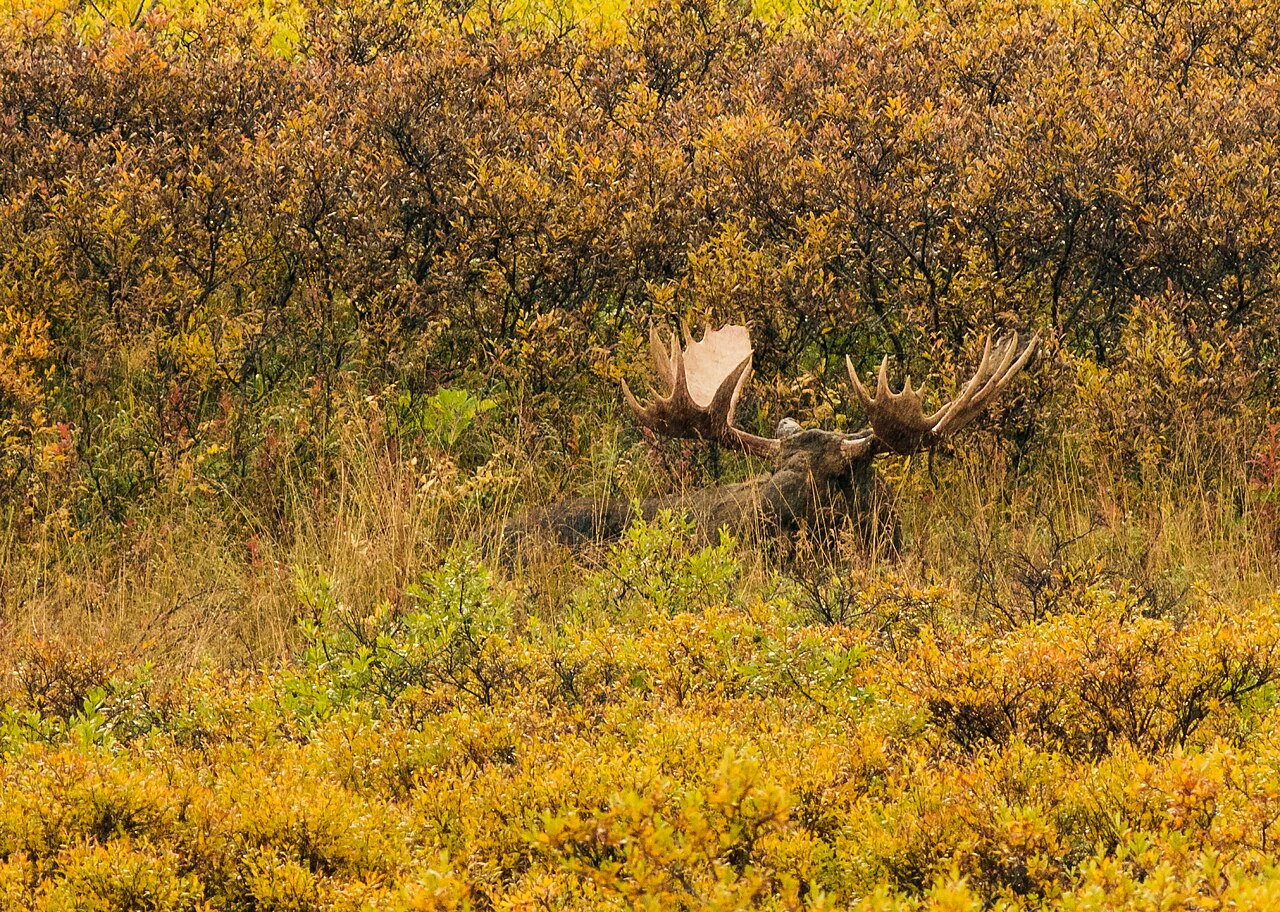
Size is the constant across both forms. Moose are the largest members of the deer family, with bulls weighing 1,000 to 1,600 pounds in North America, and the droppings scale accordingly. A moose passes several pounds of waste per day across 10 to 20 separate deposits, which is why sign accumulates quickly in a wintering area. Where moose concentrate in a willow flat or a conifer stand, the ground can be covered in pellets.
Moose Poop vs Elk Poop vs Deer Poop
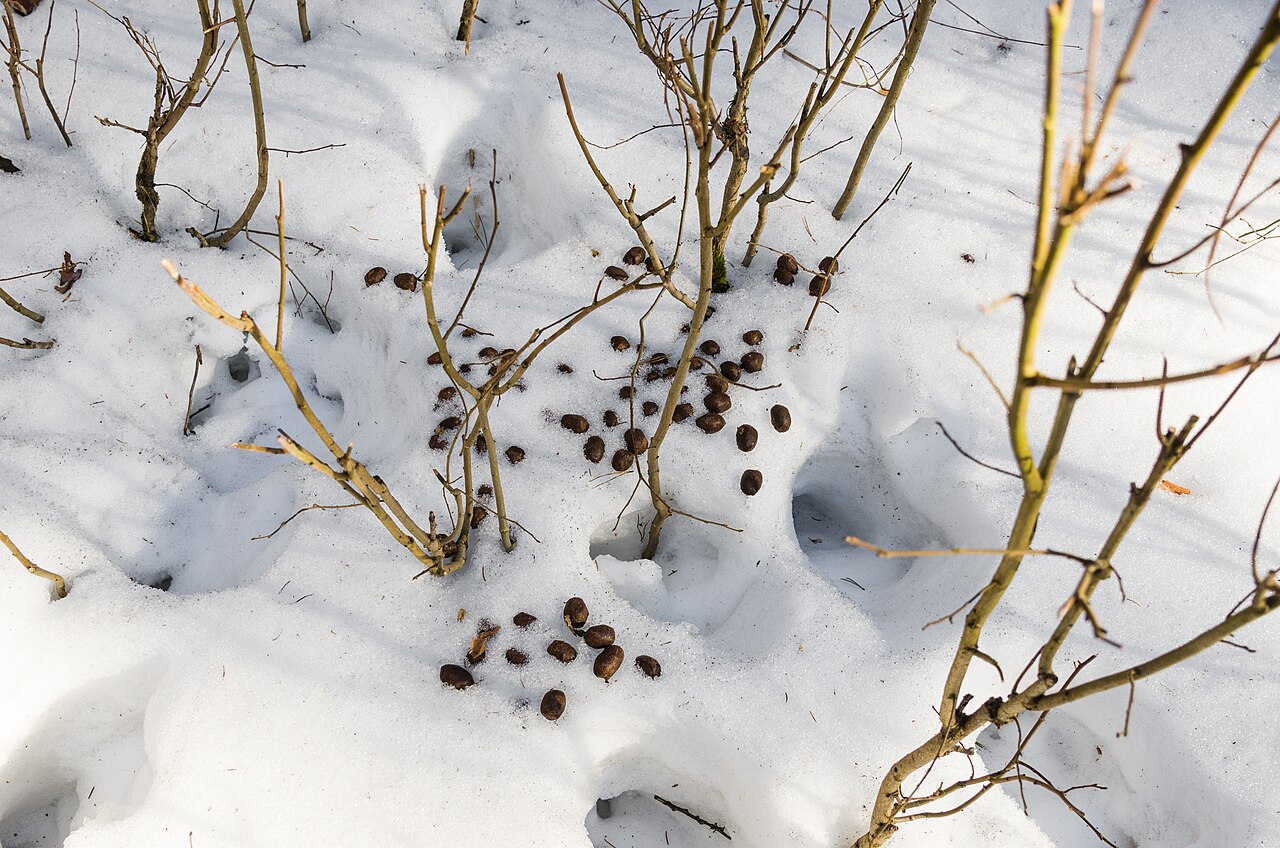
Moose, elk, and deer all produce oval pellets in winter, and the difference is size. Moose pellets are the largest, generally one to one and a half inches long. Elk pellets are smaller, roughly half to three quarters of an inch, and often more rounded with a distinct dimple on one end. White-tailed and mule deer pellets are smallest, about half an inch and typically more uniformly rounded or slightly elongated. Set side by side the difference is obvious; in isolation, a ruler or a coin for scale settles it.
Pile size and pellet count help too. A moose deposit contains many more pellets in a larger scatter than a deer deposit, simply because the animal is four to six times heavier. Elk fall in between and often defecate while moving, producing a strung-out line of pellets rather than a tight pile. All three species produce soft summer patties, and at that time of year the three become genuinely difficult to separate, though moose patties remain the largest.
Habitat is a strong secondary clue in most places. Moose favor wet willow and alder flats, beaver ponds, lake margins, and young conifer regrowth, and in summer they spend hours feeding in water. Elk use open meadows, grasslands, and forest edges, often in herds so their sign is concentrated. Deer are the most widely distributed and turn up everywhere including suburbs. The deer poop guide covers whitetail droppings in detail, and the deer poop vs rabbit poop comparison handles the smaller end of the size range.
How to Tell Moose Poop From Bear Poop
Moose summer patties and black bear scat are the most commonly confused pair in northern country, and the difference is in the content. Moose droppings are uniformly fibrous plant material with no seeds, no insect parts, no hair, and no bones, and they smell mildly of fermented vegetation, much like cow manure. Bear scat is packed with recognizable items: whole berries, fruit skins, nut shell fragments, grass, insect parts, and sometimes hair or bone.
Shape helps as a second check. Bear droppings are often tubular with blunt ends, one and a half to two and a half inches in diameter, even when loose. Moose patties spread flat on impact and rarely hold a tubular form. In winter the question does not arise, since bears are denning and moose are producing distinctive pellets. The Alaska Department of Fish and Game (adfg.alaska.gov) publishes a field comparison of moose and bear sign precisely because the summer confusion is so common.
Getting this right matters for safety rather than curiosity. Mistaking bear sign for moose sign means missing a warning that a bear is using the area. Mistaking moose sign for bear sign causes unnecessary alarm, though moose deserve respect in their own right: they injure more people in Alaska each year than bears do, particularly cows with calves in spring and bulls during the September and October rut. The bear poop guide covers bear scat identification across the seasons.
How Fresh Is the Moose Poop You Found?
Fresh moose pellets are dark, moist, and slightly shiny, and they may still be warm on a cold morning, which means the animal passed within the last hour or two. Over a day or so the surface dulls and lightens, and after several days in dry conditions the pellets turn pale brown and become hard. Weathered pellets that are gray, bleached, and crumbling under pressure are weeks to months old, and in cold dry climates pellets can persist recognizably for a year or more.
Summer patties change faster. A fresh patty is glossy and dark with a wet surface, and within a day it develops a dried crust while remaining soft underneath. Flies arrive within minutes in warm weather, so a patty with no insect activity in summer is very fresh. Rain destroys summer droppings quickly, which is why summer sign gives a much shorter window of information than winter pellets.
What the sign means depends on how much of it there is. A single old pile means a moose walked through at some point. Many piles of varying ages in a small area, combined with browsed willow tips cut at a clean 45-degree angle and tracks in soft ground, indicates a wintering area or a regularly used feeding site. Moose tracks are unmistakable: cloven and very large, five to seven inches long, far bigger than any deer track and more pointed than an elk’s.
What Does Moose Poop Tell You About Their Diet?
Moose droppings are a direct record of an extreme seasonal diet shift. In winter, moose survive almost entirely on woody browse: the twigs, buds, and bark of willow, birch, aspen, and balsam fir, food so poor in nutrition that moose typically lose weight through the season no matter how much they eat. An adult moose consumes 40 to 60 pounds of this material daily, and the fibrous pellets are what remains after a ruminant digestive system has extracted what it can.
Summer transforms both diet and droppings. Moose feed heavily on aquatic plants such as pondweed and water lilies, wading and even fully submerging to reach them, and these plants are rich in sodium, which moose need and cannot get from winter browse. A moose may eat 60 pounds of vegetation a day in summer, and the high water content produces the loose patties. This is also when moose build the fat reserves that carry them through winter.
The name itself reflects the diet. Moose comes from an Algonquian word usually translated as twig eater or bark stripper, which describes their winter feeding precisely. The word for the same animal in Europe is elk, which causes endless confusion with the North American elk, a different species entirely. The guide to what moose eat covers the full seasonal diet and how it drives their movements.
Why Is Moose Poop Used in Souvenirs?
Moose poop souvenirs are a genuine cottage industry across Alaska, Maine, New Hampshire, and Canada, and they exist because winter moose pellets are exceptionally well suited to the purpose. The pellets are made almost entirely of dried, digested wood fiber, they are essentially odorless once dried, they hold their shape, and they take varnish well. Vendors clean, dry, sterilize, and coat them, then turn them into earrings, keychains, swizzle sticks, clock faces, and novelty candy packaging.
The most famous product is probably moose poop earrings, sold in gift shops throughout northern New England, and there is a long-running tradition of moose dropping festivals, including the Talkeetna Moose Dropping Festival in Alaska, which for decades held a raffle in which numbered pellets were dropped from a height and prizes awarded based on where they landed. The festival ended its dropping event in 2009 but the name endures.
Products called moose poop candy or moose droppings are almost always chocolate, and the naming is a joke rather than a description. The actual dried pellets used in jewelry are sealed and are not a health concern once treated, though pellets found in the field should still be handled with normal precautions and not brought home unprocessed. Moose can carry parasites including the giant liver fluke and brainworm, and their droppings can harbor E. coli like any large herbivore’s.
Is Moose Poop Dangerous?
Moose poop poses a low risk to humans, comparable to cow manure, but it should be handled with basic precautions. Like any large herbivore, moose can shed E. coli and other bacteria in their feces, and moose droppings can contain parasite eggs including those of the meningeal worm and various nematodes. None of these commonly affect people, and there is no airborne risk of the kind that makes bat poop and rodent droppings genuinely hazardous.
The practical precautions are simple. Do not handle droppings with bare hands, wash hands afterward, and avoid contaminating drinking water. Backcountry travelers should filter or treat surface water in moose country as a matter of course, since heavy use of ponds and streams by moose adds to the fecal load along with beaver and other wildlife. Giardia is the more relevant waterborne concern in these areas.
Dogs are the practical problem more often than people. Dogs will eat moose pellets given the chance, and while this rarely causes serious illness, it can transmit intestinal parasites and cause digestive upset. In areas where moose winter heavily, pellet density can be extremely high, so keeping a dog leashed on trails in those areas is worthwhile for that reason as well as for avoiding a confrontation with the moose itself.
What Moose Sign Tells Researchers
Pellet counts are a standard method for estimating moose populations, and they are used across Scandinavia, Canada, and the northern United States. Because moose defecate a predictable number of times per day, biologists can survey pellet groups along fixed transects, apply a decay rate for the local climate, and derive an index of how many moose used an area over a season. The method is cheap compared with aerial surveys and works in dense forest where aircraft cannot see the animals.
Droppings also yield DNA. Cells shed from the intestinal lining allow researchers to identify individual moose, determine sex, and assess genetic diversity in isolated populations, all without capturing or disturbing an animal. In places where moose populations have declined sharply, including Minnesota and parts of New England, this non-invasive sampling has become an important monitoring tool.
Parasite loads show up in droppings too, which matters because parasites are central to recent moose declines. Winter ticks, which can infest a single moose with tens of thousands of individuals and cause fatal blood loss and hair loss in calves, and the brainworm carried harmlessly by white-tailed deer but fatal to moose, are both tracked partly through fecal analysis. Warming winters have increased tick survival, and expanding deer range has increased brainworm exposure, making moose scat a window onto a population under real pressure.
Frequently Asked Questions
What does moose poop look like?
In winter, moose poop is a pile of large oval pellets about 1 to 1.5 inches long, dry, fibrous, and light brown. In summer it forms a soft dark patty resembling cow manure, because aquatic plants and green leaves contain far more water than woody browse.
What is the difference between moose scat and deer scat?
Size, mainly. Moose pellets are roughly twice the length of deer pellets and appear in much larger piles, since a moose weighs four to six times more than a deer. Elk pellets fall between the two.
How can you tell moose poop from bear poop?
Moose droppings are uniformly fibrous plant material with no seeds, hair, or insect parts. Bear scat contains visible berries, nut shells, grass, insect fragments, and sometimes hair or bone, and it holds a tubular shape more often than moose patties do.
How big is moose poop?
Individual winter pellets are about 1 to 1.5 inches long and three quarters of an inch across. A single deposit can contain over a hundred pellets, and a moose produces several pounds of droppings daily across 10 to 20 deposits.
Why is moose poop different in summer?
Because the diet changes completely. Winter browse is dry twigs and bark, producing firm fibrous pellets. Summer food is aquatic plants and green leaves with high water content, producing loose patties. The change happens gradually in spring and autumn.
Is moose poop dangerous?
The risk is low, comparable to cow manure. Wear gloves or avoid handling it, wash your hands, and filter backcountry water in moose country. There is no airborne hazard as there is with bat or rodent droppings.
Is moose poop really used for jewelry?
Yes. Dried winter pellets are almost entirely digested wood fiber, odorless once dried, and hold their shape well, so they are cleaned, sterilized, varnished, and sold as earrings, keychains, and novelty items across Alaska, Maine, and Canada.