Ladybug Life Cycle: All Four Stages Explained
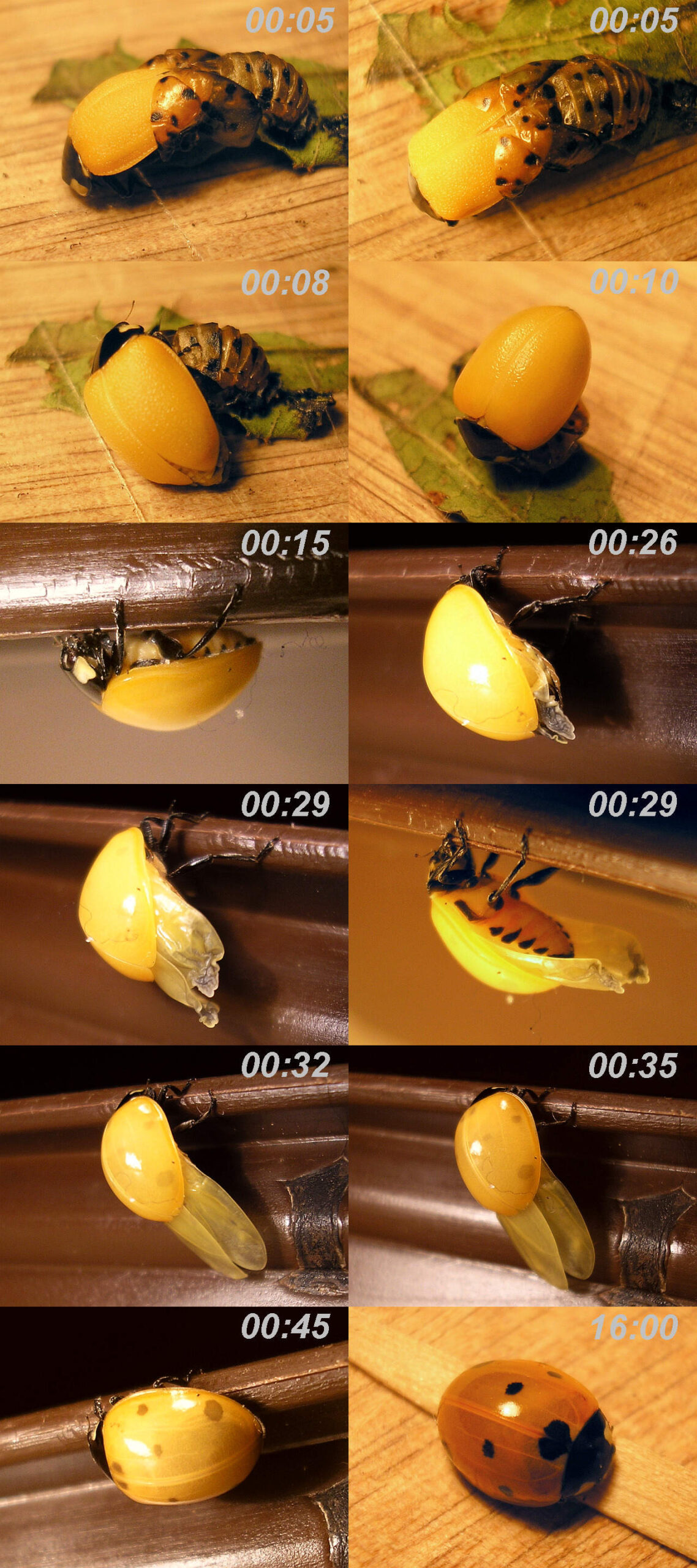
The ladybug life cycle runs through four stages, egg, larva, pupa, and adult, and takes about four to eight weeks from egg to adult depending on temperature and food supply. Eggs hatch in three to five days, the larva feeds and moults four times over one to three weeks, the pupa is stationary for five to seven days, and the emerging adult is pale yellow before its spots and red colour develop over the following hours.
The larva is where most people get lost. It looks nothing like a ladybug, resembling a tiny black and orange alligator, and it is killed as a pest in gardens routinely by people who are actively trying to attract ladybugs. A single larva eats hundreds of aphids before pupating, considerably more than the adult does. This guide covers each stage, timing, lifespan, and how to recognise all four.
The ladybug life cycle has four stages: egg, larva, pupa, and adult, taking four to eight weeks in total. Eggs hatch in three to five days, larvae feed for one to three weeks through four moults, and the pupa takes five to seven days. Adults live several weeks to a year, with overwintering generations living longest.
| Stage | Duration and Appearance |
|---|---|
| Egg | 3 to 5 days; yellow-orange, upright clusters |
| Larva 1st to 4th instar | 1 to 3 weeks; black and orange, spiky |
| Pupa | 5 to 7 days; orange-black, attached to leaf |
| New adult | Pale yellow, spots appear over hours |
| Adult lifespan | Weeks to about a year |
| Generations per year | 1 to 6, depending on climate |
| Aphids eaten | Several hundred as a larva; up to 5,000 in a lifetime |
What Are the Four Stages of a Ladybug?
Ladybugs undergo complete metamorphosis, the same four-stage pattern as butterflies and beetles generally: egg, larva, pupa, adult. Each stage looks entirely different from the others, which is why so few people recognise more than one of them, and the larva in particular bears no resemblance to the insect the name conjures.
The sequence is fixed but the timing is not. Warm weather and abundant aphids compress the whole cycle to about four weeks; cool conditions or scarce prey stretch it toward eight or longer. Development stops below roughly 50 degrees Fahrenheit, which is why the cycle runs during the warm season and pauses over winter.
The number of generations per year depends on climate, from a single generation in cold northern regions to five or six in warm areas with a long season and continuous aphid supply. In most of the United States two to three generations is typical. The ladybug guide covers the species and identification.
Where Do Ladybugs Lay Their Eggs?
On the underside of leaves, directly next to an aphid colony. Females assess prey density before laying, and a cluster of eggs placed on a heavily infested plant means the larvae hatch into food. Eggs on a clean plant would mean starvation, since a first instar larva can barely travel.
Eggs are yellow to orange, spindle-shaped, about one millimetre long, and stood upright in tight clusters of roughly ten to fifty. A female lays several hundred to over a thousand across her life, in batches every few days through the season.
Some of the eggs are never meant to hatch. Females deliberately lay a proportion of infertile eggs among the fertile ones, which the first-hatched larvae eat, buying time before they have to find aphids. Cannibalism of siblings is normal and common in the first hours. The ladybug eggs guide covers identification and what gets mistaken for them.
What Does a Ladybug Larva Look Like?
Like a tiny alligator. Ladybug larvae are elongated, tapering, soft-bodied, and covered in small spines or bumps, coloured black with orange, yellow, or white markings, and they move quickly across leaves with visible legs. They range from about one millimetre at hatching to a centimetre before pupation.
They are far more voracious than adults. A larva eats several hundred aphids over its one to three weeks of feeding, moulting four times as it grows, and the fourth instar accounts for most of that consumption. They also eat scale insects, mites, whitefly, insect eggs, and each other when aphids run short.
This is the stage most often destroyed by gardeners, who see an unfamiliar spiky black creature on an infested plant and assume it is the problem rather than the solution. Learning to recognise a ladybug larva is the single most useful piece of garden insect knowledge there is. The ladybug larvae guide covers the appearance across species in detail.
What Happens During the Pupa Stage?
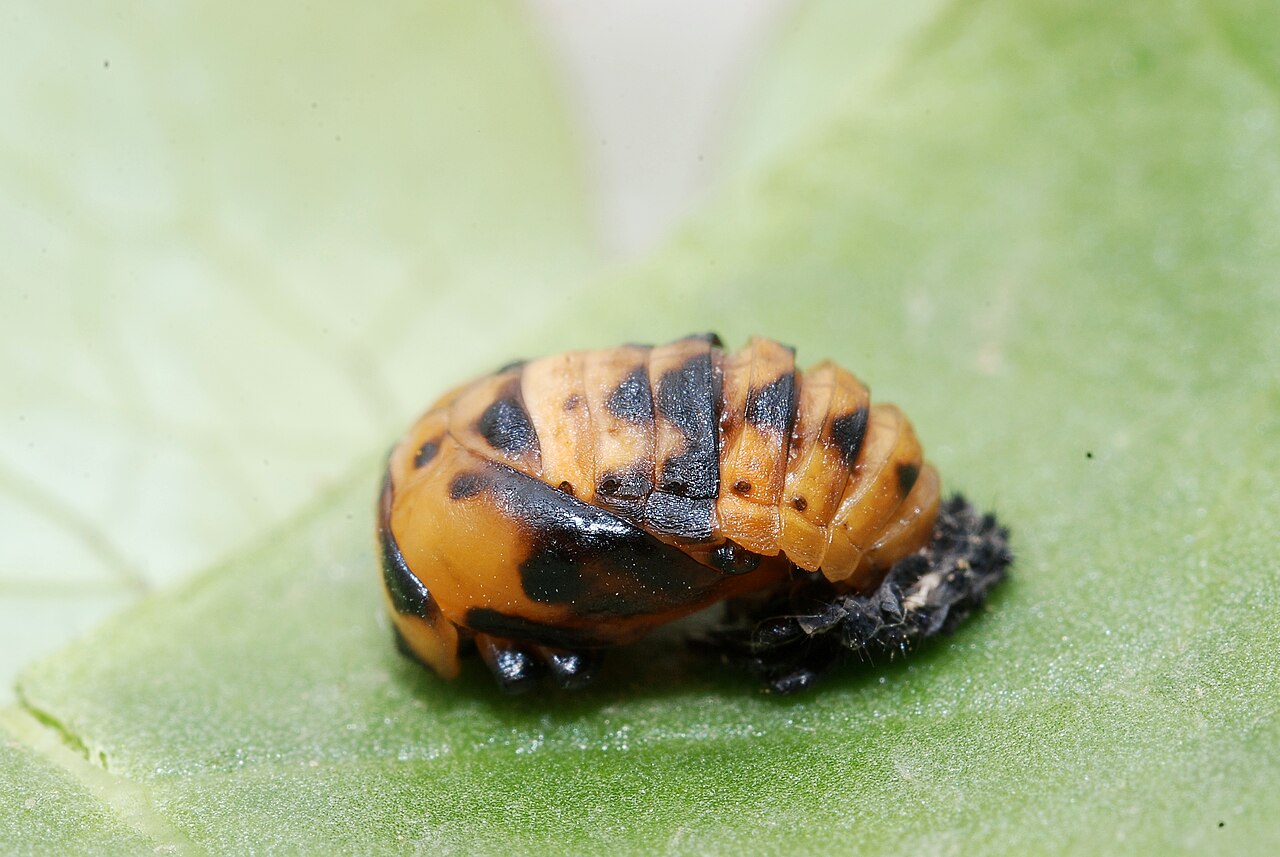
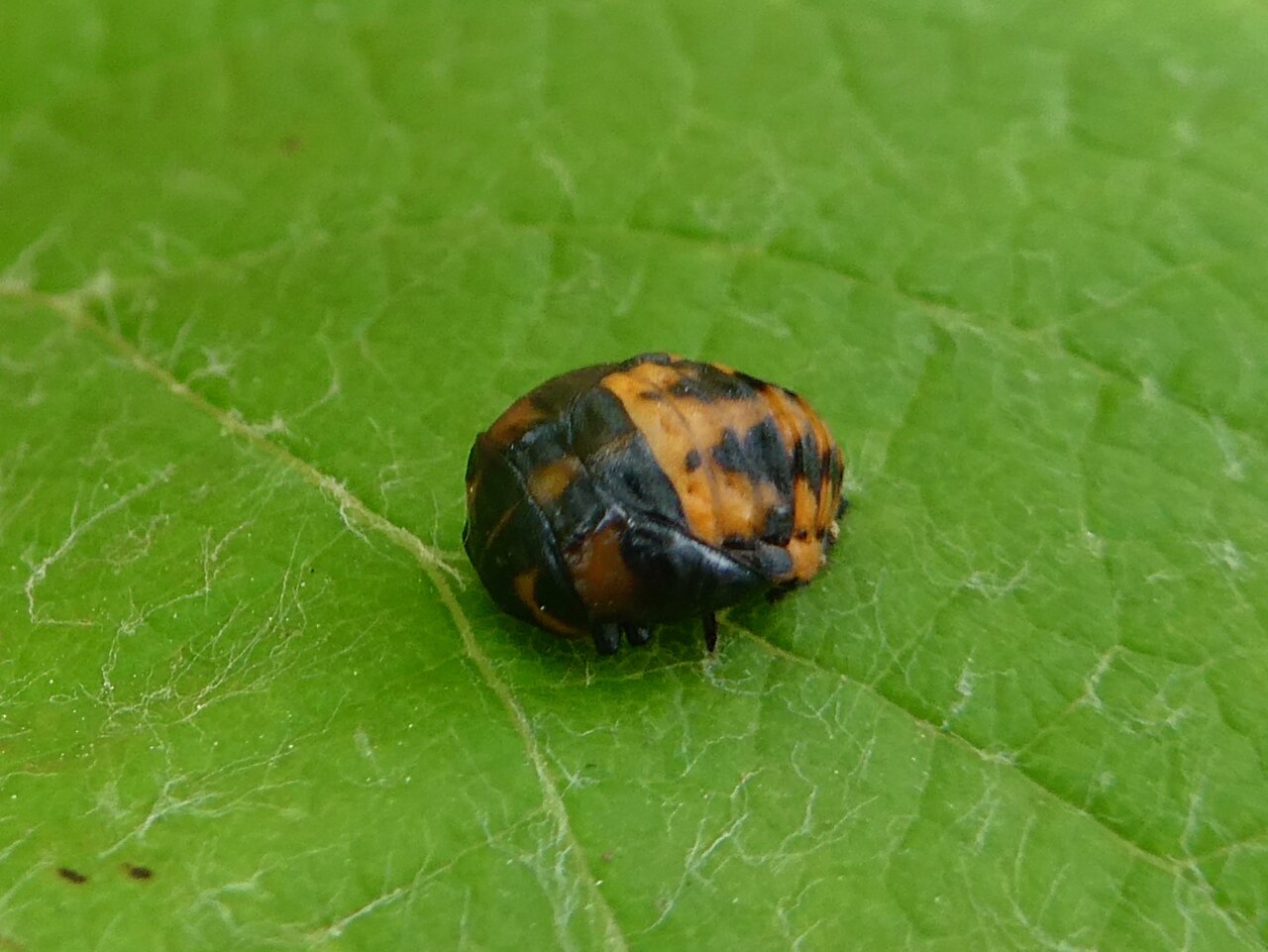
The fourth instar larva attaches its rear end to a leaf, stem, or wall with a sticky pad, curls slightly, and moults one last time into a pupa. The pupa is rounded, humped, and usually orange with black markings, roughly the size of an adult ladybug, and it sits motionless for five to seven days.
Inside, the larval body is broken down and reorganised into the adult. The pupa is not entirely inert: disturbed pupae flick upward on the attachment pad in a sharp jerking motion, which startles small predators and parasitoid wasps, and this is worth watching for since it is the only movement the stage produces.
The larval skin usually stays attached at the base of the pupa, shrivelled and pushed down to the attachment point, which is a useful confirmation when identifying one. After emergence the empty pupal case remains stuck to the leaf, pale and split open along the back, and finding several of them on a plant is good evidence that a population bred there successfully rather than passing through.
Pupae are frequently mistaken for insect eggs, scale insects, or bird droppings and are scraped off plants and walls. They are also parasitised heavily; the wasp Dinocampus coccinellae attacks adult ladybugs and forces them to guard its cocoon, one of the more striking cases of behavioural manipulation in insects.
How Long Is the Ladybug Life Cycle?
About four to eight weeks from egg to adult in typical conditions. The breakdown is roughly three to five days as an egg, one to three weeks as a larva across four instars, and five to seven days as a pupa, with temperature the main variable throughout.
Adult lifespan is separate and much more variable. Ladybugs that emerge early in the season and breed may live only a few weeks, while the generation that emerges in late summer enters diapause, overwinters, and lives close to a year, breeding the following spring before dying.
That overwintering generation is the one people encounter indoors. Ladybugs, and particularly the introduced Asian lady beetle, aggregate in large numbers in sheltered places in autumn, including wall voids, attics, and window frames, and emerge on warm days through winter. They do not breed or feed indoors and are simply waiting out the cold. The ladybug infestation guide covers what to do about them.
Why Is a New Ladybug Pale?
Because the cuticle has not hardened or coloured yet. A ladybug emerging from the pupa is soft, pale yellow or cream, and either spotless or very faintly marked, and it takes several hours to a day or two for the elytra to harden and the pigment to develop into the final red or orange with black spots.
Freshly emerged ladybugs are frequently reported as a different species, or as yellow ladybugs, which is a real thing in its own right but not what a teneral individual is. If a pale ladybug is found next to an empty pupal case, that is the explanation.
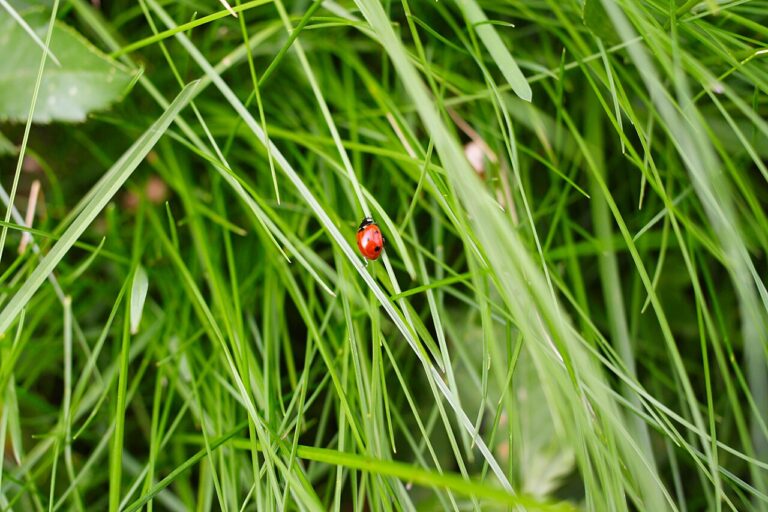
Spot number does not indicate age, which is the most persistent ladybug myth. The number of spots is fixed by species: seven-spot ladybirds have seven, two-spots have two, and the Asian lady beetle ranges from none to twenty-two within a single species. A ladybug never gains a spot. The yellow ladybug guide covers the genuinely yellow species.
How Many Aphids Does a Ladybug Eat?
A single ladybug may eat as many as 5,000 aphids across its life, with the larval stage accounting for a large share of that despite being much shorter. Daily consumption for an adult runs around 50 aphids, and a late-instar larva can exceed that.
Diet is broader than aphids alone. Ladybugs and their larvae take scale insects, mealybugs, mites, whitefly, thrips, psyllids, and the eggs and small larvae of other insects, and some species are specialists on mites or on mildew rather than on aphids at all. A few, including the Mexican bean beetle and the squash beetle, are plant feeders and genuine pests.
This is why buying and releasing ladybugs generally disappoints. Commercially sold convergent lady beetles are usually wild-collected from overwintering aggregations, arrive in a dispersal state, and mostly fly away within a day or two of release. Building habitat that supports a resident population works far better, and university extension programmes such as the University of California IPM (ucanr.edu) advise against purchased releases for that reason. The guide to what ladybugs eat covers the full diet.
How Do You Support the Full Life Cycle in a Garden?
Tolerate some aphids. This is the part people find hardest and it is the whole mechanism: ladybugs need prey to lay eggs near, and a garden kept completely aphid-free supports no ladybug population at all. A modest aphid presence on a few plants sustains the predators that keep everything else in check.
Skip broad-spectrum insecticides entirely, including the ones marketed as natural. Insecticidal soap, neem, and pyrethrin all kill ladybug eggs, larvae, and pupae on contact, and systemic neonicotinoids move into the plant and kill predators feeding on treated aphids for a full season afterward.
Plant for the adults as well. Adult ladybugs supplement their diet with pollen and nectar, and flat open flowers with accessible nectar, including dill, fennel, yarrow, coriander, alyssum, and cosmos, keep them in a garden between aphid outbreaks. Leaf litter and hollow stems left over winter provide the shelter the overwintering generation needs.
Frequently Asked Questions
What are the four stages of a ladybug?
Egg, larva, pupa, and adult. Each looks completely different, and the larva, a spiky black and orange creature resembling a tiny alligator, is the one almost nobody recognises.
How long is the life cycle of a ladybug?
Four to eight weeks from egg to adult: three to five days as an egg, one to three weeks as a larva through four moults, and five to seven days as a pupa. Warmth and aphid supply set the pace.
Where do ladybugs lay their eggs?
On the underside of leaves right next to an aphid colony, in upright clusters of ten to fifty yellow-orange eggs. Some eggs are deliberately infertile and are eaten by the first larvae to hatch.
What does a ladybug larva look like?
Elongated and spiky, black with orange, yellow, or white markings, moving quickly across leaves and resembling a tiny alligator. It eats several hundred aphids before pupating.
How long can a ladybug live?
A few weeks for adults that breed in the same season, or close to a year for the generation that emerges in late summer, overwinters in diapause, and breeds the following spring.
Do spots show a ladybug’s age?
No. Spot number is fixed by species and never changes. A freshly emerged ladybug is pale and faintly marked because the cuticle has not hardened, and it colours up within a day.
How many aphids does a ladybug eat?
Up to about 5,000 over a lifetime, roughly 50 a day as an adult and more during the last larval instar. They also eat scale insects, mites, whitefly, and other insects’ eggs.