Baby Sea Turtle: Hatchlings, Odds, and What Not to Do
A baby sea turtle is called a hatchling, and it emerges from a buried nest weighing around 20 grams with a shell about two inches long, then crawls to the sea within minutes of reaching the surface. Roughly one in a thousand survives to adulthood, and most of those losses happen in the first hours and days.
Nearly everything a hatchling does in its first day is guided by cues people accidentally disrupt. It orients to the brightest, lowest horizon, which is normally the open sea reflecting the sky, and artificial lighting on a developed beach overrides that instantly and sends hatchlings inland to die. This guide covers what hatchlings look like, where they go, why touching them is both illegal and harmful, and what to do if you find one.
A baby sea turtle is called a hatchling. It emerges at about two inches long and 20 grams, usually at night, and crawls to the sea guided by the brightest lowest horizon. Roughly one in a thousand reaches adulthood. Handling them is illegal under the US Endangered Species Act and disrupts the imprinting and energy they need.
| Feature | Sea Turtle Hatchling |
|---|---|
| Name | Hatchling |
| Size at emergence | About 2 in shell; roughly 20 g |
| Eggs per nest | Around 100, varying by species |
| Incubation | 45 to 70 days in the sand |
| Emergence | Usually at night, as a group |
| Sex determination | By nest temperature, not chromosomes |
| Survival to adulthood | Roughly 1 in 1,000 |
What Is a Baby Sea Turtle Called?
A hatchling. The term covers the animal from emergence through its first weeks at sea, after which it becomes a post-hatchling and then a juvenile. There is no separate term equivalent to duckling or fawn.
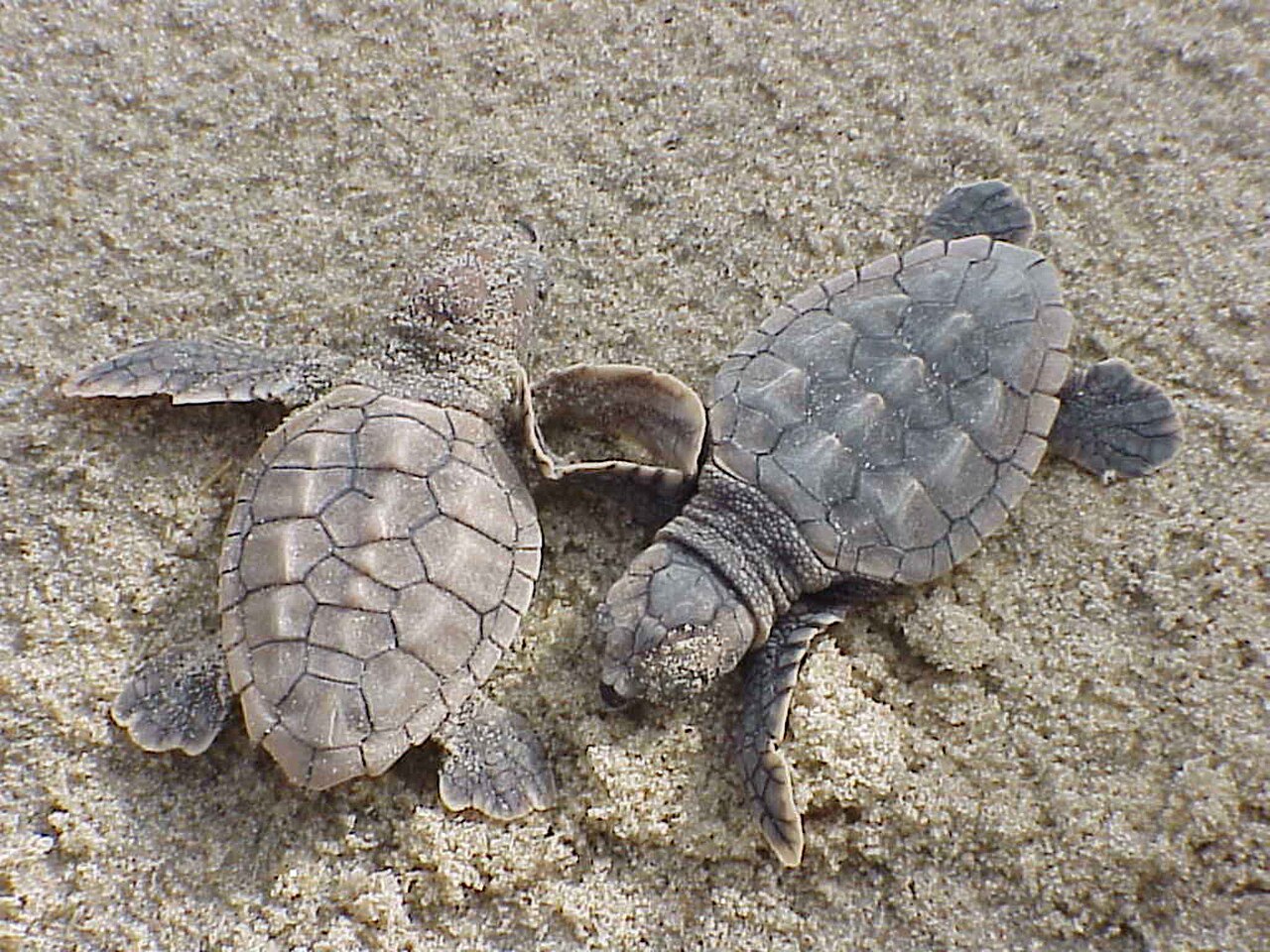
A hatchling looks like a miniature adult with proportionally enormous front flippers and a soft, slightly leathery shell that has not yet hardened. Colours vary by species: loggerheads are reddish brown, green turtles black above with white edges and a white underside, and leatherbacks black with white spotting and pronounced ridges. None of them resemble the baby box turtle people find inland.
Size is consistent across most species at around two inches of shell length and roughly 20 grams, which is about the weight of four teaspoons of sugar. Leatherback hatchlings are slightly larger. From that starting point a leatherback may eventually exceed a thousand pounds. The baby turtle guide covers freshwater hatchlings by comparison.
Where Do Baby Sea Turtles Go After Hatching?
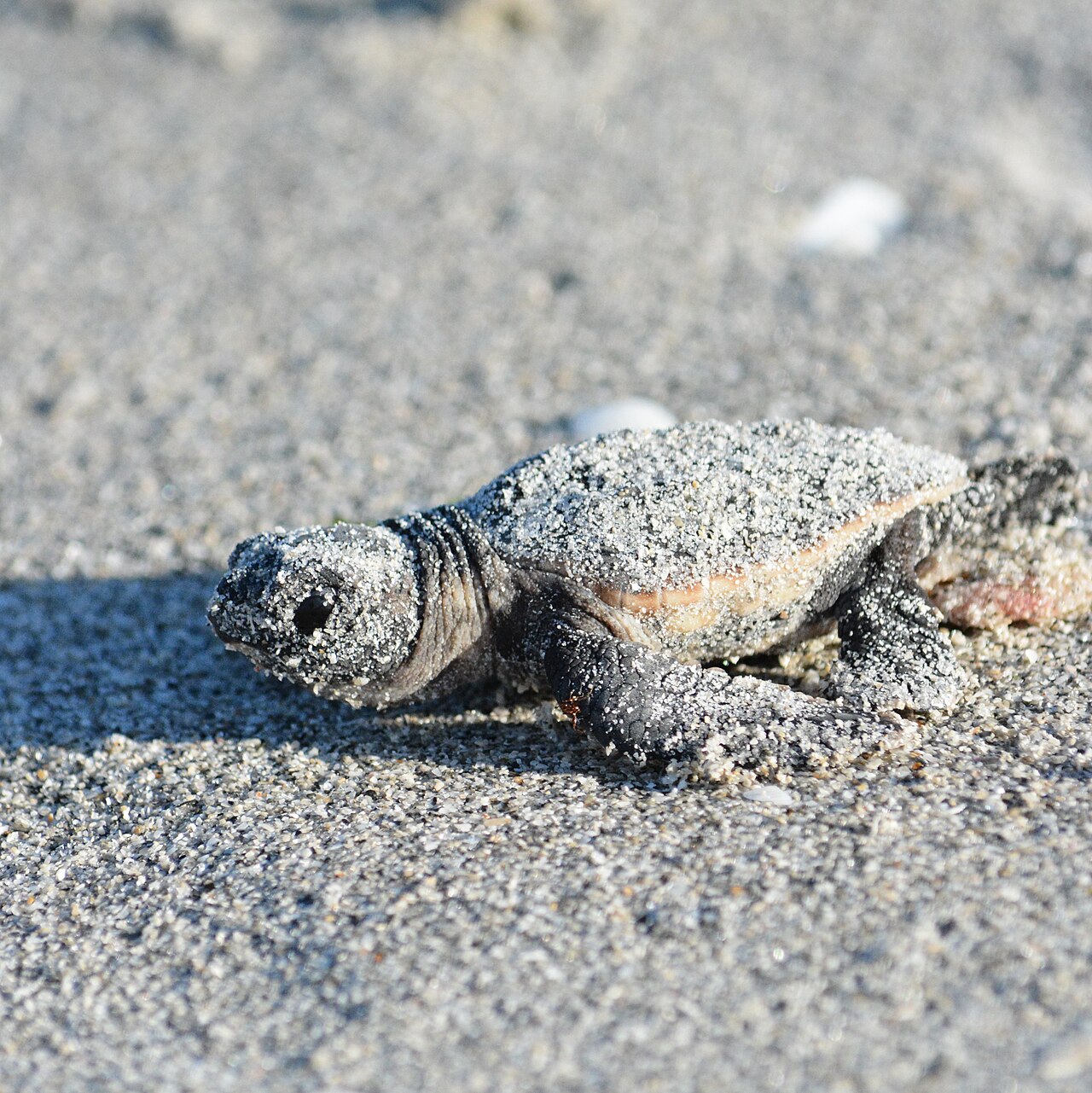
Straight to the sea, then far offshore. Hatchlings emerge from the nest together, usually after dark when sand temperatures drop, crawl to the water, and swim continuously for the first day or more in what is called the swim frenzy, powered entirely by the remaining yolk reserve absorbed before hatching.
The destination is open ocean rather than coastal water. Hatchlings head for offshore currents and gyres and spend years in floating sargassum weed and drift lines, feeding on small invertebrates and sheltering in the mats. This period, historically called the lost years, was almost unobservable until satellite tags became small enough to attach.
Years later, juveniles return to coastal feeding grounds, and adult females eventually return to nest on or near the beach where they hatched, navigating by geomagnetic imprinting acquired as hatchlings. That homing is one of the strongest arguments against moving hatchlings: the crawl down the beach and the first swim are when the imprinting happens.
Why Can’t You Touch Baby Sea Turtles?
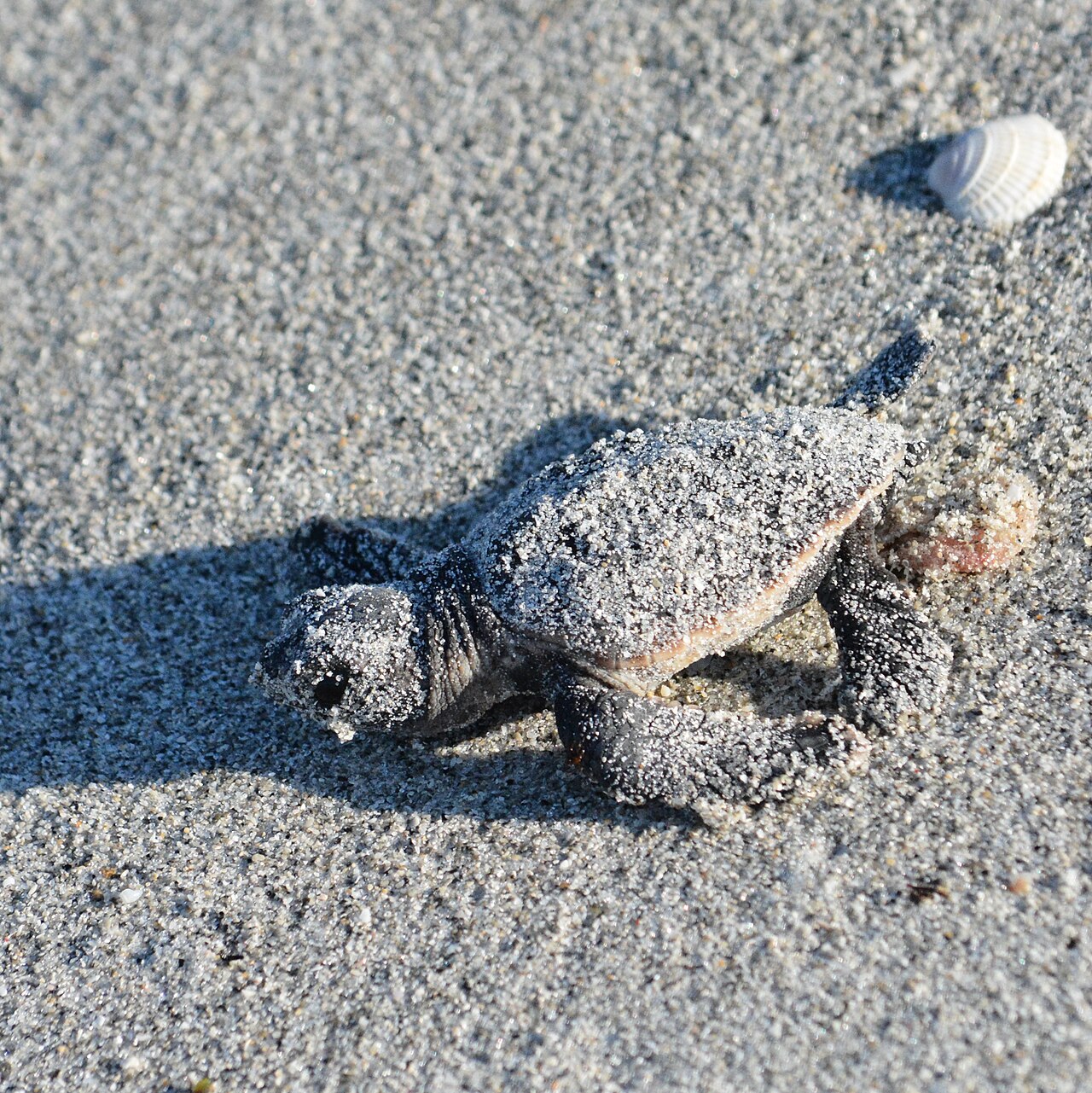
Because it is illegal and because it harms them. All sea turtle species in United States waters are protected under the Endangered Species Act, and handling, disturbing, or interfering with turtles, nests, or hatchlings carries substantial federal penalties. Similar protections exist across most nesting countries.
Biologically, the crawl matters. Hatchlings use it to orient, to imprint on the beach’s magnetic signature, and to build the muscle activation and energy state that drives the swim frenzy. A hatchling carried to the water skips that sequence, and evidence suggests it arrives less prepared for the swim it now has to make.
Energy is finite and non-renewable at that stage. Everything the hatchling has comes from the absorbed yolk, there is no feeding until it reaches the sargassum, and time spent held, photographed, or handled burns reserves it needs. Human scent and bacteria are further concerns. The correct action, in almost every case, is to stand back and let it go. The baby snapping turtle guide covers the same principle for freshwater species.
What Should You Do if You Find One?
Turn off nearby lights and get out of the way. Artificial light is the single largest human threat to hatchlings, and switching off beachfront lighting, closing curtains, and pointing phone screens away does more than any physical intervention. If you must use a light, a red-filtered one disturbs them least.
If a hatchling is heading inland, toward a road, a pool, or a lit building, contact the local sea turtle response hotline or wildlife agency rather than picking it up. Every nesting state and most nesting countries have one, and permitted responders can legally redirect hatchlings. Numbers are posted at beach accesses.
Do not put a hatchling in water, in a bucket, in a car, or in the shade to rest, and do not release it during the day when predators are active and it will overheat. Do not dig into a nest. Keep dogs leashed, remove beach furniture and fill holes at night, since a hole a few inches deep traps a hatchling permanently. NOAA Fisheries (fisheries.noaa.gov) maintains the response contacts.
What Are the Odds of a Baby Sea Turtle Surviving?
Roughly one in a thousand reaches adulthood, and the figure is an estimate rather than a precise measurement, with some sources citing one in a hundred and others one in ten thousand depending on species and region. Whatever the exact number, mortality is extreme and front-loaded.
The beach crawl alone takes a heavy toll. Ghost crabs, raccoons, foxes, coyotes, feral dogs and cats, gulls, herons, frigatebirds, and night herons all take hatchlings between nest and water, and predators learn to patrol nesting beaches during the hatching season.
The nest itself accounts for losses before any of that. Raccoons, foxes, coyotes, feral pigs, ghost crabs, and fire ants raid buried clutches, storm surge and beach erosion wash nests out, and compaction from vehicles kills eggs in place. On many managed beaches, screening nests against predators is the single most effective intervention available and routinely raises the number of hatchlings that reach the sand surface.
The sea is worse in the first hours. Fish, sharks, and seabirds take hatchlings in the surf zone and just beyond, which is why the swim frenzy exists at all: getting through the coastal predator gauntlet fast is the whole point. Survival improves substantially once a hatchling reaches offshore sargassum, and again with each year of growth. The baby alligator snapping turtle guide covers a species with a similar slow-life strategy.
Can You Keep a Baby Sea Turtle as a Pet?
No. It is illegal in the United States and in most countries, since every sea turtle species is protected under the Endangered Species Act and by CITES, and possession, sale, transport, and import all carry serious penalties. The same applies to shells, eggs, and products made from them.
It would also be impossible in practice. Sea turtles need enormous volumes of saltwater, specialised diets, and specific temperature and lighting regimes, and they grow to several hundred pounds, in the case of leatherbacks to over a thousand. Accredited facilities that hold them do so under permit for rehabilitation or research.
Hatchlings sold in markets abroad are almost always illegally taken and rarely survive long. Buying one funds the collection of more and cannot be legally brought home. Anyone who wants to be close to sea turtles should look for a permitted nest-watch or hatchling-release programme run by a licensed organisation.
How Is a Hatchling’s Sex Determined?
By the temperature of the sand during incubation, not by chromosomes. Sea turtles have temperature-dependent sex determination, and the critical window is the middle third of incubation. Warmer nests produce females, cooler nests produce males, and the pivot sits around 29 degrees Celsius in most species.
The rule of thumb used in the field is hot chicks, cool dudes, which is crude but accurate. A few degrees decides it: nests around 27 degrees produce mostly males, around 31 mostly females, and only a narrow band produces a mix. Position within a nest matters too, since the centre runs warmer than the edges.
This makes the species acutely vulnerable to warming. Studies at northern Great Barrier Reef green turtle rookeries have found extreme female bias among recent recruits, well above 99 percent in some samples, and similar skews have been reported elsewhere. Conservation responses include shading nests and relocating clutches to cooler sand, though both are interventions with their own trade-offs.
Why Do Hatchlings Emerge at Night?
Because the sand cooling is the trigger and darkness is the protection. Hatchlings dig upward as a group over several days and wait just below the surface until the sand above them cools, which signals that the sun has set, and then the whole group boils out together within a short window.
Emerging at night avoids lethal daytime sand temperatures, reduces exposure to gulls and other visual predators, and lets the orientation system work. Hatchlings find the sea by moving toward the brightest, lowest horizon, which on a natural beach is the ocean reflecting sky and starlight while the dune behind is dark.
Artificial lighting breaks that completely. Streetlights, hotel windows, parking lots, and even a phone screen create a brighter inland horizon, and hatchlings turn away from the sea and crawl toward roads and buildings, where they are crushed, exhausted, or taken by predators. Lighting ordinances on nesting beaches exist specifically because this is the largest controllable source of hatchling mortality. The baby painted turtle guide covers a freshwater species that uses different cues entirely.
Frequently Asked Questions
What is a baby sea turtle called?
A hatchling. It emerges at about two inches of shell length and 20 grams, looking like a miniature adult with proportionally huge front flippers and a shell that has not yet hardened.
Where do baby sea turtles go after hatching?
Straight to the sea, then offshore into currents and floating sargassum weed, where they spend years in what researchers call the lost years before returning to coastal feeding grounds as juveniles.
Why can’t you touch baby sea turtles?
It is illegal under the Endangered Species Act and it harms them. The crawl to the water is when they orient, imprint on the beach’s magnetic signature, and build up for the swim frenzy.
What should you do if you find a baby sea turtle?
Turn off nearby lights, keep back, and let it crawl. If it is heading inland or toward a road, call the local sea turtle response hotline rather than moving it yourself.
What are the odds of a baby sea turtle surviving?
Roughly one in a thousand reaches adulthood. Most losses happen on the beach crawl and in the first hours at sea, to crabs, raccoons, gulls, fish, and sharks.
Can you keep a baby sea turtle as a pet?
No. All species are protected under the Endangered Species Act and CITES, and possession carries serious penalties. They also grow to hundreds of pounds and need conditions no home can provide.
How is a hatchling’s sex determined?
By nest temperature during the middle third of incubation, not chromosomes. Warmer sand produces females and cooler sand males, with the pivot around 29 degrees Celsius.

Similar Posts
Rat Sounds: What Scratching and Squeaking in Walls Means
Rat sounds decoded: what scratching and gnawing in walls means, why rats are nearly silent vocally, telling rats from mice and squirrels by ear, and whether ultrasonic repellents work.
What Do Giraffes Eat? Diet, Acacias, and Feeding Habits
Giraffes eat about 75 pounds of leaves a day, mostly acacia. Here is how they handle thorns, why they chew bones, and what zoo giraffes are fed.
Clover Mite: Why They Appear and How to Stop Them
Tiny red mites that swarm sunny walls in spring and autumn, do not bite, and stain when crushed. Why vacuuming beats squashing and the one measure that actually works.
Ladybug Larvae: ID, What They Eat, and Why Not to Kill Them
Ladybug larvae look like tiny alligators and eat hundreds of aphids each. Here is how to identify them and tell them from potato beetle larvae.
What Do Scorpions Eat? Diet, Hunting, and Feeding
Scorpions eat live arthropods and can survive a year without a meal. Here is how they hunt without seeing, the two-stage venom, and what to feed a pet.
How to Get Rid of Ground Bees (And When Not To)
Most ground bees are harmless solitary pollinators that leave within weeks. Here is how to tell them from yellowjackets and what actually works.