Black and White Spider: Identification and Whether It Bites
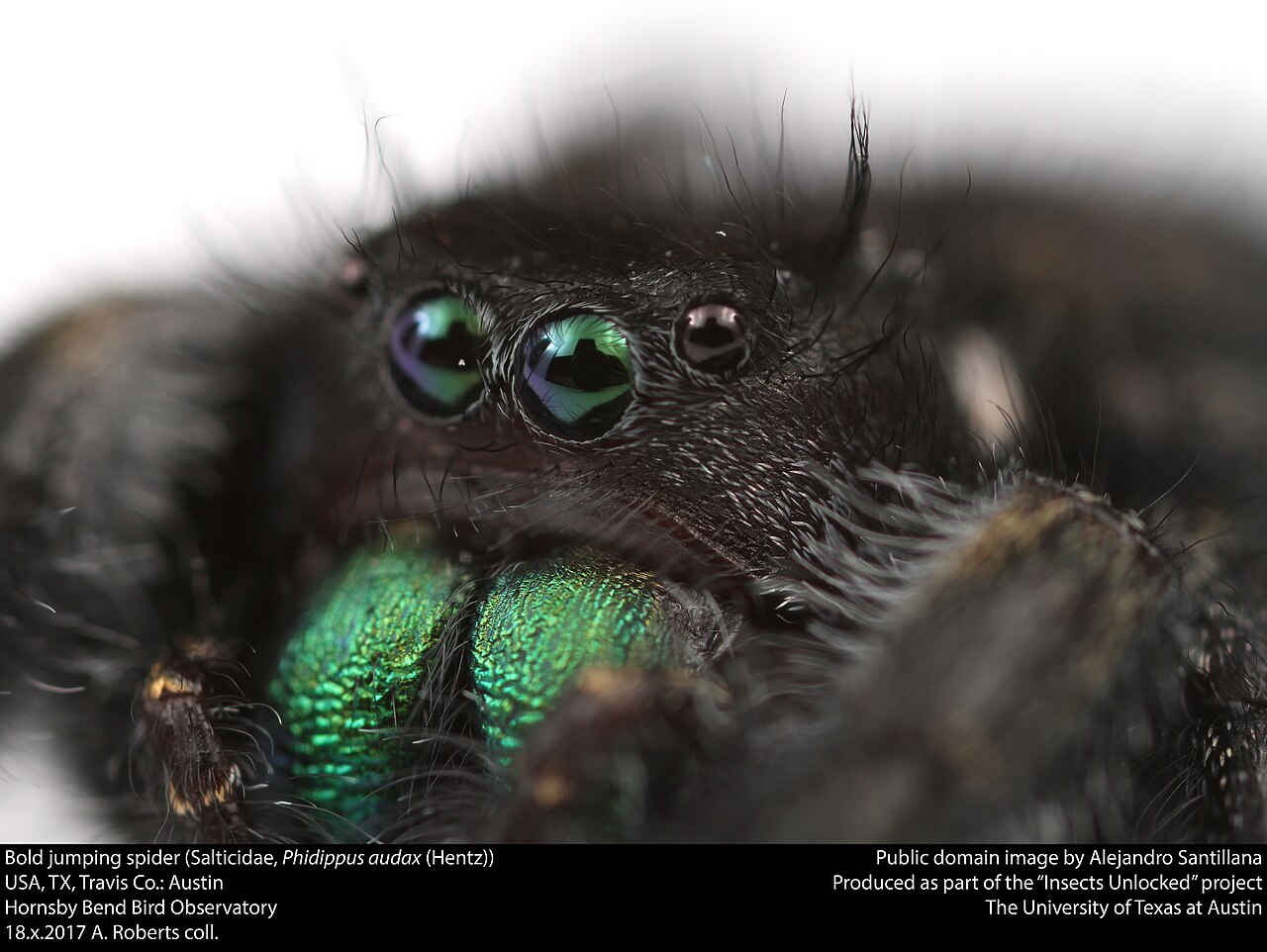
A black and white spider in North America is most often a bold jumping spider, a zebra jumping spider, or a spined micrathena, and none of the three is dangerous to people. The bold jumper is compact and fuzzy with three white spots on a black abdomen and iridescent green fangs, the zebra jumper carries clean white stripes across a smaller body, and the micrathena is a spiny white orbweaver that strings webs across forest trails at face height.
Web presence separates them immediately. Jumping spiders build no capture web at all and hunt by stalking, while orbweavers sit in a circular web and rarely leave it. That single check resolves most identification questions before any pattern detail matters.
The most common black and white spiders in North America are the bold jumping spider, zebra jumping spider, and spined micrathena. All three are harmless to humans. Jumping spiders build no web and have large forward-facing eyes, while micrathenas sit in small tight orb webs and have spiny abdomens.
| Spider | Body Length | Web | Key Feature |
|---|---|---|---|
| Bold jumping spider | 0.3 to 0.6 in | None, silk retreat only | Three white abdomen spots, green fangs |
| Zebra jumping spider | 0.2 to 0.3 in | None | Clean white bands, often on walls |
| Spined micrathena | 0.3 in | Tight orb at face height | White abdomen with black spines |
| Arrowhead orbweaver | 0.3 in | Small orb | Triangular white abdomen |
| Whitebanded crab spider | 0.2 to 0.4 in | None, ambushes on flowers | Crablike stance, front legs held wide |
| Pirate spider | 0.2 in | None, invades other webs | Mottled pale body, spined front legs |
Are Black and White Spiders Dangerous?
No black and white spider in North America poses a meaningful threat to people. The species in this group have venom calibrated for insects, small fangs, and no defensive interest in anything the size of a human. Bites happen only when a spider is pressed against skin, and they produce a brief sting with a small red mark.
Jumping spiders in particular are among the least likely spiders to bite at all. Their response to a large approaching object is to jump away or turn and watch, and they have the visual acuity to recognize that a hand is not prey. Reports of bites from this group are rare relative to how often people handle them.
The two medically significant North American spiders are neither black and white. Black widows are glossy black with a red hourglass on the underside, and brown recluses are uniformly tan with a dark violin marking. A boldly striped or spotted spider is neither one, and the recluse comparison covers how to rule the second out.
Bold Jumping Spider: The Most Common One
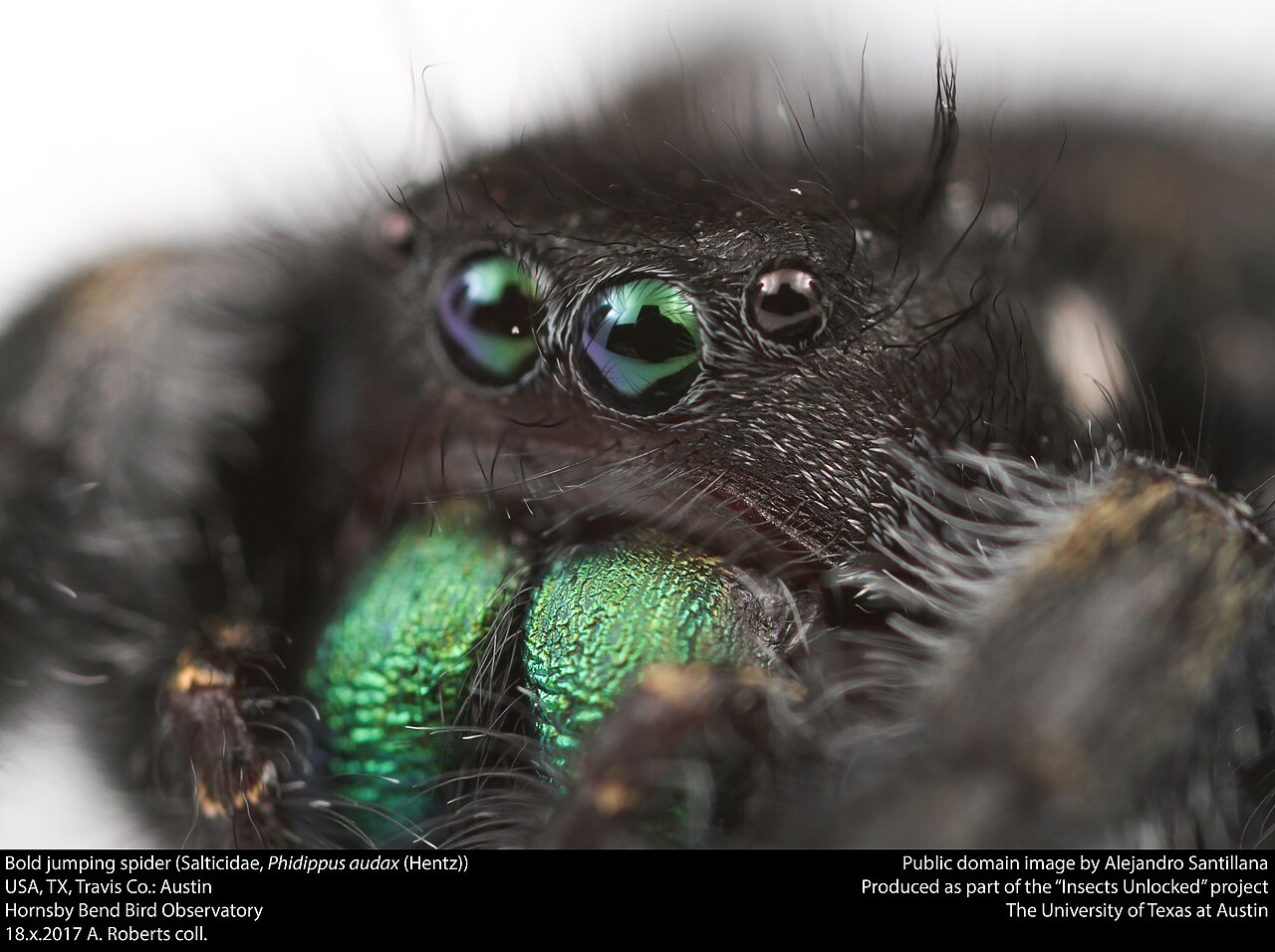
The bold jumper, Phidippus audax, is the black and white spider most people encounter. It is compact and densely furred, black with a large white or cream triangular spot on the upper abdomen and two smaller spots behind it, and it reaches about 0.5 in in mature females. Juveniles carry orange spots that turn white as they mature.
The fangs are the surprise feature, colored a metallic iridescent green or blue that is visible with a hand lens or a close phone photo. Combined with the two enormous forward-facing eyes and the alert posture, this gives the species a face that people either find charming or unsettling. It holds the front legs raised when investigating something.
They hunt by day on walls, fences, tree trunks, and vegetation, stalking prey and jumping several times their body length to seize it. A silk dragline anchors every jump as a safety line. The full profile is in the jumping spider guide, and the young are covered in the baby jumping spider guide.
Zebra Jumping Spider: The Small Striped One on Walls
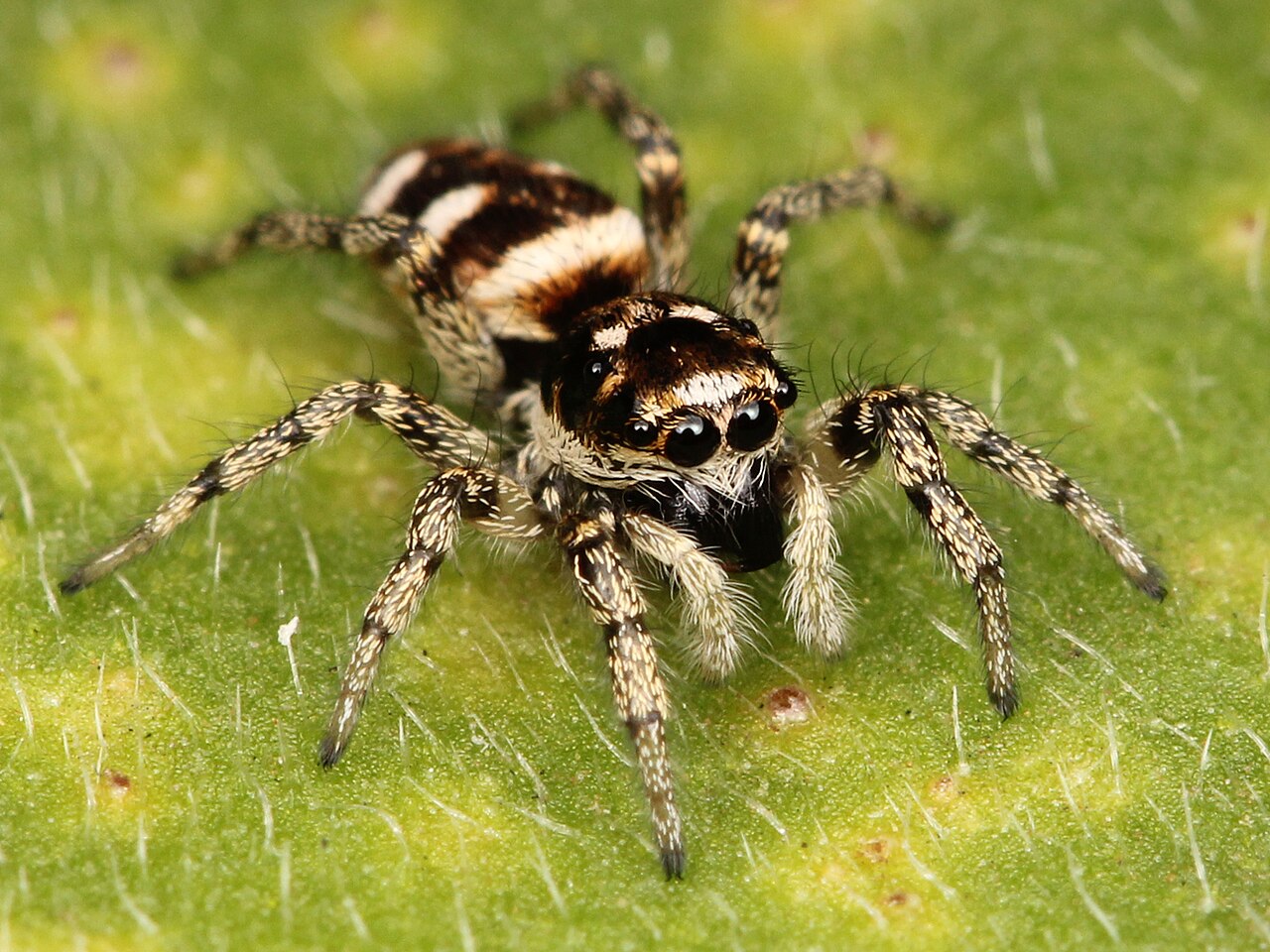
The zebra jumper is smaller and more sharply patterned, about 0.25 in, with alternating black and white bands running across a slender abdomen and matching stripes on the legs. It is far more common on artificial surfaces than in vegetation, which is why sightings cluster on house siding, window frames, fence rails, and garden walls.
Behavior is identical to other jumpers, with the same stalking approach, the same dragline, and the same tendency to turn and face an observer. Males perform a courtship display involving raised front legs waved in a species-specific rhythm, which females evaluate before accepting or driving them off.
The species is native across Europe and North America and thrives around human structures, which makes it one of the most widely reported spiders in temperate cities. It takes small flies, aphids, and other insects that gather on sunlit walls. It cannot harm people in any way.
Spined Micrathena and the Spiny Orbweavers
The spined micrathena is the spider people walk into on forest trails in late summer. The female has a white or cream abdomen studded with five pairs of black conical spines, giving a shape unlike anything else in North America, and measures about 0.3 in. Males are smaller, flatter, and largely unmarked. For a closely related question, see our guide to black and white wasp.
She builds a small, very tightly woven orb web, typically 8 to 12 in across, strung across gaps in the understory at roughly face height. The web is rebuilt daily and positioned to intercept flying insects moving along the trail corridor, which is exactly why hikers keep finding them with their faces.
The spines are structural defense against birds rather than a weapon, and the spider has no capacity to injure a person. It is also unusually reluctant to bite, typically dropping on a dragline when disturbed. Its arrow-shaped relative, the arrowhead orbweaver, uses a similar strategy with a triangular white abdomen instead of spines.
Whitebanded Crab Spiders and Ambush Hunters
Whitebanded crab spiders sit motionless on flowers with the two front leg pairs held wide, waiting for pollinators to land within reach. The body is pale with a white band running between the eyes, and individuals can slowly shift between white and yellow over several days to match the flower they are occupying. They build no web.
The color change takes place in the outer body layer and runs in both directions, taking about six days to turn yellow and considerably longer to return to white. The purpose is camouflage from both prey and predators, and it works well enough that bees land directly on top of them. Prey often exceeds the spider in size.
They are harmless to people and beneficial in gardens in a complicated way, since they take pollinators alongside pest insects. They also make one of the more striking photographic subjects in a flower bed. The wider hunting group is covered in what spiders eat.
Black and White Spiders Found Indoors
Indoor sightings are dominated by jumping spiders that wandered in through open windows or on plants brought inside. They do not establish indoors in any meaningful sense, since there is little prey, and most are found on windowsills trying to get back toward light. Releasing them outside is straightforward because they are slow to flee.
Cellar spiders account for the pale long-legged spiders in basements and ceiling corners, though these read as gray rather than black and white. They build loose tangled webs, hang upside down in them, and vibrate rapidly when disturbed. They are harmless and prey on other spiders.
A fast dark spider with pale markings running along a baseboard at night is more likely a wandering ground hunter that entered through a door gap. Sealing thresholds and reducing exterior lighting near entrances cuts indoor spider numbers more effectively than any spray. For the household species, the black house spider guide covers what stays indoors.
Why Jumping Spiders See So Well
Jumping spiders have the sharpest vision of any arthropod, produced by a pair of enormous forward-facing principal eyes backed by a long tubular retina that the spider moves internally to scan a scene. The resolution approaches that of a small mammal, which is extraordinary in a body a few millimeters across.
Six smaller eyes handle motion detection across a nearly complete field of view, so the spider registers approaching objects from behind and turns to inspect them with the main pair. That turn is what produces the impression that the spider is looking at you, because functionally it is.
The vision supports a hunting style unlike other spiders. A jumper judges distance, plans a route around obstacles, and in some species takes detours that require holding a target in memory while it is out of sight. Research summarized by the Smithsonian at si.edu documents route planning that had previously been assumed to require a larger brain.
What Black and White Spiders Eat
Jumping spiders take flies, mosquitoes, small moths, aphids, leafhoppers, and other spiders, subduing prey by pouncing and biting rather than wrapping. They hunt visually in daylight and are inactive at night, resting in a silk retreat spun under bark, in a leaf fold, or in a window frame crevice.
Micrathenas and other orbweavers take whatever flies into the web, primarily small flies and midges given the tight mesh of the web. Prey is wrapped in silk and either eaten immediately or stored at the hub. The web is consumed and rebuilt daily, which recovers most of the protein invested in it.
Crab spiders take the largest prey relative to body size, regularly killing bees and butterflies several times their own weight by injecting venom directly into the nerve tissue behind the head. That immobilizes prey too heavy to hold otherwise. Predation on all three groups is heavy, and the birds that eat spiders include wrens, chickadees, and warblers.
Pirate Spiders and Other Pale Web Invaders
Pirate spiders are small, mottled pale spiders with distinctive rows of long spines alternating with short ones on the front legs, and they build no web of their own. Instead they invade the webs of other spiders, plucking the silk in a rhythm that imitates trapped prey or a courting male, then striking when the resident approaches.
The venom acts unusually fast on other spiders, immobilizing prey larger than the pirate spider itself within seconds. They are among the few spiders that specialize almost entirely on other spiders as food. Sightings are uncommon because they spend their time inside the webs of other species rather than in the open.
Several other pale spiders turn up in the same situation. Dewdrop spiders live as kleptoparasites in orbweaver webs, stealing small prey the host ignores, and their silver and black bodies read as black and white at a glance. Both groups are entirely harmless.
Seasonal Timing and Where to Look
Jumping spiders are active from spring through fall and peak in midsummer, hunting on warm sunlit surfaces during the day and retreating into silk shelters at night and in cold weather. Walls, fence rails, deck boards, and tree trunks in full sun are the most productive places to look, particularly late morning.
Micrathenas and other small orbweavers peak later, from August into October, which is why forest trails become web-laced in late summer. Webs are rebuilt each morning, so a trail cleared by walkers during the day is strung again by dawn. Walking with a stick held ahead at face height solves the problem without destroying the spiders.
Crab spiders track flower bloom rather than temperature, appearing on whatever is flowering at a given point in the season. Goldenrod, daisies, and milkweed hold them reliably in late summer. All three groups decline sharply after the first hard frost, with only overwintering juveniles surviving into spring.
Telling Black and White Spiders Apart
Check for a web first. No web plus a compact furry body plus large front eyes means a jumping spider, no web plus a crablike stance on a flower means a crab spider, and a small tight orb web means a micrathena or arrowhead orbweaver.
Next look at the abdomen shape. Conical spines mean spined micrathena, a triangular pointed shape means arrowhead orbweaver, and a smooth oval with distinct pale spots means a jumper. Shape is more reliable than the exact pattern, which varies with age and molt stage.
Finally note the size and setting. Wall and fence sightings skew heavily toward zebra jumpers and bold jumpers, forest trails toward micrathenas, and flower heads toward crab spiders. Anyone also working through yellow-marked species should see the black and yellow spider guide.
Related reading: Yellow Spider.
Frequently Asked Questions
Is a black and white spider poisonous?
All spiders produce venom, but no black and white spider in North America is dangerous to people. Jumping spiders, micrathenas, and crab spiders all have small fangs and insect-adapted venom, and bites produce nothing worse than a brief sting and a small red mark. Neither the black widow nor the brown recluse is black and white.
Do black spiders with white spots bite?
Bold jumping spiders can bite if squeezed or trapped against skin, but they almost never do. Their normal response to a large object is to jump away or turn and watch. On the rare occasions a bite occurs, the result is a small red mark that fades within a day or two.
What is the small black and white spider on my wall?
Most likely a zebra jumping spider, which strongly favors artificial surfaces like siding, window frames, and fence rails. It measures about 0.25 in with clean black and white bands across the abdomen and legs. It builds no web and hunts small flies that gather on sunlit surfaces.
What is the white spider with spikes in the woods?
That is a spined micrathena, a small orbweaver with a white abdomen carrying five pairs of black conical spines. Females string tight circular webs across forest trails at roughly face height, which is why hikers find them so often. The spines are defense against birds and cannot hurt people.
Why do jumping spiders look at you?
Because they can actually see you. Their two large forward-facing eyes deliver resolution approaching that of a small mammal, and six smaller eyes detect motion from nearly all directions, prompting the spider to turn and inspect anything that moves. The behavior is genuine visual attention rather than an illusion.
Should I remove a black and white spider from my house?
There is no need to kill it. Jumping spiders that wander indoors do not establish, since there is little prey, and they consume insects while they are there. Catching one in a cup and releasing it outside takes a few seconds, and they are slow enough to flee that this is easy.