Millipede: Leg Counts, Bite Risk and Why They Invade Homes
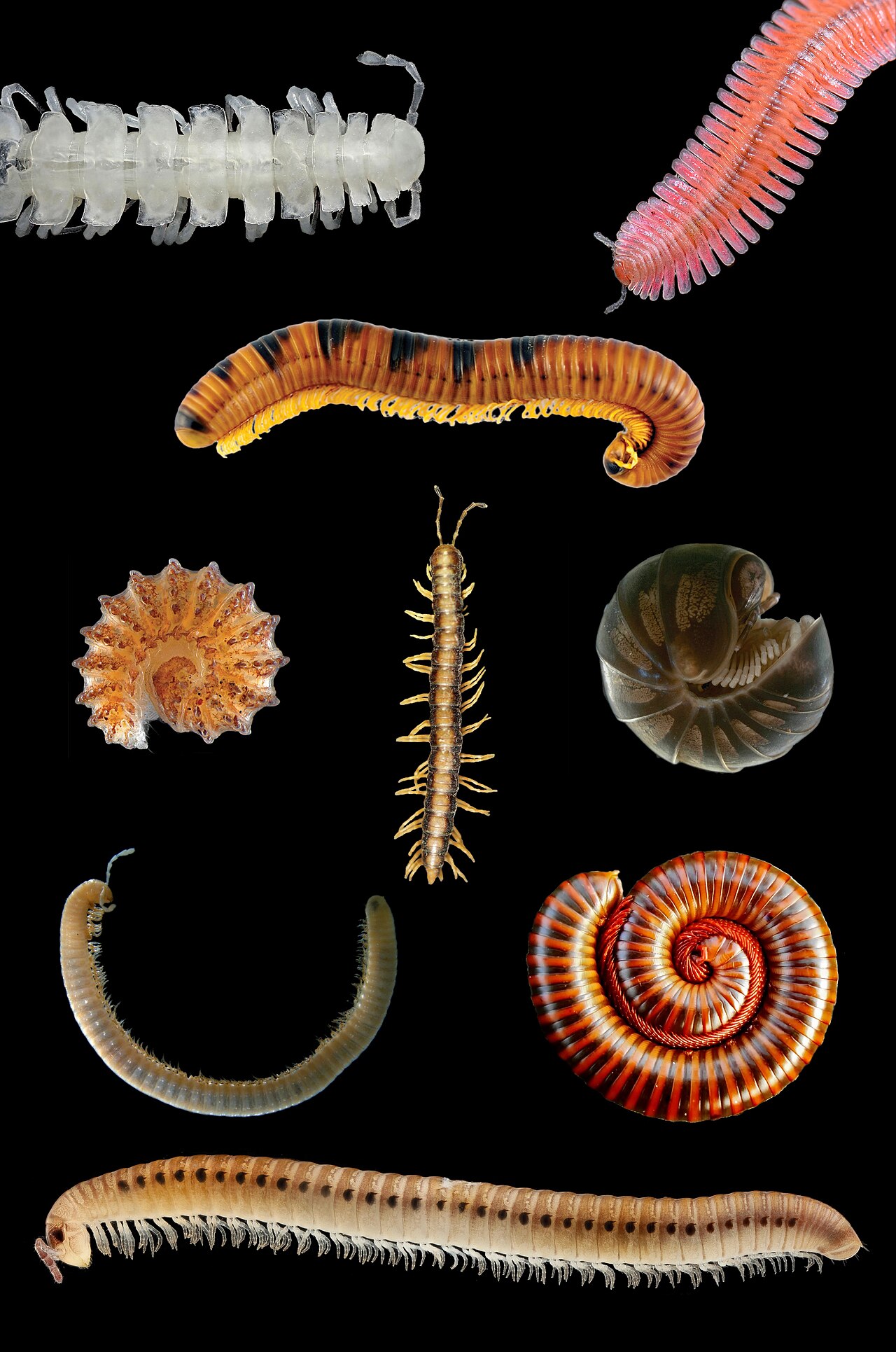
A millipede is a slow, cylindrical, many legged arthropod that eats dead leaves, and despite the name no species has a thousand legs. Millipedes belong to the class Diplopoda, which means “double leg”, because each apparent body segment is really two fused segments carrying two pairs of legs instead of one. That single feature separates them from centipedes at a glance and explains nearly everything else about how they live.
Roughly 12,000 species have been described worldwide and scientists estimate the real total near 80,000, which would make Diplopoda one of the least documented major animal groups on Earth. In North America the ones people meet are the American giant millipede in the eastern woods, flat backed millipedes under mulch, and whatever crawls under the basement door after a heavy rain.
Millipedes are detritivores with two pairs of legs per body segment, typically 34 to 400 legs total. They are not venomous and do not bite, but many species release a defensive fluid that can stain or irritate skin. Indoors they are a moisture problem, not a pest problem, because they cannot feed or reproduce in a dry house.
| Fact | Millipede |
|---|---|
| Class | Diplopoda, about 12,000 described species |
| Legs per segment | Two pairs, versus one pair in centipedes |
| Typical leg count | 34 to 400, record 1,306 in Eumillipes persephone |
| Diet | Decaying leaves, wood and plant matter |
| Defense | Coiling plus chemical secretion, no venom |
| Lifespan | 1 to 10 years depending on species |
| Peak activity | Spring and fall, especially after heavy rain |
What is a millipede?
Millipedes are arthropods, relatives of insects and crustaceans, built around a hard, rounded, segmented tube. Most are dark brown, black or reddish, though tropical species run through orange, yellow and pink. The head carries short antennae, simple eyes in most groups, and chewing mouthparts suited to soft, rotting plant material.
Movement is the giveaway. A millipede pushes forward on waves of legs that ripple down the body, slowly and steadily, because those legs evolved for burrowing power rather than speed. A centipede darts. A millipede plods, and when it is disturbed it coils into a flat spiral instead of running.
The group is ancient. Fossil millipedes from about 425 million years ago are among the oldest known land animals, which means their leaf shredding job predates flowering plants, dinosaurs and forests as we know them.
Does a millipede have 1000 legs?
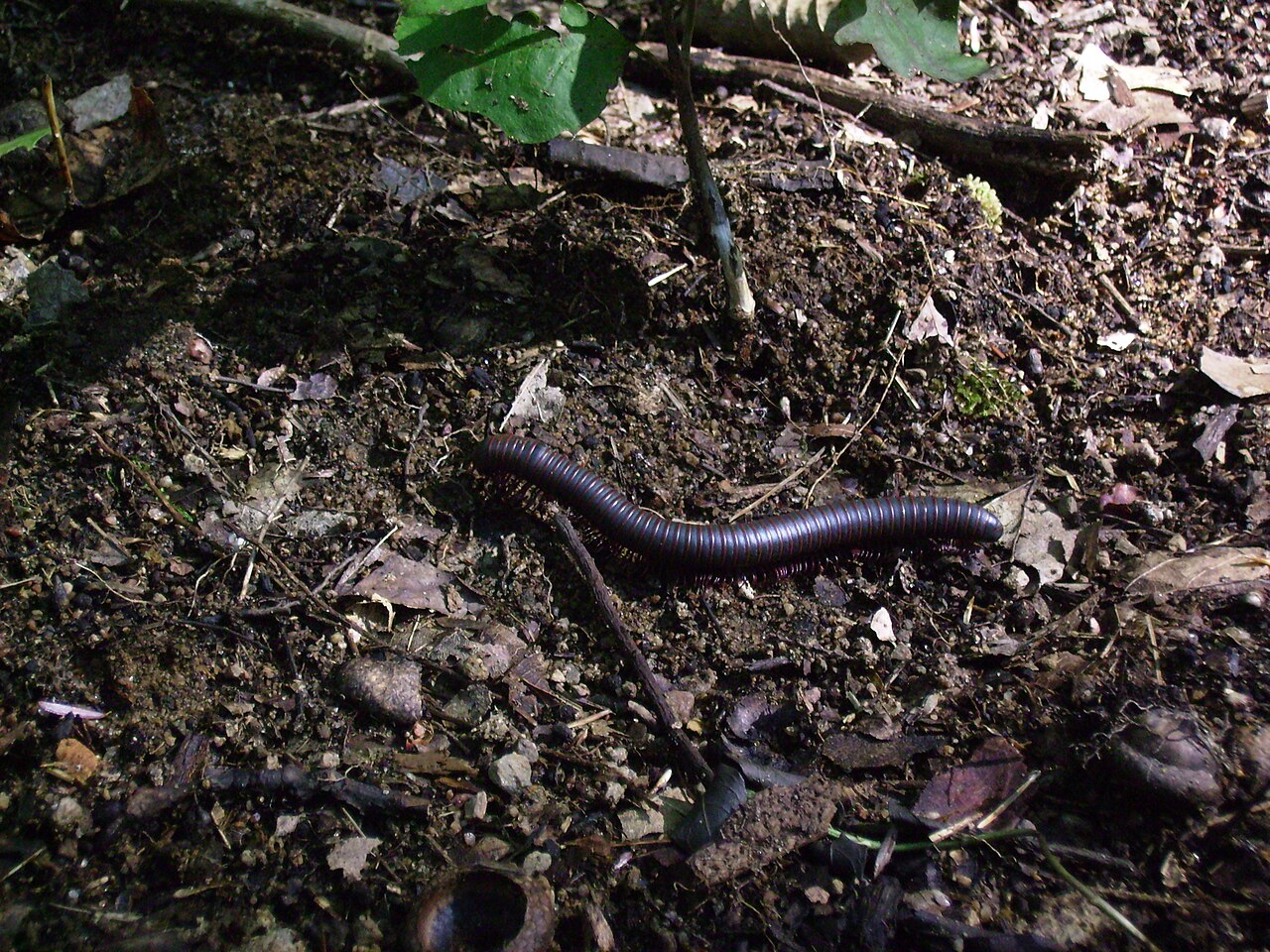
No. The name comes from Latin for “thousand feet” and it has always been an exaggeration. Common species carry between 34 and 400 legs, and the familiar American giant millipede (Narceus americanus) has around 200 to 300.
One species finally broke the thousand barrier. In 2021 researchers described Eumillipes persephone from deep mining boreholes in Western Australia, a pale, eyeless millipede with up to 1,306 legs on 330 body segments. It is the only animal ever recorded with more than a thousand legs, and it lives 200 ft (60 m) underground.
Leg count also changes with age. Millipedes hatch with only three pairs of legs and add segments and legs at each molt, a growth pattern called anamorphosis, so a big individual has simply molted more times than a small one of the same species.
Millipede vs centipede: how to tell them apart
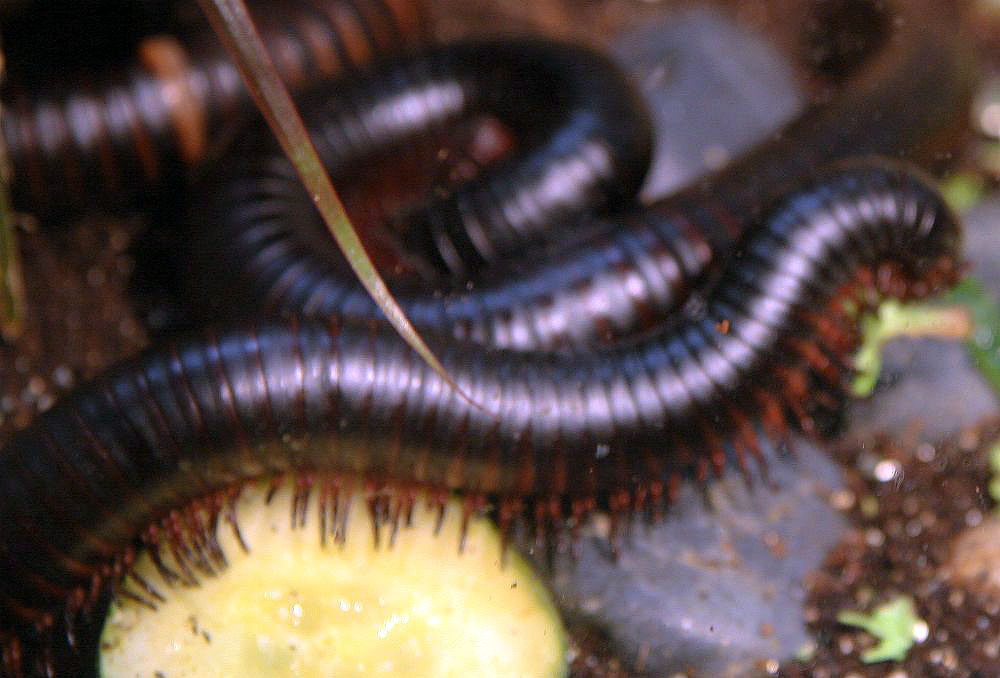
Count legs per segment if you can get close, and if you cannot, watch the behavior. Millipedes have two pairs per visible segment, round bodies and short legs tucked under them. Centipedes have one pair per segment, flattened bodies, and long legs that stick out to the sides.
Speed settles it fast. Centipedes are predators that chase and kill prey with venomous front claws called forcipules, and they move quickly enough to be startling. Millipedes are recyclers that never chase anything. A full comparison of anatomy, habitat and risk sits in our centipede vs millipede breakdown.
The practical consequence: a centipede in the house can deliver a painful bite, while a millipede cannot bite you at all. Its mouthparts are built for softened leaf litter and are not capable of breaking skin.
Are millipedes harmful to humans?
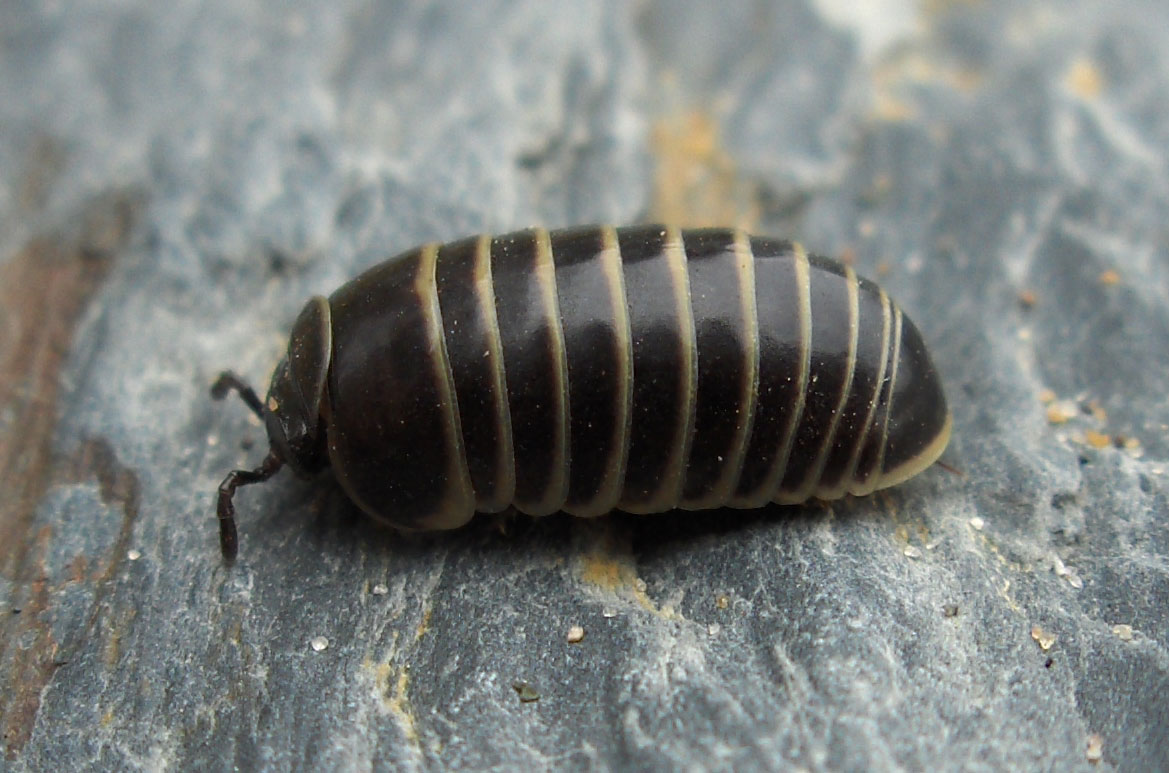
Millipedes do not bite, do not sting and have no venom. What they have is chemistry. Many species release a defensive fluid from pores along the sides of the body, and depending on the group that fluid contains benzoquinones, phenols or, in the flat backed order Polydesmida, hydrogen cyanide in small quantities.
On skin that fluid can cause a brown or purple stain that lasts days, plus burning or blistering in sensitive people. In the eyes it causes real chemical conjunctivitis and needs flushing with water and a call to a clinic. Handling a large tropical species and then rubbing your eyes is the usual way people find this out.
So they are harmless in the sense that matters, meaning no bites and no disease transmission, and not harmless in the sense of “pick one up and then eat a sandwich”. Wash your hands after handling one. Guidance from Clemson Cooperative Extension treats them as nuisance invaders rather than a health concern.
Is it bad if I have millipedes in my house?
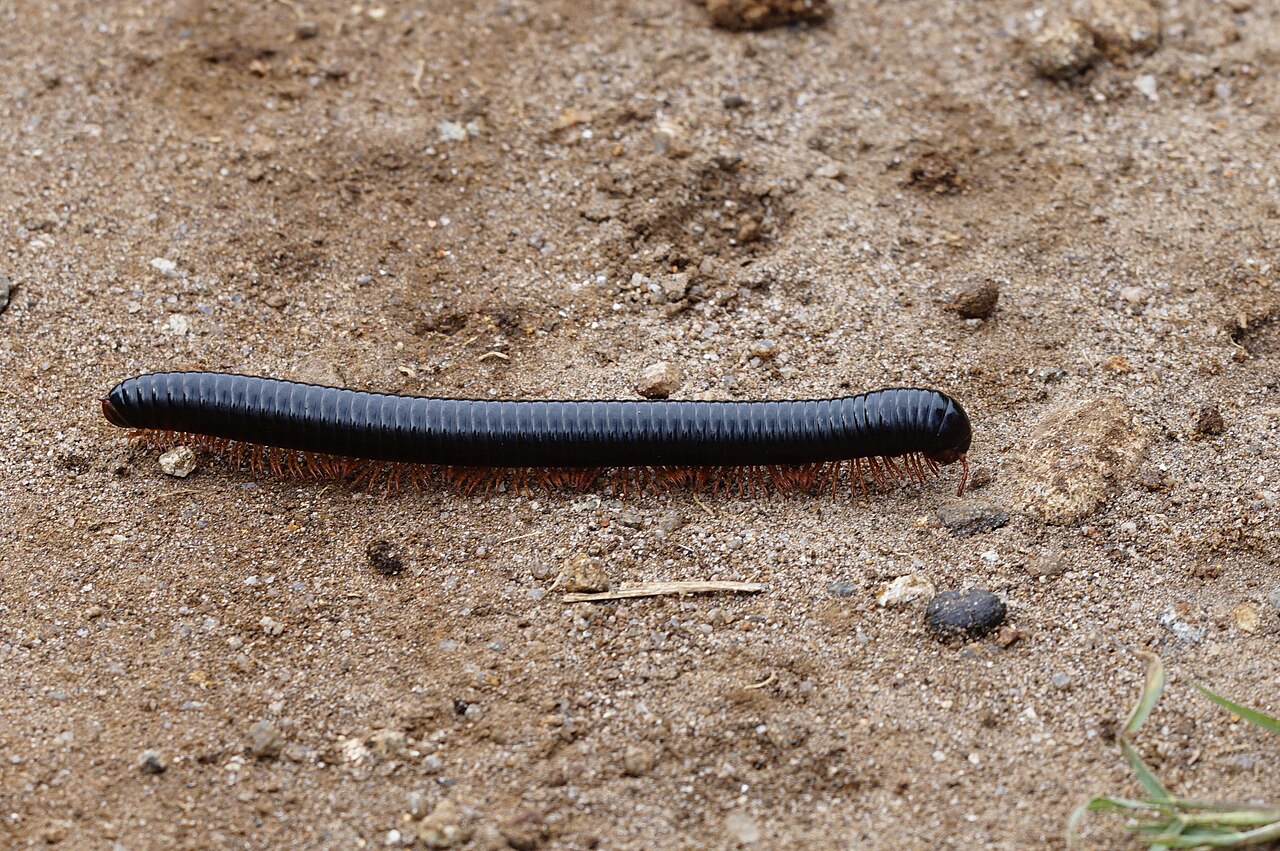
It is a signal, not a disaster. Millipedes indoors mean moisture, because they lose water through their cuticle quickly and only wander into buildings when conditions outside turn either too wet or too dry. They cannot chew wood, damage fabric, contaminate food or bite anyone.
They also cannot establish. A dry basement offers no rotting plant matter and no humidity, so millipedes that come inside dry out and die within a few days, usually curled in a corner or against a baseboard. Finding dead ones repeatedly is normal during a migration, not evidence of an infestation breeding in the walls.
What they do reveal is worth acting on. A steady stream of millipedes points to a damp crawl space, mulch piled against the siding, a leaking downspout or a foundation gap, and each of those causes more expensive problems than millipedes ever will.
What does it mean if you see a millipede in your house?
Practically, it means the ground next to your foundation is wetter than the inside of your home and the millipede walked toward the difference. Fall migrations after heavy rain push hundreds of them across driveways and into garages in a single night.
Folklore says otherwise in several cultures, where millipedes are read as omens of rain or of money coming. The rain association is not entirely superstition, since mass movement really does follow weather changes, but there is nothing predictive about a single animal in a hallway.
Treat the sighting as a humidity reading. One millipede in October after a storm is weather. Twenty in a week in a finished basement is a drainage problem.
What do millipedes eat?
Millipedes are detritivores that feed on decaying leaves, rotting wood, fungi and softened plant debris. They rarely touch living plants, though a heavy population in a greenhouse or a strawberry bed will rasp on seedlings and soft fruit already sitting on damp soil.
Their ecological role is genuinely large. By shredding leaf litter into fragments, millipedes accelerate decomposition and hand the work off to bacteria and fungi, which is why forest soils with dense millipede populations cycle nutrients faster. A single woodland acre can hold thousands of individuals doing that quietly.
Plenty of animals eat them in turn, despite the chemical defense. Ground beetles, ants, shrews, toads, and thrushes such as the American robin take small ones, insect hunters like the American kestrel grab them off open ground, and large amphibians like the African bullfrog swallow bigger species whole.
Where do millipedes live?
Millipedes live wherever dead plant matter stays damp: leaf litter, under logs and stones, in mulch beds, compost piles, rotting stumps and the top few inches of forest soil. They occur on every continent except Antarctica, from arctic tundra to rainforest.
In yards they concentrate in exactly the places people build: bark mulch against the foundation, ground cover like ivy and pachysandra, under stacked firewood, beneath outdoor storage boxes, and along the damp strip under a poorly draining gutter line.
Species vary in what they need. Flat backed millipedes prefer moist hardwood litter, while some desert species stay buried for months and surface only during summer rains, sometimes in numbers that cover roads.
Millipede life cycle and lifespan
Males transfer sperm with modified legs called gonopods, and females lay dozens to hundreds of eggs in a chamber of soil or chewed plant material. Some species build a protective nest of feces and soil around the clutch, which is more effective than it sounds.
Hatchlings emerge with three pairs of legs and almost no segments, then gain both at every molt. Reaching adult size takes several molts over one to several years, and many species molt inside a sealed underground chamber where they are soft and defenseless for days.
Lifespan runs from about a year in small species to 10 years in the giants. Archispirostreptus gigas, the giant African millipede, regularly reaches 7 to 10 years, which is why it became a long lived exotic pet before US import rules changed.
What time of year are millipedes most active?
Spring and fall, with the strongest movement in September and October in most of the United States. Cool, wet weather triggers mass migrations, and dry spells can trigger them too as animals search for moisture in the opposite direction.
Day to day they are nocturnal. Millipedes stay buried or under cover through daylight, then move at night when humidity rises and predators that hunt by sight are less active. Porch lights and lit basements do not attract them, unlike moths and beetles.
Regional pattern matters for control. Fall invaders in the Midwest and East follow the first heavy autumn rain, so sealing and drainage work done in August pays off, while the same work in October is mostly cleanup.
What kills millipedes instantly in a house?
A vacuum, a broom and a dustpan. Millipedes indoors are individual animals that are already dying, and physical removal is faster and cleaner than any spray. A wet or dry vacuum handles a heavy fall migration in minutes.
Contact insecticides labeled for household arthropods do kill on contact, and a residual pyrethroid barrier sprayed around the foundation perimeter can cut how many get inside during a migration. Diatomaceous earth in dry crawl spaces works slowly by abrading the cuticle, which means it does nothing once it gets damp.
None of that fixes the cause. The permanent measures are pulling mulch back 6 to 12 in (15 to 30 cm) from the foundation, fixing downspouts and grading, sealing door sweeps and utility penetrations, and running a dehumidifier in a damp basement. Do those and the sprays become unnecessary.
What smell do millipedes hate, and will they eventually go away?
Peppermint oil, tea tree oil and cedar get recommended as millipede repellents, and the evidence is weak. Strong essential oils irritate arthropods at close range, but a diluted spray on a doorway does not hold a line against animals pushed indoors by weather. Treat it as a minor supplement to drainage work.
The good news is that yes, they go away on their own. Indoor millipedes die within a few days without moisture and food, and migrations last one to three weeks before the population settles back into the soil. Nothing you do indoors changes that timeline much.
The bad news is that they come back on the same schedule every year unless the outdoor conditions change. A basement that got millipedes last October will get them next October, which is the argument for spending the money on gutters instead of on spray.
Keeping a millipede as a pet
Large millipedes make genuinely low maintenance pets: a plastic tub, 4 to 6 in (10 to 15 cm) of moist coconut fiber and leaf litter, a shallow water dish, room temperature and a diet of decaying hardwood leaves plus occasional vegetables and a calcium source.
The species most people want, the giant African millipede, cannot legally be imported into the United States because it carries invasive mites, so captive bred animals are the only legal source and availability is limited. Native species such as Narceus americanus are easy to keep and often collected locally where regulations allow.
Handle them over a table and rarely. The defensive fluid is the main reason, and a millipede dropped from hand height can crack its exoskeleton. For a detailed setup and species comparison, see our guide to the giant millipede.
Frequently Asked Questions
How long do millipedes live in a house?
Usually two to five days. Indoor air is far too dry, there is nothing for them to eat, and they dehydrate quickly. That is why homeowners find curled, dead millipedes along baseboards rather than living colonies, and why indoor spraying rarely changes the number you see.
Are millipedes poisonous to dogs?
Not seriously. A dog that mouths a millipede may drool, gag or vomit from the defensive secretion, and the fluid can irritate eyes and gums, but the quantities involved are small. Rinse the mouth with water and watch for a few hours. Large tropical species warrant a call to the vet.
Do millipedes bite?
No. Their mouthparts are built to scrape softened plant material and cannot break human skin. Anything that bit you in a damp basement was a centipede, an ant or a spider. The only defense a millipede has is coiling up and releasing its chemical secretion.
How do you pronounce millipede?
MIL uh peed, with the stress on the first syllable. The confusion usually comes from spelling, since “millipede” has two Ls and one P while centipede has one of each. Both names come from Latin counts of feet that nobody ever verified.
What is the biggest millipede in the world?
The giant African millipede (Archispirostreptus gigas) reaches about 15 in (38 cm) long and 0.8 in (2 cm) thick, with roughly 250 legs. The largest North American species, Narceus americanus, tops out near 4 in (10 cm), which still makes it a startling find under a log.
Do millipedes come out at night?
Yes, they are nocturnal and move after dark when humidity climbs and birds are not hunting. During the day they stay under logs, rocks, mulch and leaf litter. Mass migrations after heavy rain are the exception, and those can happen in daylight.