Poison Dart Frog Habitat: Where They Live and What They Need
Poison dart frog habitat is warm, wet, shaded lowland rainforest floor in Central and South America, almost never more than a few feet above the ground. These frogs need constant humidity above 80 percent, daytime temperatures in the mid 70s F (24 C), deep leaf litter to hunt in, and small pockets of standing water such as bromeliad cups for their tadpoles. Take away any one of those four and the population thins out fast.
That narrow set of requirements explains both where you find them and why so many species are in trouble. Roughly 200 species in the family Dendrobatidae are spread across Nicaragua to southern Brazil, and most of them occupy a range smaller than a single US county. The sections below cover the wild habitat first, then the captive terrarium that copies it, and the safety questions that come with a frog whose skin chemistry is its defense.
Poison dart frogs live on the humid floor of tropical rainforests in Central and South America, from sea level to about 5,200 ft (1,600 m). They need 80 to 100 percent humidity, temperatures of 72 to 80 F (22 to 27 C), dense leaf litter for ants and mites, and small water pools in bromeliads or tree holes where tadpoles develop.
| Habitat factor | What wild poison dart frogs require |
|---|---|
| Region | Nicaragua to southern Brazil, plus Hawaii (introduced) |
| Elevation | Sea level to about 5,200 ft (1,600 m) |
| Temperature | 72 to 80 F (22 to 27 C), rarely below 65 F (18 C) |
| Humidity | 80 to 100 percent, year round |
| Ground cover | Deep leaf litter, fallen logs, buttress roots |
| Water | Bromeliad cups, tree holes, seeps, no open ponds needed |
| Diet source | Ants, mites, termites, springtails in the litter layer |
Where do poison dart frogs mostly live?
Poison dart frogs mostly live in the lowland tropical rainforests of Central and South America, with the highest species diversity in Colombia, Ecuador, and Peru. Costa Rica and Panama hold the species most Americans see on tours, including the strawberry poison dart frog (Oophaga pumilio), which is abundant in Caribbean lowland forest and on the Bocas del Toro islands.
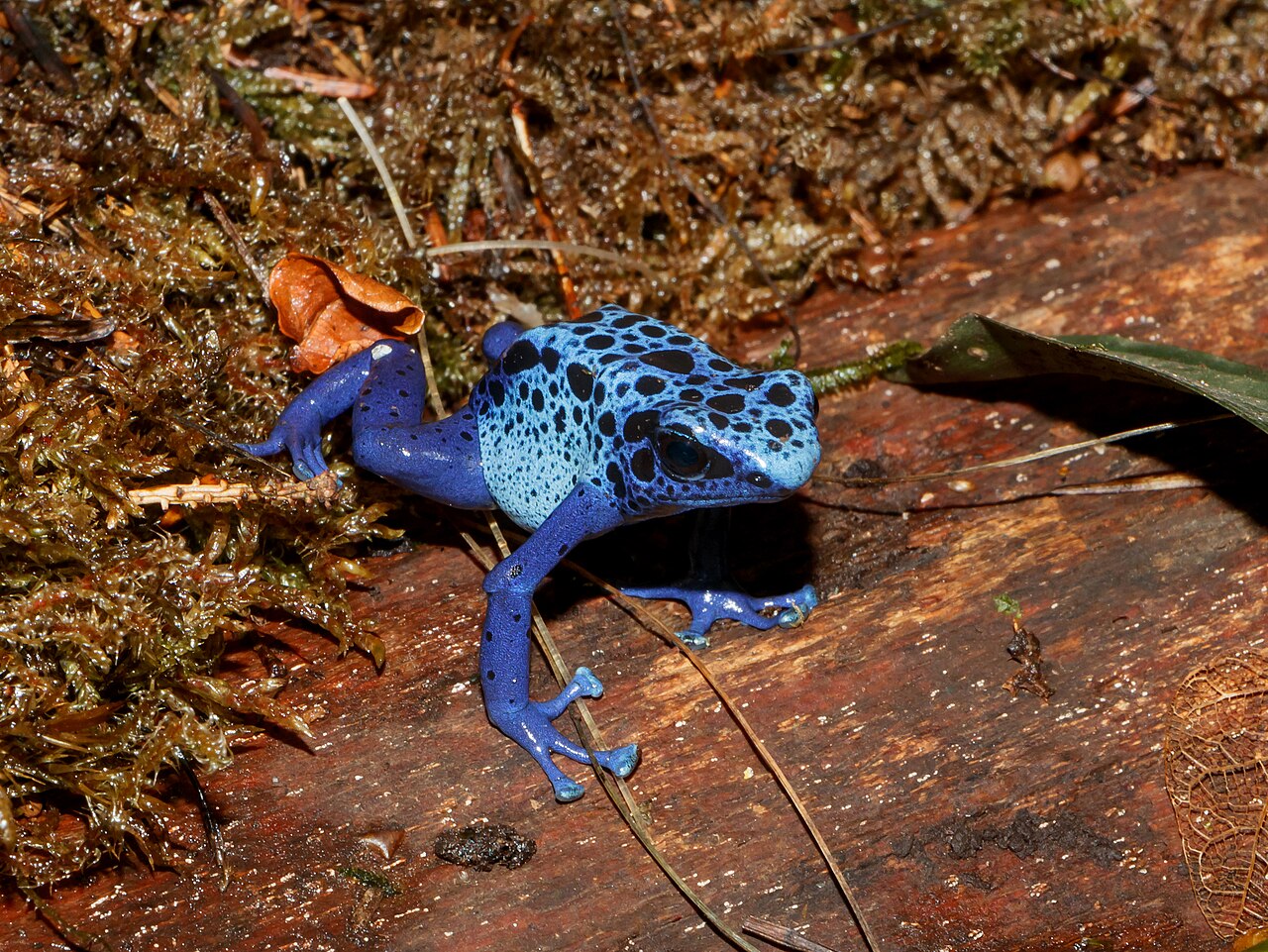
Ranges are small and often stacked by elevation rather than spread across a country. The golden poison frog (Phyllobates terribilis) is confined to a stretch of wet forest on Colombia’s Pacific slope, and the blue morph of Dendrobates tinctorius lives only in a scattering of forest islands in southern Suriname. A single hillside can hold a color form found nowhere else, which is why habitat loss and species loss are nearly the same event here.
What do poison dart frogs need in their habitat?
They need four things in the same place: moisture, warmth, cover, and tiny prey. Dart frogs breathe partly through their skin, so they dry out within hours in open sun and stay near the ground where the air holds water. Broken canopy shade, not full sun and not pitch dark, gives them the stable microclimate they hunt in.
Prey density is the factor most people overlook. Wild dart frogs eat ants, mites, springtails, and termites, and those animals live in decomposing leaf litter. A cleared forest floor with bare soil has warmth and rain but nothing to eat, so frogs vanish from it even when the trees nearby still stand. The same logic drives their adaptations, from sticky toe pads to the alkaloid chemistry described later on this page.
The rainforest floor is the whole world for most species

Most dart frogs spend their entire lives within a patch of forest floor smaller than a suburban lawn. Males of many species defend a territory of a few square yards around a calling perch, usually a low leaf, a root buttress, or a fallen palm frond. They climb, but rarely higher than about 6 ft (1.8 m), and species such as Dendrobates auratus are the ones most often found working up tree trunks.
Leaf litter depth is a good field predictor of whether frogs are present. Where fallen leaves are packed several inches deep and stay damp, the arthropod load supports frogs; where litter is thin or swept away by flooding, it does not. That is the practical difference between primary forest and a young secondary stand that looks green from the road.
Bromeliads and tree holes are the nurseries
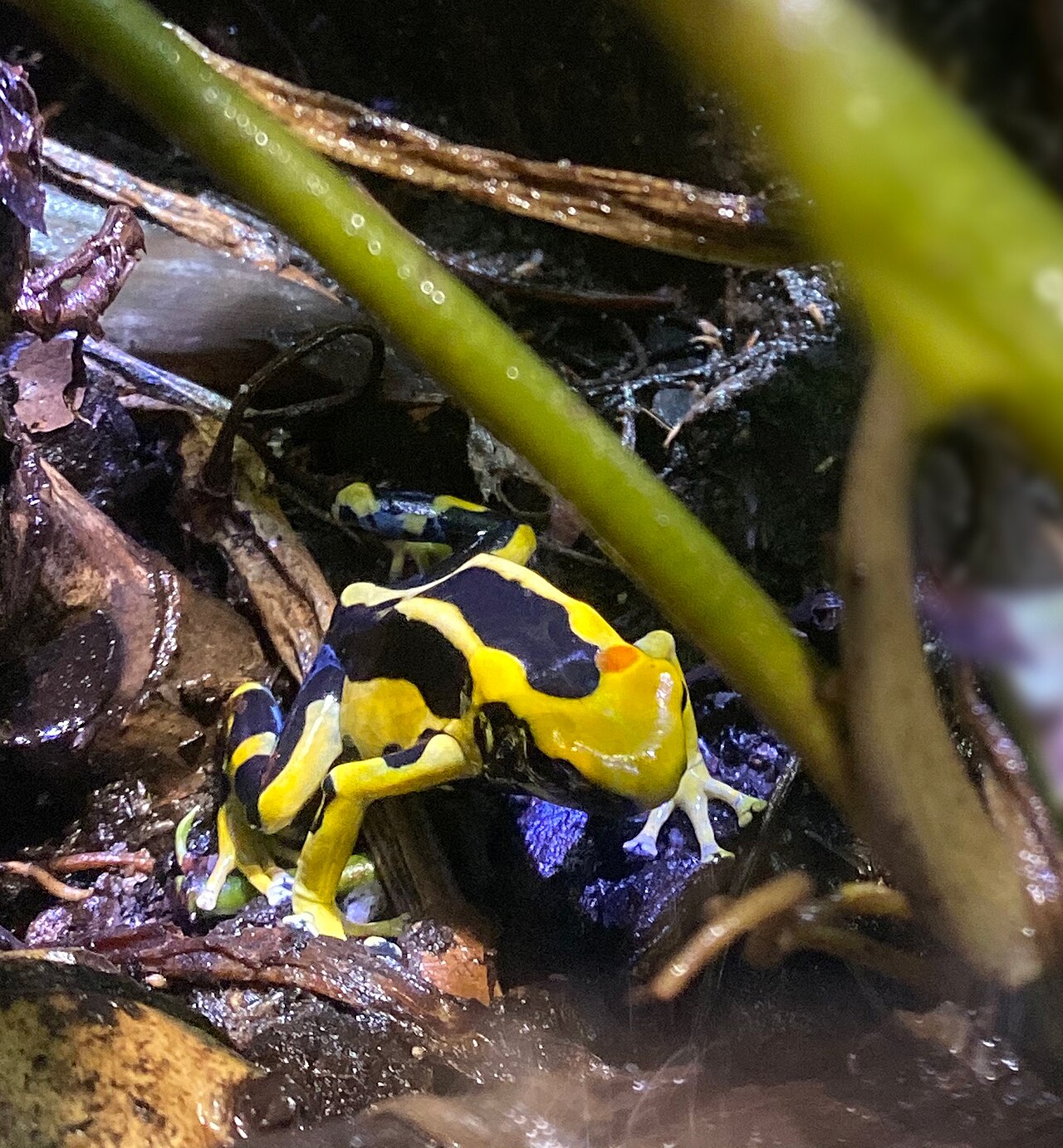
Poison dart frogs do not breed in ponds. Females lay small clutches of two to twelve eggs on a damp leaf or in leaf litter, the male keeps them moist, and once the tadpoles hatch a parent carries them on its back to a separate pocket of water. Bromeliad leaf axils, water filled tree holes, palm bracts, and even discarded bottle caps all work.
Those pools are tiny and mostly food free, so several species feed their tadpoles directly. Oophaga females return to each tadpole and deposit unfertilized eggs for it to eat, a behavior that can continue for six to eight weeks. A habitat with no epiphytes has no nursery sites, and that is one reason selective logging of large canopy trees removes dart frogs from a forest that still looks intact at ground level.
Temperature, humidity, and rainfall this habitat depends on
Dart frog forests are equatorial and barely seasonal in temperature. Annual averages sit between 72 and 80 F (22 to 27 C) with only a few degrees of swing between day and night, and sustained exposure above 86 F (30 C) is lethal for most species. Unlike temperate amphibians they have no cold season strategy, so questions about whether frogs hibernate simply do not apply to them.
Rainfall is the variable that shifts. Many sites receive 80 to 200 inches (2,000 to 5,000 mm) a year, and breeding tracks the wet season because that is when bromeliad cups fill. In drier months frogs retreat deeper into litter and under logs, calling less and moving less, then resume within days of the first heavy rains.
Why can’t you touch poison dart frogs?
You should not touch a wild poison dart frog because its skin carries alkaloid toxins and because your hands damage the frog. The toxins are not absorbed through intact skin in most cases, but they will burn a cut, an eye, or your mouth, and Phyllobates terribilis carries enough batrachotoxin that handling it bare handed is genuinely reckless. Rangers and researchers use nitrile gloves in both directions.
The risk runs the other way too. Frog skin is a breathing and drinking organ, and the salts, oils, and sunscreen on a human palm strip its protective mucus. Nets, damp gloves, and short handling times are standard practice for a reason. For general identification help, the poison dart frog overview covers what to look for without picking anything up.
What eats poison dart frogs?
Bright coloring warns off most predators, but not all of them. The fire bellied snake (Leimadophis epinephelus) in Colombia tolerates dart frog alkaloids and eats them, and large spiders, giant water bugs, and some birds take young frogs and froglets. Tadpoles in bromeliad pools are eaten by damselfly larvae, dragonfly nymphs, and other dart frog tadpoles.
Protection also depends on diet, which ties directly back to habitat. Dart frogs do not make their alkaloids; they sequester them from the ants and mites they eat. A frog in a forest with an impoverished arthropod community is less toxic, and a captive bred frog fed fruit flies is not toxic at all. Toxicity is a habitat product, not a fixed trait.
What kills a poison dart frog population
Habitat conversion is the leading cause. Clearing rainforest for cattle pasture, oil palm, and small farms removes canopy shade, dries the litter layer, and eliminates bromeliads in one step, and because many species occupy a single valley, one plantation can take out a whole range. The IUCN lists a substantial share of dendrobatids as threatened for this reason.
Two other pressures matter. Chytrid fungus (Batrachochytrium dendrobatidis) has hit montane populations hardest, since cooler high elevation sites favor the pathogen, and collection for the pet trade still pulls wild frogs out of accessible forest. Captive breeding has reduced that last pressure, which is why buying captive bred stock is the only defensible option for a hobbyist. The Smithsonian’s National Zoo publishes current status notes on the species it keeps.
Can I have a poison dart frog as a pet?
Yes, and captive bred dart frogs are among the better beginner amphibians, provided you build the habitat before you buy the frog. A pair of Dendrobates leucomelas or D. auratus does well in a sealed front opening 18 by 18 by 18 inch (45 cm cube) bioactive terrarium: drainage layer, ABG style substrate, thick leaf litter, cork bark, live bromeliads, and a springtail and isopod colony in the soil. Ventilation is small and deliberate, because the goal is 80 to 100 percent humidity.
Keep the tank at 72 to 78 F (22 to 26 C) with no basking heat, light it with a low output LED or T5 on a 12 hour cycle, and mist once or twice a day. Food is flightless fruit flies dusted with a calcium and vitamin A supplement, plus whatever springtails they find themselves. Thumbnail species such as Ranitomeya benefit from height and more bromeliads, so if you want those, plan a tall enclosure the way you would plan a box turtle habitat around the animal’s actual behavior. The blue poison dart frog profile covers one of the most commonly sold forms.
Do poison dart frogs live in the United States?
Not natively. No dendrobatid is native to the US mainland, and the frogs sold in American pet shops are captive bred stock descended from imports. The one wild exception is Oahu, Hawaii, where green and black poison dart frogs (Dendrobates auratus) introduced from Panama around 1932 for mosquito control still breed in the shaded stream valleys of the Manoa and Kalihi areas.
That Hawaiian population survives because the habitat matches: year round warmth, heavy rainfall, dense leaf litter, and abundant epiphytes. Mainland climates fail on humidity and winter temperature, so escaped pets do not establish. Anyone hoping to see dart frogs in the wild in US territory has exactly one place to go.
Frequently Asked Questions
Where do poison dart frogs mostly live?
In humid lowland rainforest from Nicaragua south to Brazil, with the greatest diversity in Colombia, Ecuador, and Peru. They stay on or just above the forest floor in shaded, damp conditions. A few populations occur on Caribbean islands off Panama, and Dendrobates auratus was introduced to Oahu, Hawaii, around 1932.
What size habitat does a poison dart frog need in captivity?
Plan on roughly 10 gallons of enclosure volume per frog, so an 18 inch cube (about 20 gallons) suits two to three ground dwelling frogs. Floor space matters more than height for Dendrobates, while thumbnail species such as Ranitomeya use vertical space and bromeliads.
Are dart frogs aggressive?
Toward people, no. Toward each other, yes in a limited way. Males wrestle and call to hold calling territory, and females of some Oophaga species harass rivals and even destroy their eggs. In a small tank that pressure can kill the loser, so keep one pair or a proven group.
Can a human hold a poison dart frog?
Physically yes, and captive bred frogs fed fruit flies carry no meaningful toxins, but it is still discouraged. Handling strips the mucus layer that the frog breathes through and can transfer oils and residues. Use a cup or a damp gloved hand when you must move one, and keep it brief.
What would happen if I licked a poison dart frog?
With a wild caught Phyllobates terribilis, batrachotoxin absorbed through the mouth could cause numbness, cardiac arrhythmia, and in extreme cases death. Most other wild species would cause burning, nausea, and swelling. A captive bred frog on a fruit fly diet would likely cause nothing, which does not make it a reasonable thing to do.
Is a poison dart frog bite poisonous?
Dart frogs do not bite in any meaningful way; their jaws cannot break human skin. The danger is the skin secretion, not a bite, and it only matters if the toxin reaches a cut, your eyes, or your mouth. That is also why the word poisonous fits them and venomous does not.