Ribbon Snake: How to ID It and Tell It From a Garter Snake
The ribbon snake is a thin, fast, harmless snake with three bright yellow stripes and a tail so long it accounts for a third of the animal. If you have seen a slender striped snake shoot across a pond edge and skim over the water surface rather than dive under it, you have most likely met one. Ribbon snakes (Thamnophis saurita) live along the eastern United States from Maine to the Gulf Coast, always close to water.
They are constantly confused with garter snakes, and for good reason: the two are close relatives in the same genus, share the same three stripe pattern, and often use the same wet meadow. The differences are real and easy to check once you know where to look. This guide covers identification, the four subspecies, diet, handling, whether a ribbon snake makes a workable pet, and what to do if one bites.
A ribbon snake is a nonvenomous, semi aquatic garter snake relative that grows 16 to 35 in (41 to 89 cm). It is recognized by three yellow stripes, a very long tail, and a plain white upper lip with a white spot in front of the eye. It eats frogs, tadpoles, salamanders and small fish, not mice.
| Quick fact | Ribbon snake |
|---|---|
| Scientific name | Thamnophis saurita |
| Adult length | 16 to 35 in (41 to 89 cm) |
| Venomous | No |
| Tail share of body | About one third, the longest proportion of any US snake |
| Main food | Frogs, tadpoles, salamanders, small fish |
| Young | Live born, 3 to 26 per litter |
| Lifespan | 2 to 4 years wild, up to 10 in captivity |
Is the Ribbon Snake Poisonous?
No. The ribbon snake is not poisonous and it is not venomous. It has no fangs, no venom glands and no medically significant bite. Like other members of the genus Thamnophis, it subdues prey by grabbing and swallowing, not by injecting anything.
Research on garter snake relatives has shown traces of mild toxic compounds in the rear of the mouth, enough to slow a frog and nothing more. No ribbon snake bite has ever required treatment beyond soap and water. The snake’s real defense is speed: it would rather be 20 ft away than in a fight.
The species is also safe to have around a yard pond. It cannot harm a dog or cat, and a curious pet is far more likely to stress the snake than the other way around.
How to Identify a Ribbon Snake
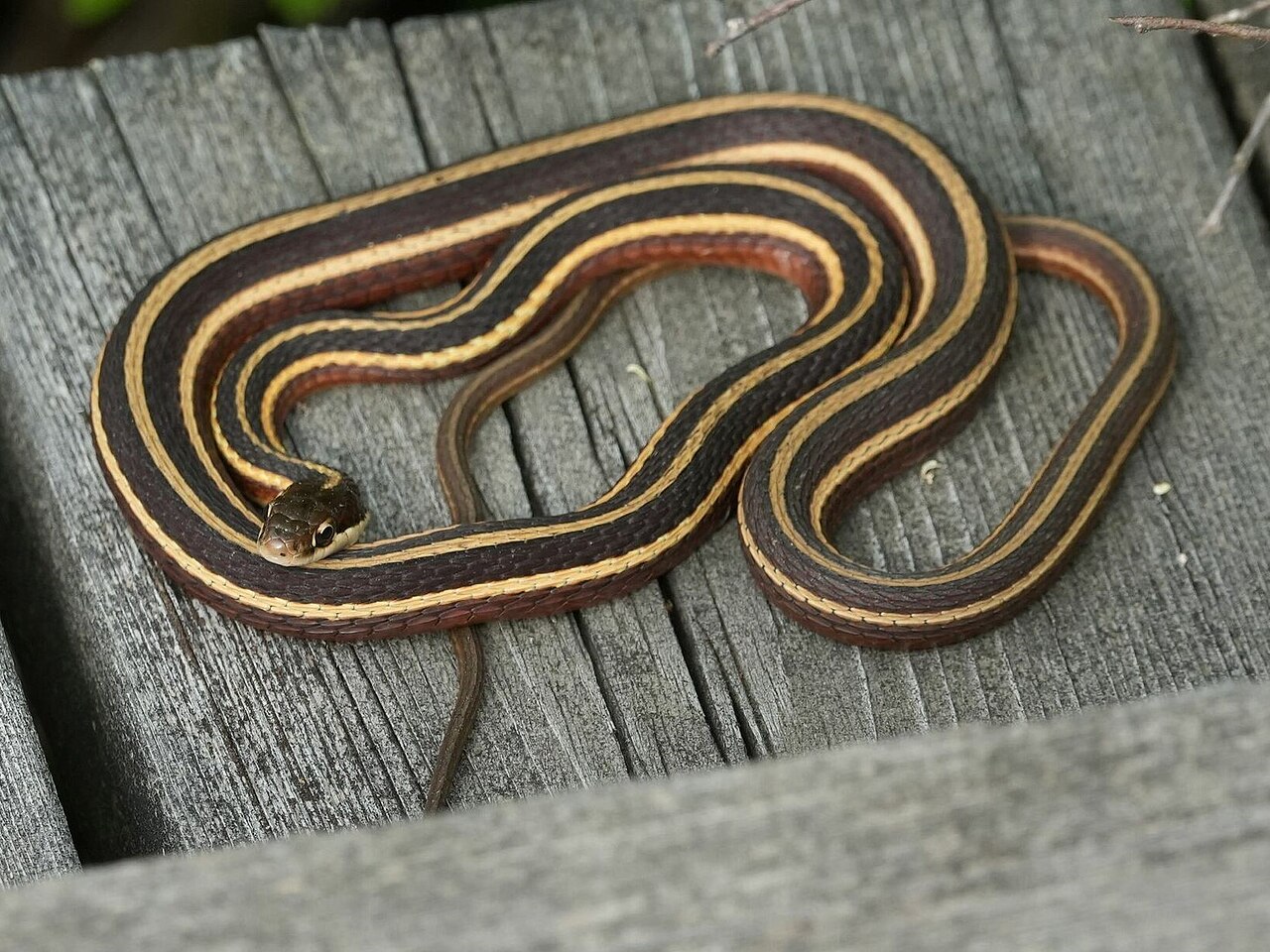
Start with the build. A ribbon snake is strikingly slender for its length, like a piece of cord, with a head barely wider than the neck. Three cream to yellow stripes run the length of a dark brown, olive or black body: one down the spine and one low on each side.
Next check the face. The upper lip scales are bright, unmarked white or yellow, and there is a distinct pale spot just in front of each eye. Garter snakes usually have dark vertical bars between the lip scales and no clean preocular spot.
Finally, look at the tail. Measure from the vent to the tip and compare it to total length. In a ribbon snake the tail is roughly one third of the body, long enough to be obvious even in a photo. That single ratio settles most identifications on its own.
Ribbon Snake vs Garter Snake: What Is the Difference?
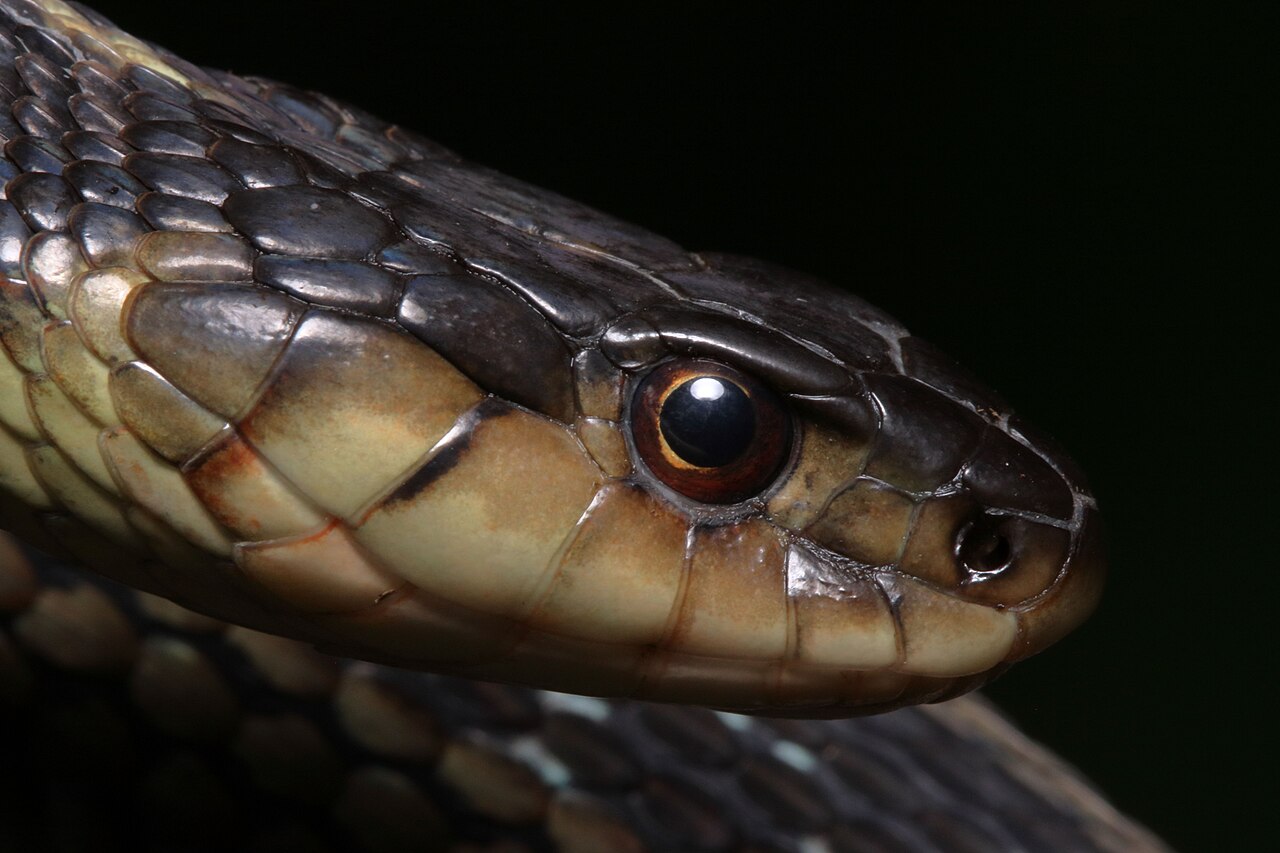
The difference between a ribbon snake and a garter snake comes down to four marks: body build, tail length, stripe placement and lip color. Ribbon snakes are thinner, have a tail near one third of total length, carry their side stripes on scale rows three and four, and have plain white lips. Common garter snakes are stockier, have a tail closer to one quarter, carry side stripes on rows two and three, and usually show black bars on the lips.
Pattern between the stripes helps too. Many garter snakes show a checkerboard of dark spots in the pale space beside the stripes. Ribbon snakes keep that space clean, so the stripes read as sharp unbroken lines.
Behavior is the tiebreaker in the field. A garter snake flushed at a pond edge often heads for cover on land. A ribbon snake goes straight to the water and glides across the surface through the vegetation, rarely submerging.
The Four Ribbon Snake Subspecies
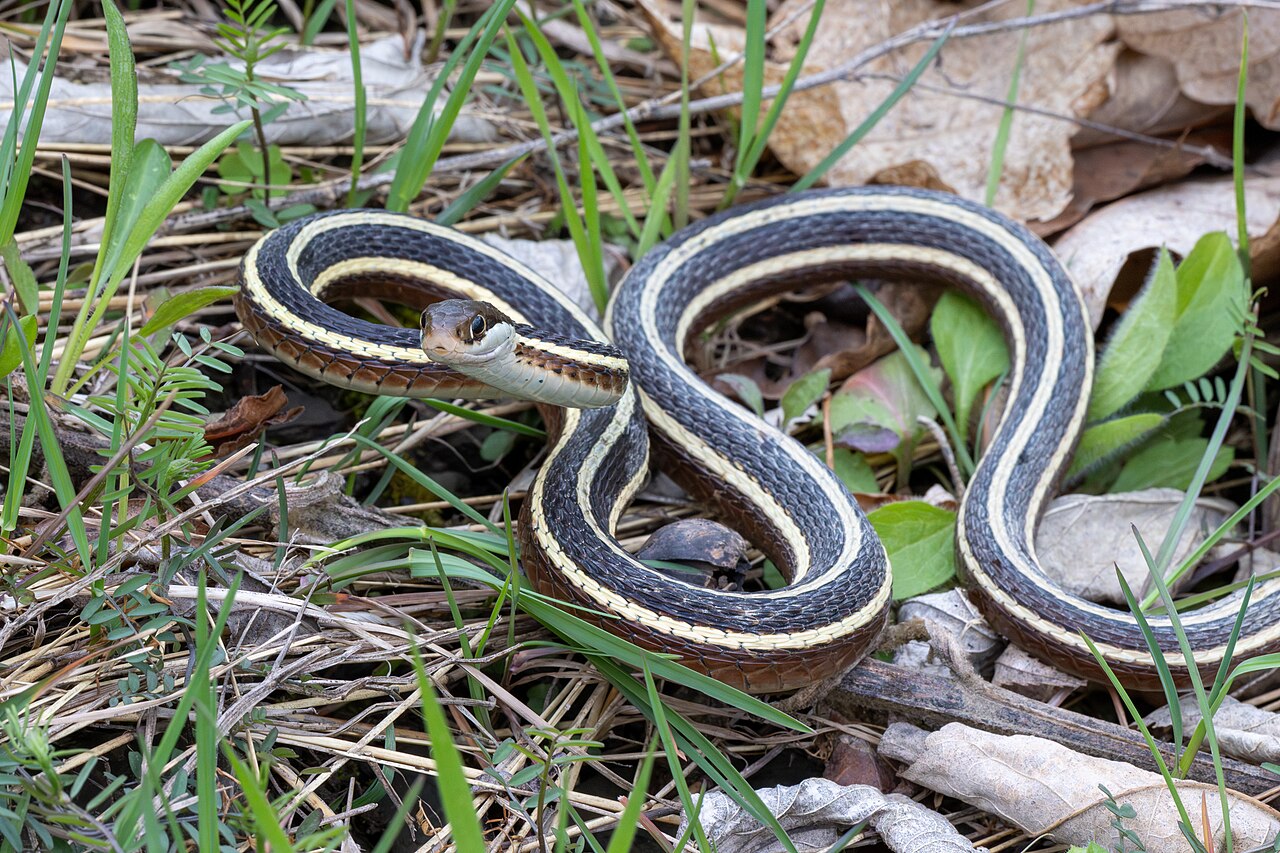
Four subspecies are recognized, and which one you meet depends on where you are standing. The eastern ribbon snake (T. s. saurita) is the familiar form from New England through the Carolinas, with a yellow mid dorsal stripe on a dark brown back.
The northern ribbon snake (T. s. septentrionalis) reaches into Michigan, Ontario and Maine and tends to be darker overall. The peninsula ribbon snake (T. s. sackenii) of Florida is paler, often with a faint or missing back stripe, which throws off identification for visitors used to the northern form.
The bluestripe ribbon snake (T. s. nitae) is limited to Florida’s Gulf coast from Wakulla to Hernando County and swaps the yellow side stripes for pale blue. It is the most localized and the most sought after by photographers. Note that the western ribbon snake of the central states is a separate species, Thamnophis proximus, not a subspecies.
Where Ribbon Snakes Live
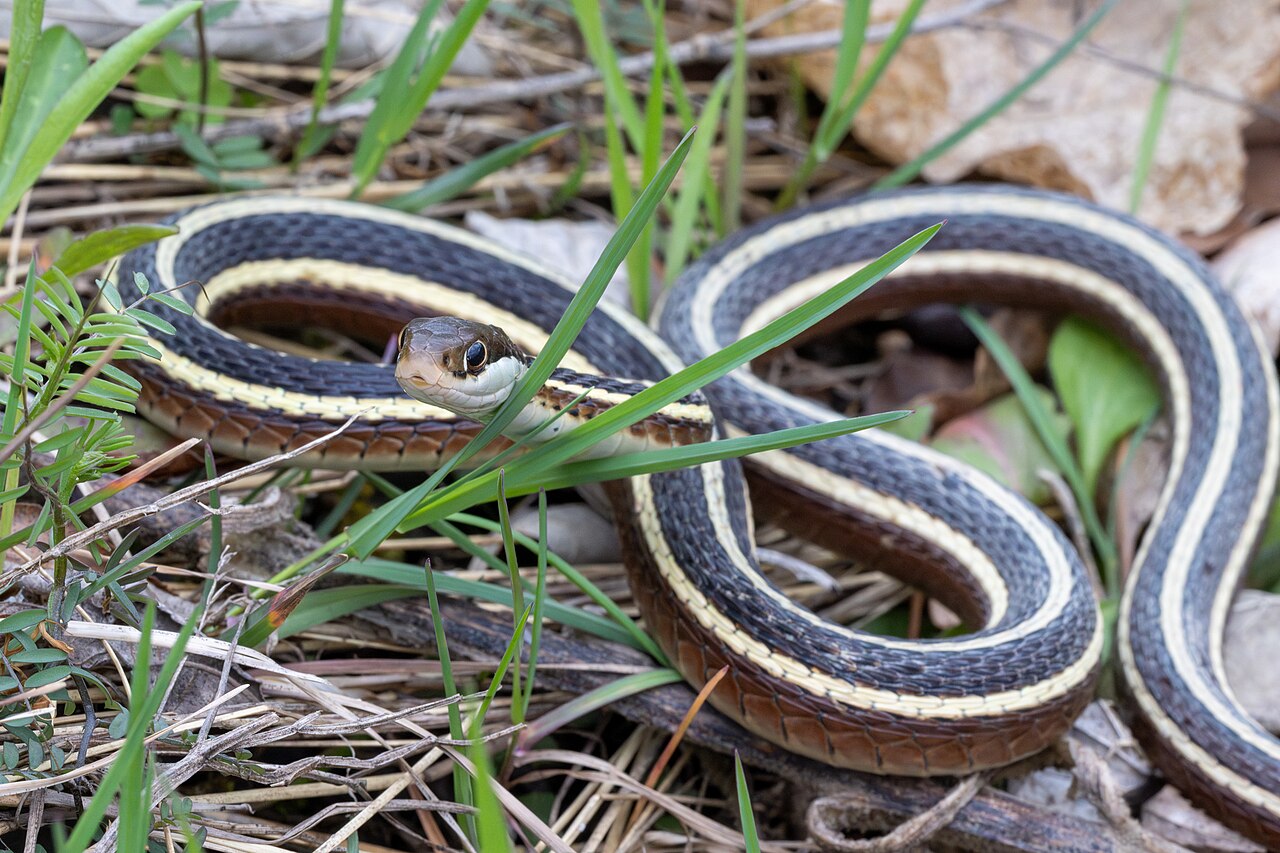
Ribbon snakes live at the edges of shallow, sunlit water: marshes, bogs, wet meadows, stream banks, cypress strands, roadside ditches and the brushy margins of ponds and lakes. They need a bank with thick low cover and a reliable frog population, and they disappear from places where either is missing.
The range runs from southern Maine and the Great Lakes south through Florida and west to the Mississippi River. They are absent from dry uplands and from deep, steep sided water without vegetation.
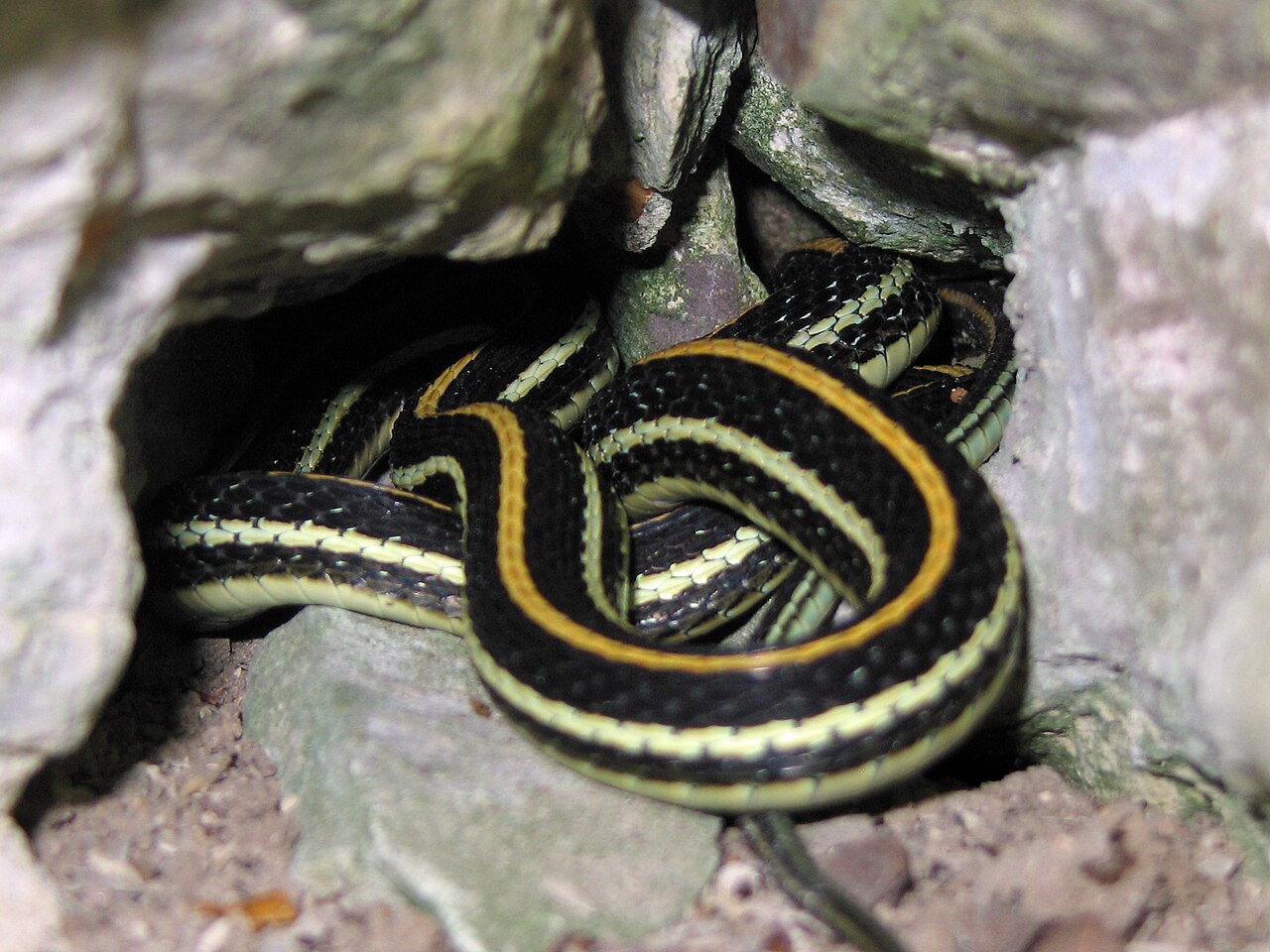
Where winters are cold they overwinter in crayfish burrows, rodent tunnels, rock crevices and old ant mounds, often alongside other species. The way snakes handle the cold season is covered in our guide to snake hibernation and brumation.
Do Ribbon Snakes Go in Water?
Yes. Ribbon snakes are semi aquatic and go into water constantly, both to hunt and to escape. When startled they slip off the bank and swim across the surface with the body held on top of the water and the head up, threading between stems rather than diving.
That surface swimming style is one of the few reliable ways to separate them at a glance from true water snakes such as the banded water snake, which is heavier and drops out of sight. A ribbon snake stays visible and moves fast.
They do not spend the whole day in water. Most of a ribbon snake’s time is spent basking on grass tussocks and low shrubs within a few feet of the shoreline, ready to drop in.
What Ribbon Snakes Eat, and Whether They Eat Mice
Ribbon snakes eat amphibians and small fish. Frogs, toads, tadpoles, newly transformed froglets, salamanders and minnows make up nearly the whole diet, with the occasional earthworm, spider or insect larva. Prey is grabbed and swallowed alive; there is no constriction.
Do ribbon snakes eat mice? Almost never. Unlike the garter snake, which will take an earthworm or a nestling rodent, the ribbon snake is a specialist on cold blooded prey and generally refuses mammals outright. That single fact is the reason so many captive ribbon snakes starve in the hands of owners who expect a rodent feeder like a corn snake.
In the wild, a ribbon snake hunts by cruising the shallows and the grass line with the tongue working, following frog scent. A good breeding pond can support a remarkable density of them in early summer.
Can You Pick Up a Ribbon Snake?
You can, but it will not go well for either of you. A ribbon snake is fast and nervous, and the usual response to being caught is to thrash, void its cloaca and smear a strong smelling musk over your hands. Some individuals bite; the teeth are tiny and the result is a scratch at most.
If you must move one, scoop it from underneath with both hands rather than gripping it, support the body, and keep the hold short. Never grab a ribbon snake by the tail. The tail is long, thin and fragile, and like many small snakes they can lose the tip permanently, which does not grow back.
Bites are trivial. Wash with soap and water and move on, the same handling as a garter snake bite.
Do Ribbon Snakes Like to Be Held?
No snake enjoys handling in the way a dog enjoys attention, and ribbon snakes tolerate it worse than most. They are a high strung, flight first species with a fast metabolism and a small body, and every minute in a warm hand is stress.
Captive raised individuals can become calm enough to sit on a palm without thrashing, but that is tolerance, not enjoyment. Wild caught adults rarely settle at all.
If handling a snake is the point of keeping one, a heavier bodied species is the better match. Ribbon snakes reward watching, not holding.
Can You Have a Ribbon Snake as a Pet?
You can keep a ribbon snake legally in most states, but it is not a beginner animal. The food is the problem: an animal that wants frogs, fish and salamanders means a supply of feeder fish, a thiaminase risk from goldfish, and often live amphibians, which many keepers cannot source reliably or ethically.
The setup is demanding as well. Ribbon snakes need a long tank with tall cover, a warm basking spot, a large water dish or shallow pool, and high humidity without wet bedding. They are escape artists, and a lid that merely rests on the tank will not hold them.
Buy captive bred if you buy at all. Wild caught ribbon snakes arrive loaded with parasites and frequently never feed. For a first snake, a corn snake with its long captive lifespan is the far more forgiving choice.
Ribbon Snake Reproduction and Lifespan
Ribbon snakes mate in spring, shortly after emerging, and some populations also mate in fall. Females give birth to live young rather than laying eggs, typically 3 to 26 per litter in late July through August. Newborns measure 7 to 9 in (18 to 23 cm) and are miniature copies of the adults, fully independent from the first day.
Growth is fast. Males can breed at under two years, females at about two to three, which keeps populations resilient where habitat is intact.
Life expectancy in the wild is short, commonly two to four years, because herons, wading birds, raccoons, largemouth bass and larger snakes all take them. Well kept captives have reached roughly 10 years.
Are Ribbon Snakes Declining?
In much of their range ribbon snakes remain common, but they are vulnerable wherever wetland edges are drained, hardened or mowed. Maine lists the northern ribbon snake as a species of special concern, and Florida’s bluestripe subspecies is tracked closely because of its tiny range.
The pressures are habitat loss, road mortality at pond crossings, and the collapse of amphibian populations they depend on. A ribbon snake cannot persist where the frogs are gone.
State wildlife agencies publish local status and identification help, including the species page from the Commonwealth of Massachusetts. Reporting sightings to a state herp atlas is a genuinely useful contribution, since ribbon snakes are under recorded compared with the more conspicuous bull snake and other large species.
Frequently Asked Questions
Is the ribbon snake poisonous?
No. Ribbon snakes are nonvenomous and not poisonous to touch. They have no fangs and no venom glands, and a bite produces at most a few pinprick scratches. Washing the spot with soap and water is the entire treatment needed.
What is the difference between a ribbon snake and a garter snake?
Ribbon snakes are slimmer, have a tail about one third of total length, carry their side stripes on scale rows three and four, and have plain white lips with a pale spot before the eye. Garter snakes are stockier, have shorter tails, lower stripes and barred lips.
Can you have a ribbon snake as a pet?
Yes, though it is a poor beginner species. They need frogs, fish or salamanders rather than mice, a humid setup with water and tall cover, and a secure lid. Buy captive bred stock only; wild caught ribbon snakes often refuse food and carry heavy parasite loads.
Do ribbon snakes eat mice?
Almost never. The diet is built around cold blooded prey: frogs, tadpoles, salamanders and small fish. Most ribbon snakes refuse rodents entirely, even in captivity, which is why keepers who expect a mouse feeding snake end up with an animal that will not eat.
Do ribbon snakes like to be held?
No. They are nervous and fast, and typically respond to handling by thrashing and releasing musk. Captive bred individuals can learn to tolerate short sessions calmly, but handling is always stress for them, never something the snake seeks out.
Do ribbon snakes go in water?
Constantly. They hunt at the shallow edges of ponds, marshes and streams and escape by swimming across the surface with the head raised, weaving through plant stems instead of diving. Water is their primary escape route, which is why they stay within a few feet of it.