Raccoon Tracks: 5 Toes, Hand-Like Prints and 4 Lookalikes
Raccoon tracks are the easiest wild mammal prints to name once you know the detail that settles it: five long toes on both the front and the hind foot, spread wide, with small claw marks just ahead of each toe pad. The front print looks like a tiny human hand and the hind print like a narrow human foot, and nothing else in a North American yard leaves that pair.
The second detail is the walking pattern. A raccoon paces, moving the front foot on one side with the hind foot on the other, so its trail is a row of offset pairs rather than a single line. Snow, mud and sand record those features differently, and the sections below take them in that order. Agency guides such as those from the National Park Service use the same two features as the primary check.
A raccoon track shows five slender toes with visible claw tips on both front and hind feet. Front prints measure 1.75 to 3 in (4.5 to 7.5 cm) long and look hand-like; hind prints are longer at 2 to 4 in (5 to 10 cm) with a heel pad. Tracks appear as offset front and hind pairs from the animal’s pacing walk.
| Feature | Front foot | Hind foot |
|---|---|---|
| Toes | 5, long and finger-like | 5, with a heel pad behind |
| Length | 1.75 to 3 in (4.5 to 7.5 cm) | 2 to 4 in (5 to 10 cm) |
| Width | 1.5 to 2.5 in (4 to 6.5 cm) | 1.5 to 2.5 in (4 to 6.5 cm) |
| Claws | Usually visible, small and sharp | Usually visible |
| Shape | Spread human hand | Narrow human foot |
| Gait | Pacing walk, front beside opposite hind | Stride 7 to 18 in (18 to 46 cm) |
| Where | Creek banks, pond edges, mud, snow, lawns | Same, plus deck rails and flat roofs |
What Do Raccoon’s Tracks Look Like?
A clear raccoon print shows five toes radiating from a rounded palm pad with a visible gap between each toe. The toes are long relative to the pad, which produces the hand-like look, and the claws register as small points set slightly forward of the toe tips rather than as part of them. The raccoon (Procyon lotor) cannot retract its claws, so in soft ground they almost always show.
Front and hind prints separate at a glance. The front is wider than long and genuinely resembles a small hand; the hind is longer and narrower, with a distinct heel that stretches the print backward into a stubby foot. Both are flat and plantigrade, meaning the whole sole touches down. The pacing gait confirms it: each pair holds one front and one hind print side by side, and the pairs alternate sides. For the four-toed canine alternative, see our guide to coyote tracks.
Raccoon Tracks in Snow
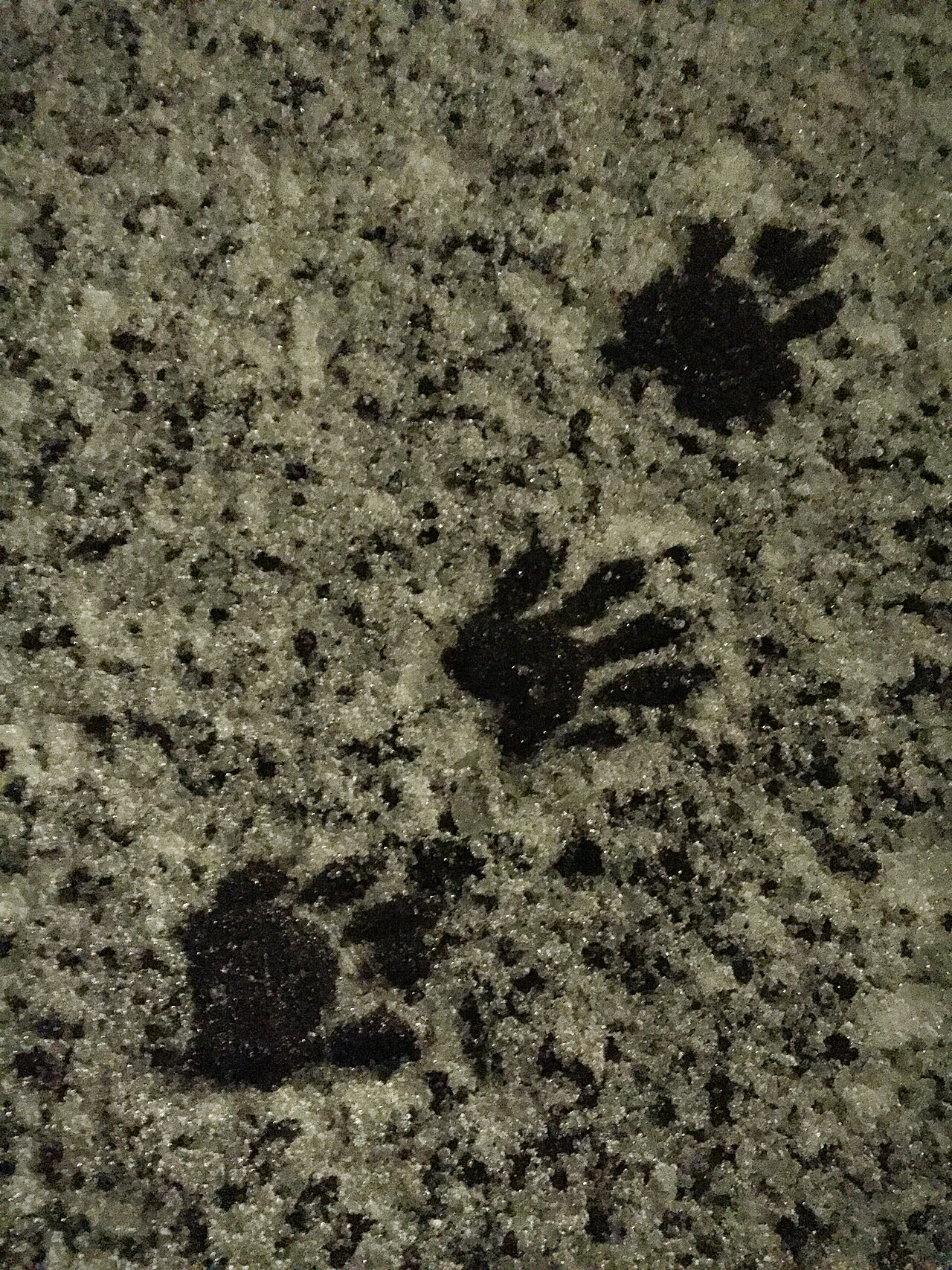
Snow gives the best raccoon records of the year, on one condition: it has to be shallow and wet enough to hold an edge. In 0.5 to 1.5 in (1 to 4 cm) of settled snow over a hard surface such as a driveway or a frozen deck, toe and claw detail survives intact and the pacing pairs read for yards.
Deep powder loses that detail. Above about 3 in (8 cm) a raccoon’s short legs drag and the trail becomes a trough with the prints collapsed inside it, still identifiable by drag marks and stride but not by toe count. Crusted snow records only a shallow smear. Winter tracks are scarcer in northern states than people expect, because raccoons den up through severe cold; our article on whether raccoons hibernate explains why a January thaw brings a sudden burst of fresh prints.
Raccoon Tracks in Mud
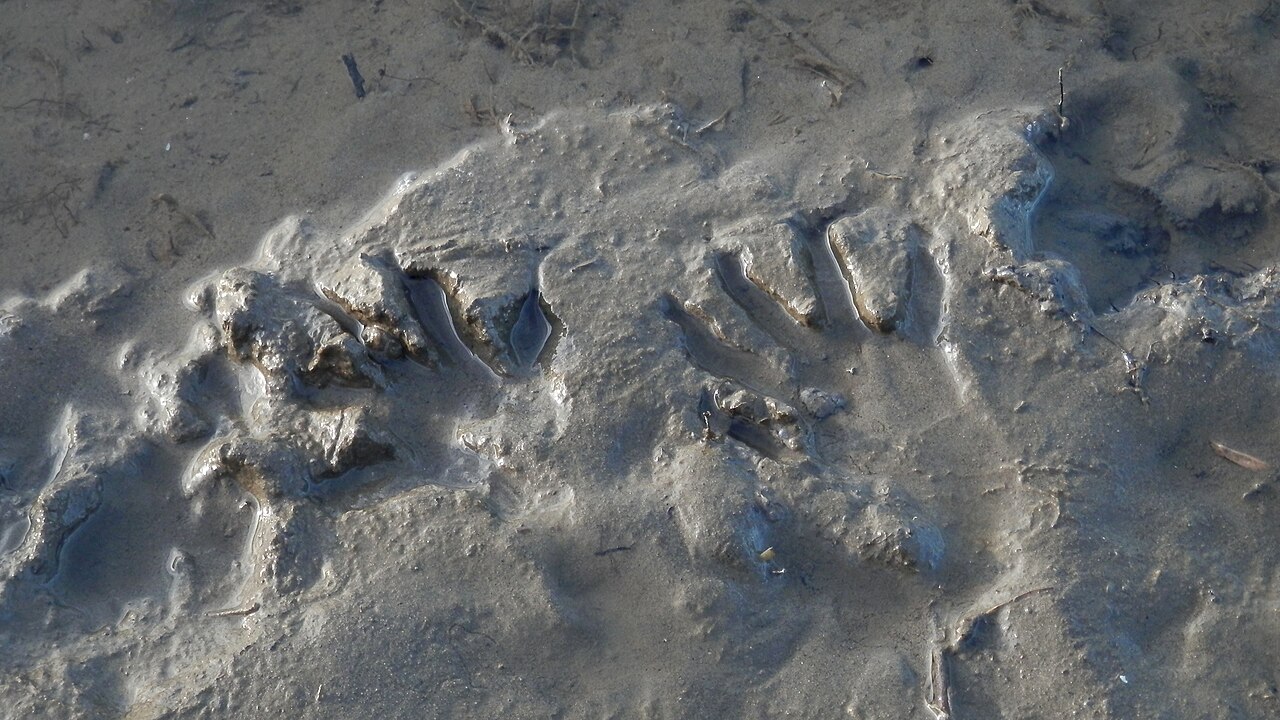
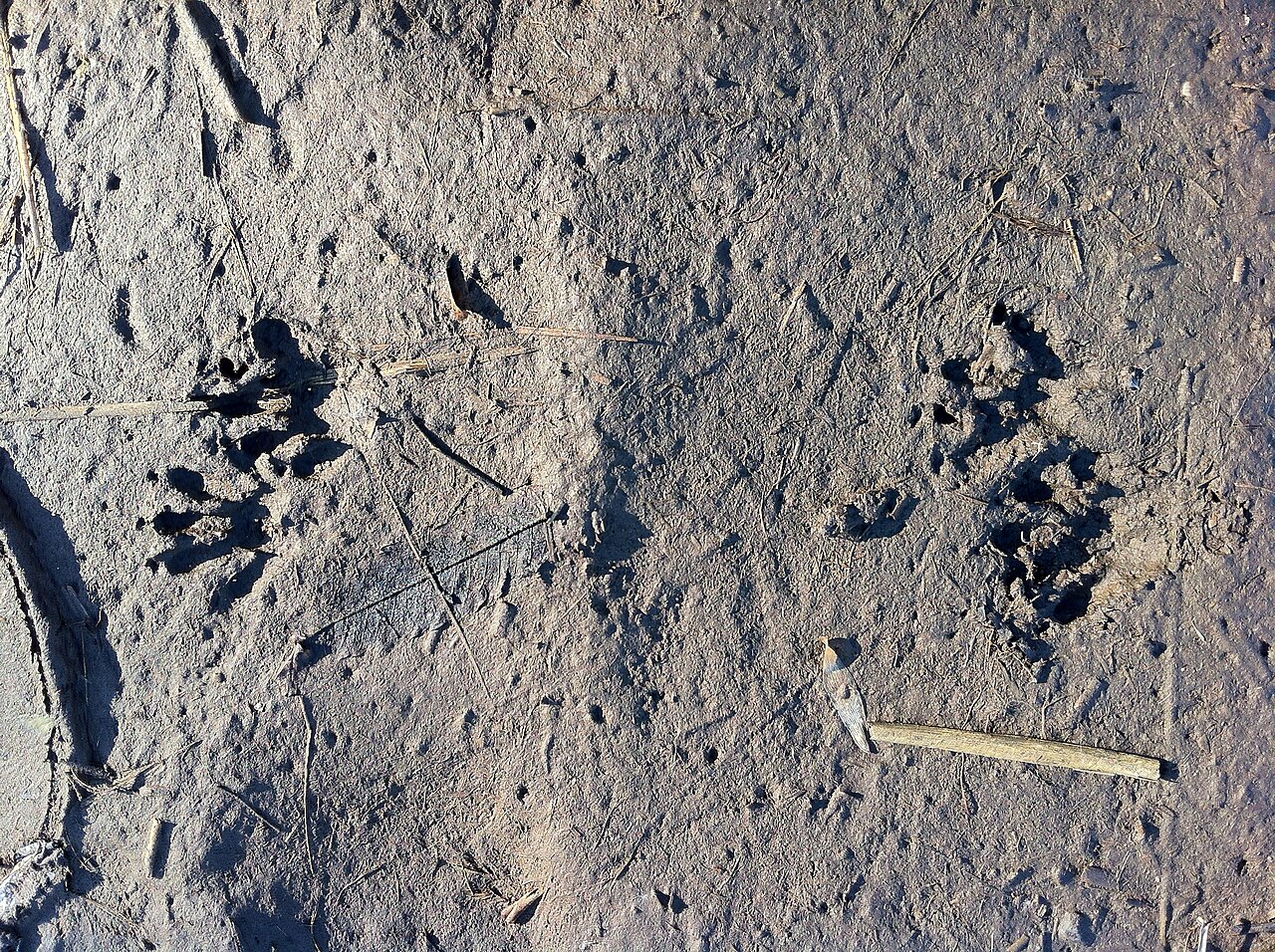
Mud at a creek edge, pond margin or the bare strip beside a garden hose is where raccoon tracks are most abundant, because raccoons forage along water for crayfish, frogs and mussels. Fine silty mud takes a near perfect cast, showing individual claw punctures and the segmented palm pad.
Read depth and edges for age. A fresh print has sharp vertical walls and a glossy surface; after a few hours the edges slump and the sheen dries off. Soft mud also exaggerates size, so measure the pad rather than the whole depression: a hind print that looks 5 in (13 cm) long is usually a 3 in (8 cm) foot with a heel slide. The stiffer prints of a bobcat on the same bank show how much the substrate adds.
Raccoon Tracks in Sand
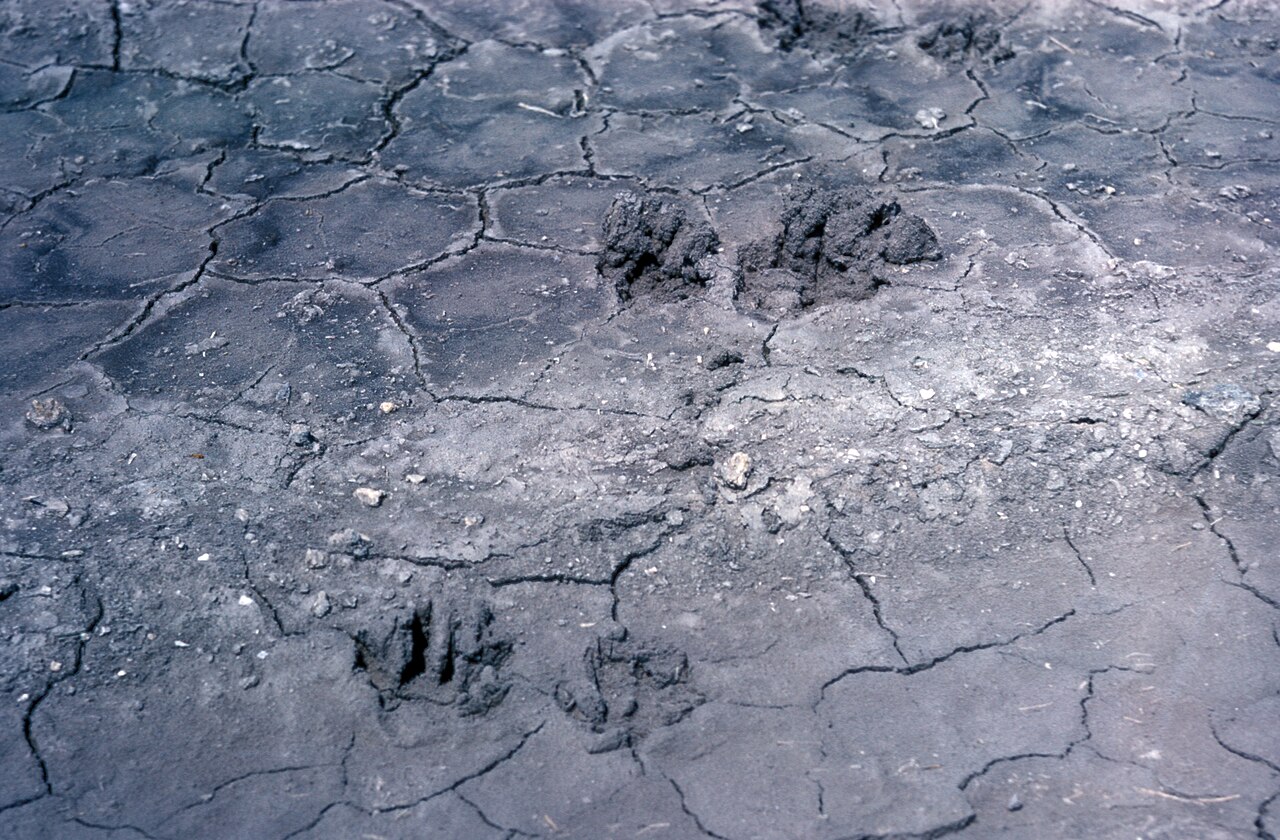
Dry sand is the hardest surface to read, because it collapses inward the moment the foot lifts. What survives is the outline and the trail pattern rather than the toes, so identification there rests almost entirely on the offset pairing and the stride length of 7 to 18 in (18 to 46 cm).
Damp sand near the waterline behaves like mud and records well. On beaches and sandbars raccoon trails run parallel to the water along the wrack line, with digging marks and overturned shells beside the prints. Wind softens sand prints within hours, so secondary sign beats dating the print itself.
What’s the Difference Between a Raccoon Track and a Possum Track?
This is the genuinely difficult pair, since the Virginia opossum also prints five toes on all four feet. The separator is the hind foot: the opossum has an opposable inner toe that sticks out sideways at close to a right angle, like a thumb, so the hind print looks like a splayed hand with one digit far off to the side. A raccoon’s toes all point roughly forward.
Toe length is the second check. Opossum toes are shorter and more evenly star-shaped around the pad, while raccoon toes are long, slim and clearly tapered, and opossum claw marks are finer or absent on the hind foot. Size overlaps too much to decide alone, with opossum front prints at 1.25 to 2 in (3 to 5 cm) against 1.75 to 3 in (4.5 to 7.5 cm) for a raccoon, so find one clean hind print and the question answers itself.
Raccoon Tracks vs Dog, Coyote, Cat and Fox Tracks
Toe count removes all four at once. Dogs, coyotes, cats and foxes are four-toed on every foot and raccoons are five-toed on every foot, and that count is decisive whenever the print is clean. Four toes means it is not a raccoon no matter what the size suggests.
The shapes differ as well. Canine prints are oval with blunt claw marks and a triangular heel pad, and coyote trails run in a tight near straight line. Cat prints are round, asymmetrical and show no claws. Fox tracks are the narrowest of the group, often with a visible bar across the front pad in the red fox. Gait settles any doubt: dogs trot in a line, cats place each foot nearly in the last print, and a raccoon leaves its alternating pairs.
What Are the Differences Between Raccoon and Skunk Tracks?
Striped skunks also have five toes, so this comparison rests on proportion and claws. A skunk’s front claws are long digging tools, up to 0.4 in (1 cm), and they print well ahead of short stubby toes, which makes the front track look like a row of dashes in front of a small pad. Raccoon claws are short and sit close to long toes.
Size separates them cleanly. A skunk front print is about 1 to 1.5 in (2.5 to 4 cm) long and the hind print 1.5 to 2 in (4 to 5 cm), and the skunk hind foot shows a long narrow heel without the hand-like spread. The digging differs too: skunks leave cone-shaped holes 2 to 4 in (5 to 10 cm) across, while raccoons peel back strips of turf. For another five-toed hind print that confuses people here, see squirrel tracks.
What Raccoon Tracks in Your Yard Are Telling You
A trail that crosses the yard once and leaves is a traveling animal and means nothing. Tracks that loop repeatedly around the same three points, typically a bin, a pet bowl and a water source, mean a raccoon has worked out a feeding route and will keep using it. The number of loops matters more than the number of prints.
Follow the trail to where it ends. Prints that stop at a downspout or at a tree against the house suggest a climb to the roof, and prints fading into a crawl space vent suggest a den. Flattened turf and tipped planters along the route show how long the pattern has run.
Frequently Asked Questions
What is a raccoon’s biggest enemy?
Coyotes are the most significant wild predator of raccoons across most of the United States, followed by bobcats, great horned owls and large domestic dogs. Young raccoons are vulnerable to all of these, while healthy adults are mainly at risk from coyotes. Vehicles and canine distemper kill more raccoons than any predator does.
What gets rid of raccoons fast?
Removing the food source works faster than anything else: secure trash bins with locking lids, bring pet food indoors, pick up fallen fruit and take down bird feeders for two weeks. Raccoons abandon a yard that stops paying. Sealing entry points to attics, chimneys and crawl spaces afterward keeps them from coming back.
What are baby raccoons called?
Baby raccoons are called kits or cubs, and a group born together is a litter of two to five. They are born blind in spring, open their eyes at about three weeks and start following the mother on foraging trips at eight to ten weeks. Our guide to the baby raccoon covers the first year.
What are raccoons terrified of?
Raccoons react most strongly to sudden light and noise, which is why motion-activated sprinklers and lights outperform static deterrents. They are also wary of open ground and of dog scent. Habituated urban raccoons lose their fear of most repellents within days, so rotating methods works better than repeating one.
What is a strange fact about raccoons?
A raccoon’s front paws carry roughly four to five times more sensory receptors than its hind paws, and about two thirds of the brain area devoted to touch processes signals from them. Wetting the paws increases that sensitivity, which is one accepted explanation for the dousing behavior behind the animal’s scientific name.