Porcupine Tracks: How to Identify Them in Snow, Mud and Sand
Porcupine tracks have two features nobody else has: a pebbled sole that prints like coarse sandpaper, and long curved claws well ahead of the toes. The North American porcupine (Erethizon dorsatum) puts four toes on each front foot and five on each hind foot, walks pigeon toed and drags its tail.
Winter is the season for this. Porcupines stay active all year, and in snow they plow troughs between den and feeding tree that you can follow for hundreds of feet.
Porcupine front tracks measure about 1.5 to 2 in (3.8 to 5 cm) long with four toes; hind tracks run 2 to 3.25 in (5 to 8 cm) with five toes. Claws print clearly, soles look pebbled, and toes angle inward. Stride is short, roughly 6 to 11 in (15 to 28 cm), with frequent tail drag.
What Do Porcupine Tracks Look Like?
Start with the toe count: four toes in front and five behind is an unusual combination at this size. The claws are long, curved and blunt from climbing, and unlike cat tracks they almost always register. Sole texture is the second marker, because small knobbed bumps print as a rough, pebbly surface across the whole pad, and nothing else in range does that.
| Feature | Front foot | Hind foot |
|---|---|---|
| Toes | 4 | 5 |
| Length | 1.5 to 2 in (3.8 to 5 cm) | 2 to 3.25 in (5 to 8 cm) |
| Width | 1 to 1.5 in (2.5 to 3.8 cm) | 1.25 to 1.75 in (3.2 to 4.4 cm) |
| Claws | Usually register | Usually register |
| Sole | Pebbled | Pebbled |
| Stride | 6 to 11 in (15 to 28 cm) | Straddle 5 to 9 in (13 to 23 cm) |
| Extra sign | Tail drag arcs | Quills, nipped twigs, scat |
Porcupine Tracks in Snow
In snow deeper than about 6 in (15 cm) the prints vanish and the animal becomes a trough maker, plowing a walled channel 6 to 9 in (15 to 23 cm) wide, the belly smoothing the floor and the tail sweeping across it. Those curved arcs are the most reliable winter sign. Follow the trough: winter porcupines reuse one packed route between den and feeding tree, so a fresh January trail ends at an active den. The straight clean lines of coyotes crossing the same snow belong to an animal traveling, not commuting.
Porcupine Tracks in Mud and Sand
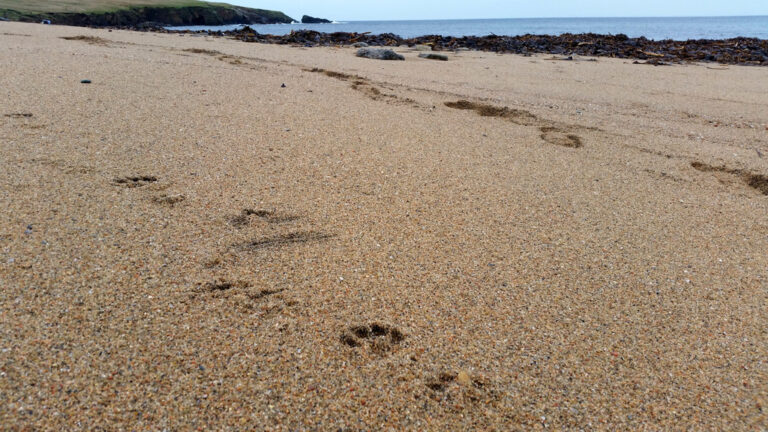
Mud holds the detail. Pond edges and logging road ruts record toe count, claw dots and pebbled sole at once, including the inward rotation of the hind feet, up to 30 degrees off the line of travel. Dry sand gives less, since the texture collapses and the claws blur, so work from the pattern: short stride, wide straddle, alternating prints with drag marks between. Wet sand behaves like mud, and deer prints usually sit nearby for scale.
Porcupine Tracks vs Beaver Tracks
Beavers share the pond edges and are the most common mix up. Toe count settles it: five toes front and hind, a huge hind foot of 5 to 7 in (13 to 18 cm), webbing that often shows as a smooth fan. A beaver tail drag is a wide flat smear, not sweeping arcs, and beaver trails run to water while porcupine trails run tree to tree.
Porcupine Tracks vs Raccoon and Fisher Tracks
Raccoons print five long toes on both feet and the hind track looks like a small human hand, so the confusion is only about size. Fishers, the porcupine’s main predator, bound in paired prints and cover ground fast where a porcupine shuffles, as our fisher track breakdown shows. Bobcat tracks make the opposite case: four round toes, no claw marks.
Other Signs Along the Trail
Look up for stripped bark with tooth grooves, usually high in hemlock, pine, maple or aspen. Look down for twigs nipped at a clean angle and for scat: comma shaped pellets 0.5 to 1 in (1.3 to 2.5 cm) long, full of wood fiber and often heaped below a den. Quills on a trail confirm the species without a print. The National Park Service publishes porcupine notes for many units.
Frequently Asked Questions
Are porcupine spikes sharp?
Yes. Quills are sharp, hollow and tipped with microscopic backward facing barbs that drive in easily and resist pulling out. They are not venomous and are not thrown. Contact happens when a dog or predator presses against the animal, which swings its tail.
Where do porcupines go during the day?
They rest in rock crevices, hollow logs, abandoned burrows and tree canopies, often using the same den for years. In summer they spend long stretches high in trees. A scat filled crevice at the end of a trail is the den.
What is another animal that looks like a porcupine?
Hedgehogs look closest but do not live wild in North America. Within its range the real look-alikes are beavers and groundhogs, both heavy bodied and slow in low light. Quills and the pebbled sole separate the porcupine.
Is it bad to have a porcupine in your yard?
Usually harmless, with two exceptions: dogs get quilled and need a vet, and the animals gnaw bark, plywood, salt treated wood and vehicle wiring. Remove salt sources and wrap valued trunks in flashing. For the larger neighbor, see bear track identification.