Baby Milk Snake: Harmless, or a Coral Snake? How to Tell
A baby milk snake (Lampropeltis triangulum) is harmless. The trouble is the paint job. Hatchlings wear red, black and yellow or white bands, and that pattern looks a lot like a venomous coral snake (Micrurus fulvius) or a young copperhead (Agkistrodon contortrix).
Milk snake hatchlings appear in late summer in basements, woodpiles and gardens. Band order, head shape and tail tip settle the question in seconds once you know where to look.
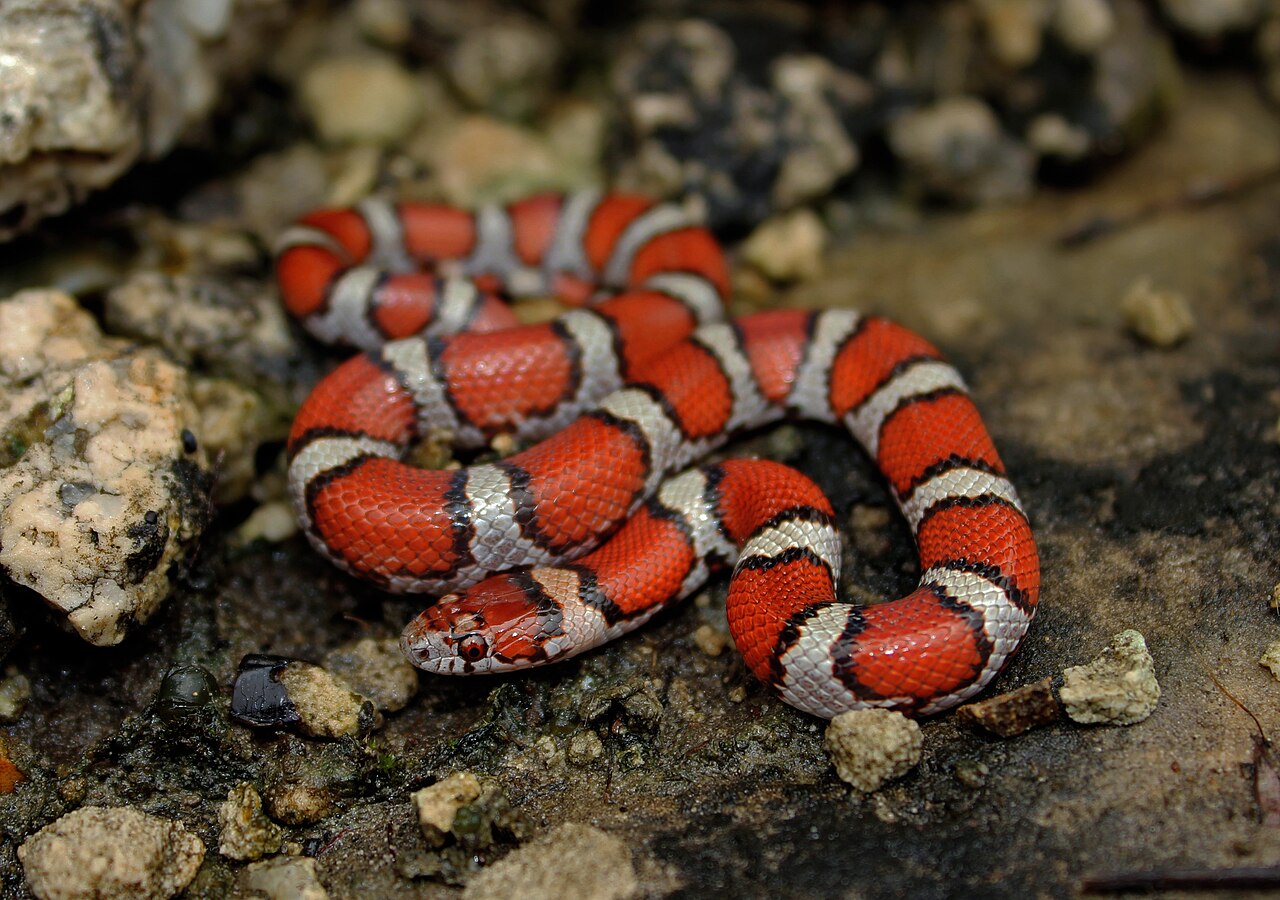
A baby milk snake is a harmless, nonvenomous constrictor. Its red or reddish brown bands or blotches are edged in black, so red touches black. A US coral snake has red touching yellow. Baby copperheads differ again, with hourglass crossbands, a broad head and a bright yellow tail tip.
What Does a Baby Milk Snake Look Like?
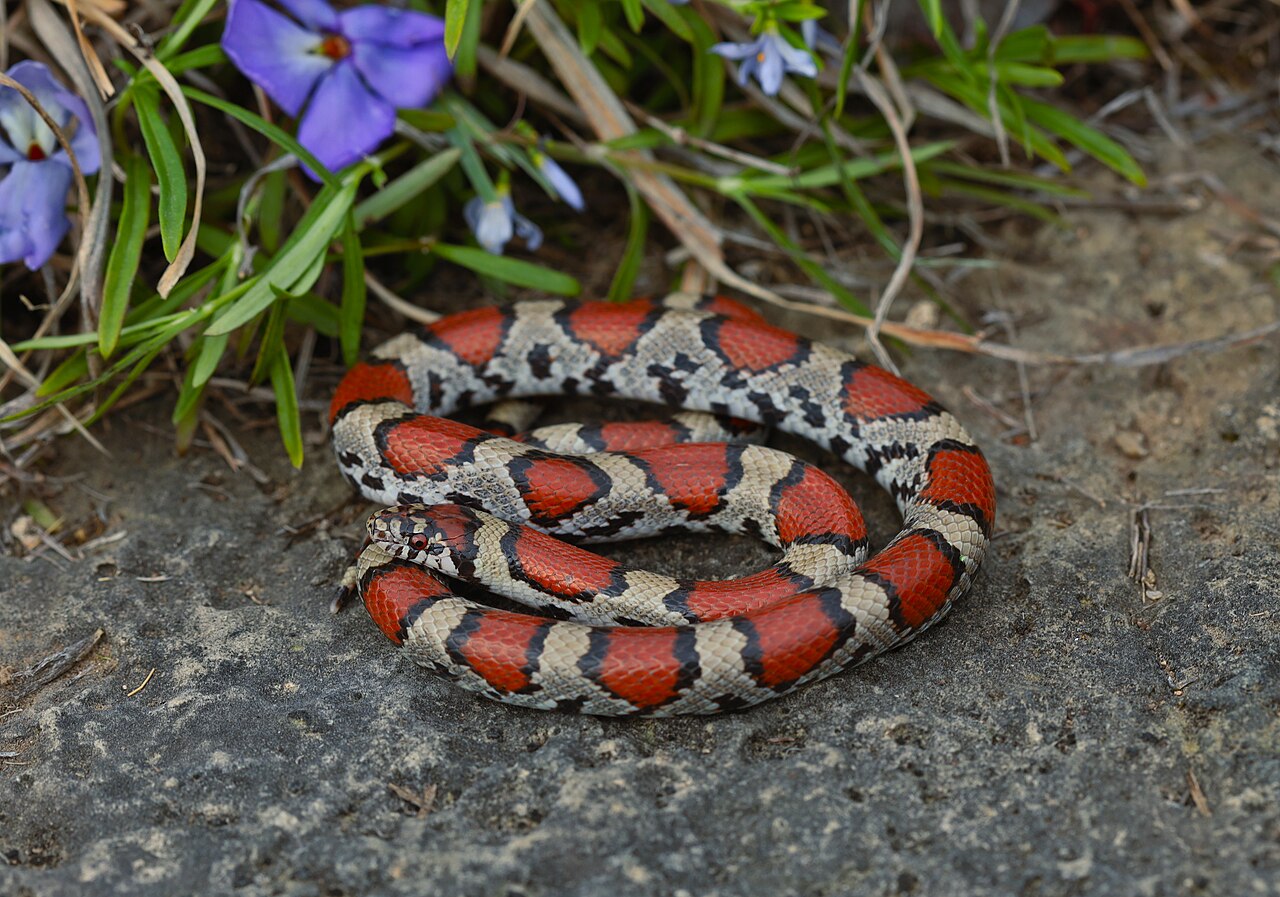
A baby milk snake is slim, small and smooth scaled, with a glossy shine. Hatchlings measure 6 to 11 inches and are about as thick as a pencil. Adults reach 2 to 3 ft. Eastern hatchlings carry bright red blotches edged in black on a gray or tan base. Southern and western forms wear red, black and yellow or white bands, often as rings that wrap the body.
Many hatchlings show a light Y or V mark on the back of the head, and the belly is checkered black and white like a chessboard. Baby corn snakes share the blotched look, but they run more orange and carry a spear point mark between the eyes.
| Milk snake form | Where it lives | Baby coloring | Wild or pet trade |
|---|---|---|---|
| Eastern milk snake | Northeast and Great Lakes states, southern Canada | Red or reddish brown blotches edged in black on gray or tan | Mostly wild |
| Western milk snake | Great Plains | Red or orange bands bordered in black, with white, cream or pale yellow bands | Wild, some bred |
| Louisiana milk snake | Louisiana, southwest Arkansas, southeast Oklahoma and east Texas | Bright red, black and yellow or white rings | Wild and bred |
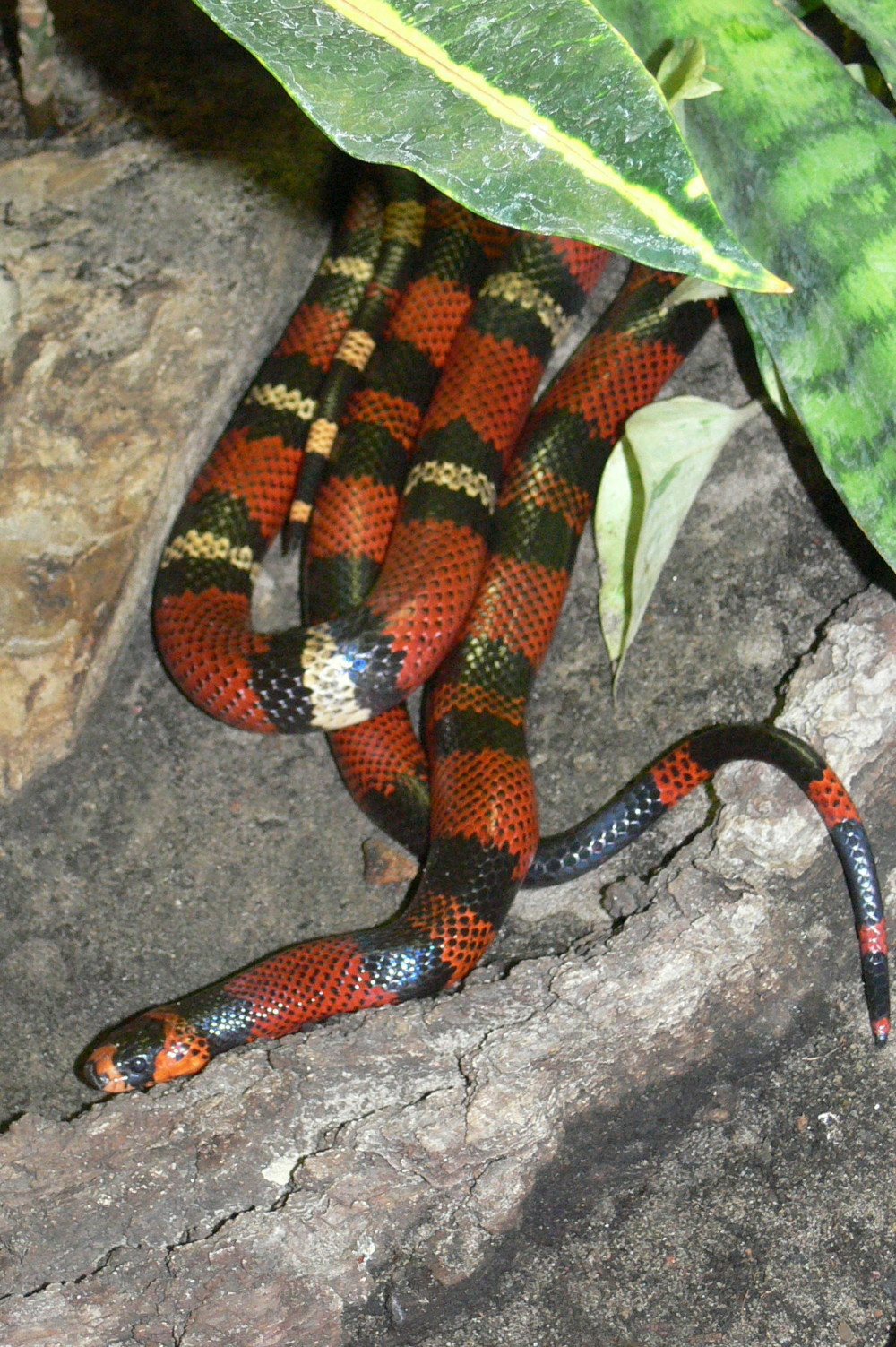
| Honduran milk snake | Central America | Wide red rings with black and yellow or orange rings | Mostly bred |
| Pueblan milk snake | South central Mexico | Red, black and white rings | Mostly bred |
Baby Milk Snake vs Coral Snake and Baby Copperhead
The milk snake’s bands copy the warning colors of the coral snake, a trick called Batesian mimicry that makes predators back off. In the US, red touching black means milk snake and red touching yellow means coral snake. Look at where the red bands meet, not at the colors alone.
The rhyme fails outside the US. Many coral snakes in Latin America have red touching black, so never use it on snakes from there or on imported pets. Do not rely on snout color. Band order is the reliable test, and only within the US. Coral snakes and king snakes get confused for the same reason, because the milk snake is itself a member of the king snake genus Lampropeltis.
Baby copperheads are the other common mix up. They show hourglass crossbands in tan and copper, a broad triangular head and a bright yellow tail tip. A milk snake has a narrow head and no yellow tail.
Where Baby Milk Snakes Live and When They Hatch
Baby milk snakes hatch across one of the largest ranges of any snake, from southern Canada through the eastern and central US and Mexico into Central America and northern South America. They use fields, woodland edges, rocky hillsides, farm buildings and old stone walls.
Females lay eggs in early summer in rotting logs, leaf piles or loose soil. The eggs hatch after about 6 to 9 weeks, in late summer. The babies get no parental care.
Eastern milk snakes cover the northern part of the range, from Maine west to Minnesota and south along the Appalachians to northern Alabama and Georgia. Farther south and west, banded forms take over.
What Do Baby Milk Snakes Eat and How Do They Grow?
Wild baby milk snakes eat small lizards such as skinks, plus other young snakes. As they grow, they switch to mice, voles and other small rodents. Baby king snakes start on a similar menu of lizards and small snakes.
A hatchling sheds its skin for the first time shortly after hatching. In eastern milk snakes, the bright red of youth darkens toward brown with age. An adult looks far duller than the baby you found.
Hawks, owls, raccoons, foxes and larger snakes all prey on hatchlings. Cover and stillness are a baby’s main defenses.
Baby Milk Snake as a Pet, Buying, Feeding and Safe Handling
A baby milk snake makes a good pet if you buy a captive bred hatchling from a breeder. Wild babies often refuse food, and taking them from the wild is a poor start. Captive hatchlings eat one pinkie mouse every 5 to 7 days. Adults need an adult mouse only every 10 to 14 days.
Hatchlings are nervous at first. They calm down with short, regular handling sessions. Adult milk snakes need a bigger enclosure and bigger prey, but the routine stays the same.
The CDC and the New York State Department of Health note that reptiles often carry Salmonella, even when they look healthy and clean. Wash your hands after every session and after cleaning the tank. Children under 5 should not handle or touch the snake or its tank. Feeder rodents can carry germs too, and freezing does not kill them.
Frequently Asked Questions
How many babies does a milk snake have at once?
About 10 eggs is typical for an eastern milk snake clutch. The eggs are white and leathery and stick together in a clump, so a whole group of hatchlings can appear in one woodpile within a few days.
How long will a baby milk snake stay in my house?
Days to weeks. A hatchling stays as long as it finds cover and mice, and slips in through foundation cracks, gaps around pipes and open vents in late summer. Most leave on their own once food runs short. Seal the gaps after the snake goes.
Are baby milk snakes active at night?
Yes, mostly in summer. Then milk snakes are active at night, and in spring and fall they are active by day.
What does a scared baby milk snake do?
Three things. It vibrates its tail, releases a foul musk and may strike several times in a row. The tail buzz in dry leaves sounds a bit like a rattle. The bite is not venomous, but wash any scratch or bite with soap and water, which also removes the musk.
Sources
- CDC, Reptiles and Amphibians (Healthy Pets, Healthy People)
- New York State Department of Health, Salmonella and Amphibians and Reptiles, Questions and Answers