Baby Raccoon: Facts, Care, and What to Do
A baby raccoon is called a kit or a cub, and it is born in spring, tiny and helpless, but already wearing the faint outline of the black mask and ringed tail that make raccoons so recognizable. Baby raccoons stay with their mother for the better part of a year, learning to climb, forage, and survive before striking out on their own. If you find one that seems alone, the most important thing to know is that the mother is very often nearby, and healthy kits are best left for her to raise.
This guide covers what baby raccoons are called, what they look like, how they grow, what they eat, where they den, what to do if you find one, and the real health risks that mean you should never handle or keep a wild raccoon. It also explains why keeping one as a pet is both illegal and unwise in most places.
| Fact | Detail |
|---|---|
| Name for a baby raccoon | Kit or cub |
| Litter size | Usually 3 to 5 |
| Born | Spring, eyes closed, faint mask |
| Eyes open | About 3 weeks |
| Stay with mother | Up to 8 to 12 months |
| Common den sites | Tree hollows, attics, chimneys |
| Health note | Rabies vector, roundworm risk, do not handle |
What Is a Baby Raccoon Called?
A baby raccoon is called a kit, and the term cub is also commonly used. A group of kits born together is a litter, and the mother is called a sow while the male is a boar, borrowing the same words used for several other mammals. Litters usually number three to five kits, born once a year in the spring.
Raccoon mothers are devoted and raise their young alone, with no help from the father. The sow keeps the kits hidden in a secure den for the first weeks of life and moves them to new dens as needed, carrying each kit by the scruff of the neck the way a cat carries kittens.
These names and facts come up whenever someone discovers a nest of kits in an attic, chimney, or hollow tree. Whether you call them kits or cubs, they are young raccoons that depend completely on their mother at first and remain with her far longer than most backyard mammals, often into the following winter.
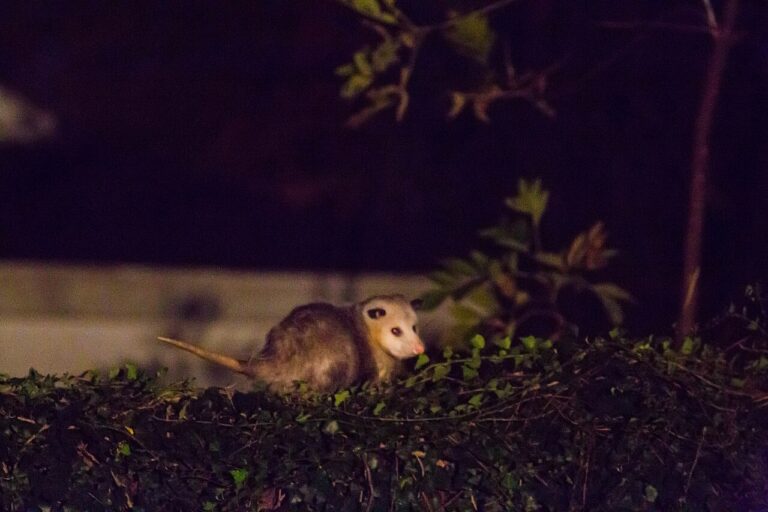
Raccoons are one of several backyard mammals people find alone as juveniles. Another common find is a baby possum, which uses a different size threshold to determine whether it is truly orphaned.
What Does a Baby Raccoon Look Like?
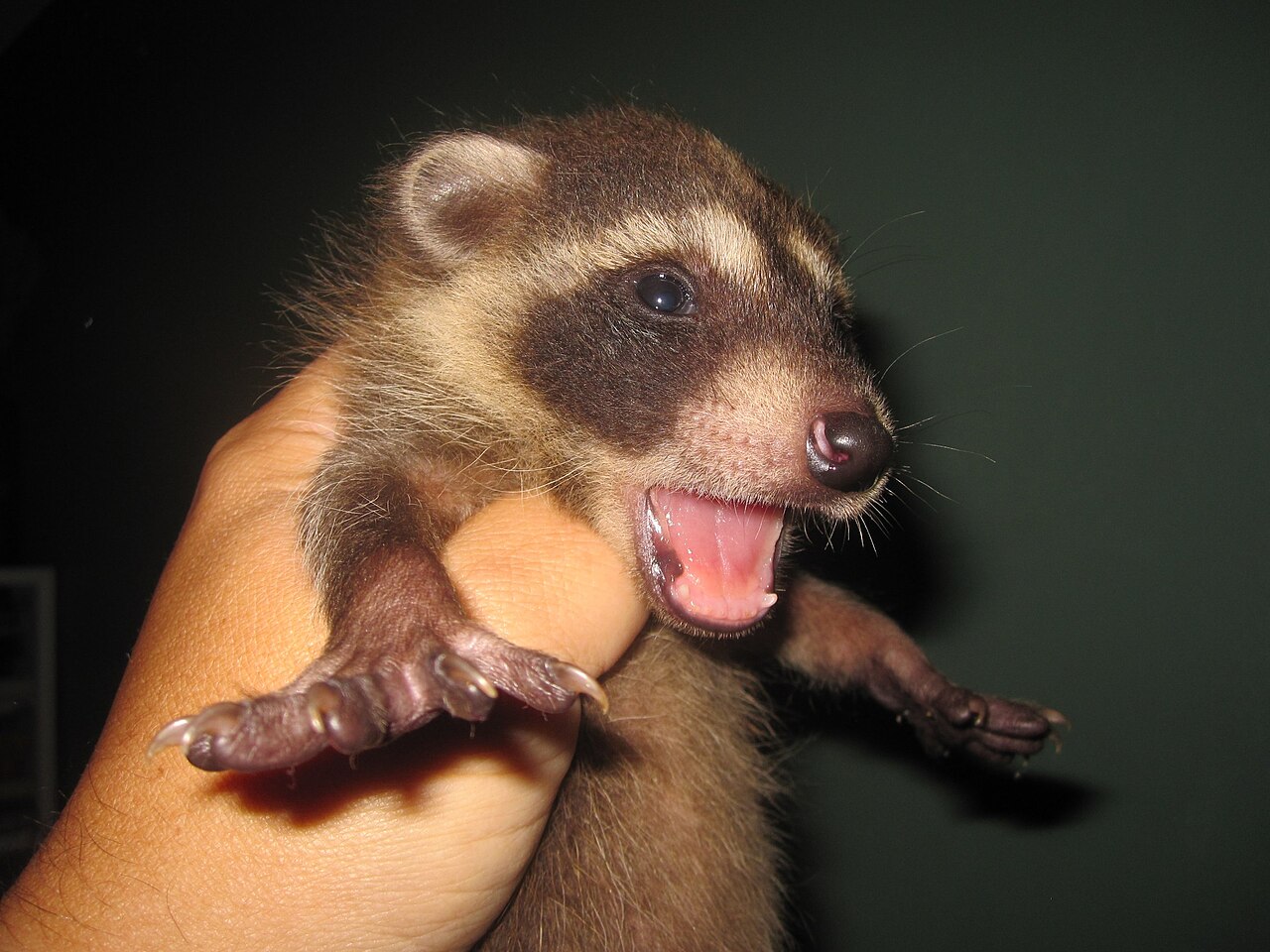
Newborn raccoon kits are small, about the size of a chipmunk, with thin fur, closed eyes, and folded ears. Remarkably, the signature facial mask and the faint rings of the tail are already visible as light markings at birth, so even a tiny newborn is recognizable as a raccoon rather than any other animal.
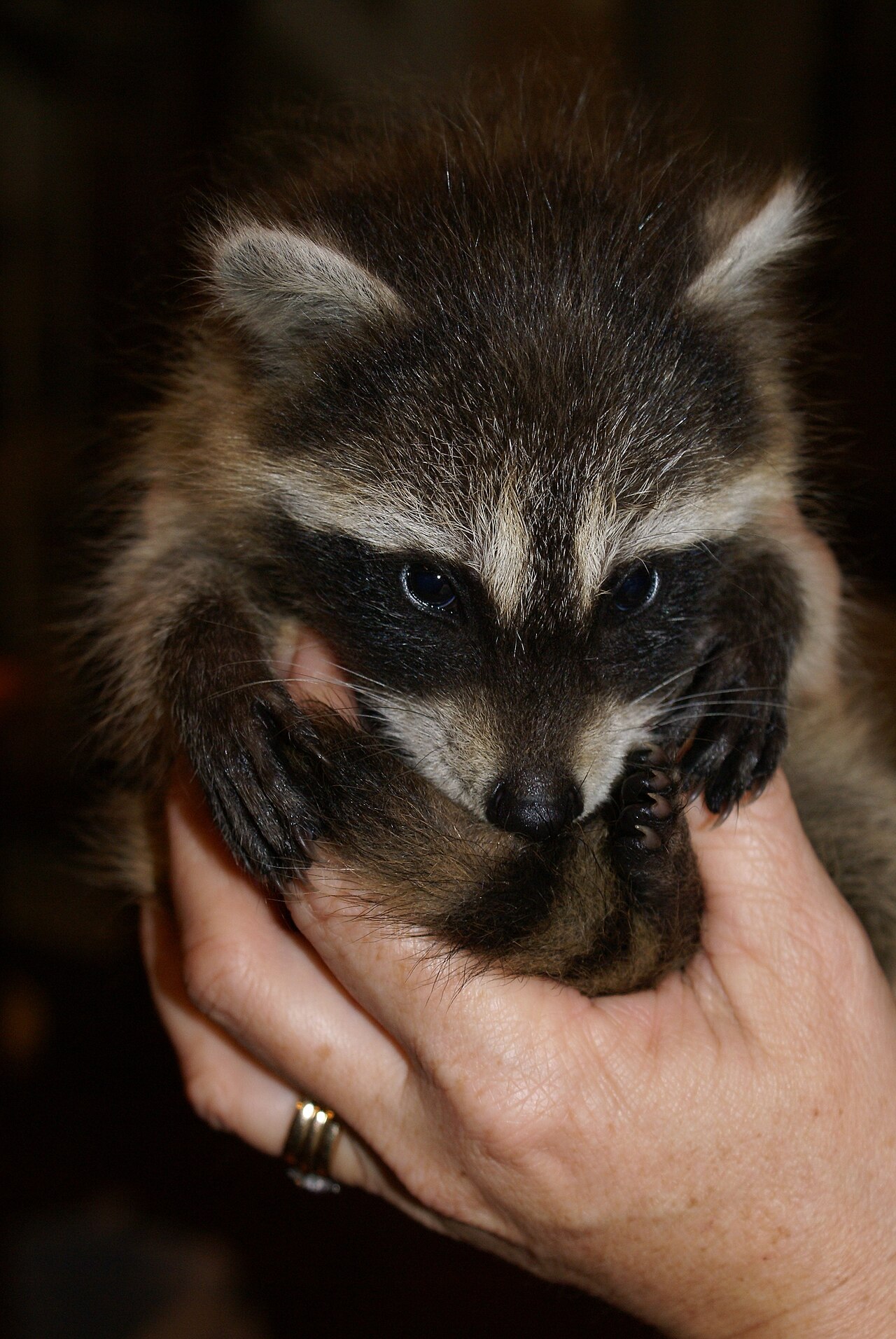
Over the first weeks the kit fills out quickly. The eyes open at around three weeks, the fur thickens into the familiar grizzled gray coat, and the black mask and boldly ringed tail darken and sharpen. By six to eight weeks the kits are furry, bright-eyed, and beginning to explore the area right around the den.
By a few months old a baby raccoon looks like a small adult, with the full mask, ringed tail, and dexterous front paws that let raccoons manipulate objects so skillfully. That mask and ringed tail make raccoon kits almost impossible to confuse with the young of other backyard animals such as fox kits or opossums.
How Do Baby Raccoons Grow Up?
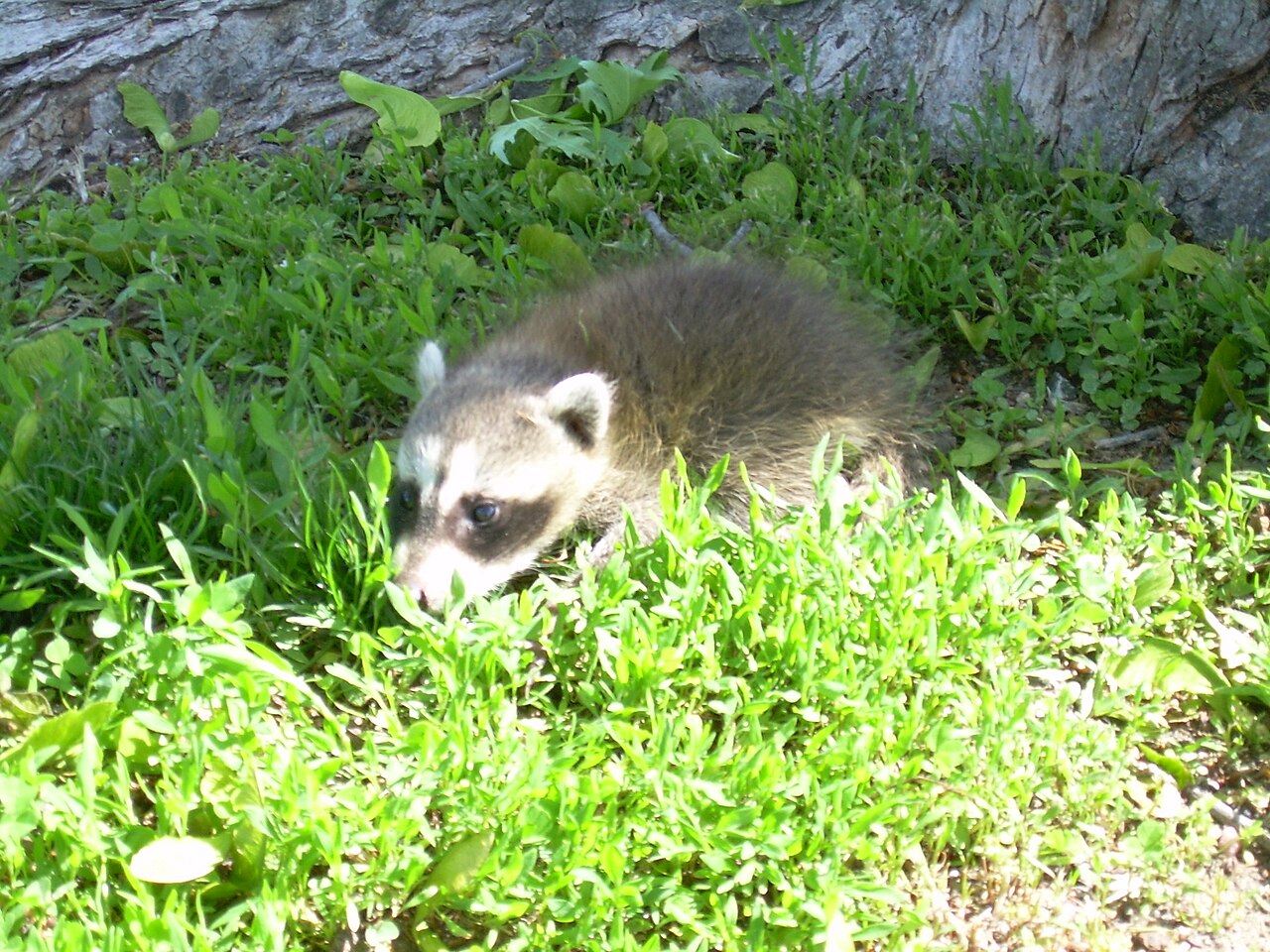
Baby raccoons develop steadily through a long dependent period. After the eyes open around three weeks, the kits begin walking and climbing within the den, and by about seven to nine weeks they start venturing out with their mother on short foraging trips. Play, climbing, and exploration during this stage build the skills they will need.
Through summer and fall the kits follow their mother closely, learning what to eat, how to open and manipulate food with their clever paws, and how to find safe den sites. This extended apprenticeship is why raccoons are so adaptable and clever, since young raccoons learn a great deal from watching their mother.
Most young raccoons stay with the sow into their first winter, often denning with her during the coldest months, and disperse the following spring at around eight to twelve months old. This long family period sets raccoons apart from faster-maturing backyard animals like rabbits, whose young are independent in just weeks.
What Do Baby Raccoons Eat?
For their first weeks, baby raccoons drink only their mother’s milk and nurse for about two months. Weaning is gradual, and as the kits begin joining the sow on foraging trips they start sampling solid food, learning the varied diet that makes raccoons such successful generalists.
Raccoons are omnivores that eat almost anything, and young raccoons learn to take a huge range of foods, including insects, worms, frogs, crayfish, eggs, fruit, nuts, seeds, and, near people, garbage and pet food. Much of a young raccoon’s education is about finding and handling this diverse menu, which includes hunting garden insects and other small prey.
This dietary flexibility is central to why raccoons thrive alongside humans. A baby raccoon raised near homes quickly learns to exploit trash cans, gardens, and pet bowls, which is convenient for the raccoon but a nuisance for homeowners and one more reason not to feed or tame wild kits.
Where Do Baby Raccoons Live?
Raccoons den in sheltered, enclosed spaces, and mothers choose the safest cavity they can find to raise kits. In wild settings that means hollow trees, rock crevices, brush piles, and burrows abandoned by other animals. The den needs to be dry, dark, and defensible while the kits are helpless.
Near people, raccoons readily move into human structures, and this is where most conflicts begin. Attics, chimneys, crawl spaces, sheds, and spaces under decks are all popular den sites, and a female raccoon will happily raise a litter in an attic if she can get in. The sounds of kits overhead are a common way homeowners discover a raccoon family.
Because they adapt so well to suburban and urban life, raccoons are among the most common wild mammals people encounter around their homes. Recognizing where they den helps you understand why a baby raccoon might turn up in a chimney or wall, and why sealing entry points after the family leaves, rather than trapping, is the humane long-term fix.
What to Do If You Find a Baby Raccoon
The first rule is that a lone kit is often not orphaned. Mother raccoons leave kits while foraging and move them between dens one at a time, so a single kit may simply be waiting for her return. Watch from a distance for several hours, ideally into the night when the sow is active, before assuming the kit needs help.
Do not handle, feed, or take in a baby raccoon. Beyond the legal issues, raccoons carry serious health risks, and a frightened kit can scratch or bite. If a kit is clearly in danger, you can place an upturned laundry basket loosely over it to keep it safe while you watch for the mother, but avoid direct contact and keep pets and children away.
Only if a kit is truly orphaned, injured, or has been alone and crying for many hours should you intervene, and then the right step is to call a licensed wildlife rehabilitator or animal control, as recommended by the Humane Society. Trained rehabbers can care for the kit safely and legally, which you cannot do at home, much as with an orphaned fox kit.
Are Baby Raccoons Dangerous?
Baby raccoons look adorable, but they carry real health risks that make handling them a genuine hazard. Raccoons are a primary carrier of rabies in North America, and a bite or scratch from any raccoon, including a kit, can transmit the virus. This alone is reason enough never to touch a wild raccoon.
Raccoons also commonly carry raccoon roundworm, a parasite whose eggs are shed in their droppings and can cause severe illness in people, especially children, if accidentally ingested. Their dens and latrines can be contaminated, which is why cleaning up after a raccoon infestation calls for care and often a professional. Fleas, ticks, and other diseases add to the risks.
None of this means baby raccoons are aggressive by nature, since a healthy kit would rather flee than fight. But the disease risk is serious and invisible, so the safe rule is simple: admire raccoons from a distance, never handle them, and keep pets vaccinated and away from raccoon droppings and dens.
Can You Keep a Baby Raccoon as a Pet?
In most of the United States, keeping a raccoon as a pet is illegal, and for good reason. Many states ban private ownership of raccoons outright because of the rabies risk, and even where permits exist they are difficult to obtain. Taking a wild kit home is against the law in most places and can trigger fines and confiscation.
Beyond the legal problem, raccoons make poor pets. They are wild animals with powerful instincts, sharp teeth and claws, and endless curiosity and strength that lead them to destroy homes, raid food, and become aggressive as they mature. A hand-raised raccoon also loses its natural fear of people, which makes it dangerous and unreleasable.
The kindest and lawful path for any orphaned kit is a licensed wildlife rehabilitator, who can raise it with others of its kind and release it to the wild. Enjoying raccoons means watching them behave as the clever wild animals they are, part of the same backyard cast as the coyotes, foxes, and the birds and wildlife that share suburban space.
Related reading: Baby Fox.
Related reading: Baby Fox.
Related reading: Baby Fox.
Related reading: Baby Fox.
Related reading: Baby Fox.
Related reading: Baby Fox.
Related reading: Baby Fox.
Related reading: Baby Fox.
Related reading: Baby Fox.
Related reading: Baby Fox.
Related reading: Baby Fox.
Related reading: Baby Fox.
Related reading: Baby Fox.
Related reading: Baby Fox.
Related reading: Baby Fox.
Related reading: Baby Fox.
Related reading: Raccoon Sounds.
Related reading: Raccoon Lifespan.
Frequently Asked Questions
What is a baby raccoon called?
A baby raccoon is called a kit or a cub. A group born together is a litter, the mother is a sow, and the father is a boar. Litters usually have three to five kits, born once a year in spring and raised by the mother alone.
What do baby raccoons eat?
Baby raccoons drink their mother’s milk for about two months, then learn to eat the varied omnivore diet of adults, including insects, worms, frogs, eggs, fruit, nuts, and, near people, garbage and pet food. Learning to find this range of food takes months.
What should I do if I find a baby raccoon?
Usually leave it alone, since the mother is often nearby and moves kits between dens. Watch from a distance for several hours, especially at night. Do not handle or feed it. Call a licensed wildlife rehabilitator only if it is injured or clearly orphaned.
Are baby raccoons dangerous to handle?
Yes, in terms of disease. Raccoons are a major rabies carrier and commonly carry raccoon roundworm, which can seriously harm people. A kit can also scratch or bite. Never handle a wild raccoon, and keep pets and children away from raccoons and their droppings.
How long do baby raccoons stay with their mother?
Baby raccoons stay with their mother far longer than most backyard mammals, often eight to twelve months. They usually den with her through their first winter and disperse the following spring, having learned to forage and survive during that long period.
Can I keep a baby raccoon as a pet?
In most states it is illegal to keep a raccoon as a pet, largely because of the rabies risk. Raccoons also make poor, destructive pets and become dangerous as they mature. Orphaned kits should go to a licensed wildlife rehabilitator, not a home.
Do baby raccoons have their mask at birth?
Yes. Newborn raccoon kits already show the faint outline of the black facial mask and the rings of the tail, even before their eyes open. The markings darken and sharpen over the first weeks, making raccoon kits easy to recognize from the start.