Black and White Dragonfly: It’s Likely a Common Whitetail
Most black and white dragonflies seen in the United States are one species, the Common Whitetail (Plathemis lydia), a skimmer found at almost any pond. Age and sex change the colors, and a few lookalikes share the same ponds.
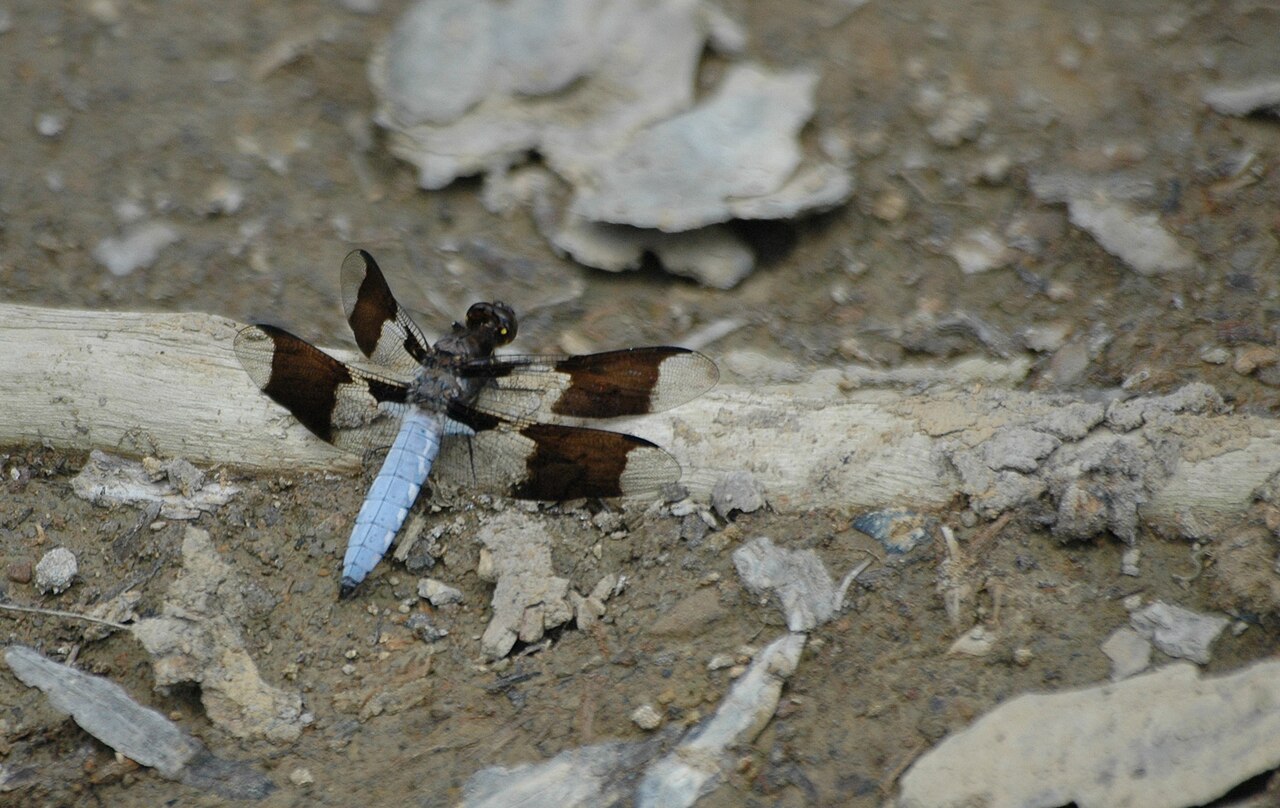
A black and white dragonfly in North America is most often a male Common Whitetail (Plathemis lydia). He has a chalky white abdomen and one broad dark band across the middle of each wing. Females are brown with dark wing spots and a broken pale line along each side of the abdomen.
Common Whitetail (Plathemis lydia), the Black and White Dragonfly
The black and white dragonfly is the Common Whitetail, Plathemis lydia. It belongs to the order Odonata, the dragonfly suborder Anisoptera and the skimmer family Libellulidae. BugGuide covers the species on its Common Whitetail page. Older field guides list it as Libellula lydia, because Plathemis was long treated as part of Libellula, and some authors still rank it as a subgenus. Its only close relative is the Desert Whitetail (Plathemis subornata).
The name refers to the male’s white abdomen, not to the wings. Skimmers are stocky dragonflies that perch often and rest with their wings held flat and open. It looks heavy for its length and flies in short, direct dashes between perches.
How to Identify Males, Females and Young Whitetails
Check the wings first. One broad dark band across the middle of each wing marks a male. Females carry dark wing spots, and the pale line along each side of the abdomen is broken, not continuous, which separates them from female Twelve-spotted Skimmers. Mature males carry a white waxy coating on the abdomen called pruinescence, and it builds up as they age.
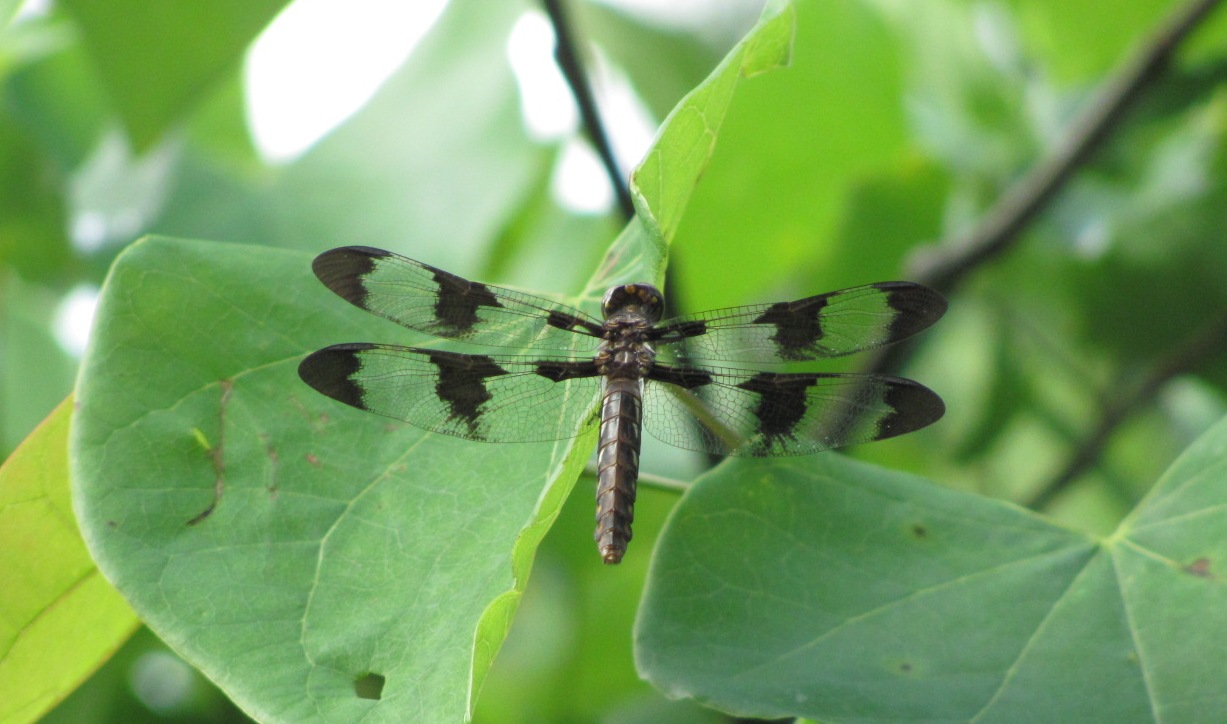
Young males share the female’s brown, dashed body, but they already wear the male wing band. A brown whitetail with banded wings is a male that has not turned white yet. Dragonfly nymphs live underwater, breathe through gills inside the rear of the abdomen and look nothing like the adults.
Where and When You See Black and White Dragonflies
Black and white dragonflies live across most of the United States and parts of southern Canada. In Illinois and the rest of the Midwest they are a fixture at ponds, marshes and slow streams. The species tolerates muddy, small and man-made water, so backyard ponds, retention basins and farm ponds all draw it.
In the northern states adults fly from about May to September; in Florida and Texas the first ones appear as early as February.
Behavior, Ground Perching, Territory Fights and Predators
Common Whitetails perch low in the open, on the ground, on rocks or on boardwalks. Males hold small territories along the shore. The National Park Service notes that when a rival enters, the resident flashes his white abdomen as a warning and chases the intruder off. A dragonfly that lands on you is using you as a sunny perch, the same way a whitetail uses a rock or a boardwalk.
Females lay eggs by tapping the water surface with the tip of the abdomen while flying. Birds, frogs and larger dragonflies prey on adult whitetails.
How Rare Is It to See a Black and White Dragonfly?
Seeing a black and white dragonfly is not rare. The Common Whitetail ranks among the most frequently seen dragonflies in North America. The rarest US dragonfly is the Hine’s Emerald (Somatochlora hineana), listed as endangered under the Endangered Species Act and found only in a few fens and wet meadows in Illinois, Wisconsin, Michigan and Missouri. Your odds of a whitetail are best on warm, sunny days near standing water, when males patrol and perch in the open.
A male with faded or patchy white is old or worn, not a rare variant. The waxy coating rubs off with age and fights. Blue dragonflies such as the Blue Dasher build up the same waxy coating, but on them it turns powder blue instead of white.
Dragonfly symbolism in Japan centers on courage and victory, and samurai wore the dragonfly, called kachimushi, as a crest.
Purple dragonflies such as the male Roseate Skimmer are far scarcer in most of the US than whitetails.
Other Black and White Dragonflies and Lookalikes
Wing pattern beats body color when you sort black and white dragonflies. In the arid West and parts of the Great Plains, the Desert Whitetail (Plathemis subornata) overlaps with the Common Whitetail and has chalky white at the base of each wing.
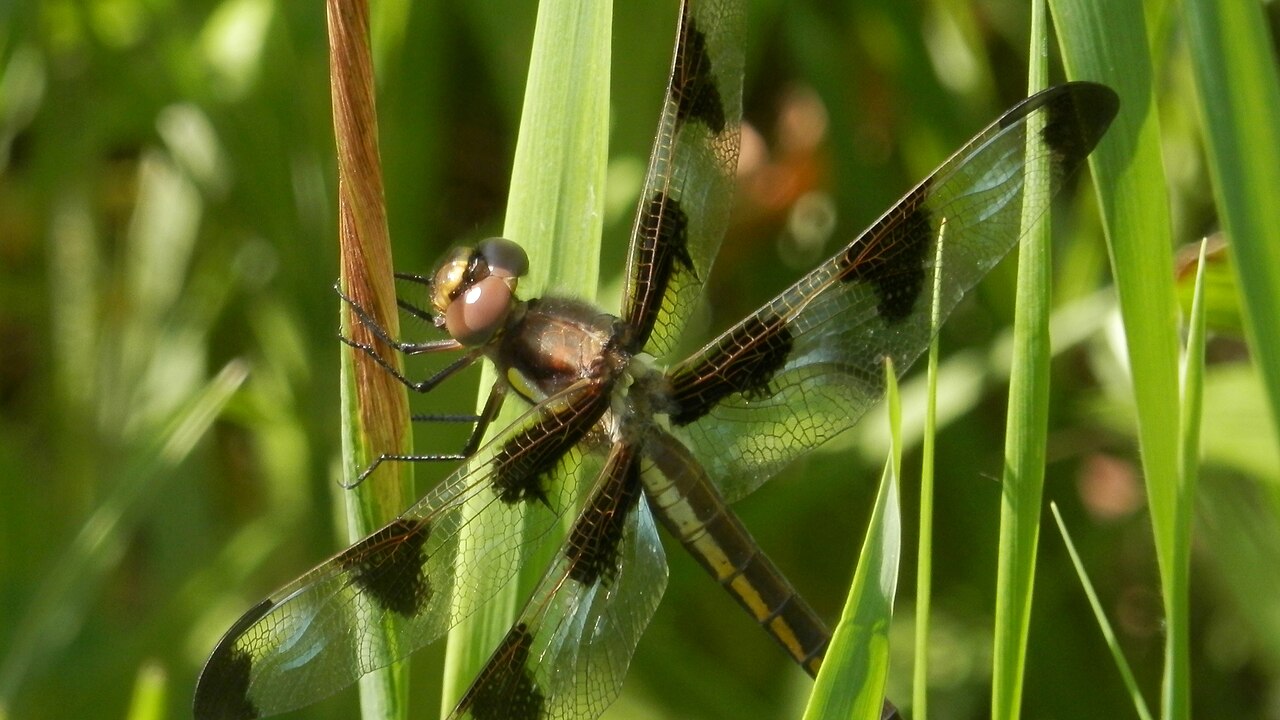
The Twelve-spotted Skimmer (Libellula pulchella) and the Widow Skimmer (Libellula luctuosa) carry their white on the wings, while the Common Whitetail carries it on the abdomen. The Dot-tailed Whiteface (Leucorrhinia intacta) is smaller, black and white-faced.
| Species | Wing pattern | Body color (male) | US region |
|---|---|---|---|
| Common Whitetail (Plathemis lydia) | One broad dark band per wing | Chalky white | Most of the US |
| Desert Whitetail (P. subornata) | Dark band edged with white patches | Pale white | West and Southwest |
| Twelve-spotted Skimmer (Libellula pulchella) | Three dark spots per wing with white spots between | Brown, turning powdery blue-white with age | Most of the US |
| Widow Skimmer (L. luctuosa) | Dark base, white band beyond it | Gray white | East, Midwest and parts of the West |
| Dot-tailed Whiteface (Leucorrhinia intacta) | Clear wings, small dark base | Black with a pale spot near the tail, white face | Northern US and Canada |
Frequently Asked Questions
Will a black and white dragonfly bite or sting you?
No. Dragonflies have no stinger and cannot sting. A dragonfly held in the hand may nip with its jaws while trying to escape, and the pinch is harmless to people.
Do black and white dragonflies eat mosquitoes?
Yes, they can. Adult Common Whitetails catch small flying insects in midair, and mosquitoes may be among the prey. Females and young males hunt in fields and woodland edges away from water and return to the pond only to mate.
What does a black and white dragonfly symbolize?
Change and balance are the most common readings. Hopi and Zuni potters painted dragonflies as a sign of water and rain, and in Japan the dragonfly stands for courage and victory. The black and white contrast of the whitetail is widely read as balance between light and dark. A male on your lawn often means a pond or wet ditch lies nearby, though young adults can wander away from water.
What looks like a dragonfly but is not a dragonfly?
Owlflies look the most like dragonflies. They have four wings, but their antennae are long and end in clubs, while dragonflies have very short, bristle-like antennae. Adult antlions look more like damselflies.
What is the rarest color of dragonfly?
Pink and violet are among the least common body colors in North America. The Roseate Skimmer (Orthemis ferruginea) of the southern states is one of the few species with a pink to violet male, while white, blue and red are widespread.
Sources
- BugGuide, Common Whitetail (Plathemis lydia)
- National Park Service, Whitetail Skimmer
- UWM Field Station, Confusing Summer Dragonflies