Box Turtle Guide: 6 US Types, Lifespan, and What to Do If You Find One
A box turtle is a land-dwelling turtle with a hinged lower shell that closes like a box, sealing the animal in completely. That hinge is the single feature that separates it from every other turtle in North America, and it is the first thing to check when something crosses your lawn.
Six kinds live in the United States, all in the genus Terrapene, and all of them are long-lived, slow-breeding, and strongly attached to a home range of a few acres. Those three facts drive almost every practical question people ask about box turtles, from whether to move one to whether to keep one.
Box turtles are terrestrial turtles of the genus Terrapene, identified by a hinged plastron that closes the shell fully. Adults reach 4 to 7 inches (10 to 18 cm) and commonly live 40 to 50 years, with verified records past 100. They are harmless to people and should be left where they are found.
| Type | Range | Field mark |
|---|---|---|
| Eastern box turtle | Maine to Georgia, west to Illinois | High domed shell, orange or yellow starburst pattern |
| Three-toed box turtle | Missouri to Texas and Alabama | Olive shell, faint pattern, three hind toes |
| Gulf Coast box turtle | Gulf states, Florida panhandle to Texas | Largest type, flared rear shell margin |
| Florida box turtle | Florida peninsula | Narrow shell, bright radiating yellow lines |
| Ornate box turtle | Great Plains, Nebraska to Texas | Flat-topped dark shell, sharp yellow rays |
| Desert box turtle | Southwest, New Mexico to Arizona | Pale shell, fine line pattern, arid grassland |
What Is a Box Turtle?
Box turtles are the only North American turtles with a fully functional plastral hinge. The lower shell is split across the middle, and muscles pull both halves upward against the carapace until the animal is shut in with no gap. Hatchlings lack a working hinge and do not gain one until their third or fourth year.
They are terrestrial. Unlike a painted turtle or a snapping turtle, a box turtle has stubby, elephant-like hind feet rather than webbed paddles, and it drowns in deep water. Box turtles wade and soak in shallow pools, but they do not swim as a way of life.
Sex is readable in adults. Males usually have red or orange eyes, a concave depression in the rear plastron, and thicker, curved rear claws. Females have brown or yellow eyes and a flat plastron.
Where Box Turtles Live and What They Eat
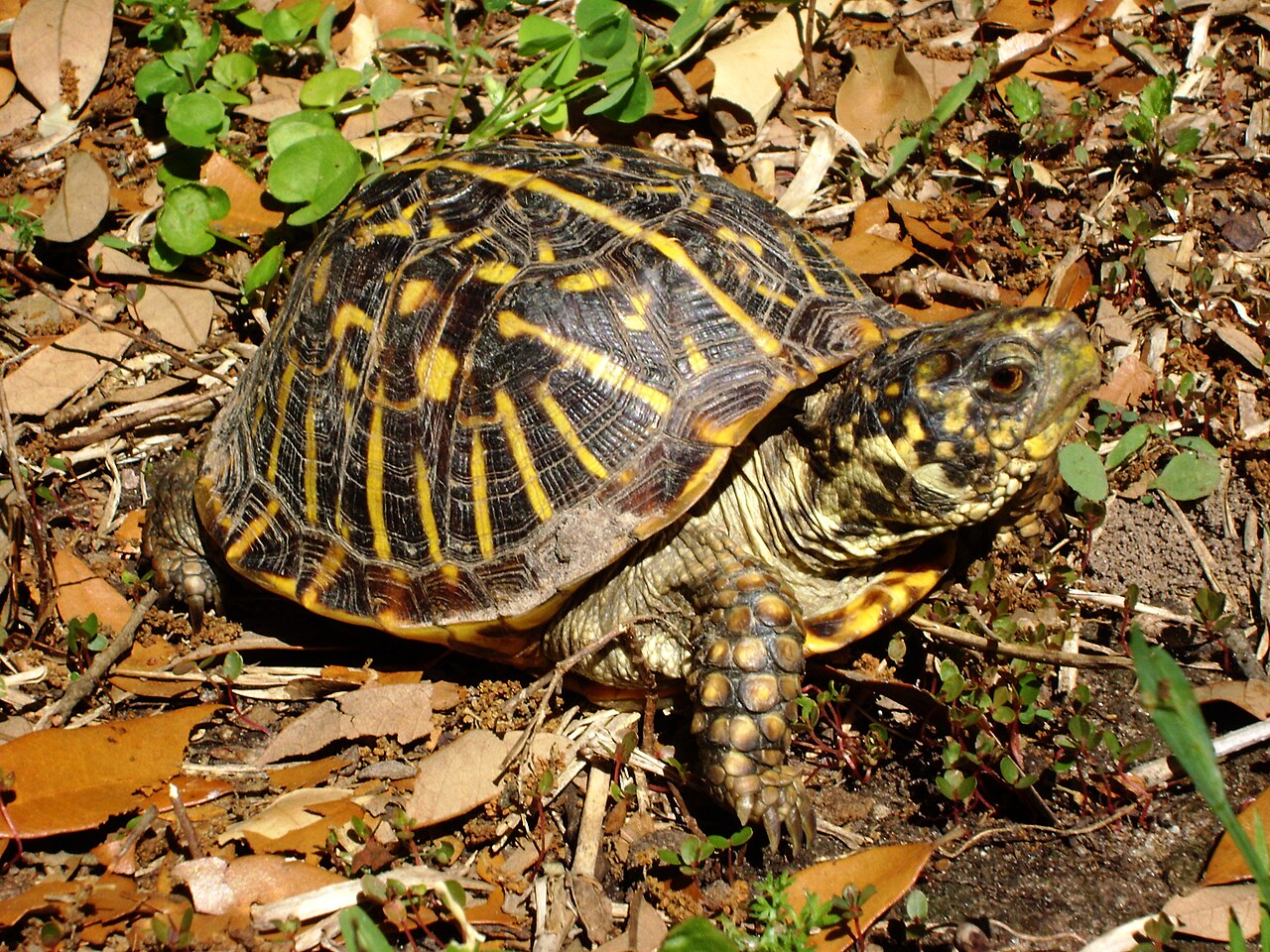
The typical habitat is deciduous woodland with an open canopy, moist leaf litter, and access to a forest edge or meadow. Ornate and desert types break that pattern, living in shortgrass prairie and arid grassland where they shelter in mammal burrows instead of leaf litter.
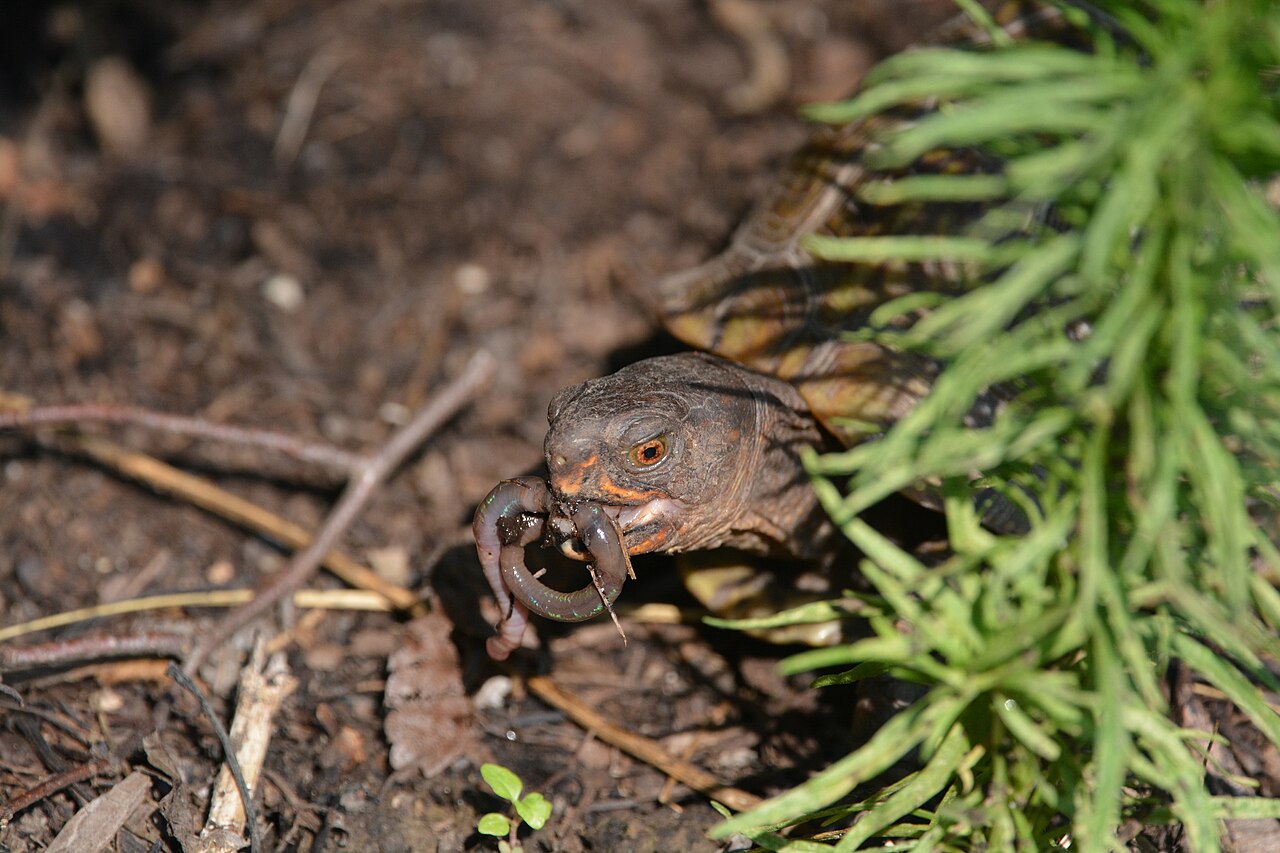
Box turtles are omnivores, and the diet shifts with age. Juveniles are heavily carnivorous, taking earthworms, slugs, snails, beetles, and carrion. Adults move toward plant matter: berries, mushrooms, fallen fruit, and flowers, often including fungi that are toxic to humans.
Home range is small, usually 2 to 10 acres, and it is fixed for life. A box turtle knows its patch of woods in detail, which is why a displaced animal will walk in a straight line for months trying to return.
Where Do Box Turtles Go at Night?
Box turtles are active by day and spend the night in a shallow form, a depression scraped into leaf litter, loose soil, or the base of a shrub. They use the same handful of sites repeatedly within their range rather than digging a new one each evening.
In hot, dry weather they reverse the pattern and go dormant by day, burying themselves in damp soil or mud and emerging after rain. A wet morning in July brings out box turtles that seemed absent for weeks.
Winter is spent buried. From October or November, box turtles dig 2 to 24 inches (5 to 60 cm) into soil below the frost line and remain there until March or April. The mechanics are covered in our guide to turtle hibernation.
What Should You Do If You Find a Box Turtle in Your Yard?
Leave it alone. A box turtle in your yard is in its home range and knows where it is going. Moving it even half a mile strands it in unfamiliar ground, and relocated box turtles spend the rest of their lives wandering, which dramatically raises their odds of being hit by a car.
The one exception is a turtle in a road. Carry it across in the direction it was already heading, place it off the shoulder, and do not turn it around. Turning a determined box turtle back only means it crosses again once you leave.
If the turtle is visibly injured, with a cracked shell or a wound, contact a licensed wildlife rehabilitator. Box turtles survive serious shell damage with proper care, and their long lives make each adult worth the effort to a local population.
Can You Keep a Box Turtle as a Pet?
Taking a wild box turtle home is illegal in most states, and it is a bad idea everywhere. Box turtle populations decline steadily across their range, and because females may not breed until age 7 to 10 and produce only 3 to 8 eggs a year, removing a single adult female measurably harms a local population.
Captive care is also harder than it looks. Box turtles need a large outdoor enclosure, seasonal temperature cycling, high humidity, UVB exposure, and a varied omnivorous diet. Indoor box turtles commonly develop shell rot, metabolic bone disease, and eye problems from vitamin A deficiency.
The lifespan is the other catch. A healthy box turtle outlives most dogs by decades and frequently outlives the person who acquired it, which makes it a genuine multi-generational commitment rather than a starter reptile. Details on the earliest years are in our guide to the baby box turtle.
What Is a Predator of a Box Turtle?
Adult box turtles have few predators once the hinge works, since a closed shell defeats most attacks. Raccoons, skunks, coyotes, and dogs still manage to injure or kill adults, often by chewing at exposed limbs or by catching a turtle before it shuts.
Eggs and hatchlings are another matter, and mortality is very high. Raccoons, skunks, foxes, crows, snakes, and large frogs take nests and young, and a soft-shelled hatchling has none of the protection an adult relies on. Fewer than one in ten hatchlings reaches breeding age.
Cars, mowers, and habitat fragmentation now kill more adult box turtles than any natural predator. Because the species compensates for low reproduction with extreme adult longevity, losing mature animals is the fastest way to empty a population. Range and conservation status information is maintained by the Smithsonian National Zoo and by state wildlife agencies.
Related reading: Florida Box Turtle.
Related reading: Ornate Box Turtle.
Related reading: Three-Toed Box Turtle.
Related reading: Types of Box Turtles.
Related reading: Box Turtle Lifespan.
Frequently Asked Questions
Are box turtles harmless?
Yes. Box turtles do not attack, have no venom, and their first response to anything is to close their shell. The only real caution is salmonella, which reptiles can carry on their skin and shell, so wash your hands after any contact and keep turtles away from food preparation areas.
Does a box turtle bite hurt?
Barely. Box turtles have a beak rather than teeth and lack the jaw strength to break skin on an adult hand in most cases. A bite is a startled pinch, and it is nothing like a snapping turtle bite. Nearly all box turtle bites happen when a finger is mistaken for food.
Do box turtles like to be picked up?
No. Handling is stressful for a box turtle, and a picked-up animal will often close its shell, empty its bladder, or refuse to feed afterward. That stored bladder water is an emergency reserve in dry weather, so losing it to handling can genuinely harm the turtle.
What month do box turtles lay eggs?
Most nesting happens from late May through early July, with a peak in June. The female digs a flask-shaped nest in loose, sunny soil at dusk and lays 3 to 8 eggs, then leaves. Incubation runs 70 to 90 days, and nest temperature determines the sex of the hatchlings.
Do box turtle babies stay with mom?
No. The female leaves the nest immediately after covering the eggs and provides no care at all. Hatchlings dig out on their own in late summer or fall, or overwinter in the nest and emerge the following spring, and they are secretive for their first few years. Aquatic species such as the softshell turtle follow the same pattern.