Sweat Bee: Identification, Sting Pain, and Why They Land on You
A sweat bee is any of roughly 500 North American bees in the family Halictidae, named for the habit of landing on people to drink perspiration. Most are tiny, between 0.12 and 0.5 in (3 to 12 mm), and many are a startling metallic green or blue that makes them look more like a fly than a bee. They are the insects that persistently settle on your arms in July and refuse to be waved off.
They also matter. Halictids are among the most important wild pollinators in the United States, working crops and native plants that honey bees visit poorly, and they almost never sting. This guide covers identification, what the sting actually feels like, why they want your sweat, which lookalikes get blamed for their behavior, and how to get one off your skin without either of you getting hurt.
Sweat bees are small bees in the family Halictidae, often metallic green or dull black, that land on people to drink sweat for its salt and moisture. Only females can sting, the sting rates a 1 out of 4 on the pain scale, and they are not aggressive. Most nest alone in bare soil and are valuable native pollinators.
| Trait | Sweat bee |
|---|---|
| Family | Halictidae, about 4,500 species worldwide and 500 in North America |
| Size | 0.12 to 0.5 in (3 to 12 mm) |
| Color | Metallic green, blue, bronze, or dull black with pale bands |
| Sting | Females only, pain level 1 of 4, no lasting reaction in most people |
| Nest | Bare or sparsely vegetated soil, sometimes rotting wood |
| Active season | March through October in most of the US |
| Diet | Nectar and pollen; adults also take sweat for salt and water |
What Is a Sweat Bee?
Sweat bees make up the family Halictidae, the second largest bee family on earth. In North America the group covers about 500 species in genera including Lasioglossum, which is the largest bee genus in the world, Halictus, the brilliant green Agapostemon, and the smaller metallic Augochlora and Augochlorella. The common name comes from one behavior shared across much of the family rather than from any shared appearance.
They are true bees, not wasps, meaning they feed their young on pollen and nectar rather than meat. Females carry pollen on dense hairs on the hind legs, visit a wide range of flowers, and provision underground cells one at a time. Most species are solitary or only loosely social, so there is no large colony to defend and no hive to protect.
How to Identify a Sweat Bee
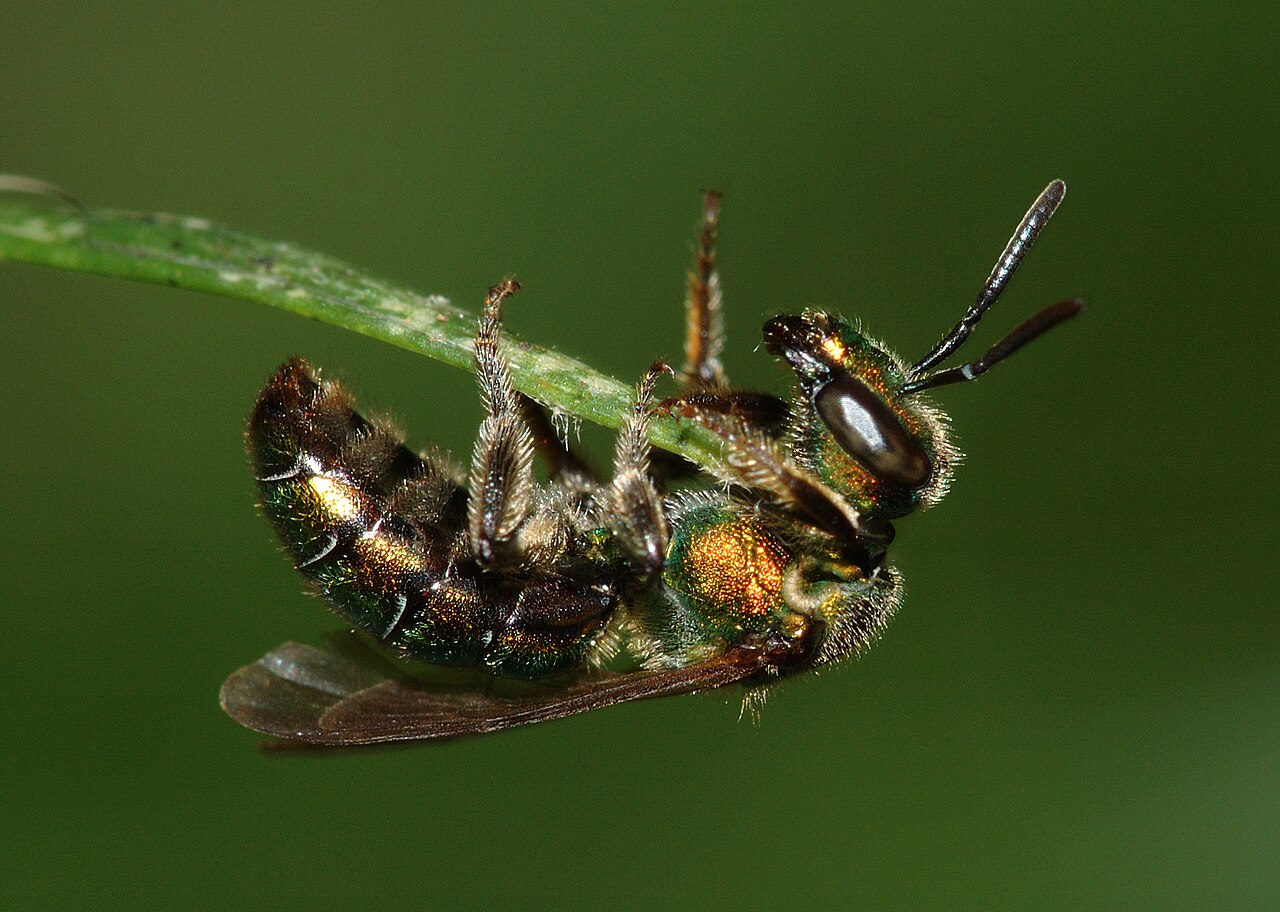
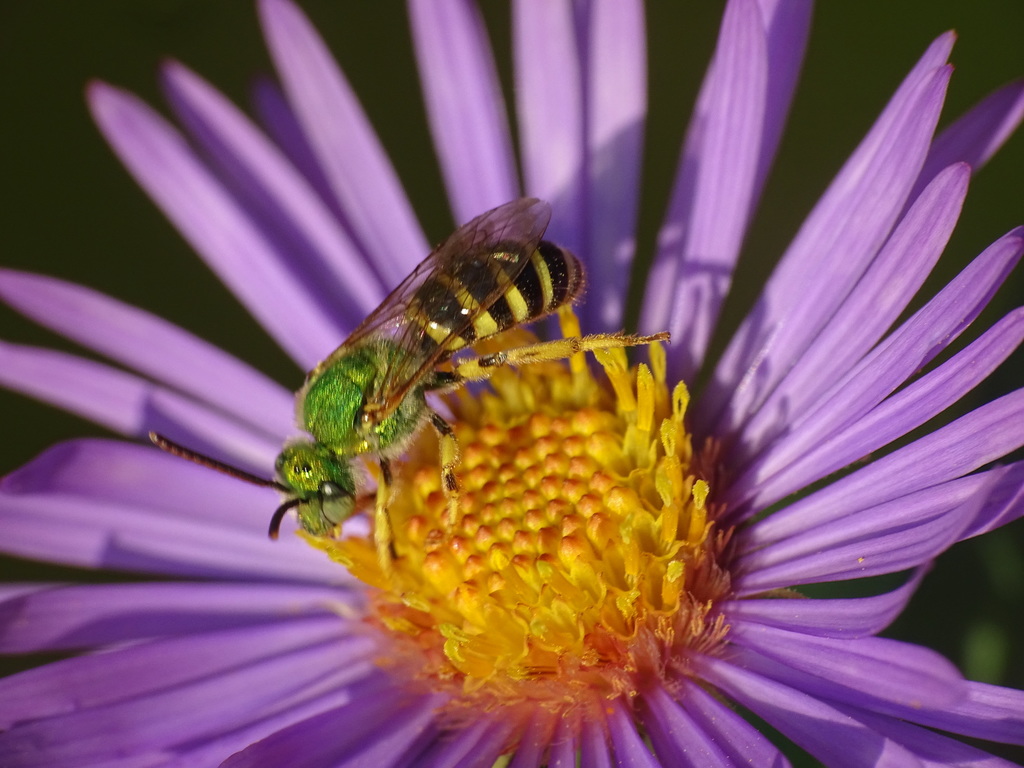
Size is the first clue. If a bee on your arm is smaller than a grain of rice and looks slightly flattened, it is very likely a halictid. The metallic species are unmistakable once you see one in good light: Agapostemon virescens has a shining emerald head and thorax with a black abdomen banded in yellow, and Augochlora pura is uniformly brilliant green.
The dull species are harder. Most Lasioglossum are brownish black with faint pale hair bands on the abdomen, easily mistaken for small flies until you notice four wings instead of two. Look for the bent basal vein in the forewing, a family trait, plus visible pollen on the hind legs and a slow deliberate walk over your skin rather than the quick darting of a fly. For the wider picture, see our guide to types of bees.
Do Sweat Bees Sting You?
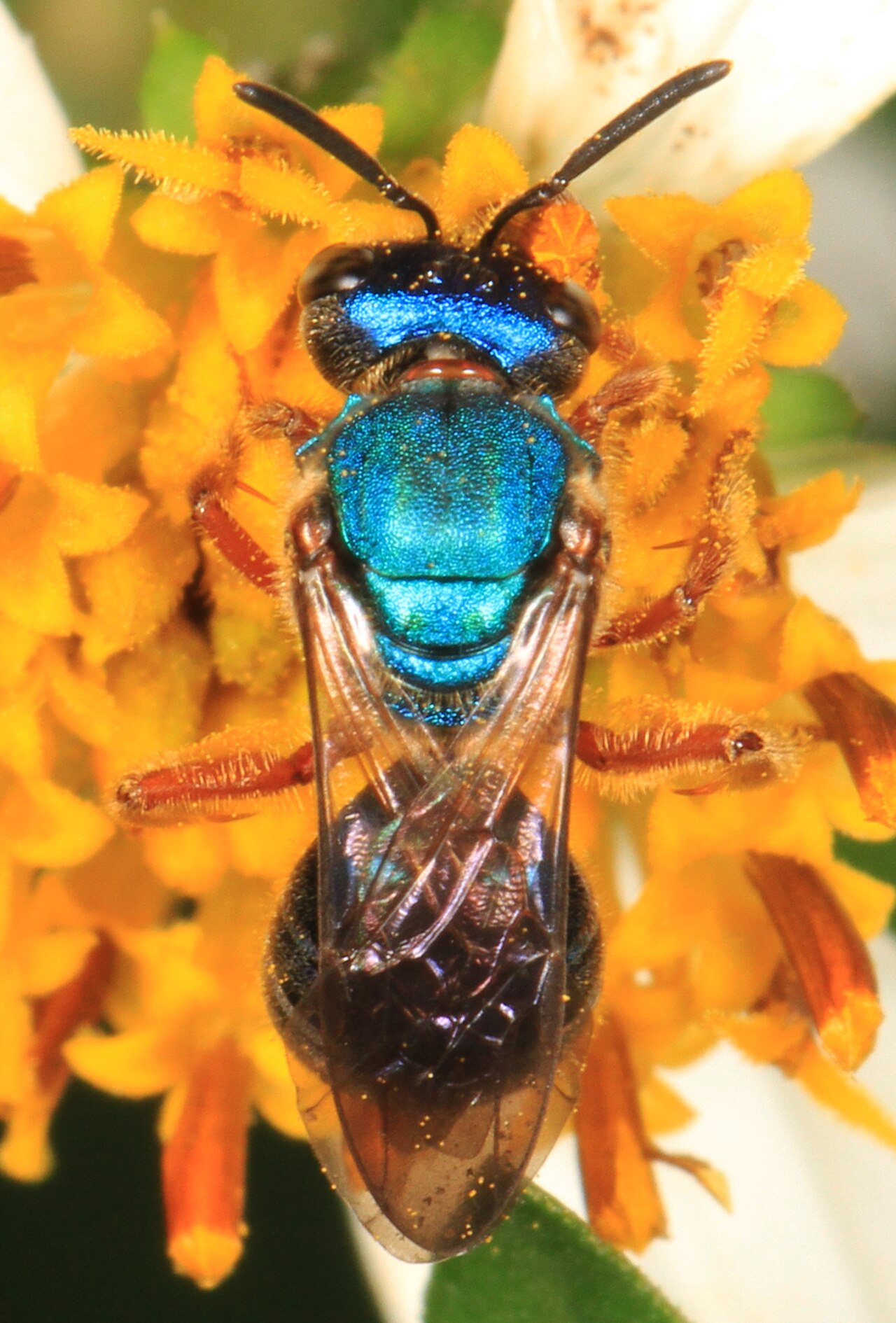
They can, but rarely do. Only female sweat bees have a sting, since the structure is a modified egg-laying organ, and males have nothing to sting with at all. A female will sting if you press, swat, or trap her against your skin, and she can sting more than once because the sting is not barbed and does not detach.
The pain is minor. Entomologist Justin Schmidt rated the halictid sting at 1.0 on his four-point scale, the same tier as a fire ant, describing it as light and momentary. Most people feel a brief pinprick with little swelling and no lasting mark. That said, anyone with a known bee or wasp allergy should treat any sting as a medical matter, because the venom proteins overlap with other bees.
Why Are Sweat Bees Attracted to You?
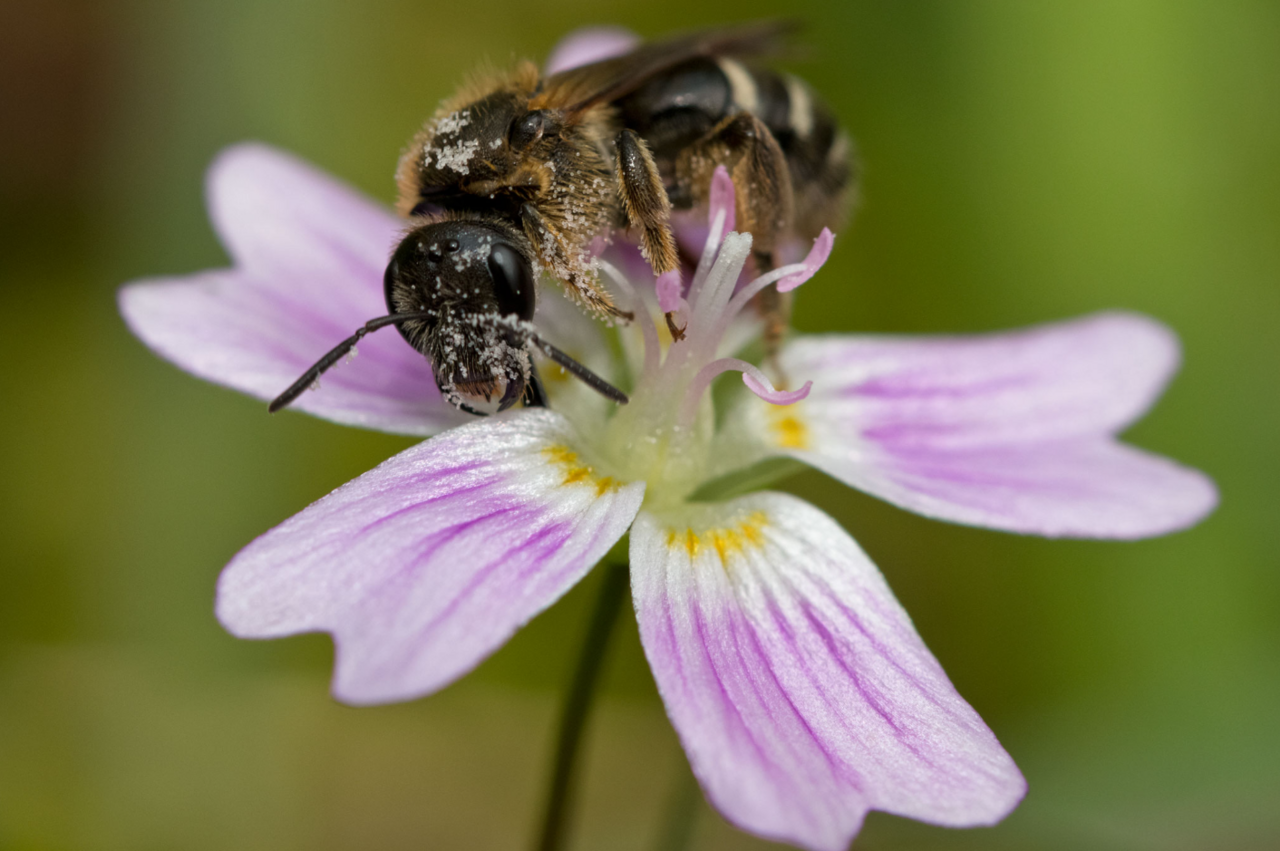
They want the salt and the water. Human perspiration carries sodium, potassium, and trace minerals that are hard for a small bee to find in nectar, and males in particular seem to seek them out. On hot, dry days when puddles and damp soil have disappeared, a sweating hiker becomes the best mineral source in the area.
Nothing about you is unusual if they pick you. Heavy sweating, salty skin, and simply standing still in a sunny clearing all increase the odds, and so does wearing light colors that reflect like a flower. They are not attracted to blood, they are not looking for a host, and they have no interest in your food the way yellowjackets do. Folk readings of the behavior are covered in our piece on what it means when a bee lands on you.
Is It Okay to Let Sweat Bees Lick You?
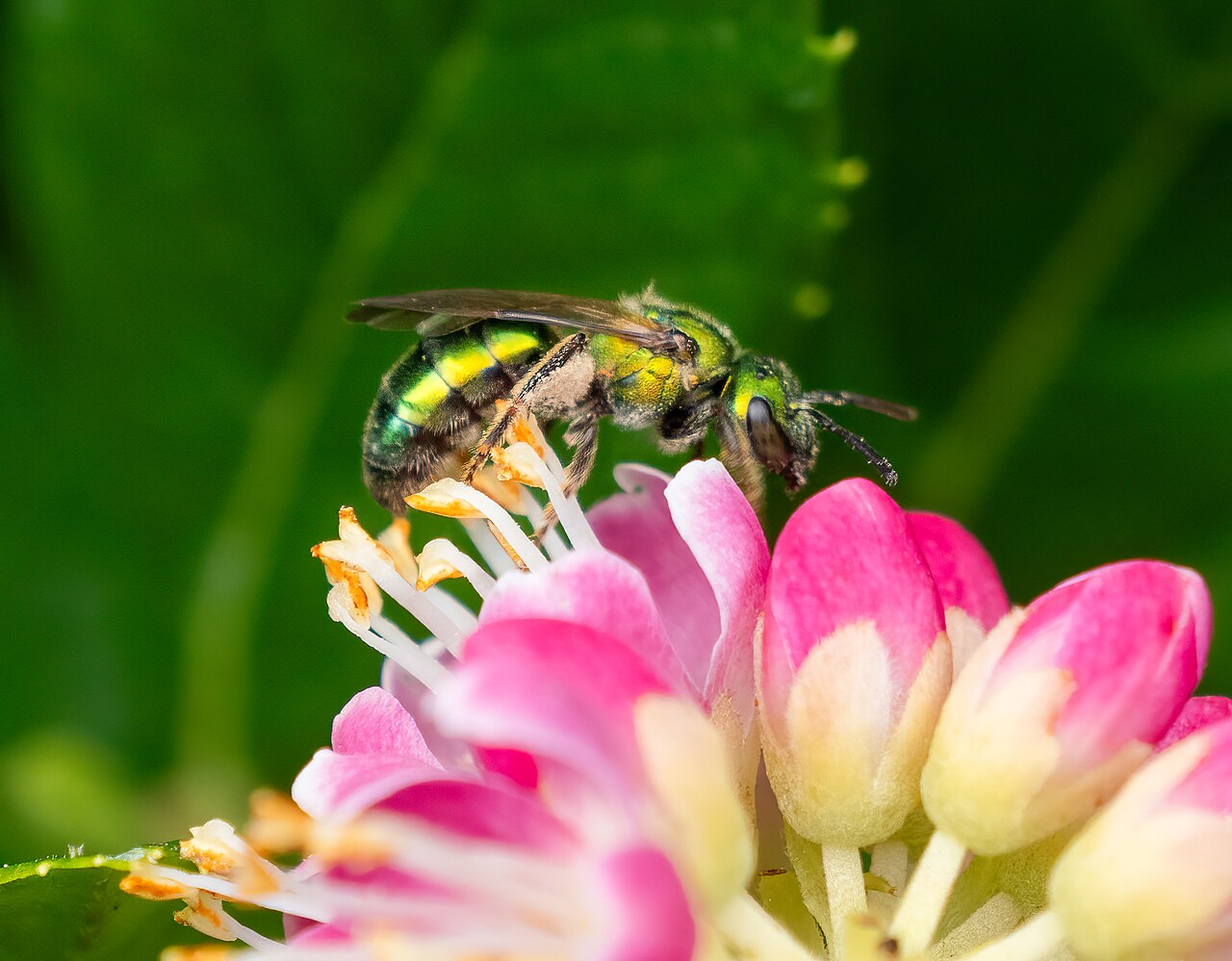
It is, and it is the lowest-risk option available. A sweat bee lapping perspiration with her tongue cannot hurt you, carries no disease that transmits to humans, and will leave on her own once she has taken what she wants, usually within a minute or two. Letting her finish is how experienced field biologists handle it.
The risk appears the moment you react. Swatting, brushing, or clamping down on a bee already sitting on your skin is what produces almost every sweat bee sting on record, because a trapped female defends herself. If you cannot tolerate the sensation, slide her off with a leaf or the edge of a card rather than using your hand.
What Is Mistaken for Sweat Bees?
Several insects get blamed for sweat bee behavior. Hover flies and flower flies in the family Syrphidae are the most common mix-up, since they are small, sometimes metallic, and also land on sweaty skin; they have two wings and cannot sting at all. Small carpenter bees in the genus Ceratina are dark metallic blue-green and nest in stems, and they are frequently called sweat bees.
Going the other way, people often call biting insects sweat bees when they are not bees. Deer flies, stable flies, and no-see-um midges bite hard and draw blood, which halictids never do, so a bite that stings sharply and leaves a welt is a fly problem. Larger black-and-yellow bees on your deck are more likely a bumble or carpenter bee, and our profile of the black bumble bee sorts out the dark ones.
Common Sweat Bee Species in the United States
The bicolored striped sweat bee (Agapostemon virescens) is the most recognizable, widespread across the northern two thirds of the country and common in cities. The pure green sweat bee (Augochlora pura) nests in rotting wood in eastern forests. Golden furrow bees in the genus Halictus, including Halictus ligatus, are the brownish, hair-banded bees most often photographed on asters.
The genus Lasioglossum alone holds well over 200 North American species, many separable only under a microscope, and it dominates most bee surveys by sheer number of individuals. A few halictids are cleptoparasites: Sphecodes species, red and black and hairless, lay eggs in other sweat bees’ nests instead of building their own.
Where Sweat Bees Nest
Most sweat bees dig into the ground. A female excavates a vertical tunnel a few inches to over a foot deep in bare, well-drained soil, then branches off side cells that she stocks with a ball of pollen and nectar and one egg. Bare patches in lawns, path edges, sandy banks, and slopes with thin vegetation all attract them.
Nests cluster without being colonies. Dozens or hundreds of females may nest within a few square feet of suitable soil, each tending her own tunnel, which creates the impression of an infestation where none exists. A minority of species, including Augochlora pura, nest in soft rotting wood instead. If nesting bees are in the wrong place entirely, see our guide on how to get rid of ground bees.
Sweat Bee Life Cycle and Social Life
Overwintering females emerge in early spring, mate, and start nests. Eggs laid on pollen provisions hatch into grub-like larvae that eat the store, pupate in the cell, and emerge as adults, with one to three generations per season depending on species and latitude. Most adults live only a few weeks; the mated females that overwinter live the better part of a year.
The family is famous for sitting at every step between solitary and social living. Some species are strictly solitary, some share a nest entrance while working independently, and others such as Halictus ligatus and Augochlorella aurata are primitively eusocial, with a founding female and a small set of daughter workers. Behavior can even shift with elevation inside one species, which is why halictids are a standard model for studying how social life evolved.
Do Sweat Bees Have a Purpose?
They are among the most productive pollinators in North America. Because they are small and visit flowers other bees ignore, they carry pollen for blueberries, cranberries, apples, stone fruit, alfalfa, sunflowers, watermelon, and hundreds of native wildflowers. Regional pollinator surveys, including the USGS native bee inventory, routinely record halictids as the most abundant bees collected.
Their nesting also helps soil, since thousands of small tunnels aerate ground and cycle organic matter. And they feed other wildlife: tanagers, flycatchers, and other insectivores take them steadily, a relationship covered in our piece on birds that eat bees. The US Geological Survey maintains the national inventory that tracks these populations.
How to Get Sweat Bees Off You Without Killing Them
Stay still and wait, or move her mechanically. Blowing a steady breath at the bee usually persuades her to leave within a few seconds, and sliding a leaf, card, or shirt cuff under her feet lifts her off without pressure. Walking briskly into shade works too, since she is tracking a moisture source and will give up on a moving target.
Avoid swatting, pinching, and spraying. Insect repellent has little effect on halictids, and killing individual bees accomplishes nothing because more are nearby. If a nesting aggregation in a lawn is the real problem, the durable fix is covering the bare soil with mulch or thicker turf, which removes the nesting substrate rather than the bees.
Making Your Yard Better for Sweat Bees
Leave some soil bare. A sunny, undisturbed patch of sandy or loamy ground, even a few square feet at the edge of a bed, gives ground-nesting halictids somewhere to dig, and skipping landscape fabric and heavy mulch in that spot is most of the work. Rotting logs and untidy corners support the wood-nesting species.
Then supply flowers across the season. Sweat bees favor open, shallow blooms, so asters, goldenrod, coreopsis, mountain mint, yarrow, sunflowers, and flowering herbs like oregano and thyme all pay off, and a sequence from March to October matters more than any single plant. Skip neonicotinoid-treated nursery stock, which carries systemic insecticide into pollen. People who like the symbolism as much as the insect can read our note on the bee tattoo meaning.
Frequently Asked Questions
Do sweat bee stings hurt or swell?
A sweat bee sting rates 1.0 out of 4 on the Schmidt pain index, felt as a brief pinprick that fades in minutes. Swelling is usually minimal, a small red bump at most. Wash the area and apply something cold if it itches. Anyone with a known bee venom allergy should treat it like any other bee sting.
What do bees absolutely hate?
Bees avoid strong smoke, sudden air movement, and dark fuzzy objects near their nest, and they dislike heavy floral perfumes that mask the flowers they are tracking. For sweat bees specifically, dry skin is the real deterrent, since they are following salt and moisture rather than scent.
Will a bee chase me if I run?
A sweat bee will not. Halictids have no colony to defend and lose interest within a few feet, so walking away ends the encounter. Honey bees and yellowjackets defending a nest genuinely will pursue for some distance, which is the situation that gave running its reputation.
Can bees tell if you’re friendly?
Not in an emotional sense, but they respond to your behavior. Bees read movement, vibration, carbon dioxide, and body heat, and honey bees can learn to recognize patterns including human faces in laboratory tests. A person standing still reads as harmless, a person swatting reads as a threat, so calm behavior genuinely lowers your odds of a sting.
Do bees regret stinging you?
Bees do not experience regret. A honey bee dies after stinging because her barbed sting tears free, which is a physical consequence and not a decision she reflects on. Sweat bees keep their smooth sting and survive, so there is no cost at all beyond the risk of being crushed.
How long do sweat bees live?
Adult sweat bees active in summer typically live three to six weeks. Mated females produced late in the season overwinter underground and live eight to ten months in total. Where a species is primitively eusocial, workers live only a few weeks while the founding female survives the whole colony cycle.