Possum Tracks: How to Identify Them in Snow, Mud and Sand
Possum tracks are the easiest five toed prints to name in North America, because the hind foot leaves what looks like a tiny human handprint. The Virginia opossum (Didelphis virginiana) has five toes on every foot, and the inside toe of the hind foot is a true opposable thumb that points sideways or even backward. Once you see that thumb in snow or mud, nothing else in the woods looks like it.
The front print is a different shape entirely: a splayed star of five slim toes spreading almost evenly around a small palm pad. Those two shapes land in pairs along a slow, wide, pacing trail, often with a thin tail drag between them. Winter is the best time to learn them, because fresh snow holds the thumb clearly while dry dust rarely does.
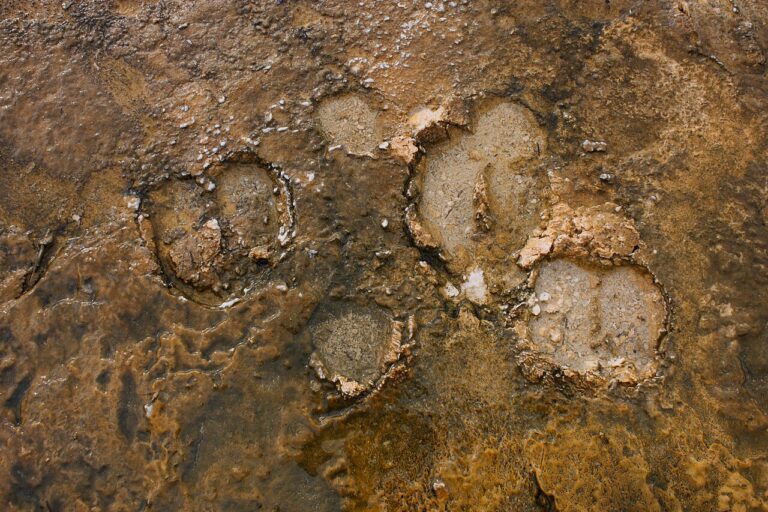
Opossum tracks show five toes on both feet. The front print is star shaped, 1.25 to 2 in (3.2 to 5 cm) wide, with fine claw marks. The hind print is 1.5 to 2.5 in (3.8 to 6.4 cm) long and carries an opposable inner toe that angles out like a thumb, with no claw on it.
| Measure | Opossum track detail |
|---|---|
| Toes, front foot | 5, spread in a star, roughly even length |
| Toes, hind foot | 5, with an opposable thumb angled inward or backward |
| Front track size | 1.25 to 2 in long, 1.25 to 2 in wide (3.2 to 5 cm) |
| Hind track size | 1.5 to 2.5 in long, 1.5 to 2.25 in wide (3.8 to 6.4 cm) |
| Claws | Thin points on front toes and four hind toes, never on the thumb |
| Stride | 6 to 11 in (15 to 28 cm), pacing walk, front and hind paired |
| Straddle | 3 to 4.5 in (7.6 to 11.4 cm), wide for the animal’s size |
What Do Possum Tracks Look Like?
A possum track looks hand like, which is the single most useful description in the field. The toes are long, thin and well separated, and they leave individual pads rather than the fused blob you get from a dog or cat. Palm pads are small and weakly marked, so the toes dominate the impression.
In a good substrate you will see all five toes on both prints and a narrow set of claw points ahead of the front toes. In poor substrate the thumb is often the only part that registers clearly, sticking out at an angle no other animal’s toe does. Look for pairs rather than single prints, because the paired shapes confirm the call.
Front Track vs Hind Track: The Five Toe Giveaway
The front foot prints as a star. Five toes radiate outward at roughly equal spacing, two of them pointing nearly sideways, which makes the track about as wide as it is long. The overall outline suggests a small maple seedling leaf pressed into the mud.
The hind foot is the one that settles the identification. Four toes face forward in a tight group, and the fifth, the hallux, swings out at 90 degrees or more with no claw at the tip. That thumb does the work of gripping branches, and its print is the reason trackers call possum sign a baby handprint. The hind track also sits slightly behind or over the front track in a walking trail.
Opossum Track Size and Stride Measurements
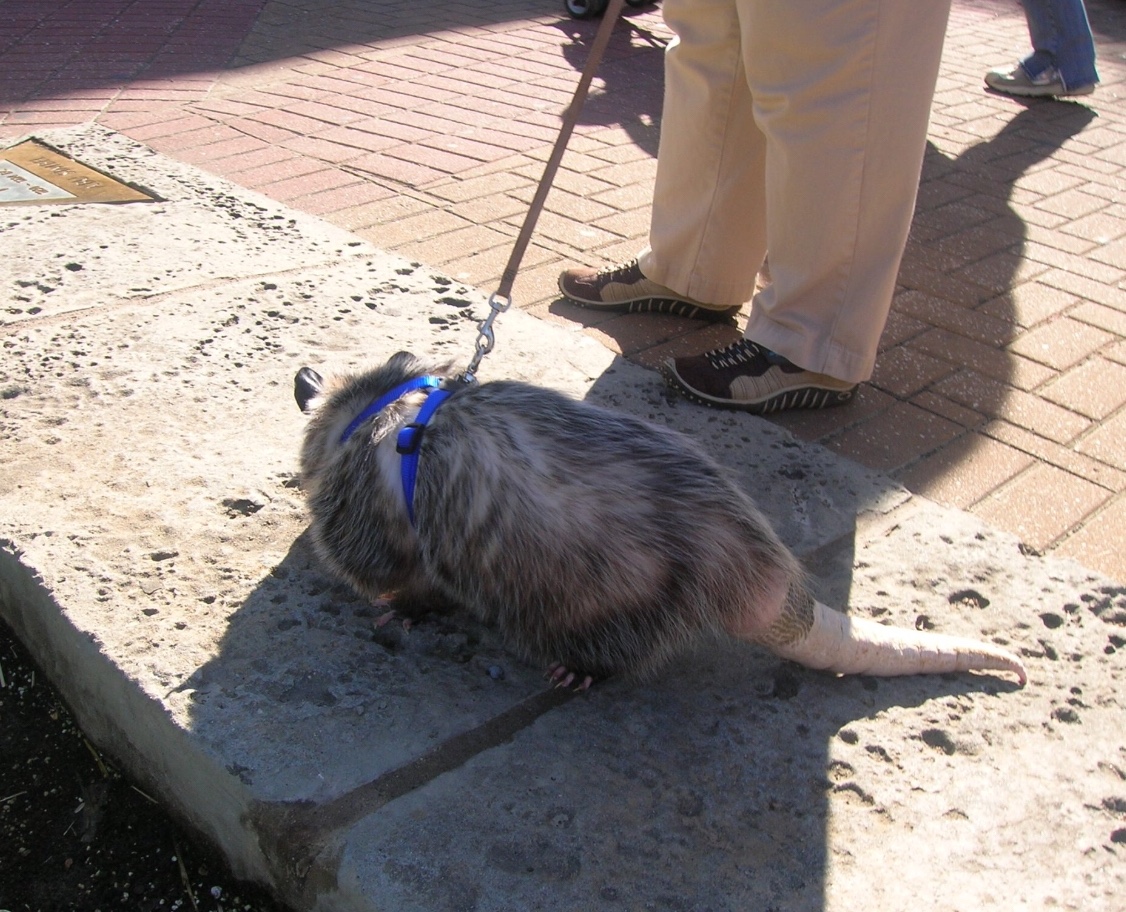
Front tracks measure 1.25 to 2 in (3.2 to 5 cm) long and nearly the same across. Hind tracks run slightly larger at 1.5 to 2.5 in (3.8 to 6.4 cm) long. A large adult at 10 to 13 lbs (4.5 to 5.9 kg) sits at the top of those ranges, and a late season juvenile at the bottom.
Stride matters as much as size. Opossums use a pacing walk, moving both legs on one side together, which produces a wide straddle of 3 to 4.5 in (7.6 to 11.4 cm) and a short stride of 6 to 11 in (15 to 28 cm). The result reads as a slow, waddling, slightly drunken trail rather than the tight line a fox leaves.
How to Read Possum Tracks in Snow
Snow is the best teacher, and winter is when opossum trails are easiest to follow for long distances. Shallow, wet snow of half an inch to two inches over firm ground gives the cleanest prints, with the thumb and claw points both visible. In deeper snow the animal plows a trough, drags its tail and belly, and the individual toes blur into oval holes.
Opossums stay active through winter in the North but shorten their rounds in hard cold, so snow trails tend to run short loops between a den, a compost pile and a feeder. Frost bitten ear and tail tips are common in these populations, a reminder that the species is a recent northern arrival.
Possum Tracks in Mud
Mud records more detail than any other surface. Soft streamside silt or the edge of a puddle will hold the small palm pads, the fine claw tips and the full angle of the thumb, which is exactly what you need for a confident identification. Check pond margins, culvert outflows and the first few feet of a dirt road after rain.
Those same wet margins hold the sign of everything else that drinks there, so expect overlapping prints. Raccoon, mink, heron and rodent tracks share the space, and in beaver country you may find the chewed sticks and beaver droppings that mark a colony nearby.
Possum Tracks in Sand and Dust
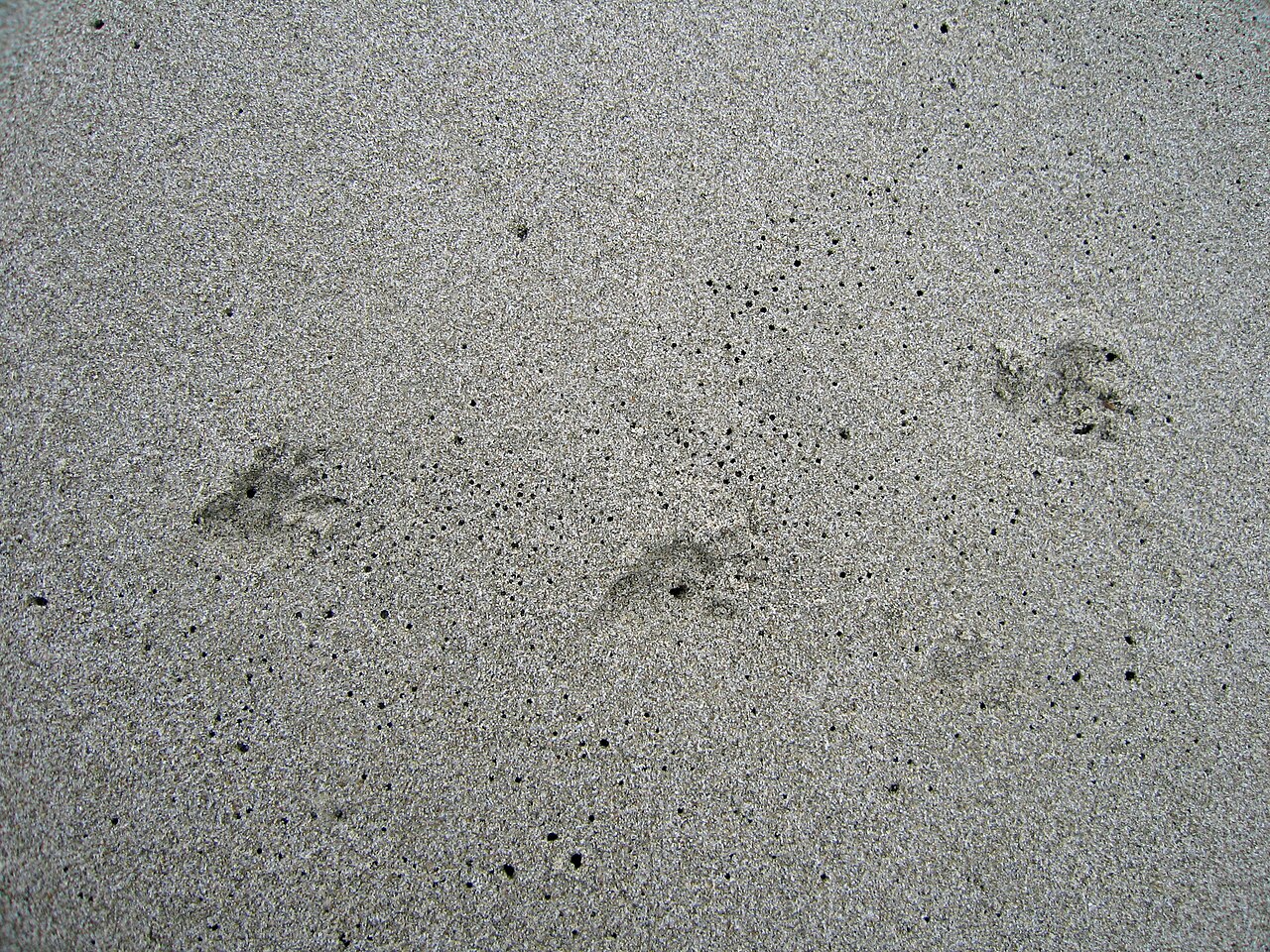
Dry sand and road dust are the hardest substrates, because loose grains collapse into the print before it sets. Expect a soft outline with the toes merged and the claws invisible, and judge by the overall shape and the trail pattern instead. Damp sand just above the waterline on a beach or sandbar is far better and can rival mud for detail.
Low angle light is the trick here. Visit sandy sites in early morning or late afternoon, get your eye close to ground level, and read the shadow in the depression rather than the depression itself. In fine dust, a tail drag line is often the clearest feature of the whole trail.
Possum Tracks vs Raccoon Tracks
Raccoons are the main source of confusion, since both animals have five toes and both forage the same yards and creek banks. Raccoon tracks are larger, 2 to 3.5 in (5 to 9 cm) long, with long slender toes on both feet that all point forward, and the hind print is distinctly elongated like a narrow human foot.
The deciding detail is still the thumb. No raccoon toe stands out at a right angle, and raccoon toes are longer relative to the palm. Side by side comparisons of raccoon tracks make the difference obvious once you have seen both in the same mud.
Possum Tracks vs Cat and Fox Tracks
House cats and gray foxes leave four toes, not five, which eliminates them in one glance if the substrate is decent. Cat prints are round, about 1 to 1.5 in (2.5 to 3.8 cm) wide, with retracted claws that leave no marks and a trail that runs almost in a straight line.
Fox prints are oval, show small claw points, and fall in a tight, direct register line because foxes place the hind foot in the front track. Both are compact and neat, while opossum sign is splayed and sloppy. The detail work in fox tracks is worth learning for exactly that contrast.
Possum Tracks vs Dog and Coyote Tracks
Dogs and coyotes print four toes with blunt, always visible claws and a single large heel pad that takes up much of the track. Coyote prints are oval and tidy at 2 to 3 in (5 to 7.6 cm) long, with the front two toes set clearly ahead of the outer two, and the trail runs in a purposeful straight line.
Opossum tracks have no dominant heel pad, five toes instead of four, and a meandering trail. Where both occur you often find them on the same farm road, and the comparison with coyote tracks is the fastest way to train your eye on the four versus five toe split.
Other Possum Signs Near the Tracks
Tracks rarely stand alone. Opossum scat is 1 to 2 in (2.5 to 5 cm) long, smooth, often curled with tapered ends, and full of insect parts, fruit seeds and sometimes fur. Look also for raided compost, tipped pet bowls, scattered trash and greasy rub marks on the underside of decks and sheds.
Do possums walk on fences? They do, routinely, and a fence rail is a highway for them. Check the tops of wooden fences, low branches and deck railings for muddy five toed prints. Smaller five toed climbers leave similar sign, so compare against rat tracks before deciding.
What Does It Mean When a Possum Hangs Around Your House?
It means there is reliable food, water or shelter within a short walk. Pet food left out, unsecured garbage, fallen fruit, a bird feeder and a crawl space with a gap are the usual draws. Opossums are nomadic and rarely stay long once the food source closes, so removing the attraction solves most cases within a week or two.
They are also useful neighbors, eating ticks, slugs, carrion and rodents, and they very seldom carry rabies due to a low body temperature. The US Fish and Wildlife Service and state agencies recommend exclusion over removal. Repeated sightings in spring often mean a female with young, as described in the opossum joey account.
Frequently Asked Questions
What does a possum vs. opossum look like?
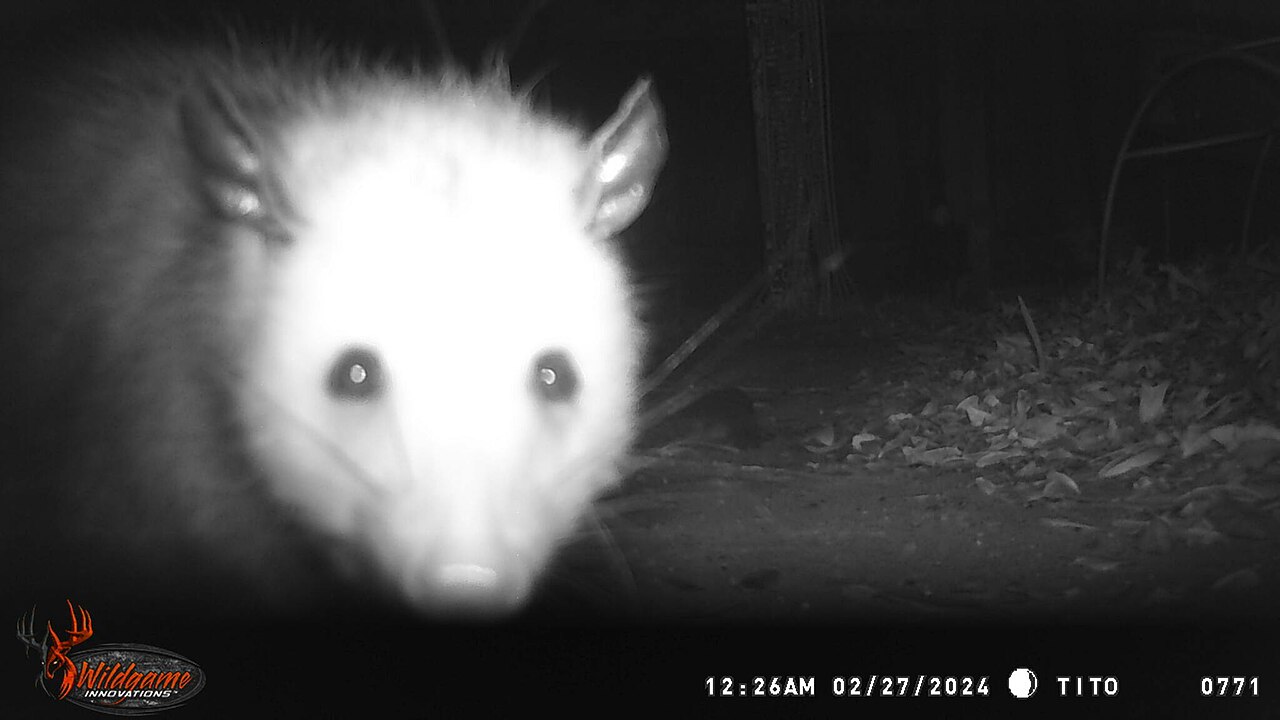
In the US both words name the same animal, the Virginia opossum: gray body, white face, pink nose, naked tail. True possums live in Australia and New Guinea, have furred tails, and look more squirrel like. So American possum tracks and opossum tracks are the same tracks.
Are possum tracks the same size as raccoon tracks?
No. Opossum prints top out near 2.5 in (6.4 cm) long, while raccoon prints commonly reach 3 to 3.5 in (7.6 to 9 cm). Shape separates them even better than size: look for the right angle thumb on the opossum hind foot.
What month are possums most active?
Activity peaks from late spring through fall, with a strong surge in February and March during the breeding season when males travel widely. Winter tracking is still productive in the North, but trails get shorter and stay close to dens during cold snaps.
Do possums walk on fences?
Yes. The opposable hind thumb and a partly prehensile tail make them good climbers, and they use fence rails, branches and utility lines as travel routes. Muddy five toed prints on a fence top or deck rail are a common first clue to a resident animal.
What do opossums eat?
Almost anything: insects, slugs, ticks, carrion, eggs, small rodents, fruit, pet food and garbage. That broad diet is why their scat is so variable and why they follow human food sources, which is covered in what opossums eat.
What smell does a possum hate?
Strong ammonia, mothball type odors and capsaicin based repellents put them off, but the effect fades fast and none of it beats removing the food. Sealing the crawl space, securing bins and taking in pet dishes at dusk works where scent deterrents do not.