Black and Green Frog: Which Species, and Is It Poisonous?
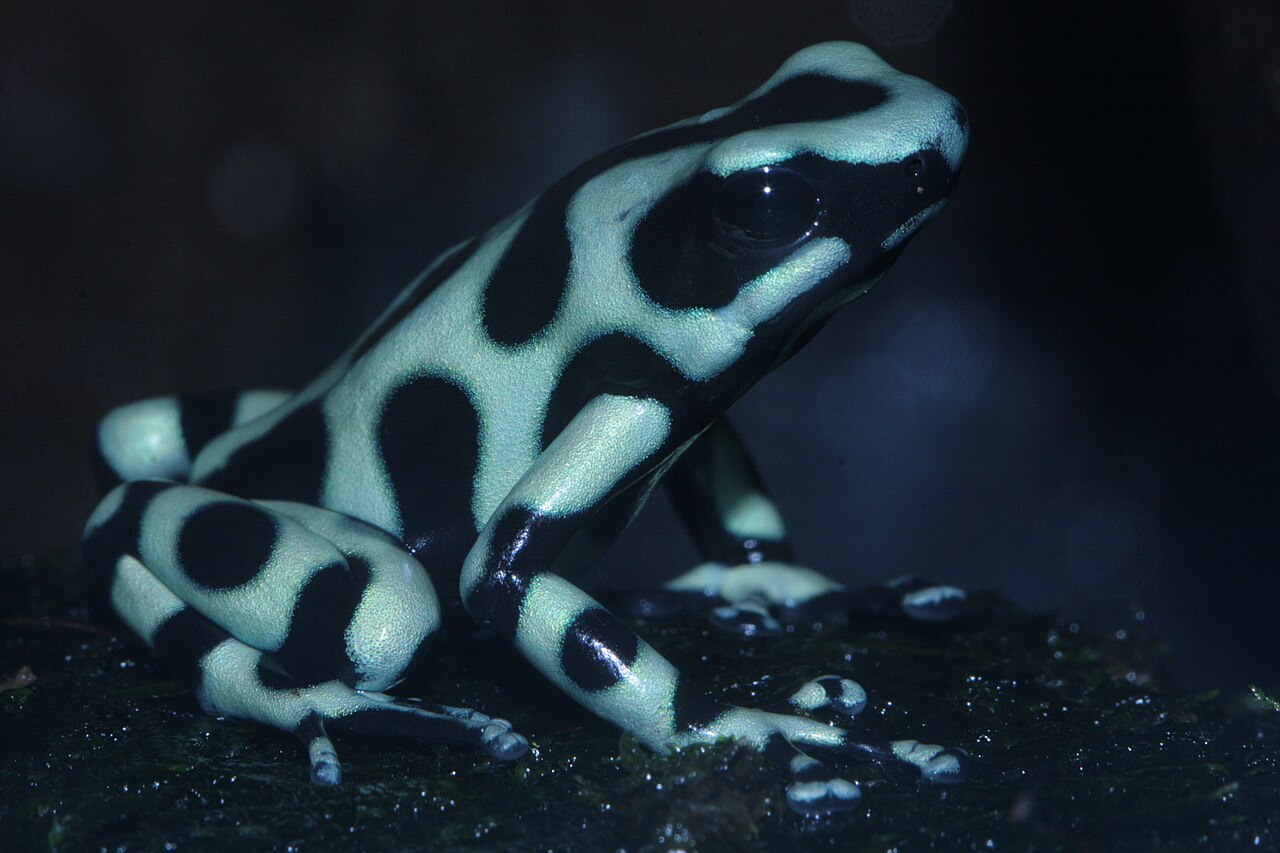
A black and green frog is most likely the green and black poison dart frog (Dendrobates auratus), a small rainforest species from Central America and a common pet. A spotted green frog in a US mainland pond or lawn is a different, native animal, and pattern plus location settle the ID.
The black and green frog is usually the green and black poison dart frog (Dendrobates auratus) of Central America. Wild ones carry skin toxins and should not be handled, while captive-bred pets carry little or none. In a US yard, a green frog with dark rounded spots is a harmless northern leopard frog (Lithobates pipiens).
Green and Black Poison Dart Frog (Dendrobates auratus)
The green and black poison dart frog has a glossy black body crossed by bright green or blue-green bands and blotches. Some populations swap the green for turquoise or a bronze tone, and pet sellers offer these as separate morphs.
Its home is the humid lowland forest floor of Central America, reaching into northwestern Colombia. It is active by day and hops openly across leaf litter, which most frogs avoid. That bold daytime habit is a warning display. Bright color tells predators the skin is distasteful.
Size is a quick check. An adult D. auratus is about 1 to 1.5 inches long, so a black and green frog as big as your palm is another species. Glass frogs share the same Central American forests, but they are typically lime green and see-through underneath, without the bold black pattern of a dart frog.
Is the Green and Black Dart Frog Poisonous, and Is It a Safe Pet?
Yes, wild green and black dart frogs are poisonous, though far less so than the golden poison frog (Phyllobates terribilis). Their skin toxins can burn in a cut, the eyes or the mouth, so never handle one in the forest. Wild frogs build these toxins from the ants and mites they eat. Captive-bred frogs raised on fruit flies carry little or none of them.
The bigger risk with a pet frog is germs. Salmonella is the most common germ carried by reptiles and amphibians, according to the CDC. Frogs carry it in their digestive tracts even when they look clean and healthy. You do not have to touch the frog to get sick, because tank water and decor spread the bacteria too.
The CDC does not recommend reptiles and amphibians for households with young children, adults 65 and older, or people with weakened immune systems, and says children younger than 5 should not handle or touch them. Many keepers house adults as a pair or a small group, but breeders disagree on how well adult females get along, so watch the group and separate any frog that bullies the others.
Other Frogs That Look Black and Green
In a US yard, a green frog with dark spots is most often a northern leopard frog (Lithobates pipiens). Its spots are rounded and dark, edged with pale rims. Two pale ridges run down the back from behind the eyes to the hips.

The American green frog (Lithobates clamitans) is the other common pond look-alike. It has a green upper lip and head, and dark bars cross its hind legs. Both it and the leopard frog are harmless to people. American green tree frogs (Hyla cinerea) are a different animal, a slim climber that clings to windows and porch lights at night.

Gray tree frogs can turn green as well. They climb trees and carry irregular blotches rather than the rounded spots of a leopard frog.
Green tree frogs and other tree frogs have sticky toe pads, while a pond frog has a long, ridged back and webbed hind feet.
Black-eyed tree frogs (Agalychnis moreletii) have leaf-green bodies and dark eyes, and they climb at night in Central American forests. The painted mantella (Mantella baroni) of Madagascar is black with green and orange patches and turns up in pet stores.
| Frog | Native range | Look | Active |
|---|---|---|---|
| Green and black poison dart frog | Central America to northwestern Colombia | Glossy black, green or blue-green bands, 1 to 1.5 in | Day |
| Northern leopard frog | Northern and central North America | Green or brown, rounded dark spots with pale rims | Night and day |
| American green frog | Eastern North America | Green head and upper lip, dark leg bars | Night and day |
| Black-eyed tree frog | Southern Mexico and Central America | Leaf-green body, dark eyes | Night |
| Painted mantella | Madagascar | Black with green and orange patches | Day |
Frequently Asked Questions
What is a black rain frog?
The black rain frog (Breviceps fuscus) is a burrowing frog from the southern coast of South Africa. It is dark brown to black all over, with no green on it. It spends much of its life buried in damp soil.
Do green and black dart frogs live in Hawaii?
Yes, an introduced wild population lives in wet valleys on Oahu. The frogs were released there in 1932 to control mosquitoes. Leave any Oahu frog on the ground where you found it.
How soon does Salmonella from a frog cause symptoms?
1 to 3 days after contact, according to the New York State Department of Health. Expect diarrhea, abdominal cramps and fever, and occasionally vomiting. Most people recover within 4 to 7 days without treatment.
Sources
- CDC, Healthy Pets, Reptiles and Amphibians
- New York State Department of Health, Salmonella from Amphibians and Reptiles, Questions and Answers